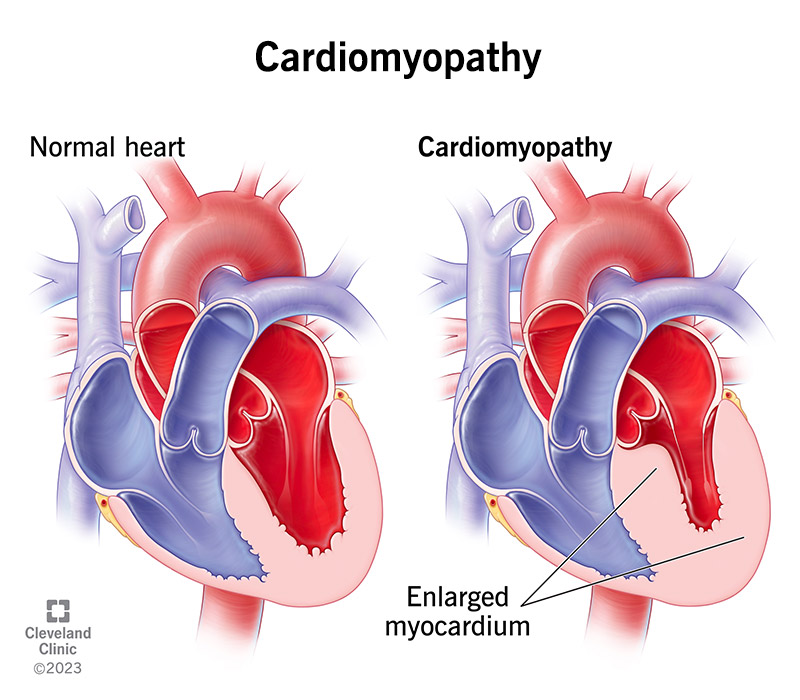
Cardiomyopathy refers to diseases of the heart muscle. These diseases have a
variety of causes, symptoms, and treatments.
In cardiomyopathy, the heart muscle becomes enlarged, thick, or rigid. In
rare cases, the muscle tissue in the heart is replaced with scar tissue.
As cardiomyopathy worsens, the heart becomes weaker. It's less able to pump
blood through the body and maintain a normal electrical rhythm. This can lead to
heart failure or arrhythmia. In turn, heart failure can cause
fluid to build up in the lungs, ankles, feet, legs, or abdomen.
The weakening of the heart also can cause other severe complications, such as
heart valve problems.
Overview
The four main types of cardiomyopathy are:
- Dilated cardiomyopathy
- Hypertrophic cardiomyopathy
- Restrictive cardiomyopathy
- Arrhythmogenic right ventricular dysplasia (ARVD)
The different types of the disease have different causes, signs and symptoms,
and outcomes.
Cardiomyopathy can be acquired or inherited. "Acquired" means you aren't born
with the disease but you develop it due to another disease, condition, or
factor. "Inherited" means your parents passed the gene for the disease on to
you. In many cases, the cause of cardiomyopathy isn't known.
Cardiomyopathy can affect people of all ages. However, certain age groups
are more likely to have certain types of cardiomyopathy. This document focuses
on cardiomyopathy in adults.
Outlook
Some people who have cardiomyopathy have no signs or symptoms and need no
treatment. For other people, the disease develops rapidly, symptoms are severe,
and serious complications occur.
Treatments for cardiomyopathy include lifestyle changes, medicines, surgery,
implanted devices to correct arrhythmias, and a nonsurgical procedure. These
treatments can control symptoms, reduce complications, and stop the disease from getting worse.
Types of Cardiomyopathy
Dilated Cardiomyopathy
Dilated cardiomyopathy is the most common type of the disease. It mostly
occurs in adults aged 20 to 60. Men are more likely than women to have this type
of cardiomyopathy.
Dilated cardiomyopathy affects the heart's ventricles and atria. These are
the lower and upper chambers of the heart, respectively.
The disease often starts in the left ventricle, the heart's main pumping
chamber. The heart muscle begins to dilate (stretch and become thinner). This
causes the inside of the chamber to enlarge. The problem often spreads to the
right ventricle and then to the atria as the disease gets worse.
When the chambers dilate, the heart muscle doesn't contract normally. Also,
the heart can't pump blood very well. Over time, the heart becomes weaker and
heart failure can occur. Symptoms of heart failure include fatigue (tiredness);
swelling of the ankles, feet, legs, and abdomen; and shortness of breath.
Dilated cardiomyopathy also can lead to heart valve problems, arrhythmias,
and blood clots in the heart.
Hypertrophic Cardiomyopathy
Hypertrophic cardiomyopathy is very common and can affect people of any age.
About 1 out of every 500 people has this type of cardiomyopathy. It affects men
and women equally. Hypertrophic cardiomyopathy is the most common cause of
sudden cardiac arrest (SCA) in young people, including young athletes.
This type of cardiomyopathy occurs when the walls of the ventricles (usually
the left ventricle) thicken. Despite this thickening, the ventricle size often
remains normal.
Hypertrophic cardiomyopathy may block blood flow out of the ventricle. When
this happens, the condition is called obstructive hypertrophic cardiomyopathy.
In some cases, the septum thickens and bulges into the left ventricle. (The
septum is the wall that divides the left and right sides of the heart.) In both
cases, blood flow out of the left ventricle is blocked.
As a result of the blockage, the ventricle must work much harder to pump
blood out to the body. Symptoms can include chest pain, dizziness, shortness of
breath, or fainting.
Hypertrophic cardiomyopathy also can affect the heart's mitral valve, causing
blood to leak backward through the valve.
Sometimes the thickened heart muscle doesn't block blood flow out of the left
ventricle. This is called nonobstructive hypertrophic cardiomyopathy. The entire
ventricle may become thicker, or the thickening may happen only at the bottom of
the heart. The right ventricle also may be affected.
In both types (obstructive and nonobstructive), the thickened muscle makes
the inside of the left ventricle smaller, so it holds less blood. The walls of
the ventricle also may stiffen. As a result, the ventricle is less able to relax
and fill with blood.
These changes cause increased blood pressure in the ventricles and the blood
vessels of the lungs. Changes also occur to the cells in the damaged heart
muscle. This may disrupt the heart's electrical signals and lead to arrhythmias.
Rarely, people who have hypertrophic cardiomyopathy have no signs or
symptoms, and the condition doesn't affect their lives. Others have severe
symptoms and complications, such as serious arrhythmias, an inability to
exercise, or extreme fatigue with little physical activity.
Rarely, people who have this type of cardiomyopathy can have SCA during very
vigorous physical activity. The physical activity can trigger dangerous
arrhythmias. If you have this type of cardiomyopathy, talk to your doctor about
what types and amounts of physical activity are safe for you.
Restrictive Cardiomyopathy
Restrictive cardiomyopathy tends to mostly affect older adults. In this type
of the disease, the ventricles become stiff and rigid. This is due to abnormal
tissue, such as scar tissue, replacing the normal heart muscle.
As a result, the ventricles can't relax normally and fill with blood, and the
atria become enlarged. Over time, blood flow in the heart is reduced. This can
lead to problems such as heart failure or arrhythmias.
Arrhythmogenic Right Ventricular Dysplasia
Arrhythmogenic right ventricular dysplasia (ARVD) is a rare type of
cardiomyopathy. ARVD occurs when the muscle tissue in the right ventricle dies
and is replaced with scar tissue.
This process disrupts the heart's electrical signals and causes arrhythmias.
Symptoms include palpitations and fainting after physical activity.
ARVD usually affects teens or young adults. It can cause SCA in young
athletes. Fortunately, such deaths are rare.
Other Names for Cardiomyopathy
- Alcoholic cardiomyopathy. This term is used when overuse of alcohol
causes the disease.
- Congestive cardiomyopathy.
- Diabetic cardiomyopathy.
- Familial dilated cardiomyopathy.
- Idiopathic cardiomyopathy.
- Ischemic cardiomyopathy. This term is used when coronary artery disease
or heart attack causes the disease.
- Peripartum cardiomyopathy. This term is used when the disease develops
in a woman shortly before or after she gives birth.
- Primary cardiomyopathy.
Other names for Hypertrophic Cardiomyopathy
- Asymmetric septal hypertrophy
- Familial hypertrophic cardiomyopathy
- Hypertrophic nonobstructive cardiomyopathy
- Hypertrophic obstructive cardiomyopathy
- Idiopathic hypertrophic subaortic stenosis
Other names for Restrictive Cardiomyopathy
- Infiltrative cardiomyopathy
Other names for Arrhythmogenic Right Ventricular Dysplasia
- Arrhythmogenic right ventricular cardiomyopathy
- Right ventricular cardiomyopathy
- Right ventricular dysplasia
What causes Cardiomyopathy?
Cardiomyopathy can be acquired or inherited. "Acquired" means you aren't born
with the disease, but you develop it due to another disease, condition, or factor.
"Inherited" means your parents passed the gene for the disease on to you.
Researchers continue to look for the genetic links to cardiomyopathy. They also
continue to explore how these links cause or contribute to the various types of
cardiomyopathy.
Many times, the cause of cardiomyopathy isn't known. This is often the case
when the disease occurs in children.
Dilated Cardiomyopathy
In more than half of the cases of dilated cardiomyopathy, the cause isn't
known. As many as one-third of the people who have dilated cardiomyopathy
inherit it from their parents.
Certain diseases, conditions, and substances also can cause the disease, such as:
- Coronary artery disease, heart attack, diabetes, thyroid disease, viral
hepatitis, and HIV
- Infections, especially viral infections that inflame the heart muscle
- Alcohol, especially if you also have a poor diet
- Complications during the last month of pregnancy or within 5 months of
birth
- Certain toxins, such as cobalt
- Certain drugs (such as cocaine and amphetamines) and two medicines used
to treat cancer (doxorubicin and daunorubicin)
Hypertrophic Cardiomyopathy
Most cases of hypertrophic cardiomyopathy are inherited. It also can develop
over time because of high blood pressure or aging.
Sometimes, other diseases, such as diabetes or thyroid disease, can cause
hypertrophic cardiomyopathy. Sometimes the cause of hypertrophic cardiomyopathy isn't known.
Restrictive Cardiomyopathy
Certain diseases and conditions can cause restrictive cardiomyopathy, including:
- Hemochromatosis. This is a disease in which too much iron builds up in
your body. The extra iron is toxic to the body and can damage the organs,
including the heart.
- Sarcoidosis. This is a disease that causes inflammation (swelling). It
can affect various organs in the body. The swelling is due to an abnormal
immune response. This abnormal response causes tiny lumps of cells to form
in the body's organs, including the heart.
- Amyloidosis. This is a disease in which abnormal proteins build up in
the body's organs, including the heart.
- Connective tissue disorders.
Arrhythmogenic Right Ventricular Dysplasia
Researchers think that arrhythmogenic right ventricular dysplasia is an inherited disease.
Who is at risk for Cardiomyopathy?
People of all ages can have cardiomyopathy. However, certain types of the
disease are more common in certain groups.
Dilated cardiomyopathy is more common in African Americans than in Whites.
This type of the disease also is more common in men than women.
Teens and young adults are more likely than older people to have
arrhythmogenic right ventricular dysplasia, although it's rare in both groups.
Major risk factors
Certain diseases, conditions, or factors can raise your risk for
cardiomyopathy. Major risk factors include:
- A family history of cardiomyopathy, heart failure, or sudden cardiac
arrest (SCA)
- A disease or condition that can lead to cardiomyopathy, such as coronary
artery disease, heart attack, or a viral infection that inflames the heart
muscle
- Diabetes, other metabolic diseases, or severe obesity
- Diseases that can damage the heart, such as hemochromatosis, sarcoidosis,
or amyloidosis
- Long-term alcoholism
- Long-term high blood pressure
Some people who have cardiomyopathy never have signs or symptoms. That's why
it's important to identify people who may be at high risk for the disease. This
can help prevent future problems, such as serious
arrhythmias or SCA.
What are the signs and symptoms of Cardiomyopathy?
Some people who have cardiomyopathy never have signs or symptoms. Others
don't have signs or symptoms in the early stages of the disease.
As cardiomyopathy worsens and the heart weakens, signs and symptoms of
heart failure usually occur. These signs and symptoms include:
- Shortness of breath or trouble breathing.
- Fatigue (tiredness).
- Swelling in the ankles, feet, legs, and abdomen. Rarely, swelling may
occur in the veins of your neck.
Other signs and symptoms can include dizziness, lightheadedness, fainting
during physical activity, chest pain, arrhythmias, and heart murmur (an extra or
unusual sound heard during a heartbeat).
How is Cardiomyopathy diagnosed?
Your doctor will diagnose cardiomyopathy based on your medical history, a
physical exam, and the results from tests and procedures.
Specialists involved
Often, a cardiologist or pediatric cardiologist diagnoses and treats
cardiomyopathy. A cardiologist is a doctor who specializes in treating heart
diseases. A pediatric cardiologist is a doctor who specializes in treating heart diseases in children.
Medical history
Your doctor will want to learn about your medical history. He or she will
want to know what symptoms you have and how long you've had them. Your doctor
also will want to know whether anyone in your family has had cardiomyopathy,
heart failure, or sudden cardiac arrest.
Physical exam
Your doctor will use a stethoscope to listen to your heart and lungs for
sounds that may suggest cardiomyopathy. These sounds may even suggest a certain
type of the disease.
For example, the loudness, timing, and location of a heart murmur may suggest
hypertrophic obstructive cardiomyopathy. A "crackling" sound in the lungs may be
a sign of heart failure. (This condition often develops in the later stages of cardiomyopathy.)
Physical signs also help your doctor diagnose cardiomyopathy. Swelling of the
ankles, feet, legs, or abdomen suggests fluid buildup, a sign of heart failure.
Signs or symptoms of cardiomyopathy may be found during a routine exam. For
example, your doctor may hear a heart murmur or you may have abnormal test results.
Diagnostic tests
You may have one or more of the following tests to diagnose cardiomyopathy.
Blood tests: During a blood test, a small amount of blood is taken from your body. It's
usually drawn from a vein in your arm using a thin needle. The procedure usually
is quick and easy, although it may cause some short-term discomfort.
Blood tests give your doctor information about your heart and help rule out other conditions.
Chest x ray: A chest x ray takes pictures of the organs and structures inside your chest,
including your heart, lungs, and blood vessels. This test can show whether your
heart is enlarged. A chest x ray also can show whether fluid is building up in your lungs.
EKG (electrocardiogram): An EKG is a simple test that records the heart's electrical activity. This
test shows how fast your heart is beating and whether the rhythm of your
heartbeat is steady or irregular. An EKG also records the strength and timing of
electrical signals as they pass through each part of your heart.
This test is used to detect and study many heart problems, such as heart
attack, arrhythmia, and heart failure. EKG results also can suggest other
disorders that affect heart function.
Echocardiography: Echocardiography is a test that uses sound waves to create a moving picture
of your heart. The picture shows how well your heart is working and its size and shape.
There are several different types of echocardiography, including a stress
echocardiogram, or "stress echo." This test is done as part of a stress test. A
stress echo can show whether you have decreased blood flow to your heart, a sign
of coronary artery disease.
Another type of echo is a transesophageal echo, or TEE. TEE provides a view
of the back of the heart.
For a TEE, a sound wave wand is put on the end of a special tube. The tube is
gently passed down your throat and into your esophagus (the passage leading from
your mouth to your stomach). You will be given medicine to relax you during this procedure.
Stress test: Some heart problems are easier to diagnose when your heart is working hard
and beating fast. During stress testing, you exercise (or are given medicine) to
make your heart work hard and beat fast while heart tests are done.
These tests may include nuclear heart scanning, echocardiography, magnetic
resonance imaging (MRI), and positron emission tomography (PET) scanning of the heart.
Diagnostic procedures
You may have one or more medical procedures to confirm a diagnosis or if
surgery is planned. These procedures may include cardiac catheterization,
coronary angiography, or myocardial biopsy.
Cardiac Catheterization: This procedure checks the pressure and blood flow in your heart's chambers.
The procedure also allows your doctor to collect blood samples and look at your
heart's arteries using x-ray imaging.
During cardiac catheterization, a long, thin, flexible tube called a catheter
is put into a blood vessel in your arm, groin (upper thigh), or neck and
threaded to your heart. This allows your doctor to study the inside of your
arteries to look for blockages.
Coronary Angiography: This procedure often is done with cardiac catheterization. During the
procedure, dye that can be seen on an x ray is injected into your coronary
arteries. The dye lets your doctor study the flow of blood through your heart and blood vessels.
Dye also may be injected into your heart chambers. This allows your doctor to
study the pumping function of your heart.
Myocardial biopsy: For this procedure, your doctor removes a piece of your heart muscle. This
can be done during cardiac catheterization. The heart muscle is studied under a
microscope to see whether changes in cells have occurred that may suggest cardiomyopathy.
The biopsy is useful for diagnosing some types of cardiomyopathy.
Genetic testing
Some types of cardiomyopathy run in families. Thus, your doctor may suggest
genetic testing to look for the disease in your parents, brothers and sisters,
or other family members.
Genetic testing can show how the disease runs in families. It also can find
out the chances of parents passing the genes for the disease on to their children.
Genetic testing also may be useful if your doctor thinks you may have
cardiomyopathy, but you don't yet have signs or symptoms. Your doctor can then
start treatment early, when it may be more effective.
How is Cardiomyopathy treated?
Not everyone who has cardiomyopathy needs treatment. People who have no signs
or symptoms may not need treatment. In some cases, dilated cardiomyopathy that
comes on suddenly may even go away on its own.
For other people who have cardiomyopathy, treatment is needed. Treatment
depends on the type of cardiomyopathy you have, how severe the symptoms and
complications are, and your age and overall health.
The main goals of treating cardiomyopathy are to:
- Manage any conditions that cause or contribute to the disease
- Control signs and symptoms so that you can live as normally as possible
- Stop the disease from getting worse
- Reduce complications and the chance of sudden cardiac arrest (SCA)
Treatments may include lifestyle changes, medicines, surgery, implanted
devices to correct arrhythmias, and a nonsurgical procedure.
Lifestyle changes
Your doctor may suggest lifestyle changes to manage a condition that's
causing your cardiomyopathy. These changes can help reduce symptoms.
Healthy diet and physical activity
A healthy diet and physical activity are part of a healthy lifestyle. A
healthy diet includes a variety of fruits, vegetables, and grains; half of your
grains should come from whole-grain products.
Choose foods that are low in saturated fat, trans fat, and
cholesterol. Healthy choices include lean meats, poultry without skin, fish,
beans, and fat-free or low-fat milk and milk products.
Choose and prepare foods with little sodium (salt). Too much salt can raise
your risk for high blood pressure. Recent studies show that following the
Dietary Approaches to Stop Hypertension (DASH) eating plan can lower blood pressure.
Choose foods and beverages that are low in added sugar. If you drink
alcoholic beverages, do so in moderation.
Aim for a healthy weight by staying within your daily calorie needs. Balance
the calories you take in with the calories you use while doing physical
activity. Be as physically active as you can.
Some people should get medical advice before starting or increasing physical
activity. For example, talk to your doctor if you have a chronic (ongoing)
health problem, are on medicine, or have symptoms such as chest pain, shortness
of breath, or dizziness. Your doctor can suggest types and amounts of physical
activity that are safe for you.
Your doctor can help you decide what kind of eating plan and physical activity are right for you.
Other lifestyle changes
Your doctor also may recommend other lifestyle changes, such as:
- Quitting smoking
- Losing excess weight
- Avoiding the use of alcohol and illegal drugs
- Getting enough sleep and rest
- Reducing stress
- Treating underlying conditions, such as diabetes and high blood pressure
Medicines
A number of medicines are used to treat cardiomyopathy. Your doctor may prescribe medicines to:
- Lower your blood pressure. ACE inhibitors, angiotensin II receptor
blockers, beta blockers, and calcium channel blockers are examples of
medicines that lower blood pressure.
- Slow your heart rate. Beta blockers, calcium channel blockers, and
digoxin are examples of medicines that slow the heart rate. Beta blockers
and calcium channel blockers also are used to lower blood pressure.
- Keep your heart beating with a normal rhythm. These medicines help
prevent arrhythmias.
- Balance electrolytes in your body. Electrolytes are minerals that help
maintain fluid levels and acid-base balance in the body. They also help
muscle and nerve tissues work properly. Abnormal electrolyte levels may be a
sign of dehydration (lack of fluid in your body), heart failure, high blood
pressure, or other disorders. Aldosterone blockers are an example of a
medicine used to balance electrolytes.
- Remove excess fluid and sodium (salt) from your body. Diuretics, or
"water pills," are an example of a medicine that helps remove excess fluid
and sodium from the body.
- Prevent blood clots from forming. Anticoagulants, or "blood thinners,"
are an example of a medicine that prevents blood clots. Blood thinners often
are used to prevent blood clots from forming in people who have dilated cardiomyopathy.
- Reduce inflammation. Corticosteroids are an example of a medicine used
to reduce inflammation.
Surgery
Several different types of surgery are used to treat cardiomyopathy. These
include septal myectomy, implanted devices to help the heart work better, and heart transplant.
Septal Myectomy
Septal myectomy is open-heart surgery. It's used for people who have
hypertrophic obstructive cardiomyopathy and severe symptoms. This surgery
generally is used for younger patients and for people whose medicines aren't working well.
During the surgery, a surgeon removes part of the thickened septum that's
bulging into the left ventricle. This improves blood flow through the heart and
out to the body. The removed tissue doesn't grow back.
The surgeon also can repair or replace the mitral valve at the same time (if needed). Septal myectomy often is successful and allows you to return to a normal life with no symptoms.
Surgically implanted devices
Surgeons can place several types of devices in the heart to help it work
better. One example is a pacemaker. This is a small device that's placed under
the skin of your chest or abdomen to help control abnormal heart rhythms. The
device uses electrical pulses to prompt the heart to beat at a normal rate.
Sometimes doctors choose to use a biventricular pacemaker. This device
coordinates contractions between the heart's left and right ventricles.
A left ventricular assist device (LVAD) helps the heart pump blood to the
body. An LVAD can be used as a long-term therapy or as a short-term treatment
for people who are waiting for a heart transplant.
An implantable cardioverter defibrillator (ICD) helps control
life-threatening arrhythmias, which may lead to SCA. This small device is
implanted in the chest or abdomen and connected to the heart with wires.
If an ICD senses a dangerous change in heart rhythm, it will send an electric
shock to the heart to restore a normal heartbeat.
Heart transplant
For this surgery, a doctor replaces a person's diseased heart with a healthy
heart from a deceased donor. Heart transplant is a last resort treatment for
people who have end-stage heart failure. "End-stage" means the condition has
become so severe that all treatments, other than heart transplant, have failed.
Nonsurgical procedure
Doctors may use a nonsurgical procedure called alcohol septal ablation to treat cardiomyopathy.
For this procedure, your doctor injects ethanol (a type of alcohol) through a
catheter into the small artery that supplies blood to the thickened area of
heart muscle. The alcohol kills cells, and the thickened tissue shrinks to a more normal size.
This allows blood to flow freely through the ventricle, and symptoms improve.
How can Cardiomyopathy be prevented?
You can't prevent inherited types of cardiomyopathy. However, you can take
steps to lower your risk for conditions that may lead to or complicate
cardiomyopathy, such as coronary artery disease, high blood pressure, and heart attack.
Your doctor may advise you to make lifestyle changes, such as following a healthy diet and doing physical activity.
Living with Cardiomyopathy
Some people who have cardiomyopathy—especially those who have the
hypertrophic type—may live a healthy life with few problems or symptoms. Others
may have serious symptoms and complications.
If you have cardiomyopathy, you can take steps to take care of your heart.
Lifestyle changes and ongoing care can help you manage your disease.
Lifestyle changes
A healthy diet and physical activity are part of a healthy lifestyle. Your
doctor can help you decide what kind of eating plan is right for you.
Talk with your doctor about the amounts and types of fluids that are safe and
healthy for you. Your doctor also may suggest a diet that's low in sodium (salt) and fat.
Talk with your doctor about the amount and type of physical activity that's
right for you. People who have hypertrophic cardiomyopathy shouldn't do vigorous
exercise. However, moderate exercise, such as walking, often is a good idea.
Your doctor also may recommend other lifestyle changes, such as:
- Quitting smoking
- Losing excess weight
- Avoiding the use of alcohol and illegal drugs
- Getting enough sleep and rest
- Reducing stress
Ongoing care
If you have cardiomyopathy, it's important to get ongoing care. Call your
doctor if you notice new or worse symptoms, such as swelling in your ankles,
feet, legs, or abdomen. These symptoms may be a sign that the disease is getting worse.
You also should:
- Take all of your medicines as your doctor prescribes.
- Make all of the lifestyle changes that your doctor recommends.
- Make sure you go to all of your medical checkups.
- Follow your treatments for any underlying conditions, such as diabetes
and high blood pressure.
Cardiomyopathy often runs in families. Your doctor may suggest that your parents, brothers and sisters, and children get checked to see whether they have the disease.
Source: National Institutes of Health; National Heart, Lung, and Blood Institute
Can't find the health information you’re looking for?
Ask a Health Educator, Live!
Know someone who could use this information?...send them this link.
This information is provided by the Cleveland Clinic and is not intended to replace the medical advice of your doctor or health care provider. Please consult your health care provider for advice about a specific medical condition. This document was last reviewed on: 12/30/2008...#5846