
Caring approach:
Our team is here for you at every stage — before, during and after surgery. We listen and offer support so you can feel more confident about your treatment. Meet our team.




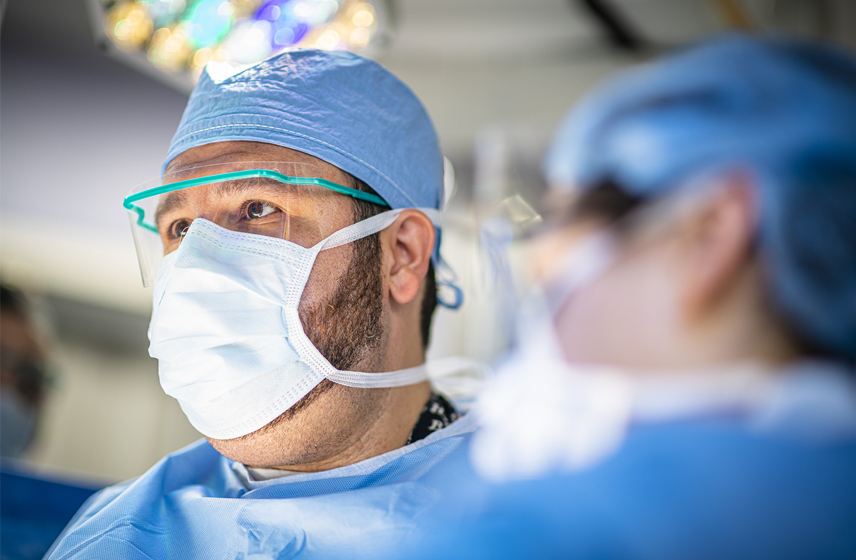
Surgery can feel overwhelming — but when other treatments haven’t helped, it may be the best way to relieve ongoing pelvic pain, heavy bleeding and other symptoms.
When symptoms don’t improve — or the cause isn’t clear — surgery may be an important step toward answers and relief. Your reproductive organs — including your uterus, ovaries, fallopian tubes and vagina — work together as a connected system. So, conditions affecting one area can impact your overall health, comfort and daily life.
At Cleveland Clinic, our gynecologic surgery specialists treat the full range of conditions affecting this system. We take time to understand what’s going on, create a personalized surgical plan and support you at every step — from preparation through recovery.
Our team is here for you at every stage — before, during and after surgery. We listen and offer support so you can feel more confident about your treatment. Meet our team.

Whenever possible, we use laparoscopic, robotic and vaginal techniques. These approaches use small — or no — abdominal incisions (cuts) and often lead to less discomfort, a shorter recovery and a faster return to your normal activities.

We care for both common and complex conditions, including cases that may require advanced surgical planning or care from several specialists. Many people are referred to us for second opinions or specialized treatment.

Your care is tailored to your diagnosis, symptoms and goals — including fertility considerations, recovery time and long-term health. When needed, we work closely with specialists in colorectal surgery, urology, vascular surgery and other fields to provide comprehensive care.

When you’re recovering from surgery, there’s no place like home. And that’s why you can schedule some follow-up appointments as virtual visits.

Cleveland Clinic is a trusted healthcare leader. We’re recognized in the U.S. and throughout the world for our expertise and care.
At Cleveland Clinic, we treat the full range of conditions affecting your reproductive organs, including:
We recommend surgery when it’s the most effective way to treat your condition, relieve symptoms or improve your quality of life. Depending on your situation, we may begin with surgery or try nonsurgical treatments first.
During your evaluation, you’ll first spend time talking with your providers so they can learn more about your condition. They’ll ask you to share your story and answer questions, like:
They’ll also do a physical exam to check your overall health and a pelvic exam to look for growths, organ prolapse, infections and more. Depending on your symptoms and suspected condition, your provider will also order tests.
All of these things help them craft the most personalized surgery and recovery plan — one that always keeps you at the center of your care.
You may have several tests so we can better understand what’s causing your symptoms. Depending on your symptoms — such as pain, bleeding or a suspected growth — this testing may include imaging like a pelvic or transvaginal ultrasound, MRI or CT scan to look at your reproductive organs.
If needed, we may also do a hysteroscopy to look inside your uterus or a colposcopy to examine your cervix more closely. These procedures help us find polyps, fibroids or abnormal tissue.
If we see anything concerning, we may take a small tissue sample (biopsy) for further evaluation.
Once our team has confirmed your diagnosis, they’ll begin creating your surgery plan.
Even though your condition might start in your reproductive system, it can affect nearby body parts, like your colon, liver or bladder. That’s why we make sure your care team has providers from all the specialties you may need, like:
Our healthcare providers see patients at convenient locations throughout Northeast Ohio.
The kind of surgery you have depends on your diagnosis, health and needs. Whenever possible, we use minimally invasive techniques to help reduce pain, shorten recovery time and get you back to your daily activities sooner.
Minimally invasive surgery includes several approaches to avoid large incisions. The type of surgery you have is based on your condition and treatment goals. You may have:
This procedure can be used both to diagnose uterine conditions and to treat them. Hysteroscopy allows us to manage abnormal bleeding or remove polyps or fibroids. Certain hysteroscopies can be done right in your provider’s office.
These approaches use small incisions and specialized instruments. In laparoscopic surgery, your surgeon uses handheld instruments while viewing the surgical area on a screen. In robotic surgery, your surgeon uses a robotic system to control the instruments. The robot doesn’t perform the surgery — your surgeon is in full control at all times and uses the system as a tool during the procedure.
Using these minimally invasive approaches, we treat a wide range of gynecologic conditions. Common procedures include:
We also use these techniques for more specialized procedures, such as repairing a cesarean scar defect (isthmocele), removing a rudimentary uterine horn and treating retained products of conception. In some cases, they may also be an option for treating certain gynecologic cancers, depending on your diagnosis and overall health.
Sometimes, we may be able to do surgeries like a hysterectomy, oophorectomy and salpingectomy — or a combination of any or all of these — through your vagina (transvaginally). This approach minimizes the need for incisions. We can also repair weaknesses in your vaginal wall (colporrhaphy) or repair reproductive organ prolapses (colpocleisis).
In some situations, open surgery may be the best option. This depends on factors like the size of the cyst or tumor and your specific diagnosis. Your care team will explain what to expect, including recovery and pain management.
We also offer procedures to improve comfort, function or appearance of the vulvar and vaginal area. These include:
MonaLisa Touch® laser therapy is also available to relieve the symptoms of vaginal atrophy, such as dryness and discomfort, as well as certain vulvar conditions.
Deciding to have gynecologic surgery can feel like a big step, but if it’s the best option to relieve pelvic pain, heavy bleeding and other ongoing issues, our expert team will guide you through the entire process. At Cleveland Clinic, we focus on personalized care so you can feel supported, informed and confident in the decisions you make about your care.

Getting an appointment with Cleveland Clinic’s gynecologic surgery experts is easy. We’re here to help you get the care you need.

Manage your Cleveland Clinic account. Find billing information and financial assistance, plus FAQs.

Securely access your personal health information at any time, day or night.
 Health Library
Find answers to your health questions from experts you can trust. It's like having a friend who's a doctor.