


They Headed North and West for the Best
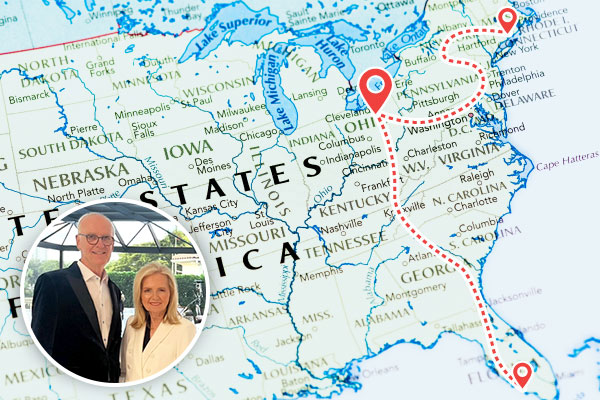
H. Thomas "Tom" and Carol Ostrander never would have predicted their medical journey would take them anywhere but in a northeasterly direction.
They are longtime Bonita Springs, Florida, residents, but hail from Connecticut. The couple, married 42 years, continues to maintain a home in East Haddam, Connecticut. And they, not surprisingly, were familiar with some of the world's most respected academic hospitals in New York and Boston.
But when they discovered Tom had a serious heart condition in 2011, their research, along with advice from doctors and friends, pointed them to Cleveland Clinic.
Suddenly Serious
Tom maintains he had no symptoms. "It started with a chest cold," he said. He thought he had recovered, but when the congestion came back, Carol urged him to seek treatment.
"All of a sudden, the doctor examining me gets another doctor in the room and said, 'Your heart murmur's really acting up.'" Tom wasn't aware he had a heart murmur. He recalls being told he needed to see a cardiologist immediately.
"We live in a community with a lot of doctors, so we put our feelers out and got a name of a top cardiologist in Naples," Tom said. "He told me, 'This is serious. You not only have congestive heart failure, but you have a very large aortic aneurysm.'"
Tom, in fact, had a 6.7 centimeter aneurysm, which is unusual and carries a high risk of rupture.
"I remember him saying, 'You want to go somewhere that does hundreds of these procedures a year, not four. You're going to Cleveland Clinic.'"
A Serendipitous Meeting
While the Naples cardiologist, Ronald Levine, MD, was working on a referral to Cleveland Clinic, Carol recalled having met a woman a few weeks earlier who she thought might be helpful. Nancy Roselli — who was renting a condominium in their building — happened to be the mother of Eric Roselli, MD, chief of Adult Cardiac Surgery and a staff surgeon in the Cleveland Clinic Department of Thoracic and Cardiovascular Surgery. Nancy was happy to make an introduction.
"Eric called me that night and we spoke for 45 minutes. He explained everything to me," Tom said. "He had me come in the next week." Tom had aortic valve repair surgery shortly thereafter.
"It was a good nine-hour surgery," Tom said. He recovered in the hospital for almost a week and flew home three days later.
Tom and his heart thrived for the next 13 years. Tom stayed active, walking as much as seven miles a day. And he developed a passion for selling homes in southwest Florida — a second career, with which Carol assists. The two had both enjoyed 30-year careers with AT&T in Connecticut.
"My ejection fraction (the percentage of blood pumped out of the heart’s main chamber with each heartbeat) was starting to get lower and lower," Tom shared. "And in discussions I had with Dr. Levine, he said, 'It's time to send all your records again out to Dr. Roselli and have him take a look.'"
Continued Good Care
A few months later, Tom returned to Cleveland Clinic for a Bio-Bentall procedure, an open heart surgery that replaced a diseased aortic root, ascending aorta and aortic valve using a biological valve.
"I was very active before both surgeries and knew recovery would require time and patience," Tom said. Although the second surgery was more challenging, he steadily regained his strength, resumed his walking routine and returned to work.
Tom continues to be seen at Cleveland Clinic by cardiologist Ben Alencherry, MD, in addition to the care he receives locally. "I remember Dr. Alencherry saying, 'The way you look right now, the way your surgery went and the way you recovered, your life expectancy is as normal as if you never had heart disease.'"
"They not only take care of the patient, they take care of the caregiver," Carol shared. "The service, communication and the whole process were just phenomenal."
The Ostranders' recently became members of the Pyramid Legacy Society, which honors donors who include Cleveland Clinic in their estate plans. The Ostranders' gift will support high risk cardiovascular research in honor of Dr. Roselli.
Meeting Big Challenges from the Tiniest Patients
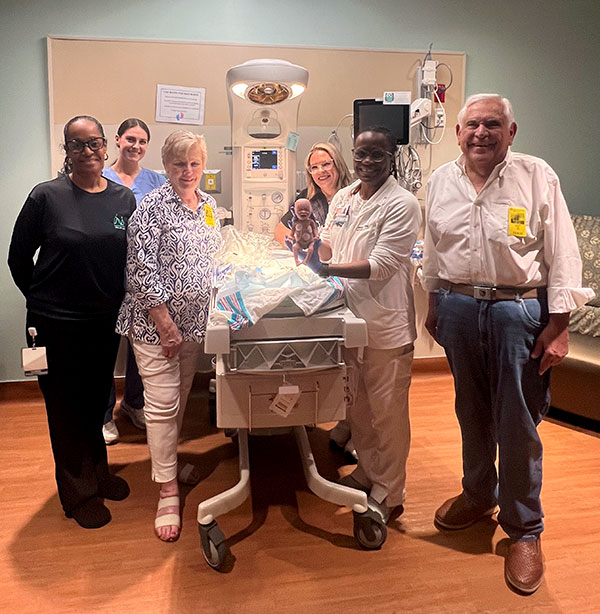
When Charles A. "Charlie" and Geraldine C. "Gerry" Ruibal watched a neonatal intensive care unit (NICU) team respond to a simulated emergency at Cleveland Clinic Tradition Hospital in Port St. Lucie, Florida, they were witnessing the impact of their philanthropy up close and in real time. And they were awestruck.
Using "Nicole," an advanced preterm infant simulator, the interdisciplinary medical team calmly practiced caring for a baby in distress. The lifelike mannequin replicates a baby born at just 25 weeks gestation, complete with an umbilical cord, realistic heart rate, pulse and blood pressure, allowing caregivers to rehearse high-stakes procedures without placing a fragile newborn at risk.
Tradition Hospital is part of Cleveland Clinic Martin Health, which serves Florida’s Treasure Coast. Its NICU cares for babies in St. Lucie, Martin, Okeechobee and Indian River counties. The simulator helps healthcare professionals manage the unique challenges presented by premature newborns, ultimately aiming to improve survival rates and health outcomes for these vulnerable patients.
Making a Tangible Difference
"We were blown away," Charlie said. "The realism was incredible. The staff handled the simulator exactly as they would a real premature baby."
For Gerry, too, the demonstration was deeply gratifying—evidence that their investment was making a tangible difference. "It was amazing—not only seeing this lifelike baby but witnessing the professionalism and expertise of the staff."
When given the opportunity, the couple named the simulator after a neighbor's daughter, the only girl among triplets born prematurely 26 years ago. Together, the three babies weighed just over 6 pounds at birth. Last year, all three graduated from Syracuse University College of Law and passed their bar exams.
"That's what these tiny babies can grow up to become," Charlie said, marveling, as well, that one of the boys was now more than 6 feet tall. “Seeing the impact firsthand made the gift so much more meaningful. It’s a great example of good stewardship.”
Investing in Transformational Healthcare
Married nearly 60 years and grandparents to six, the Ruibals have called Sailfish Point in Stuart home since 1997 and have been longtime supporters of Martin Health. They are donors at both the Cleveland Clinic Martin Health Barstow-Reed Society level and Cleveland Clinic Cornerstone Society level.
When Cleveland Clinic assumed leadership of Martin Health in 2019, Charlie recalled that he and Gerry, along with neighbors throughout the community, were optimistic. They anticipated that Cleveland Clinic would introduce resources far exceeding the capabilities of a standalone community hospital—and that vision, Charlie said, has materialized and is transforming healthcare in the region.
The gift to expand Cleveland Clinic Martin Health's Simulation Center reflects the values that have guided the couple’s philanthropy for decades. Charlie, who emigrated from Cuba as a teenager and attended Villanova University with the help of financial aid from donors he never met, believes in giving others opportunities that might otherwise be out of reach.
“I was the beneficiary of someone else’s generosity,” Charlie said. “That really is what has driven our philanthropy.”
Benefiting Babies and Families
In a thank you letter to Charlie and Gerry, the NICU interprofessional and simulation teams conveyed how grateful they were for the “truly inspiring” gift that will help caregivers more realistically train and enhance critical thinking, communication and procedural skills in a safe learning environment. The Ruibals’ investment, they added, will “directly benefit the premature babies entrusted to (the team’s) care and the families who rely on us.”
In addition to their generous support of Cleveland Clinic, the Ruibals have continuously invested in Villanova University and its students through scholarships. Charlie and Gerry are especially proud of the Villanova RUIBAL program, which was created to provide mentoring and after-school enrichment for children in underserved communities. Charlie and Gerry make a point of personally meeting each scholar and, to the extent possible, everyone impacted by their giving.
The couple also supports other organizations and initiatives that advance their philanthropic goals. They are inspired by a philosophy that the most meaningful giving comes from seeing philanthropy “in action” and witnessing the impact firsthand.
