


Transplant Leads to Research Funding
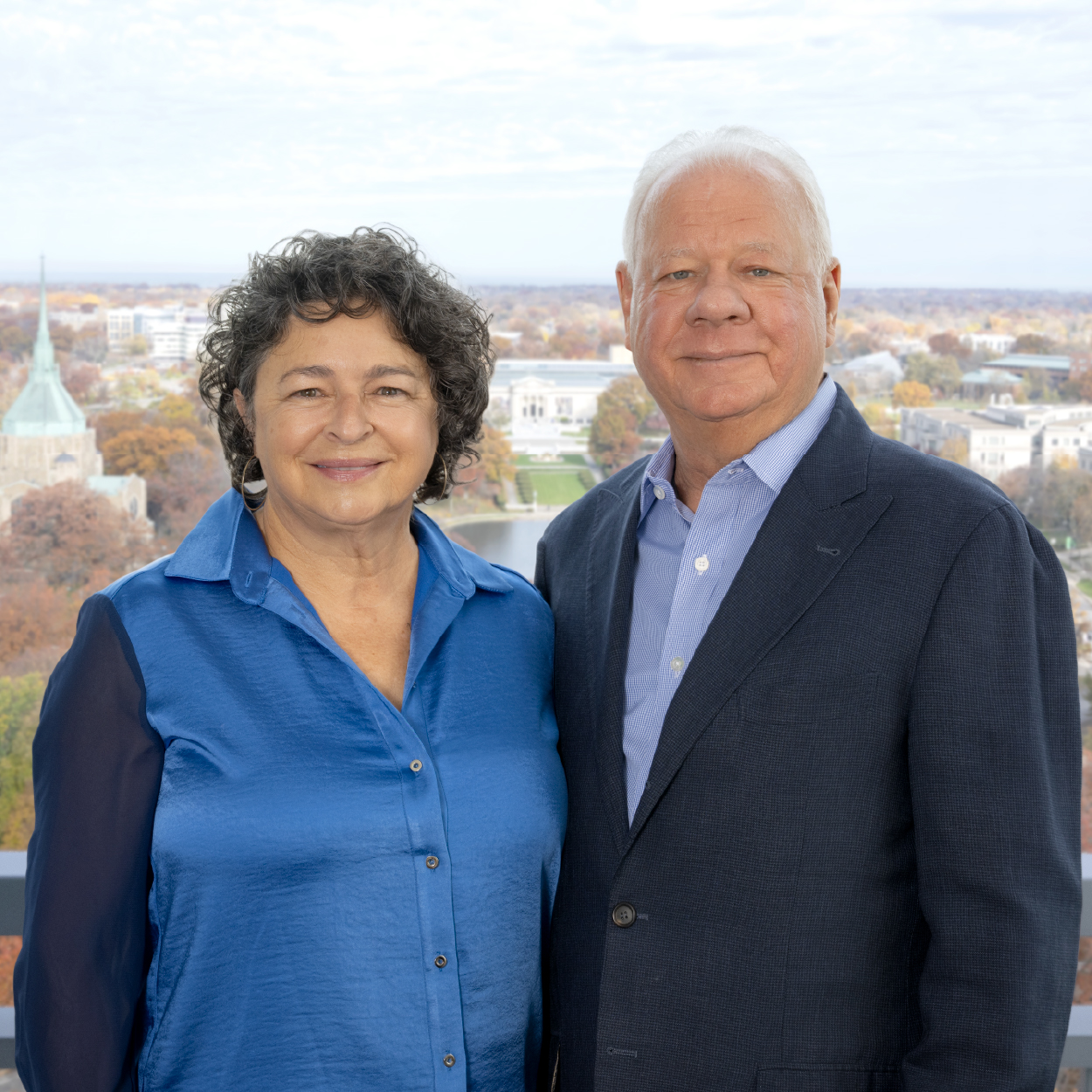
“Being able to breathe again was like nothing I've ever experienced. It was miraculous,” says R. Madison Murphy. “I took a deep breath and went, whoa, this is amazing.”
Madison was recalling his experience of recovering from a lung transplant at Cleveland Clinic in May 2025, just a year after his diagnosis of pulmonary fibrosis. “I hadn't forgotten what it felt like to take a deep breath. I just couldn't do it.”
Madison and his wife, Suzanne, still live in El Dorado, Arkansas, where they first met in seventh grade science class. They’ve been married for 46 years. Madison rose to success in his family’s oil and timber business, whose interests now include a family-run California winery. He and Suzanne are generous supporters of higher education and healthcare in south Arkansas and an arts district they helped create in El Dorado.
Trouble Ahead
Madison had his first lung surgery at age 62 in 2019 for a collapsed lung. Although his history of smoking cigars, pipes and cigarettes was long in the past, doctors warned that his lungs were not in good shape. Then, in early 2024, he had a triple-bypass. During cardiac rehab he still was experiencing shortness of breath. This led to a visit with a pulmonologist in Little Rock who advised him to go someplace that does a lot of lung transplants, because that's what he was going to need.
The Murphys were already donors to Cleveland Clinic because of their excellent treatment at Cole Eye Institute. They quickly learned that Cleveland Clinic's Lung Transplant Program is a leader in lung transplants, both for patient volumes and successful outcomes. More than 2,500 transplants have been performed since the program's inception in 1990, with long term survival rates above the national average.
By April 2024, Madison was at Cleveland Clinic for testing and scans, including X-rays, laboratory tests and breathing tests, and while he was not shocked by the diagnosis of pulmonary fibrosis – his mother passed away from the disease in 1996, long before any real treatment existed – Madison and Suzanne were alarmed by how quickly his symptoms progressed. He was placed on the transplant list on February 1, 2025, and the waiting began.
“It was totally surreal because I'd had heart surgery and other cardiovascular issues but I never thought I was going to die from those things,” Madison says. “I realize I may have come pretty close, but to be told you probably do not have a year to live and you need to do all this testing to ascertain if you can be a candidate for a transplant? That's sobering.”
A Type of Lung Disease
Pulmonary fibrosis is a scarring and thickening in the lungs that makes it hard to breathe deeply. It’s a type of interstitial lung disease, which affects the tissue between the air sacs in the lungs (alveoli).
Hard, stiff lung tissues don’t expand as well as they should. Patients with pulmonary fibrosis may get short of breath during daily tasks that never seemed tiring before. Pulmonary fibrosis is permanent and usually gets progressively worse over time. There is no cure for pulmonary fibrosis.
The Ultimate Gift
Madison and Suzanne just happened to be in Cleveland when they got the call.
“It's absolutely profound. And this is where I'll get emotional … Someone else's tragedy and grief provided me and my family with relief, hope and an extraordinary gift. Then the surgeons and the care team do everything to make it happen. It's overwhelming. It's highly emotional, frankly. And it should be. If it isn't, then I think something's probably wrong,” Madison says quietly.
“He wrote a beautiful letter to express his gratitude to the donor’s family,” Suzanne added. “I cried when I read it.”
Over the months of testing and waiting, Madison and Suzanne had formed a close relationship with Marie Budev, DO, MPH, Medical Director of the Lung and Heart-Lung Transplant Program at Cleveland Clinic. “She's such a compassionate person,” says Suzanne.
“This disease isn’t understood very well,” notes Madison. “They can do the transplant, which is a miracle in and of itself, but what are causal factors? What other things does it affect? Apparently a lot.”
A Connection Between Pulmonary Fibrosis and Telomeres?
After learning about Dr. Budev’s study of telomeres and their impact on lung transplantation success and outcomes, Madison and Suzanne were curious, because Madison was found to have shortened telomeres. A telomere is a region of repetitive DNA sequences at the end of a chromosome. Telomeres protect the ends of chromosomes from becoming frayed or tangled. Each time a cell divides, the telomeres become slightly shorter. Eventually, they become so short that the cell can no longer divide successfully, and the cell dies.
Researchers have found that patients with idiopathic pulmonary fibrosis who have shortened telomeres tend to have worse outcomes after transplantation.
Today, blood samples collected from patients at Cleveland Clinic with idiopathic pulmonary fibrosis are shared with the Johns Hopkins Diagnostic Lab, a Nobel Prize winning laboratory, to verify if they have shortened telomeres. Dr. Budev and her team recently began collecting data to be entered into databases for study and have already yielded an incredible success rate of identifying new patients with shortened telomeres.
A Catalyst for Research
Grateful for the exemplary care and intrigued by Dr. Budev’s telomere research, Madison and Suzanne made a gift of $2 million to fund the first-of-its-kind Short Telomere Clinic and help determine how telomere length impacts transplant patients clinically.
Because shortened telomeres affect many aspects of the patient’s health, this dedicated clinic will ensure that patients are seen by a multidisciplinary team to best handle their care, improve outcomes and help inform treatment options. “Currently around 10% of our transplant patients have shortened telomeres, which impacts the care we provide,” says Dr. Budev. “Expanding our research will provide significant insights into this population.”
“We came here because reputationally and statistically, Cleveland Clinic is the best in the world,” says Madison emphatically. “And they're not just reputationally and statistically and clinically the best in the world – they’re the best in the world, period. They have done this for so long and so well that they understand how you feel and what you need to know to be able to deal with it. And the doctors are incredibly smart, very humble and empathetic. They're completely focused on you – the patient – trying to save your life.”
Hitting the Courts for Cancer Research
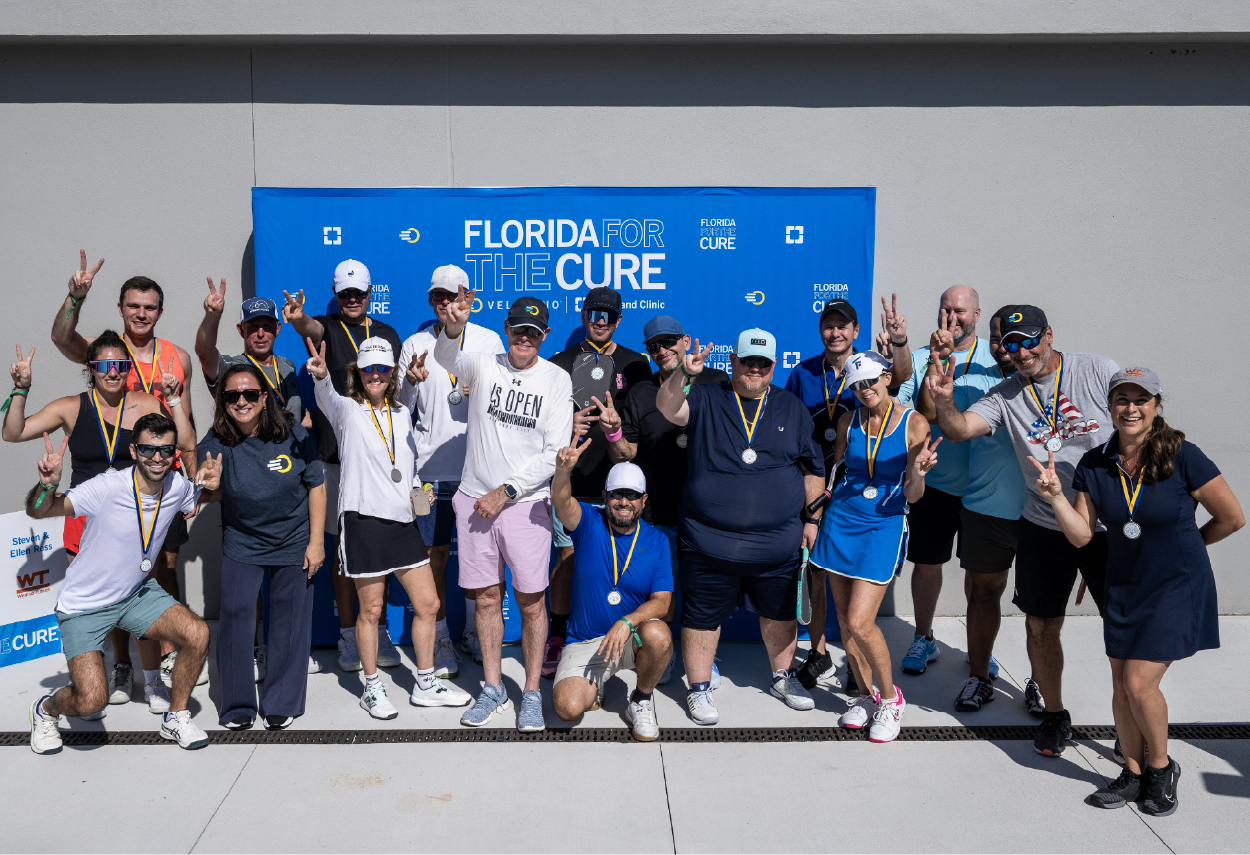
The energy at The Fort in Fort Lauderdale was electric on March 28, as the 2026 VeloSano season kicked off with the inaugural VeloSano Florida for the Cure event. The day was defined by fast-paced rallies, community spirit and one singular, powerful goal: ending cancer.
As one of South Florida’s premier social sports destinations, featuring 43 professional regulation courts and the world’s first dedicated pickleball stadium, The Fort provided the perfect backdrop for supporters and Cleveland Clinic caregivers to unite. From first-time players picking up a paddle to seasoned competitors, the tournament was an inspiring display of teamwork and passion on the courts.
After a series of thrilling matches, the tournament concluded with a medal ceremony celebrating the winners from the intermediate and advanced divisions. The moment served as a powerful testament to the impact a united community can have in the fight against cancer.
One of the tournament’s top champions reflected on what made this victory so meaningful.
“This cause is incredibly personal to me,” says Dr. Sandy Lieberman. “As a physician, I know the weight of a cancer diagnosis, and as someone who has lost family to the disease, I’ll show up anytime to play in support of cancer research.”
Fueling the Future of Research
The day concluded with an inspiring Mission Moment led by Zeina Nahleh, MD, FACP, Vice Chief, Cancer Institute at Cleveland Clinic in Florida and Director of the Maroone Cancer Center, who highlighted how the VeloSano movement is directly accelerating lifesaving progress.
“Cancer is a devastating disease that impacts every family,” says Dr. Nahleh. “Advancing research is essential to reducing its burden, and it is only through the coordinated efforts of scientists, clinicians, community leaders and advocates that meaningful progress becomes possible.”
The impact in Florida is already significant. Since 2018, Cleveland Clinic teams across the state have completed 109 clinical trials, enrolled nearly 1,600 patients, trained 15 research fellows and published 164 scientific manuscripts. Florida researchers earned their first VeloSano research grant in 2024, followed by a second grant in 2025.
VeloSano Florida for the Cure marks the beginning of a year-round movement to fuel the fight against cancer. This momentum continues with upcoming events including London for the Cure (June 21, 2026), Trike & Bike in Cleveland (June 28, 2026) and Bike to Cure in Cleveland (September 18-19, 2026).
Thanks to VeloSano’s promise that 100% of every dollar raised goes directly to cancer research, participants know their impact is immediate and meaningful. Joining the VeloSano movement means that together, we can accelerate progress and change the future for millions of cancer patients around the world.
Keeping the Momentum Going
Whether you prefer a paddle, a bike or a direct donation, there are plenty of ways to keep fueling lifesaving research. Donate today to support the ongoing cancer research efforts at Cleveland Clinic.
Double Your Impact at Indian River Hospital
Thanks to the extraordinary generosity of the Welsh family, every gift to expand Electrophysiology services at Indian River Hospital’s Welsh Heart Center will be matched dollar for dollar, doubling your impact immediately. Time is critical—we must secure commitments by May 2026 to meet this challenge.
This expansion represents one of our community’s most urgent healthcare priorities, ensuring patients have access to advanced cardiac care close to home when they need it most. The Welsh family created this match because they believe in this community’s ability to rise when it matters most— and that moment is now.
“Heart rhythm disorders are one of the fastest-growing cardiovascular challenges we are seeing in our community,” says Brett Faulknier, DO, FACC, FHRS, Director of Electrophysiology at Indian River Hospital. “Adding a second electrophysiology lab will dramatically expand our ability to treat patients with complex arrhythmias, reduce wait times for lifesaving procedures and ensure more people on the Treasure Coast can access the most advanced cardiac care close to home."
Double your impact today and help us expand access to advanced cardiac care close to home. Make your gift online here, or call 772.226.4960.
