


Breast Cancer Vaccine Trials Show Promise

Cleveland Clinic researchers are presenting final Phase 1 data from their novel study of a vaccine aimed at preventing triple-negative breast cancer, the most aggressive and lethal form of the disease.
The study team found that the investigational vaccine produced an immune response in the majority (74%) of all participants and was safe and well tolerated. They determined the maximum tolerated dose and described that side effects primarily consisted of mild skin inflammation at the injection site. The findings, which will inform the subsequent Phase 2 study, were presented at the San Antonio Breast Cancer Symposium.
“Triple-negative breast cancer remains one of the most challenging forms of the disease to treat effectively,” said G. Thomas Budd, MD, of Cleveland Clinic’s Cancer Institute and principal investigator of the study. “The results from this trial are promising, as they suggest the investigational vaccine is not only safe and well tolerated but also capable of inducing immune responses in over 70% of participants.”
Funded by the U.S. Department of Defense, the clinical trial evaluated safety and monitored immune response to the vaccine. The Phase 1 study, conducted at Cleveland Clinic’s Main Campus in partnership with Anixa Biosciences, Inc., included 35 patients across three cohorts:
- Phase 1a — patients who completed treatment for early-stage, triple-negative breast cancer within the past three years and are tumor-free but at high risk for recurrence.
- Phase 1b — cancer-free individuals who carry genetic mutations associated with elevated breast cancer risk, and who elected to have a preventative mastectomy.
- Phase 1c — early-stage triple-negative breast cancer patients who received pre-operative chemoimmunotherapy and surgery and were treated with pembrolizumab. These patients have residual cancer in the breast tissue, making them at risk of recurrence.
Launched in 2021, the trial enrolled 26 patients in Phase 1a, four in Phase 1b, and five in Phase 1c. Anixa is planning a Phase 2 study to evaluate the efficacy of the vaccine. The trial is expected to begin late next year and is projected to last approximately two to three years.
There is a great need for improved treatments for triple-negative breast cancer, which does not have biological characteristics that typically respond to hormonal or targeted therapies. Although it makes up only 10-15% of breast cancer cases, it causes a disproportionately high number of breast cancer deaths, according to the American Cancer Society. This aggressive cancer is twice as common in Black women, and accounts for 70-80% of breast tumors in patients with BRCA1 gene mutations.
The investigational vaccine is based on pre-clinical research led by the late Vincent Tuohy, PhD, who was the Mort and Iris November Distinguished Chair in Innovative Breast Cancer Research at Cleveland Clinic. Dr. Tuohy’s decades of groundbreaking research led to the development of this investigational vaccine.
The vaccine targets a lactation protein, α-lactalbumin, which is no longer found after lactation ceases in normal, aging breast tissues but is present in most triple-negative breast cancers. The vaccine is designed to stimulate the immune system to attack tumors if they develop.
The study is based on Dr. Tuohy’s research that showed that activating the immune system against α-lactalbumin was safe and effective in preventing breast tumors in mice. The research, originally published in Nature Medicine, was funded in part by philanthropic gifts from more than 20,000 people over the last 13 years.
“It was Dr. Tuohy’s hope that this vaccine would demonstrate the potential of immunization as a new way to combat breast cancer, and that a similar approach could someday be applied to other types of malignancies,” said Justin Johnson, PhD, researcher in Cleveland Clinic’s Department of Inflammation and Immunity and presenter of the study. “Our findings that the majority of participants across all three cohorts demonstrated an immune response to α-lactalbumin is an encouraging sign for the vaccine’s potential moving forward.”
Anixa is the exclusive worldwide licensee of the novel breast cancer vaccine technology developed at Cleveland Clinic. Cleveland Clinic is entitled to royalties and other commercialization revenues from the company.
This article originally appeared in the Cleveland Clinic Newsroom.
A Lasting Difference

Even now, 10 years after the passing of A. James “Jim” Clark, his impact endures. Mr. Clark believed in supporting organizations that support their communities. That commitment is making a significant difference for Cleveland Clinic Indian River Hospital, which received an investment of $5.5 million from the A. James & Alice B. Clark Foundation.
“The A. James & Alice B. Clark Foundation is thrilled to make this investment in Cleveland Clinic’s Indian River Hospital to strengthen its ability to meet the healthcare needs of the individuals and families it serves here in Indian River County,” said Courtney Clark Pastrick, Board Chair of the foundation and the Clarks’ daughter.
Mr. Clark was a builder and renowned innovator who led Clark Construction for decades. Well known for projects that transformed the landscape of Washington, D.C., the company also established a national presence, developing buildings as well as major convention centers in Atlanta, Boston, Chicago, Los Angeles, San Francisco, San Diego and Nashville, plus highway interchanges, libraries and performing-arts centers across the country.
Beyond forging a legacy of construction, Mr. Clark was known for his integrity and strong values. He cared deeply about the quality of his projects and the safety of his employees, continuing to visit job sites and engage with workers on the frontlines well into his 80s.
In 1987, the Clark family established the Clark Charitable Foundation. Dedicated to supporting the communities where they lived and worked, Mr. Clark and Courtney directed charitable contributions to organizations, hospitals, schools and cultural institutions.
Before Mr. Clark passed away in March 2015, he mandated that the vast majority of his estate be spent within 10 years. From 2016 to 2025, the team at the A. James & Alice B. Clark Foundation honored his legacy of giving by investing over $1.4 billion in focus areas important to him and in alignment with his core values.
Recognizing the quality of care and uncompromising dedication to patients at Cleveland Clinic Indian River Hospital, the foundation’s leadership decided to invest in the hospital. The Clark Foundation’s decision to support Cleveland Clinic Indian River Hospital also reflected the family’s deep personal connection to Vero Beach, a community close to the hearts of the founders and a place the Clark family still calls home.
Of the investment, $5 million will be applied to the comprehensive renovation and expansion of the Emergency Department to address increasing patient volumes. The Behavioral Health Center, which provides psychiatric care for patients of all ages and has been seeing dramatically increasing admissions, will receive $250,000. The Clark Foundation’s investment also includes $250,000 to support ongoing renovations to the Labor & Delivery unit, aimed at improving maternity care facilities and creating a family-centered environment.
Those who knew Jim Clark note that he didn’t seek attention for his philanthropy. Rather, he genuinely cared about making a lasting difference. For countless patients and their loved ones who walk through the doors of Cleveland Clinic Indian River Hospital in a time of need, that difference will be felt.
“Shark Tank” Challenge Sparks Healthcare Innovation
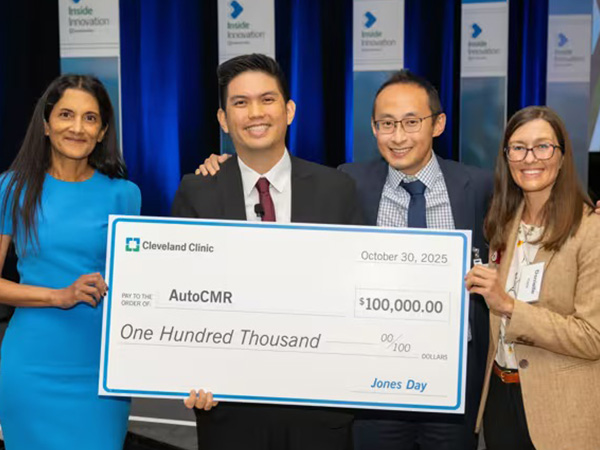
The excitement in the room was palpable as three researchers pitched their projects in a competition to receive a $100,000 grant sponsored by Jones Day during the second annual Inside Innovation challenge held at the InterContinental Cleveland on Oct. 30, 2025.
The event attracted nearly 250 donors, entrepreneurs, clinicians and scientists interested in learning about groundbreaking medical inventions under development at Cleveland Clinic.
Hands-On Innovation
The opening reception invited attendees to explore “Inventors Row,” an interactive showcase of leading-edge healthcare technologies from Cleveland Clinic inventors. Hands-on exhibits included a virtual reality experience that helps neurodiverse individuals with life skills; a nanobody therapy that targets immune response; and a surgical navigation technology that blends “X-ray vision” with CT imaging and ultrasound.
Next was a panel discussion led by D. Geoffery Vince, PhD, Chief of Cleveland Clinic Innovations and the Virginia Lois Kennedy Chair of Biomedical Engineering and Applied Therapeutics. Joined by Laura Jehi, MD; Francis Papay, MD; and Kurt Spindler, MD, the group explored topics such as the ethical use of AI in healthcare and the importance of quantum computing.
Ideas That Transform Care
Then, taking their cue from television’s “Shark Tank” product competition show, the three finalists each took the stage for 5 minutes, giving lively pitches complete with theme music and pop culture references to help the audience understand the complex ideas they have been working on for years.
Their groundbreaking medical innovations included a new approach to ending paralysis, an innovative pediatric heart valve, and an automated push-button system for heart imaging.
After several minutes of deliberating, the judges and the audience cast their votes using a QR code, awarding the $100,000 prize to Chris Nguyen, PhD, and his team for their work on AutoCMR. AutoCMR transforms heart imaging with a push-button system that delivers a full chest scan in just 30 minutes. It automates the entire MRI process, reduces scan time variability by 67%, and provides more complete imaging of the heart, capturing anatomy, function, and viability. AutoCMR makes cardiac MRIs faster, easier, and more accessible to patients who previously couldn’t undergo advanced cardiac imaging.
“Innovation in medicine is never a solo journey. I’m proud to work alongside a team that shares a deep commitment to improving patient outcomes,” Dr. Nguyen says. “This award isn’t just a win for our team, it is a win for patients everywhere. AutoCMR has the potential to redefine cardiac care by making imaging faster, more consistent and more accessible.”
Supporting Innovation in the Community
Tracy Stratford, a partner at Jones Day and one of the event’s judges, was amazed by the innovation on display, noting, “None of this happens without the support of the community. And whether you're talking about an individual, private philanthropy or big businesses contributing, these great innovations don't happen without it. It is just great to see people supporting ideas and research that really help our community and the entire world.”
“It was so inspiring,” agreed Jeff Kapp, also a partner at Jones Day and judge for the event. “The potential impact on healthcare is game-changing.”
Drawing parallels between the legal field and medicine, he continued, “Jones Day is constantly trying to innovate and be thought leaders in our industry. And being able to partner with Cleveland Clinic is remarkable. I don't think you can overstate the relationship between Jones Day and Cleveland Clinic.”
Expressing his gratitude for the support from Jones Day, Dr. Vince concurred. “You've heard a lot about ethics and innovation, but finding a partner like Jones Day who believes in that mission of ethics—ethical responsibility to serve our community—they've been fantastic partners to support Cleveland Clinic.”
