



Celiac disease is an autoimmune disease that triggers an abnormal reaction from your immune system when you eat gluten. This reaction causes inflammation in your small intestine, which can damage it over time. Fortunately, eating a gluten-free diet can often stop and reverse the damage.
Advertisement
Cleveland Clinic is a non-profit academic medical center. Advertising on our site helps support our mission. We do not endorse non-Cleveland Clinic products or services. Policy
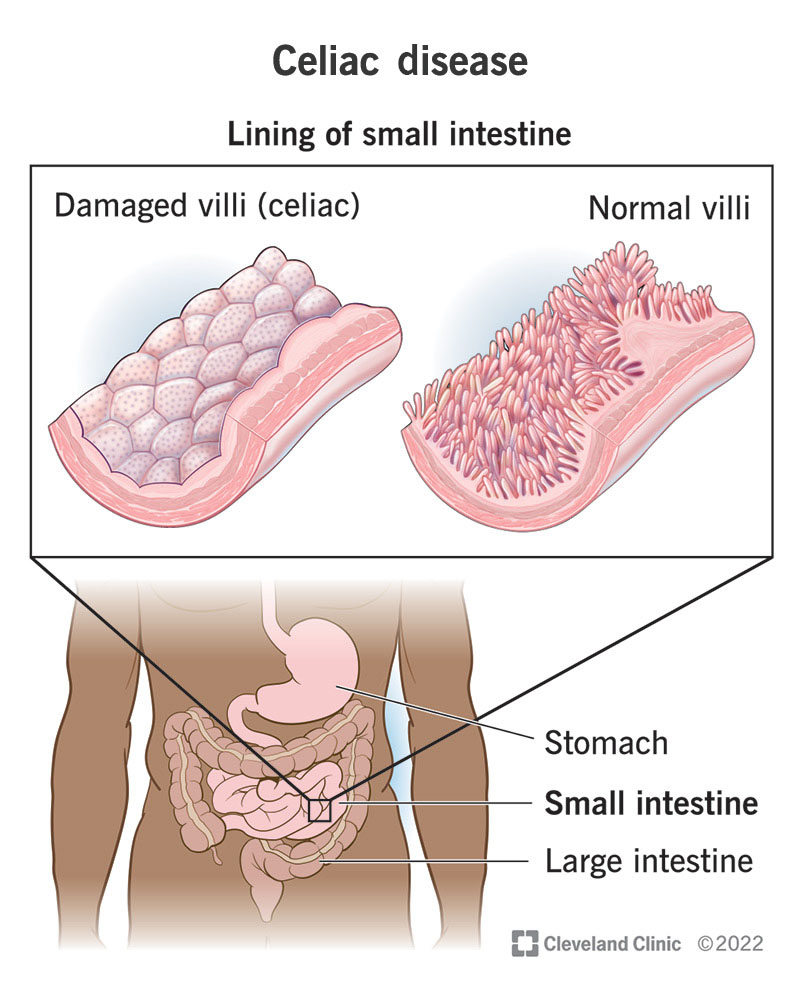
Image content: This image is available to view online.
View image online (https://my.clevelandclinic.org/-/scassets/Images/org/health/articles/14240-celiac-disease.jpg)
Celiac disease is an autoimmune disease that causes your body to react to a protein called gluten. When you eat gluten, it triggers an abnormal response from your immune system. Your immune system attacks the gluten in your digestive system, causing inflammation. This inflammation damages the inside of your small intestine.
Advertisement
Cleveland Clinic is a non-profit academic medical center. Advertising on our site helps support our mission. We do not endorse non-Cleveland Clinic products or services. Policy
Your small intestine is where most of the nutrition from food gets absorbed. So, damage to this organ can prevent it from doing its job and lead to serious complications.
Without treatment, celiac disease can lead to malabsorption and malnutrition. Malnutrition has many serious side effects, especially in children. Children with celiac disease may have growth and development delays.
Gluten is found in grains like wheat, barley and rye. These grains make up many of the staple foods of the standard Western diet. These include bread, cereals, pasta and beer. Gluten is also added to many food products that you may not expect. These include sauces, soups and packaged foods.
If you have celiac disease, it’s important to eat gluten-free.
Video content: This video is available to watch online.
View video online (https://cdnapisec.kaltura.com/p/2207941/sp/220794100/playManifest/entryId/1_sxyjai9r/flavorId/1_5f3sgelj/format/url/protocol/https/a.mp4)
Symptoms vary widely and require a gluten-free diet for management.
Signs and symptoms of celiac disease can appear at any age. Healthcare providers most often see it develop during two clear age windows:
Celiac disease symptoms vary widely. Some people don’t notice any symptoms at all. Some experience indigestion or other GI symptoms after eating gluten. Others only begin to see signs of nutrient deficiencies later, when significant damage has been done.
Advertisement
Gastrointestinal (digestive) symptoms of celiac disease may include:
Nondigestive symptoms may include:
Some people with celiac disease develop a condition called dermatitis herpetiformis. This is an itchy rash that looks like clusters of bumps or blisters. It affects your elbows, knees, butt and scalp.
Almost everyone with celiac disease has a genetic change (variant) in the HLA-DQ2 gene or HLA-DQ8 gene. You get these changes from your biological parents. But not everyone with these genes develops celiac disease.
Celiac disease is partly genetic, but other factors are also involved in triggering it. Some experts think the balance of microorganisms living in your gut might play a part. Others think a major physical event, like an illness or surgery, might trigger it.
You’re more likely to develop celiac disease if you’re female. Your chances also increase if you have:
Without treatment, celiac disease can lead to long-term complications. These include:
Celiac disease may also affect your liver. Over time, you can develop chronic liver disease. Untreated celiac disease also increases your risk of developing small intestine cancer.
If you have celiac disease symptoms after eating gluten, you may have the condition.
Keep in mind that food intolerances can cause discomfort that mimics celiac disease. Many people have a sensitivity to gluten or wheat products.
But these conditions don’t damage your small intestine the way celiac disease does. To make a celiac disease diagnosis, your healthcare provider will look for signs of this damage.
Healthcare providers use two celiac disease tests. They like to use them together to confirm the diagnosis:
Advertisement
Your provider may also want to test your blood for nutrient deficiencies. Severe deficiencies can have wide-ranging effects on your body. You may need nutrition therapy to treat them. Common findings include:
The most crucial step in celiac disease treatment is to stop eating gluten. You can’t change the way your body reacts to gluten. But you can prevent gluten from triggering that reaction.
When you stop eating gluten, it allows your small intestine to begin to heal. It will soon be able to absorb nutrients again. But you need to be strict about following a gluten-free diet for life. Otherwise, gluten could hurt your small intestine again.
Other celiac disease treatments may include:
You’ll also need regular follow-up care, including frequent testing.
Advertisement
Most people say their symptoms improve almost immediately after starting to eat gluten-free. It may take several weeks to reverse your nutrient deficiencies. It may take several months for your gut lining to fully heal. It can take longer, in some cases. It depends on how damaged your gut is and how long the damage has been going on. Eating any amount of gluten (however small) can also delay healing.
Most people who stop eating gluten have an excellent prognosis. Most of the damage done by celiac disease can be undone. If you continue to have symptoms, it may be that you’re consuming small amounts of gluten without realizing it. It’s also possible you have another condition. A small percentage of people have a type of celiac disease that doesn’t respond to standard treatments.
A celiac disease diagnosis will change your life in many ways and make you think twice before ordering anything off a menu. It might seem overwhelming at first. But the change that comes from getting this diagnosis is for the better. Before diagnosis, you didn’t know you needed to avoid gluten. You didn’t know what it was doing to your small intestine. You may have had strange and uncomfortable symptoms for years without understanding why. Now that you know, the power is in your hands to restore your health.
Advertisement



Sign up for our Health Essentials emails for expert guidance on nutrition, fitness, sleep, skin care and more.
Learn more about the Health Library and our editorial process.
Cleveland Clinic’s health articles are based on evidence-backed information and review by medical professionals to ensure accuracy, reliability and up-to-date clinical standards.
Cleveland Clinic’s health articles are based on evidence-backed information and review by medical professionals to ensure accuracy, reliability and up-to-date clinical standards.
If celiac disease gets in the way of your everyday life, Cleveland Clinic’s experts can help. We can craft a treatment plan that’s specific to you.
