For people with diabetes, having too much glucose (sugar) in their blood for
a long time can cause some serious complications, including foot and skin
problems, as well as heart disease, stroke, kidney disease, eye damage, and other problems.
How can diabetes affect my feet?
Diabetes can cause two problems that can affect your feet:
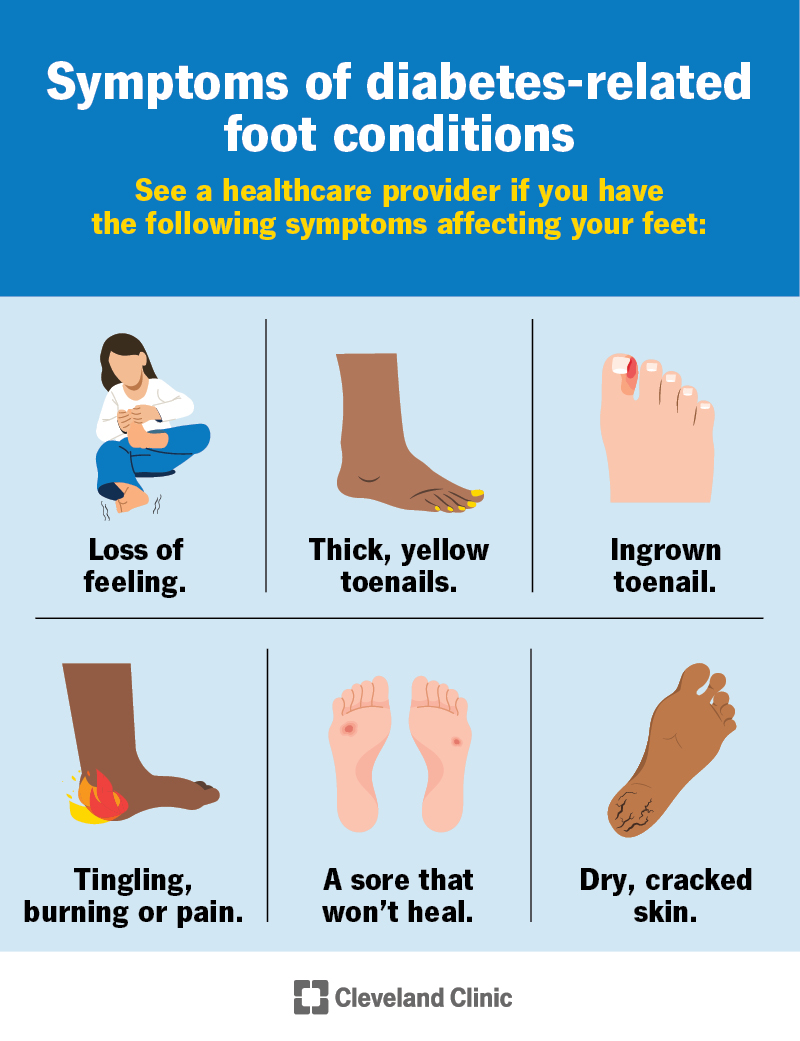
- Diabetic neuropathy — Uncontrolled diabetes can damage
your nerves. If you have damaged nerves in your legs and feet, you might not
feel heat, cold or pain. This lack of feeling is called diabetic neuropathy.
If you do not feel a cut or sore on your foot because of neuropathy, the cut
could get worse and become infected.
- Peripheral vascular disease — Diabetes also affects the
flow of blood. Without good blood flow, it takes longer for a sore or cut to
heal. Poor blood flow in the arms and legs is called peripheral vascular
disease. (The word "peripheral" means "located away from a
central point," and the word "vascular" refers to the blood
vessels. Peripheral vascular disease is a circulation disorder that affects
blood vessels away from the heart.)
If you have an infection that will not heal because of poor blood flow, you
are at risk for developing gangrene, which is the death of tissue due to a lack
of blood. To keep gangrene from spreading, the doctor may have to remove a toe,
foot, or part of a leg. This procedure is called amputation. Diabetes is the most
common, non-traumatic cause of leg amputations. Each year, more than 56,000
people with diabetes have amputations. However, research suggests that more than
half of these amputations can be prevented through proper foot care.
What are some common foot problems of people with diabetes?
Anyone can get the foot problems listed below. For people with diabetes,
however, these common foot problems can possibly lead to infection and serious
complications, such as amputation.
Athlete’s foot — Athlete’s foot is a fungus that
causes itching, redness, and cracking. Germs can enter through the cracks in
your skin and cause an infection. Medicines that kill the fungus are used to
treat athlete’s foot. These medicines may be pills and/or creams applied
directly to the problem area. Ask your health care provider to recommend a
medication for athlete’s foot.
Fungal infection of nails — Nails that are infected with
a fungus may become discolored (yellowish-brown or opaque), thick and brittle,
and may separate from the bed of the nail. In some cases, the nail may
crumble. The dark, moist and warm environment of shoes can promote fungal
growth. In addition, an injury to the nail can put you at risk for a fungal
infection. Fungal nail infections are difficult to treat. Topical medications
are available, but they only help a small number of fungal nail problems. Oral
medications may be prescribed by your health care provider. Treatment also may
include periodic removal of the damaged nail tissue.
Calluses — A callus is a build-up of hard skin,
usually on the underside of the foot. Calluses are caused by an uneven
distribution of weight, generally on the bottom of the forefoot or heel.
Calluses also can be caused by improperly fitting shoes or by a skin
abnormality. Keep in mind that some degree of callus formation on the sole of
the foot is normal. Proper care is necessary if you have a callus. After your
bath or shower, use a pumice stone to gently remove the build-up of tissue.
Use cushioned pads and insoles. Medications also may be prescribed to soften
calluses. DO NOT try to cut the callus or remove it with a sharp object.
Corns — A corn is a build-up of hard skin near a bony
area of a toe or between toes. Corns may be the result of pressure from shoes
that rub against the toes or cause friction between the toes. Proper care is
necessary if you have a corn. After your bath or shower, use a pumice stone to
gently remove the build-up of tissue. Do not use over-the-counter remedies to
dissolve corns. DO NOT try to cut the corn or remove it with a sharp object.
Blisters — Blisters can form when your shoes keep
rubbing the same spot on your foot. Wearing shoes that do not fit properly or
wearing shoes without socks can cause blisters, which can become infected.
When treating blisters, it’s important not to "pop" them. The skin
covering the blister helps protect it from infection. You also may use an
antibacterial cream and clean, soft bandages to help protect the skin and
prevent infection.
Bunion — A bunion forms when your big toe angles in
toward the second toe. Often, the spot where your big toe joins the rest of
the foot becomes red and callused. This area also may begin to stick out and
become hard. Bunions can form on one or both feet. Bunions may run in the
family, but most often they are caused by wearing high-heeled shoes with
narrow toes. These shoes put pressure on the big toe, pushing it toward the
second toe. The use of felt or foam padding on the foot may help protect the
bunion from irritation. A device also may be used to separate the big and
second toes. If the bunion causes severe pain and/or deformity, surgery to
realign the toes may be necessary.
Dry skin — Dry skin can result if the nerves in your
legs and feet do not get the message from your brain (because of diabetic
neuropathy) to sweat, which keeps your skin soft and moist. Dry skin can
crack, which can allow germs to enter. Use moisturizing soaps and lotions to
help keep your skin moist and soft.
Foot ulcers — A foot ulcer is a break in the skin or a
deep sore, which can become infected. Foot ulcers can result from minor
scrapes, cuts that heal slowly or from the rubbing of shoes that do not fit
well. Early intervention is important in treating foot ulcers. Ask your health
care provider for advice on how to best care for your wound.
Hammertoes — A hammertoe is a toe that is bent because of a
weakened muscle. The weakened muscle makes the tendons (tissues that connect
muscles to bone) shorter, causing the toes to curl under the feet. Hammertoes
can run in families. They also may be caused by wearing shoes that do not fit
properly (are too short). Hammertoes can cause problems with walking and can
lead to other foot problems, such as blisters, calluses, and sores. Splinting
and corrective footwear can help in treating hammertoes. In severe cases,
surgery to straighten the toe may be necessary.
Ingrown toenails — Ingrown toenails occur when the edges
of the nail grow into the skin. Ingrown nails cause pressure and pain along
the nail edges. The edge of the nail may cut into the skin, causing redness,
swelling, pain, drainage, and infection. The most common cause of ingrown
toenails is pressure from shoes. Other causes of ingrown toenails include
improperly trimmed nails, crowding of the toes, and repeated trauma to the
feet from activities such as running, walking, or doing aerobics. Keeping your
toenails properly trimmed is the best way to prevent ingrown toenails. If you
have a persistent problem or if you have a nail infection, you may need a
health care provider’s care. Severe problems with ingrown nails may be
corrected with surgery to remove part of the toenail and growth plate.
Plantar warts — Plantar warts look like calluses
on the ball of the foot or on the heel. They may appear to have small pinholes
or tiny black spots in the center. They are usually painful and may develop
singly or in clusters. Plantar warts are caused by a virus that infects the
outer layer of skin on the soles of the feet. DO NOT use over-the-counter
medications to dissolve the wart. If you are not sure if you have a plantar
wart or a callus, let your health care provider decide.
Can these foot problems be prevented?
Proper foot care can help prevent these common foot problems and/or treat
them before they cause serious complications. Here are some tips for good foot
care:
- Take care of yourself and your diabetes. Follow your health care
provider’s advice regarding nutrition, exercise, and medication. Keep your
blood glucose level within the range recommended by your health care provider.
- Wash your feet in warm water every day, using a mild soap. Do not soak
your feet. Dry your feet well, especially between the toes.
- Check your feet every day for sores, blisters, redness, calluses or any
of the other problems listed above. If you have poor blood flow, it is
especially important to do a daily foot check.
- If the skin on your feet is dry, keep it moist by applying lotion after
you wash and dry your feet. Do not put lotion between your toes. Your health
care provider can tell you which type of lotion is best to use.
- Gently smooth corns and calluses with an emery board or pumice stone. Do
this after your bath or shower, when your skin is soft. Move the emery board
in only one direction.
- Check your toenails once a week. Trim your toenails with a nail clipper
straight across. Do not round off the corners of toenails or cut down on the
sides of the nails. After clipping, smooth the toenails with an emery board.
- Always wear closed-toed shoes or slippers. Do not wear sandals. Do not
walk barefoot, even around the house.
- Always wear socks or stockings. Wear socks or stockings that fit your
feet well and have soft elastic.
- Wear shoes that fit well. Buy shoes made of canvas or leather, and break
them in slowly.
- Protect your feet from heat and cold. Wear shoes at the beach or on hot
pavement. Wear socks at night if your feet get cold.
- Keep the blood flowing to your feet. Put your feet up when sitting,
wiggle your toes and move your ankles several times a day, and don’t cross
your legs for long periods of time.
- Stop smoking. Smoking can make blood flow problems worse.
- If you have a foot problem that gets worse or won’t heal, contact
your health care provider for advice and treatment.
- Make sure your diabetes doctor examines your feet during each check-up.
- See your podiatrist (foot doctor) every two to three months for
check-ups, even if you don’t have any foot problems.
When should I contact my health care provider?
Contact your health care provider if you experience any of the following problems:
- Changes in skin color
- Changes in skin temperature
- Swelling in the foot or ankle
- Pain in the legs
- Open sores on the feet that are slow to heal or are draining
- Ingrown toenails or toenails infected with fungus
- Corns or calluses
- Dry cracks in the skin, especially around the heel
- Unusual and/or persistent foot odor
How can diabetes affect my skin?
If your blood glucose is high, your body loses fluid, causing your skin to
become dry. This occurs because the body is turning the water into urine to
remove excess glucose from the blood. Your skin also can get dry if the nerves,
especially those in your legs and feet, do not get the message to sweat (because
of diabetic neuropathy). Sweating helps keep your skin soft and moist.
Dry skin can become red and sore, and can crack and peel. Germs can enter
through the cracks in your skin and cause an infection. In addition, dry skin
usually is itchy, and scratching can lead to breaks in the skin and infection.
Skin problems are common in people with diabetes. Blood glucose provides an
excellent breeding ground for bacteria and fungi, and can reduce the body’s
ability to heal itself. These factors put people with diabetes at greater risk
for skin problems. In fact, as many as a third of people with diabetes will have
a skin disorder related to their disease at some time in their lives.
Fortunately, most skin conditions can be prevented and successfully treated if
caught early. But if not cared for properly, a minor skin condition can turn
into a serious problem with potentially severe consequences.
What are some common skin problems in people with diabetes?
Some of the problems listed below—such as bacterial infections, fungal
infections and itching—are skin conditions that can affect anyone. However,
people with diabetes are more prone to getting these conditions, which can lead
to serious complications. Some of the conditions listed—such as diabetic
dermopathy, necrobiosis lipoidica diabeticorum and eruptive xanthomatosis—occur
only in people with diabetes. (Remember, people with diabetes also can develop
skin conditions that affect people who do not have diabetes.)
Some common skin conditions include:
Acanthosis nigricans — This is a condition that results
in the darkening and thickening of the skin. Often, areas of tan or brown
skin, sometimes slightly raised, appear on the sides of the neck, the armpits,
and groin. Occasionally, these darkened areas may appear on the hands, elbows,
and knees. Acanthosis nigricans usually strikes people who are very
overweight. There is no cure for acanthosis nigricans, but losing weight may
improve the condition. Acanthosis nigricans usually precedes diabetes.
Allergic reactions — Allergic reactions to foods, bug
bites, and medicines can cause rashes, depressions, or bumps on the skin. If you
think you may be having an allergic reaction to a medicine, contact your
health care provider. Severe allergic reactions may require emergency
treatment. It is especially important for people with diabetes to check for
rashes or bumps in the areas where they inject their insulin.
Atherosclerosis — Atherosclerosis is the narrowing of
blood vessels from a thickening of the vessel walls. While atherosclerosis
most often is associated with blood vessels in or near the heart, it can
affect blood vessels throughout the body, including those that supply the
skin. When the blood vessels supplying the skin become narrow, changes occur
due to a lack of oxygen. Loss of hair, thinning and shiny skin, thickened and
discolored toenails, and cold skin are symptoms of atherosclerosis. Because
blood carries the white blood cells that help fight infection, legs and feet
affected by atherosclerosis heal slowly when they are injured.
Bacterial infections — There are different kinds of
bacterial infections affecting the skin. These include styes, which are
infections of the glands of the eyelids; boils, which are infections of the
hair follicles; and carbuncles, which are deep infections of the skin and the
underlying tissue. There also are bacterial infections that affect the nails.
With a bacterial infection, the areas involved generally are hot, swollen, red,
and painful. Most bacterial infections require treatment with antibiotics in
the form of pills and/or creams.
Bullosis diabeticorum (diabetic blisters) — In rare
cases, people with diabetes develop blisters that resemble burn blisters.
These blisters—called bullosis diabeticorum—can occur on the fingers,
hands, toes, feet, legs, or forearms. Diabetic blisters usually are painless
and heal on their own. They often occur in people who have diabetic
neuropathy. Bringing your blood glucose level under control is the treatment
for this condition.
Diabetic dermopathy — Diabetes can affect the small
blood vessels of the body that supply the skin with blood. Changes to the
blood vessels because of diabetes can cause a skin condition called diabetic
dermopathy. Dermopathy appears as scaly patches that are light brown or red,
often on the front of the legs. The patches do not hurt, blister or itch, and
treatment generally is not necessary. The patches are sometimes called skin
spots.
Digital sclerosis — The word "digital" refers
to your fingers and toes, and "sclerosis" means hardening. Digital
sclerosis, therefore, is a condition in which the skin on your toes, fingers
and hands become thick, waxy and tight. Stiffness of the finger joints also
may occur. The treatment is to bring your blood glucose level under control.
Lotions and moisturizers may help soften the skin.
Disseminated granuloma annulare — This condition causes
sharply defined, ring- or arc-shaped areas on the skin. These rashes most
often occur on the fingers and ears, but they can occur on the trunk. The rash
can be red, red-brown or skin colored. Treatment usually is not required, but
some cases may benefit from a topical steroid medication, such as
hydrocortisone.
Eruptive xanthomatosis — Eruptive xanthomatosis can
occur in some individuals when blood glucose levels are not well controlled
and when triglycerides in the blood rise to extremely high levels. This
condition appears as firm, yellow, pea-like bumps on the skin. The bumps—which
are surrounded by red halos and are itchy—usually are found on the feet,
arms, legs, buttocks and backs of the hands. Treatment for eruptive
xanthomatosis consists of controlling your blood glucose level. Lipid-lowering
drugs also may be needed.
Fungal infections — A yeast-like fungus called Candida
albicans is responsible for many of the fungal infections affecting people
with diabetes. This fungus creates itchy red rashes, often surrounded by tiny
blisters and scales. These infections most often occur in warm, moist folds of
the skin. Three common fungal infections are jock itch, which appears as a
red, itchy area on the genitals and the inside of the thighs; athlete’s
foot, which affects the skin between the toes; and ringworm, which causes
ring-shaped, scaly patches that can itch or blister. Ringworm can appear on
the feet, groin, trunk, scalp, or nails. Medicines that kill the fungus may be
needed to treat these infections.
Itching — Itching skin, also called pruritus, can have
many causes, such as a yeast infection, dry skin or poor blood flow. When
itching is caused by poor blood flow, the lower legs and feet are most often
affected. Using lotion can help to keep your skin soft and moist, and prevent
itching due to dry skin.
Necrobiosis lipoidica diabeticorum — Necrobiosis
lipoidica diabeticorum (NLD) is caused by changes in the blood vessels and
generally affects the lower legs. With NLD, the affected skin becomes raised,
yellow and waxy in appearance, often with a purple border. Sometimes, NLD is
itchy and painful. As long as the sores do not break open, treatment is not
necessary. If the sores do break open, see your health care provider for
treatment.
Scleroderma diabeticorum — Like digital sclerosis, this
condition causes a thickening of the skin; but scleroderma diabeticorum
affects the skin on the back of the neck and upper back. This condition, which
is rare, most often affects people with diabetes who are overweight. The
treatment is to bring your blood glucose level under control. Lotions and
moisturizers may help soften the skin.
Vitiligo — Vitiligo is a condition that affects skin
coloration. With vitiligo, the special cells that make pigment (the substance
that controls skin color) are destroyed, resulting in patches of discolored
skin. Vitiligo often affects the trunk, but may be found on the face around
the mouth, nostrils and eyes. This condition usually occurs in people with
type 1 diabetes. There is no specific treatment for vitiligo. You should use
sunscreen with a SPF of 15 or higher to prevent sunburn on the discolored
skin.
Assessing skin turgor (fullness) is a way for health care workers to assess
the amount of fluid loss that may occur from various conditions, such as
diarrhea or vomiting. Loss of body fluid through frequent urination also is a
concern for people with diabetes. Skin turgor refers to the skin’s elasticity
(its ability to change shape and return to normal). An assessment of skin turgor
is used to help determine the effects of diabetes on skin health.
Can these skin problems be prevented?
Keeping your diabetes under control is the most important factor in
preventing the skin-related complications of diabetes. Follow your health care
provider’s advice regarding nutrition, exercise, and medication. Keep your
blood glucose level within the range recommended by your health care provider.
Proper skin care also can help reduce your risk of skin-related problems.
© Copyright 1995-2009 The Cleveland Clinic Foundation. All rights reserved.
Can't find the health information you’re looking for?
Ask a Health Educator, Live!
Know someone who could use this information?...send them this link.
This information is provided by the Cleveland Clinic and is not intended to replace the medical advice of your doctor or health care provider. Please consult your health care provider for advice about a specific medical condition. This document was last reviewed on: 10/24/2007...#9492