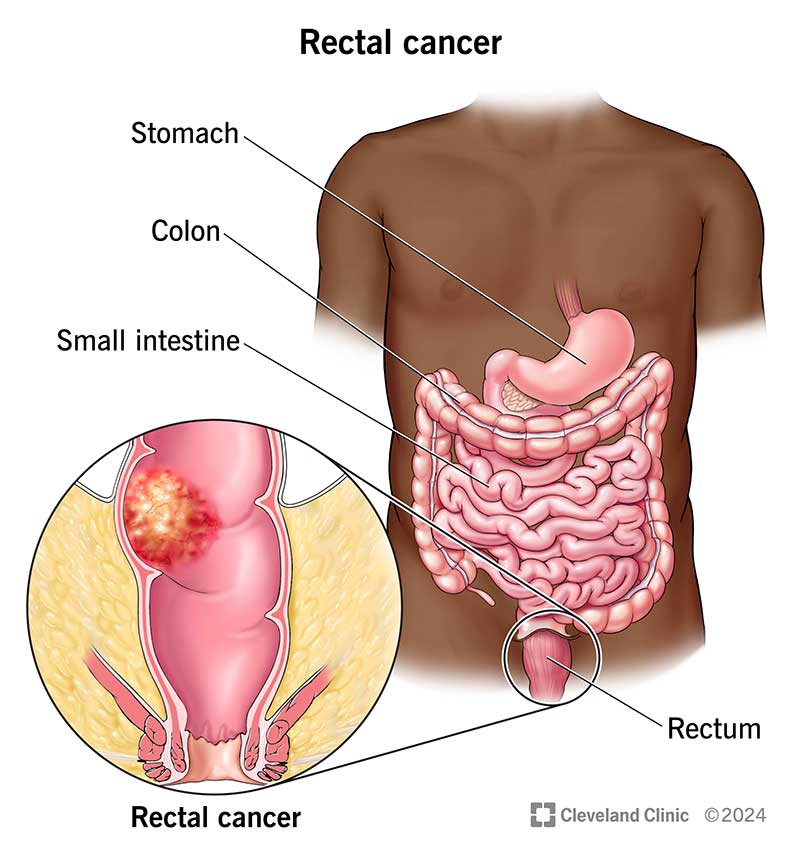
Rectal cancer is a disease in which malignant (cancer) cells
form in the tissues of the rectum.
The rectum is part of the body’s digestive system. The digestive
system removes and processes nutrients (vitamins, minerals, carbohydrates, fats,
proteins, and water) from foods and helps pass waste material out of the body.
The digestive system is made up of the esophagus, stomach, and the small and
large intestines. The first 6 feet of the large intestine are called the large
bowel or colon. The last 6 inches are the rectum and the anal canal. The anal
canal ends at the anus (the opening of the large intestine to the outside of the body).
Age and family history can affect the risk of developing rectal cancer.
Anything that increases your chance of getting a disease is
called a risk factor. Having a risk factor does not mean that you will get
cancer; not having risk factors doesn’t mean that you will not get cancer.
People who think they may be at risk should discuss this with their doctor. The
following are possible risk factors for rectal cancer:
- Being aged 40 or older.
- Having certain hereditary conditions, such as familial adenomatous
polyposis (FAP) and hereditary nonpolyposis colon cancer (HNPCC or Lynch syndrome).
- Having a personal history of any of the following:
-
Colorectal cancer.
-
Polyps (small pieces of bulging tissue) in the colon or rectum.
-
Cancer of the ovary, endometrium, or breast.
- Having a parent, brother, sister, or child with a history of colorectal cancer or polyps.
Possible signs of rectal cancer include a change in bowel
habits or blood in the stool.
These and other symptoms may be caused by rectal cancer. Other
conditions may cause the same symptoms. A doctor should be consulted if any of
the following problems occur:
- A change in bowel habits.
-
Diarrhea
-
Constipation
-
Feeling that the bowel does not empty completely.
-
Stools that are narrower or have a different shape than usual.
- Blood (either bright red or very dark) in the stool.
- General abdominal discomfort (frequent gas pains, bloating, fullness, or cramps).
- Change in appetite.
- Weight loss for no known reason.
- Feeling very tired.
Tests that examine the rectum and colon are used to detect
(find) and diagnose rectal cancer.
Tests used to diagnose rectal cancer include the following:
- Physical exam and history: An exam of the body to check
general signs of health, including checking for signs of disease, such as lumps
or anything else that seems unusual. A history of the patient’s health habits
and past illnesses and treatments will also be taken.
- Digital rectal exam (DRE): An exam of the rectum. The doctor
or nurse inserts a lubricated, gloved finger into the lower part of the rectum
to feel for lumps or anything else that seems unusual. In women, the vagina may
also be examined.
- Proctoscopy: An exam of the rectum using a proctoscope,
inserted into the rectum. A proctoscope is a thin, tube-like instrument with a
light and a lens for viewing. It may also have a tool to remove tissue to be
checked under a microscope for signs of disease.
- Colonoscopy: A procedure to look inside the rectum and colon
for polyps (small pieces of bulging tissue), abnormal areas, or cancer. A
colonoscope is a thin, tube-like instrument with a light and a lens for viewing.
It may also have a tool to remove polyps or tissue samples, which are checked
under a microscope for signs of cancer.
- Biopsy: The removal of cells or tissues so they can be
viewed under a microscope to check for signs of cancer. Tumor tissue that is
removed during the biopsy may be checked to see if the patient is likely to have
the gene mutation that causes HNPCC. This may help to plan treatment. The
following tests may be used:
- Reverse-transcription polymerase chain reaction (RT-PCR) test: A
laboratory test in which cells in a sample of tissue are studied using chemicals
to look for certain changes in the structure or function of genes.
- Immunohistochemistry study: A laboratory test in which a substance such
as an antibody, dye, or radioisotope is added to a sample of tissue to test for
certain antigens. This type of study is used to tell the difference between
different types of cancer.
- Carcinoembryonic antigen (CEA) assay: A test that measures
the level of CEA in the blood. CEA is released into the bloodstream from both
cancer cells and normal cells. When found in higher than normal amounts, it can
be a sign of rectal cancer or other conditions.
Certain factors affect prognosis (chance of recovery) and treatment options.
The prognosis (chance of recovery) and treatment options depend on the following:
- The stage of the cancer (whether it affects the inner lining of
the rectum only, involves the whole rectum, or has spread to lymph nodes, nearby
organs, or other places in the body).
- Whether the tumor has spread into or through the bowel wall.
- Where the cancer is found in the rectum.
- Whether the bowel is blocked or has a hole in it.
- Whether all of the tumor can be removed by surgery.
- The patient’s general health.
- Whether the cancer has just been diagnosed or has recurred (come back).
Stages of Rectal Cancer
After rectal cancer has been diagnosed, tests are done to find
out if cancer cells have spread within the rectum or to other parts of the body.
The process used to find out whether cancer has spread within
the rectum or to other parts of the body is called staging. The information
gathered from the staging process determines the stage of the disease. It is
important to know the stage in order to plan treatment. The following tests and
procedures may be used in the staging process:
- Chest x-ray: An x-ray of the organs and bones inside the
chest. An x-ray is a type of energy beam that can go through the body and onto
film, making a picture of areas inside the body.
- CT scan (CAT scan): A procedure that makes a series of
detailed pictures of areas inside the body, taken from different angles. The
pictures are made by a computer linked to an x-ray machine. A dye may be
injected into a vein or swallowed to help the organs or tissues show up more
clearly. This procedure is also called computed tomography, computerized
tomography, or computerized axial tomography.
- MRI (magnetic resonance imaging): A procedure that uses a
magnet, radio waves, and a computer to make a series of detailed pictures of
areas inside the body. This procedure is also called nuclear magnetic resonance
imaging (NMRI).
- Endoscopic ultrasound (EUS): A procedure in which an
endoscope or rigid probe is inserted into the body through the rectum. The
endoscope or probe has a light and a lens for viewing. A device at the end is
used to bounce high-energy sound waves (ultrasound) off internal tissues or
organs and make echoes. The echoes form a picture of body tissues called a
sonogram. This procedure is also called endosonography.
- PET scan (positron emission tomography scan): A procedure to
find malignant tumor cells in the body. A small amount of radioactive glucose
(sugar) is injected into a vein. The PET scanner rotates around the body and
makes a picture of where glucose is being used in the body. Malignant tumor
cells show up brighter in the picture because they are more active and take up
more glucose than normal cells do.
- Carcinoembryonic antigen (CEA) assay: A test that measures
the level of CEA in the blood. CEA is released into the bloodstream from both
cancer cells and normal cells. When found in higher than normal amounts, it can
be a sign of rectal cancer or other conditions.
There are three ways that cancer spreads in the body.
The three ways that cancer spreads in the body are:
- Through tissue. Cancer invades the surrounding normal tissue.
- Through the lymph system. Cancer invades the lymph system and
travels through the lymph vessels to other places in the body.
- Through the blood. Cancer invades the veins and capillaries and
travels through the blood to other places in the body.
When cancer cells break away from the primary (original) tumor
and travel through the lymph or blood to other places in the body, another
(secondary) tumor may form. This process is called metastasis. The secondary
(metastatic) tumor is the same type of cancer as the primary tumor. For example,
if breast cancer spreads to the bones, the cancer cells in the bones are
actually breast cancer cells. The disease is metastatic breast cancer, not bone cancer.
The following stages are used for rectal cancer:
Stage 0 (Carcinoma in Situ)
In stage 0, abnormal cells are found in the innermost lining of the rectum.
These abnormal cells may become cancer and spread into nearby normal tissue.
Stage 0 is also called carcinoma in situ.
Stage I
In stage I, cancer has formed and spread beyond the innermost lining of the
rectum to the second and third layers and involves the inside wall of the
rectum, but it has not spread to the outer wall of the rectum or outside the
rectum. Stage I rectal cancer is sometimes called Dukes A rectal cancer.
Stage II
In stage II, cancer has spread outside the rectum to nearby tissue, but it
has not gone into the lymph nodes (small, bean-shaped structures found
throughout the body that filter substances in a fluid called lymph and help
fight infection and disease). Stage II rectal cancer is sometimes called Dukes B
rectal cancer.
Stage III
In stage III, cancer has spread to nearby lymph nodes, but it has not spread
to other parts of the body. Stage III rectal cancer is sometimes called Dukes C
rectal cancer.
Stage IV
In stage IV, cancer has spread to other parts of the body, such as the
liver, lungs, or ovaries. Stage IV rectal cancer is sometimes called Dukes D
rectal cancer.
Recurrent Rectal Cancer
Recurrent rectal cancer is cancer that has recurred (come back)
after it has been treated. The cancer may come back in the rectum or in other
parts of the body, such as the colon, pelvis, liver, or lungs.
Treatment Option Overview
There are different types of treatment for patients with rectal cancer.
Different types of treatment are available for patients with
rectal cancer. Some treatments are standard (the currently used treatment), and
some are being tested in clinical trials. A treatment clinical trial is a
research study meant to help improve current treatments or obtain information on
new treatments for patients with cancer. When clinical trials show that a new
treatment is better than the standard treatment, the new treatment may become
the standard treatment. Patients may want to think about taking part in a
clinical trial. Some clinical trials are open only to patients who have not
started treatment.
Three types of standard treatment are used:
Surgery
Surgery is the most common treatment for all stages of rectal
cancer. The cancer is removed using one of the following types of surgery:
- Polypectomy: If the cancer is found in a polyp (a small piece of
bulging tissue), the polyp is often removed during a colonoscopy.
- Local excision: If the cancer is found on the inside surface of the
rectum and has not spread into the wall of the rectum, the cancer and a
small amount of surrounding healthy tissue is removed.
- Resection: If the cancer has spread into the wall of the rectum, the
section of the rectum with cancer and nearby healthy tissue is removed.
Sometimes the tissue between the rectum and the abdominal wall is also
removed. The lymph nodes near the rectum are removed and checked under a
microscope for signs of cancer.
- Pelvic exenteration: If the cancer has spread to other organs near
the rectum, the lower colon, rectum, and bladder are removed. In women, the
cervix, vagina, ovaries, and nearby lymph nodes may be removed. In men, the
prostate may be removed. Artificial openings (stoma) are made for urine and
stool to flow from the body to a collection bag.
After the cancer is removed, the surgeon will either:
- do an anastomosis (sew the healthy parts of the rectum together,
sew the remaining rectum to the colon, or sew the colon to the anus); or
- make a stoma (an opening) from the rectum to the outside of the body for waste
to pass through. This procedure is done if the cancer is too close to the anus
and is called a colostomy. A bag is placed around the stoma to collect the waste.
Sometimes the colostomy is needed only until the rectum has
healed, and then it can be reversed. If the entire rectum is removed, however,
the colostomy may be permanent.
Radiation therapy or chemotherapy may be given before surgery to
shrink the tumor, make it easier to remove the cancer, and lessen problems with
bowel control after surgery. Treatment given before surgery is called
neoadjuvant therapy. Even if all the cancer that can be seen at the time of the
operation is removed, some patients may be given radiation therapy or
chemotherapy after surgery to kill any cancer cells that are left. Treatment
given after the surgery, to lower the risk that the cancer will come back, is
called adjuvant therapy.
Radiation therapy
Radiation therapy is a cancer treatment that uses high-energy
x-rays or other types of radiation to kill cancer cells. There are two types of
radiation therapy. External radiation therapy uses a machine outside the body to
send radiation toward the cancer. Internal radiation therapy uses a radioactive
substance sealed in needles, seeds, wires, or catheters that are placed directly
into or near the cancer. The way the radiation therapy is given depends on the
type and stage of the cancer being treated.
Chemotherapy
Chemotherapy is a cancer treatment that uses drugs to stop the
growth of cancer cells, either by killing the cells or by stopping the cells
from dividing. When chemotherapy is taken by mouth or injected into a vein or
muscle, the drugs enter the bloodstream and can reach cancer cells throughout
the body (systemic chemotherapy). When chemotherapy is placed directly in the
spinal column, an organ, or a body cavity such as the abdomen, the drugs mainly
affect cancer cells in those areas (regional chemotherapy). The way the
chemotherapy is given depends on the type and stage of the cancer being treated.
Other types of treatment are being tested in clinical trials.
This section describes treatments that are being studied in
clinical trials. It may not mention every treatment being studied.
Targeted therapy
Targeted therapy is a type of treatment that uses drugs or other
substances to identify and attack specific cancer cells without harming normal
cells. Monoclonal antibody therapy is a type of targeted therapy being studied
in the treatment of rectal cancer.
Monoclonal antibody therapy uses antibodies made in the
laboratory from a single type of immune system cell. These antibodies can
identify substances on cancer cells or normal substances that may help cancer
cells grow. The antibodies attach to the substances and kill the cancer cells,
block their growth, or keep them from spreading. Monoclonal antibodies are given
by infusion. They may be used alone or to carry drugs, toxins, or radioactive
material directly to cancer cells.
Patients may want to think about taking part in a clinical trial.
For some patients, taking part in a clinical trial may be the
best treatment choice. Clinical trials are part of the cancer research process.
Clinical trials are done to find out if new cancer treatments are safe and
effective or better than the standard treatment.
Many of today's standard treatments for cancer are based on
earlier clinical trials. Patients who take part in a clinical trial may receive
the standard treatment or be among the first to receive a new treatment.
Patients who take part in clinical trials also help improve the
way cancer will be treated in the future. Even when clinical trials do not lead
to effective new treatments, they often answer important questions and help move
research forward.
Patients can enter clinical trials before, during, or after
starting their cancer treatment.
Some clinical trials only include patients who have not yet
received treatment. Other trials test treatments for patients whose cancer has
not gotten better. There are also clinical trials that test new ways to stop
cancer from recurring (coming back) or reduce the side effects of cancer treatment.
Clinical trials are taking place in many parts of the country.
Follow-up tests may be needed.
Some of the tests that were done to diagnose the cancer or to
find out the stage of the cancer may be repeated. Some tests will be repeated in
order to see how well the treatment is working. Decisions about whether to
continue, change, or stop treatment may be based on the results of these tests.
This is sometimes called re-staging.
Some of the tests will continue to be done from time to time
after treatment has ended. The results of these tests can show if your condition
has changed or if the cancer has recurred (come back). These tests are sometimes
called follow-up tests or check-ups.
After treatment for rectal cancer, a blood test to measure
amounts of carcinoembryonic antigen (a substance in the blood that may be
increased when cancer is present) may be done to see if the cancer has come
back.
Treatment Options by Stage
For some types or stages of cancer, there may not be any trials listed. Check with your
doctor for clinical trials that are not listed here but may be right for you.
Stage 0 (Carcinoma in Situ)
Treatment of stage 0 may include the following:
- Simple polypectomy.
- Local excision.
- Resection (when the tumor is too large to remove by local excision).
- Internal or external radiation therapy.
Stage I Rectal Cancer
Treatment of stage I rectal cancer may include the following:
- Local excision.
- Resection.
- Resection with radiation therapy and chemotherapy before or after surgery.
Stage II Rectal Cancer
Treatment of stage II rectal cancer may include the following:
- Resection plus a combination of chemotherapy and radiation therapy
before or after surgery.
- Resection with or without chemotherapy after surgery.
- A clinical trial of a new treatment.
Stage III Rectal Cancer
Treatment of stage III rectal cancer may include the following:
- Resection plus a combination of chemotherapy and radiation therapy
before or after surgery.
- Resection with or without chemotherapy after surgery.
- A clinical trial of a new treatment.
Stage IV and Recurrent Rectal Cancer
Treatment of stage IV and recurrent rectal cancer may include the following:
- Resection with or without a combination of radiation therapy and
chemotherapy before surgery.
- Resection or pelvic exenteration, as palliative therapy to relieve
symptoms and improve the quality of life.
- Radiation therapy, chemotherapy, or a combination of both, as palliative
therapy to relieve symptoms and improve the quality of life.
- Chemotherapy to control the growth of the tumor.
- Placement of a stent to help keep the rectum open if it is partly
blocked by the tumor, as palliative therapy to relieve symptoms and improve
the quality of life.
- Systemic chemotherapy with or without monoclonal antibody therapy, such
as bevacizumab.
- A clinical trial of a new anticancer drug.
Treatment of rectal cancer that has spread to other organs
depends on which organ the cancer has spread to.
- Treatment for areas of cancer that have spread to the liver
includes the following:
-
Regional or systemic chemotherapy.
-
Internal radiation therapy.
-
Surgery to remove the tumor with or without chemotherapy before surgery.
- Treatment for areas of cancer that has spread to the lung or ovaries is surgery.
Check for U.S. clinical trials from NCI's PDQ Cancer Clinical
Trials Registry that are now accepting patients with rectal cancer. For more
specific results, refine the search by using other search features, such as the
location of the trial, the type of treatment, or the name of the drug. General
information about clinical trials is available from the NCI Web site.
For more information from the NCI, please write to this address:
NCI Public Inquiries Office
Suite 3036A
6116 Executive Boulevard, MSC8322
Bethesda, MD 20892-8322
U.S. residents may call the National Cancer Institute's (NCI's) Cancer
Information Service toll-free at 1-800-4-CANCER (1-800-422-6237) Monday through
Friday from 9:00 a.m. to 4:30 p.m. Deaf and hard-of-hearing callers with TTY
equipment may call 1-800-332-8615. Information about ongoing clinical trials is available from the NCI Web site.
Source: National Institutes of Health; National Cancer Institute
Can't find the health information you’re looking for?
Ask a Health Educator, Live!
This information is provided by the Cleveland Clinic and is not intended to replace the medical advice of your doctor or health care provider. Please consult your health care provider for advice about a specific medical condition. This document was last reviewed on 10/2/2009...#6177