



Breast cancer happens when breast cells mutate and become abnormal cells that multiply and form tumors. It typically affects women over 50, but it can also affect men and younger women. Symptoms vary but may include a lump, thickening skin or nipple discharge. Healthcare providers treat breast cancer with surgery, radiation and drug therapies.
Advertisement
Cleveland Clinic is a non-profit academic medical center. Advertising on our site helps support our mission. We do not endorse non-Cleveland Clinic products or services. Policy
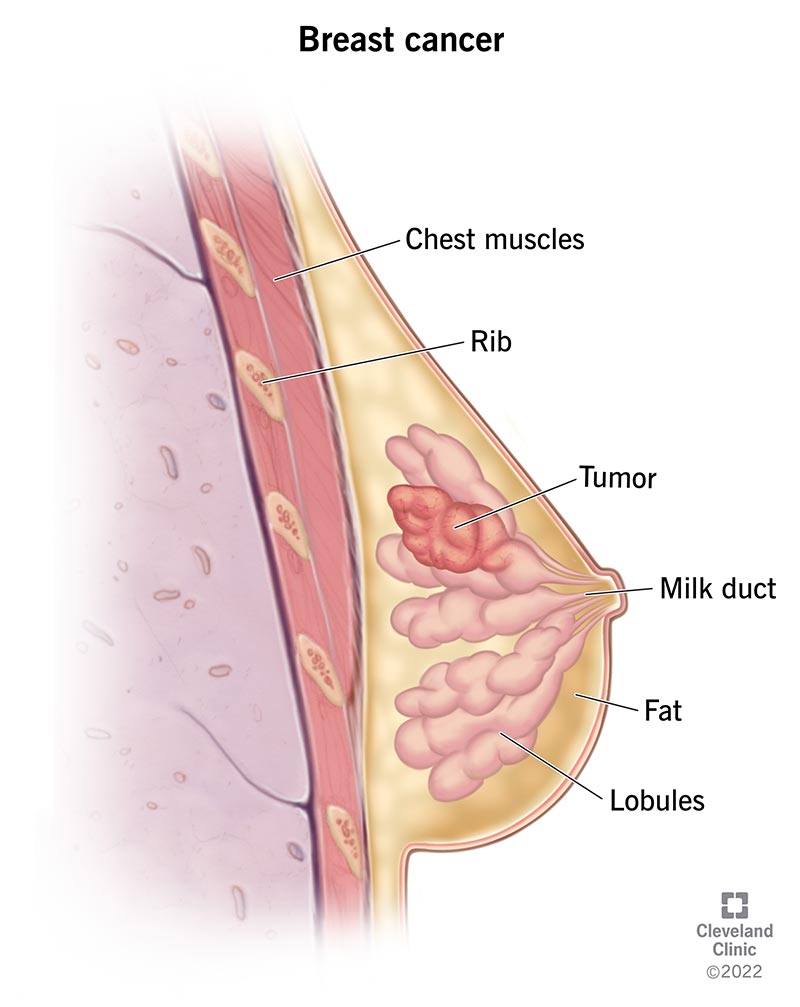
Image content: This image is available to view online.
View image online (https://my.clevelandclinic.org/-/scassets/Images/org/health/articles/3986-breast-cancer)
Breast cancer happens when healthy breast cells become abnormal, multiply and form tumors. Most breast cancers are carcinomas that start in milk ducts or milk-producing glands. Most cases are invasive. This means that without treatment, a tumor can spread to other parts of your body.
Advertisement
Cleveland Clinic is a non-profit academic medical center. Advertising on our site helps support our mission. We do not endorse non-Cleveland Clinic products or services. Policy
Breast cancer is one of the most common cancers that affects women. Approximately 1 in 8 women in the United States will develop breast cancer in their lifetime. Although it’s rare, male breast cancers also occur.
Most people who have breast cancer survive it. Still, what a breast cancer diagnosis means is different for everyone. The cancer type, its stage and your response to treatment are just a few factors that will shape your outlook.
There are several types of breast cancer. Knowing the type helps your healthcare provider choose the best treatment. Common types include:
Less common breast cancer types include:
Advertisement
During diagnosis, healthcare providers look for receptors on cancer cells to classify them into subtypes. Receptors are protein molecules. Cells with receptors (+) can attach to hormones, like estrogen and progesterone. This makes the cancer grow. High amounts of HER2 protein on cancer cells can also lead to cancer growth.
Breast cancer subtypes are:
Knowing the subtype helps providers plan treatment. For example, there are drug treatments that can block the receptors, so that hormones can’t attach and cause cancer growth. But this only helps if the cancer cells have the receptors (+).
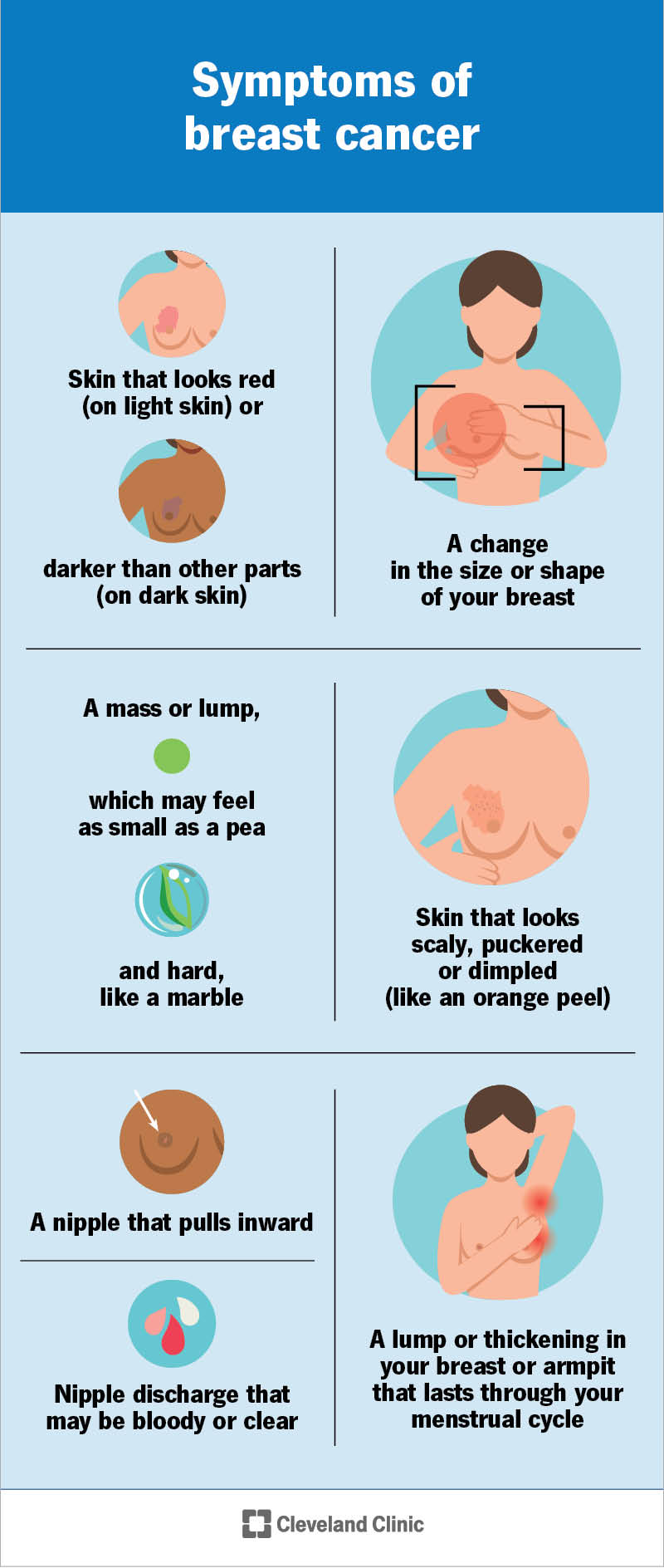
Image content: This image is available to view online.
View image online (https://my.clevelandclinic.org/-/scassets/images/org/health/articles/3986-breast-cancer-infographic)
Many people worry that finding a breast lump means cancer. But breast lumps are also signs of noncancerous breast conditions. Sometimes, the only sign of breast cancer is a suspicious finding on a screening mammogram. This is why routine mammograms are extremely important for all women.
Breast cancer symptoms may include:
There isn’t just one sign or symptom of breast cancer. This is why it’s important to see a healthcare provider if you notice a change in the look or feel of your breast or nipple.
Breast cancer happens when the genes inside breast cells change (mutate). The mutation causes the cells to grow out of control and form tumors. Medical experts aren’t sure what triggers the change. The cause is likely a mix of the genes you’re born with and factors in your environment.
Many factors may increase your chances of developing breast cancer. They include:
Advertisement
Healthcare providers use the following tests to diagnose breast cancer:
It’s important to know that a breast biopsy doesn’t make the cancer spread and is absolutely needed to make the diagnosis.
Cancer staging systems help healthcare providers plan treatment and learn your prognosis, or what you can expect after treatment. The most well-known one is called the TNM system. It considers tumor size and location, and whether cancer has spread to lymph nodes or other sites. Providers use this information to stage breast cancer from 0 to IV. Higher numbers mean more advanced disease.
The TNM stages are:
Advertisement
Providers also consider cell features to help them identify the:
These features may lead your provider to upstage (increase the cancer stage) or downstage the cancer. For example, a Stage II tumor may be downstaged to Stage I if it’s ER+. This is because ER+ breast cancers often have a better prognosis than Stage II cancers without estrogen receptors.
The stage is one of the most important pieces of information about a breast cancer diagnosis. But it involves a lot of factors that are unique to you. And it can be a lot to process. This is why it’s important to ask your healthcare provider to explain what the cancer stage means for your experience.
Surgery is the primary breast cancer treatment. The goal is to remove the entire tumor so that no cancer cells remain. Breast cancer surgeries include:
Advertisement
Providers may combine surgery with one or more of the following treatments:
Providers tailor treatment to your needs. For example, they consider factors like the cancer type, its stage, and whether you’re getting treatment for the first time or the cancer has come back after treatment (breast cancer recurrence).
See a provider if you have a breast change that doesn’t go away after a few days. Most lumps and bumps in your breast aren’t cancer, but they can be. You’ll need a provider to examine you or run tests to know for sure.
Breast cancer survival rates vary based on lots of factors, but most people survive this cancer. According to data that tracked cancer survival from 2016 to 2024 in the U.S., about 92% of women with breast cancer were alive five years after their diagnosis. But the survival numbers vary based on how advanced the disease is:
As you think about survival rates, remember that they’re only estimates based on other people’s experiences. If you have questions about your life expectancy, ask your healthcare provider. They’re your best resource because they know your situation.
Learning you have breast cancer can feel jarring and scary. But if you’re diagnosed, it may help to know that the odds are in your favor. Right now, more women are being diagnosed with early-stage breast cancer. This means they’re diagnosed when it’s easier to treat. Fewer people are dying of this disease.
Still, one of the best things you can do is to learn as much as you can about your diagnosis. Don’t hesitate to ask your healthcare provider questions. They can help you understand what you’re dealing with.
You may not be able to prevent breast cancer. But there are things you can do to reduce your breast cancer risk. This includes doing regular breast self-exams so that you can easily detect a change. You should do these exams no matter your sex. Women of average risk should start getting routine mammograms once they turn 40.
Talk to your healthcare provider if you’re concerned about your chances of developing breast cancer. They can walk you through breast cancer risk assessments that help predict how likely it is that you’ll develop this disease. If you’re high risk, they may advise you to:
There isn’t just one way that breast cancer looks or feels. This is why it’s so important to see a healthcare provider if you find changes in your breasts. It’s also important to get routine mammograms on a schedule based on your risk. Cancer screenings help women with this disease get treatment early, when it may be curable.
Nearly 4 million women in the U.S. are breast cancer survivors. So, if you’re diagnosed, know that you are not alone. You can count on your healthcare team to recommend the best treatments tailored to you. And here’s something else: If you have breast cancer, you can count on your team to be there for you, from diagnosis onward.



Sign up for our Health Essentials emails for expert guidance on nutrition, fitness, sleep, skin care and more.
Learn more about the Health Library and our editorial process.
Cleveland Clinic’s health articles are based on evidence-backed information and review by medical professionals to ensure accuracy, reliability and up-to-date clinical standards.
Cleveland Clinic’s health articles are based on evidence-backed information and review by medical professionals to ensure accuracy, reliability and up-to-date clinical standards.
A breast cancer diagnosis can turn your world upside down. At Cleveland Clinic, we offer expertise, compassion and personalized treatment plans.
