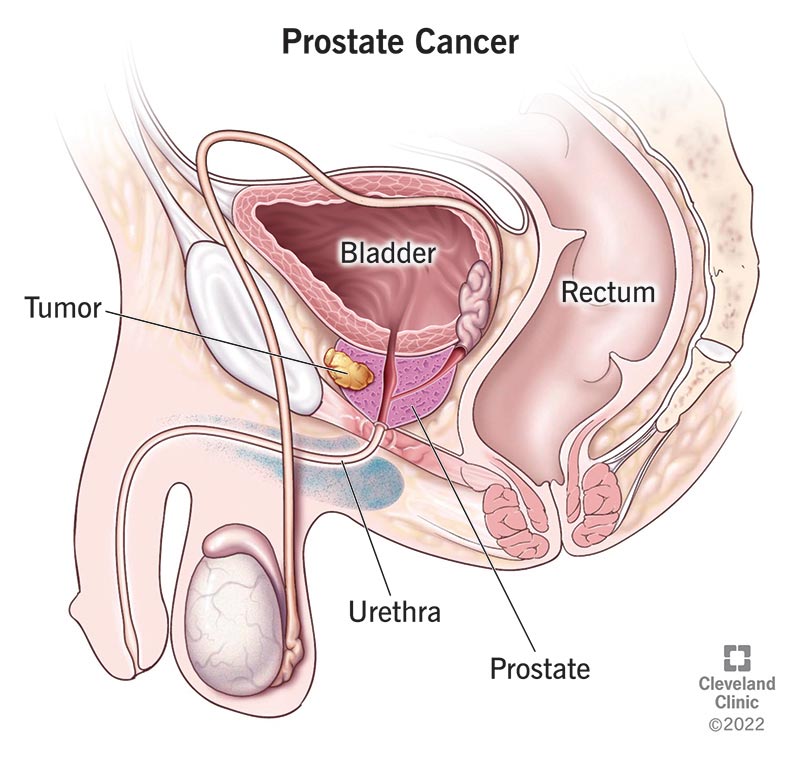
Taussig Cancer Institute's GU Medical Oncology Program has ongoing multidisciplinary clinics with colleagues from the Glickman Urologic and Kidney Institute and the GU section of the Department of Radiation Oncology. Urologic oncologists, pediatric urologists, medical and radiation oncologists, radiologists, and genitourinary pathologists at the Clinic collaborate to provide services for more than 1,000 adrenal, renal (kidney), bladder, prostate and testicular cancer and Wilms’ tumor patients annually. More than 350 surgical procedures for urologic cancer are performed each year. What is the prostate gland? The prostate gland is part of the male reproductive system. It is located between the bladder and the rectum, deep in the pelvis. Women do not have a prostate gland. In men, the urethra (the tubular structure through which we urinate) passes through the prostate gland as it carries urine from the bladder toward the penis. The prostate gland contributes to reproduction by producing some of the fluid in semen, the substance that is emitted from the penis during ejaculation. The purpose of this fluid is to provide nutrition and protection for the sperm and to facilitate movement of the sperm within the vagina after sexual intercourse. The prostate gland is not known to serve any other function besides its role in reproduction. It should be noted that the word “prostate” (pronounced PROS-tate) has only one “r”. It is often mispronounced as “pros-trate”. What is prostate cancer? Prostate cancer is the most common cancer in men and the second leading cause of cancer death among men in the United States. Prostate cancer is a disease in which a malignant tumor (an abnormal and uncontrolled growth of cells with the potential to spread around the body) arises in the prostate gland. The ability of prostate cancer to travel around the body and grow in other organs makes cancers dangerous because they can disrupt the function of other organs. When prostate cancers spread, they often go to bones, where they may weaken the bones and predispose them to breaking. In addition, men whose prostate cancer has spread around the body often lose weight and become tired as a result of the cancer’s impact on the functioning of the body. The process of cancers spreading is referred to as metastasis. When cancer cells travel and grow to form a tumor in a new location, these tumors are referred to as metastases. The first goal of treating prostate cancer is to prevent it from spreading (metastasizing) to other parts of the body. However, it is not always possible to achieve this goal. While the potential of prostate cancer to spread is frightening, most prostate cancers do not spread. For every 1,000 men diagnosed with prostate cancer, only two will die as a result of the disease within the subsequent five years. No other cancer except non-melanoma skin cancer has such a high survival rate. On the other hand, as men get beyond the first five years after diagnosis, the risk of dying of prostate cancer rises. Indeed, prostate cancer is such a common cancer, it ends up killing about 30,000 men each year even though the vast majority of men with prostate cancer die of other causes. One very unusual aspect of prostate cancer is the fact that most men will develop prostate cancer by the time they reach age 75 but most of them will never know they have the disease, will never be treated for it and will never appear to suffer from prostate cancer. Thus, it appears that several different conditions are all lumped together and referred to as “prostate cancer,” or that there are several different kinds of prostate cancer. Some prostate cancers are very aggressive and deadly, while most pose little or no risk to a man’s health. Unfortunately, we are unable to predict very accurately which prostate cancers are likely to need treatment and which can be safely left untreated. For men who are diagnosed with prostate cancer, the key question is whether or not they need treatment. The difficulty predicting whether or not a man’s prostate cancer is destined to spread can make decisions about treatment very challenging. On-going research aims to develop ways to predict the behavior of prostate cancer so that we can better determine which cancers need treatment and which can safely be left alone. In the meantime, some experts worry that we are diagnosing and treating many men who do not require treatment. Because the treatments for prostate cancer can result in unpleasant side effects, unnecessary treatment can lead to a lower quality of life. On the other hand, prostate cancer kills more men than any other cancer except lung cancer, so failing to treat a dangerous prostate cancer may result in the man dying of cancer when he could have been cured with surgery or radiation. At this point, doctors and patients must make treatment decisions without being sure whether or not treatment is necessary. When people talk about prostate cancer, they almost always mean a type of cancer called adenocarcinoma. Almost all prostate cancers are adenocarcinomas, but there are other kinds of cancer that sometimes originate in the prostate, including small cell carcinoma, transitional cell carcinoma, and certain types of sarcoma. This discussion about prostate cancer is about adenocarcinoma and does not necessarily apply to other types of prostate cancer. Prostate Cancer Causes It is not known exactly what causes prostate cancer, but there is strong evidence that testosterone, the primary male sex hormone, plays an important role. Men with higher testosterone levels appear to be at higher risk of developing prostate cancer. Evidence also exists that eating animal fat increases the risk of being diagnosed with prostate cancer. Eating a diet low in red meat and other sources of animal fat may lower the risk of prostate cancer but this has not been proven. Men who are obese also appear to have an increased risk of developing and dying from prostate cancer, but it is not clear why. Genetic factors contribute to the development of prostate cancer and men with brothers, fathers, and/or sons with prostate cancer have an increased risk of being diagnosed with the disease themselves. Who is at risk for prostate cancer? Research has identified several risk factors for prostate cancer. The clearest risk factors are African ancestry and a family history of prostate cancer. In the United States, black men are 60 percent more likely to be diagnosed with prostate cancer and more than twice as likely to die from the disease. About one in five black men will be diagnosed with prostate cancer and one in 20 will die from the disease.
In other words, about 5 percent of black men die of prostate cancer compared to less than 3 percent of white men. Similarly, a man with a brother or father with prostate cancer is twice as likely to be diagnosed with prostate cancer as a man with no close family history of the disease. The more close blood relative with prostate cancer, the higher a man’s risk. This is particularly true if the relatives were diagnosed with prostate cancer before the age of 60. These are the currently known or suspected risk factors for prostate cancer: Known Prostate Risk Factors - Blood relatives with prostate cancer (particularly a father or brother)
- African ancestry (African Americans and black Americans)
Suspected Prostate Risk Factors - Diet high in animal fat, particularly from red meat and dairy products
- Obesity
- High levels of testosterone in the blood
What are the symptoms of prostate cancer? Prostate cancer does not usually result in symptoms unless it behaves aggressively and spreads around the body. When prostate cancer is still limited to the prostate itself and is thus still potentially curable, it only rarely results in symptoms. Therefore, symptoms are not a reliable way to tell whether or not a man might have prostate cancer. Nonetheless, the following is a list of prostate cancer symptoms that sometimes result from prostate cancer. It is important to remember that most men with these symptoms do NOT have prostate cancer. In other words, the symptoms below can be caused by prostate cancer but are usually caused by something else. In particular, the symptoms of frequent urination, difficulty emptying the bladder, slow urine stream and difficulty postponing urination are common symptoms among men over the age of 60 and they usually result from a benign enlargement of the prostate and not from a cancer. - Frequent urination with small amounts of urine coming out each episode
- Difficulty emptying the bladder
- Slow urine stream
- Difficulty delaying urination; in other words, the need to urinate is usually very urgent and comes on suddenly
- Blood in the semen or urine
- Pain in the pelvis
- Back pain or bone pain
- Unexplained weight loss
How is prostate cancer diagnosed? Most prostate cancers in the United States are diagnosed in men with no symptoms of prostate cancer. The diagnosis is usually made as a result of a blood test called PSA, which stands for prostate specific antigen. The PSA test is a way to look for prostate cancer before the cancer is big enough to cause symptoms. The goal is to identify cancers as early as possible, before they can spread around the body. The blood test does not tell you whether or not you have prostate cancer but it can indicate what your risk of having prostate cancer is. Men with a high PSA level are considered to be at high risk of having prostate cancer and they are usually referred to a urologist for a biopsy of the prostate. Some prostate cancers are discovered as a result of a digital rectal examination, another test that aims to identify early prostate cancers in men without symptoms. The digital rectal examination, or DRE, consists of a health-care provider inserting a gloved finger into the rectum so that the provider can feel the surface of the prostate. If the prostate feels hard or has lumps, that can be a sign of cancer and a biopsy is typically recommended. (The word “digital” here refers to the doctor’s finger. The Latin word for finger is digitus.) As described in greater detail below, a biopsy is a procedure where tiny pieces of tissue are removed from the prostate and examined under a microscope. If the doctor looking at the tissue under the microscope (this kind of doctor is called a pathologist) sees cancer, then a diagnosis of cancer is made. In addition to deciding whether or not cancer is present, the pathologist also determines what type of cancer it is. While most cancers in the prostate are prostate cancer, in rare cases, a cancer from another organ in the body may have traveled to the prostate and started to grow there. In addition to confirming whether or not prostate cancer is present, the pathologist will describe how aggressive the cancer appears to be and will give the cancer a score ranging from 2 to 10, where 10 is the most aggressive. This score is referred to as the Gleason Score or Gleason Sum. Almost all diagnosed prostate cancers have a score between 5 and 10. Other men may have prostate cancer discovered unexpectedly if they undergo a surgical procedure to remove part of the prostate. This type of procedure is performed if the prostate grows too big and compresses the urethra. The problem in this situation is that the prostate can block the flow of urine and make it very difficult to empty the bladder. This condition is referred to as benign prostatic hyperplasia, or BPH. The procedure to treat BPH involves removing pieces of prostate tissue in order to allow the urethra to open so that urine can pass through it. The pieces of tissue that are removed are examined under the microscope, and sometimes cancer is seen. Cancers discovered in this way have a particularly favorable prognosis in most cases. While most prostate cancers are discovered as a result of blood tests or a rectal examination in men who have no symptoms of prostate cancer, there are some men whose cancers are only discovered as a result of symptoms of the disease. When evaluating a man suspected of having prostate cancer, a doctor will perform an examination and order tests to help determine whether a cancer is present. Tests may include: Physical examination – The first step in evaluating a man suspected of having prostate cancer is to examine the prostate by performing a digital rectal examination. This allows the doctor to feel whether the prostate is hardened and whether or not there are lumps on the surface. Blood tests – The blood is tested for prostate specific antigen, also known as PSA. If the PSA level is high, that can be a sign that prostate cancer is present. The PSA test is used to estimate how likely it is that a man has prostate cancer. Ultrasound – This is a test that uses high-frequency sound waves that are transmitted through body tissues. The sound waves bounce off the tissue and return to the ultrasound probe and these returning sound waves (referred to as echoes) vary according to the type of tissue that the sound waves strike. The echoes are recorded and translated into video or photographic images that are displayed on a monitor. Ultrasound machines are not very useful for detecting prostate cancer. Rather, they are used to show the doctor exactly where the prostate is located so that when a biopsy is performed, the doctor can be sure that the biopsy needle is going into the correct location. Biopsy – A biopsy is how the actual diagnosis of prostate cancer is made. The biopsy involves inserting a small medical instrument called an ultrasound probe into the rectum so that the doctor can see the prostate on an ultrasound machine (see preceding description of ultrasound). Six to 12 tiny pieces of tissue are then taken from the prostate by passing a needle through the wall of the rectum into the prostate. These pieces of tissue are then sent to a laboratory to be examined under a microscope. If prostate cancer is seen under the microscope, then the man has prostate cancer. Computed tomography (CT or CAT) scan – This is a special X-ray that uses a computer to create a series of images, or pictures, of the inside of the body. CT scans are not usually ordered in men with prostate cancer unless the cancer has already spread or if there is a high risk that the cancer may have spread or if the scans are needed to help plan treatment. Bone scan – A bone scan is a test in which a small amount of radioactive material is injected into the bloodstream. The injected material is formulated so that it goes to the bone. The material accumulates in areas of diseased or injured bone, such as at sites of fractures, infection and tumors. A sensor scans the person being tested after the radioactive material is injected and measures the amount of radioactivity in the bones. Because the injected material accumulates at sites where there is cancer in the bone, more radioactivity is present at these spots and the sensor detects these “hot spots”. A bone scan thus allows the doctor to look for cancer growing in any of the bones in the body. Bone scans should only be ordered if the patient is known to have cancer that has spread outside the prostate, if the patient has a cancer with a high risk of having spread, or if the patient is having bone pain or other evidence of cancer in the bones. If a prostate cancer is found If a prostate cancer is found, the doctor needs to know the stage of the cancer. In other words, he or she needs to know how far the cancer has spread and how much it has grown. Fortunately, most prostate cancers have not spread at the time they are diagnosed and the cancer is confined within the prostate gland. In order to predict how likely it is that a man’s prostate cancer may have spread, the health-care provider usually looks at some combination of the following variables: how high the PSA was before the biopsy (the biopsy itself irritates the prostate so the PSA will be artificially elevated for a month or longer after the biopsy), what the prostate felt like on digital rectal examination before the biopsy, what the Gleason Score of the cancer is, and how much cancer was found by the biopsy. In addition to considering how high the PSA is, some doctors also consider whether or not the PSA was rising over time and, if so, how quickly. Any of the following factors indicates a higher risk that the cancer has already spread: a high PSA, a high Gleason Score, or a cancer that can be felt to have grown outside the prostate on the digital rectal examination. In addition, men whose biopsies show a larger amount of cancer have a higher risk of having their cancers spread. Most men have a very low risk of the cancer having spread and for these men, staging studies such as bone scans and CT scans are not recommended unless the CT scan is needed to assist with treatment planning. On the other hand, men with higher-risk disease who have an intermediate or high risk of having cancer detected on these tests are usually advised to undergo a bone scan and a CT scan of the abdomen and pelvis in order to determine whether metastases can be seen. Unfortunately, even if the tests are normal, that is not a guarantee that the cancer has not spread. Sometimes metastases are too small to be found but grow larger later on. Staging prostate cancer In staging prostate cancer, the major distinction is between cancers that have spread versus those limited to the prostate. This distinguishes cancers that are likely to be curable from those that are most often incurable. There are, however, four stages of prostate cancer and these are subdivided further. Stage I – Low-grade cancer is discovered unexpectedly as a result of a surgical procedure on the prostate. The cancer must constitute less than 5 percent of the tissue examined. Stage II – Cancer is confined within the prostate and does not meet the criteria of stage I. Stage III – The cancer extends outside the prostate into adjacent tissue or into the seminal vesicles but not into other organs. Stage IV – Any of the following qualifies as stage IV: - invasion of the cancer from the prostate into adjacent organs such as the rectum, the bladder or the pelvic muscles
- spread of the cancer to lymph nodes in the pelvis
- spread of the cancer to distant sites in the body
In general, stages I, II and III are treated as potentially curable cancers, although the likelihood of cure is greater for stage I than for stage II and is greater for stage II than for stage III. In other words, the higher the stage, the less likely it is that the man will be cured of prostate cancer. Stage IV cancers are almost never cured if the cancer has spread to the bones or other distant sites, but stage IV patients whose cancer has spread only to lymph nodes in the pelvis can in some instances be cured with aggressive treatment, although the success rate is low. How is prostate cancer treated? The treatment for prostate cancer depends on the stage of the cancer. Treatment decisions (particularly for stage II cancers) are also influenced by the PSA level, the Gleason Score, and the amount of cancer that was found by biopsy. There is controversy about what represents the best treatment for early stage prostate cancer and even whether or not many of these cancers need to be treated. Treatments for prostate cancer include: Observation – Although observation is not a treatment for prostate cancer, some prostate cancers do not require treatment. For men with low-risk cancers, observation may be recommended as one option for management. Radiation therapy – Radiation therapy is a treatment for prostate cancer that uses radiation to kill cancer cells and it can be administered in one of two ways. One approach uses radiation that is generated by a machine outside the body and is then directed through the skin into the pelvis toward the prostate. This is called external beam radiation. Alternatively, radioactive seeds can be implanted into the prostate. This treatment for prostate cancer is called brachytherapy. In addition to being used to try to cure prostate cancers that are confined to the prostate or pelvis, radiation therapy is also sometimes used to reduce pain from prostate cancer that has spread to the bones or other areas. Radiation is also often used in those rare cases when prostate cancer has spread to the brain because chemotherapy is not very effective in treating tumors in the brain. Like surgery, radiation therapy to the prostate can result in erectile dysfunction and urinary incontinence. Radiation as a treatment for prostate cancer, can also cause bleeding from the rectum and frequent or painful bowel movements. Hormonal therapy – Hormonal therapy comes in several different forms, but in general, the purpose of hormonal therapy is to prevent testosterone (the male sex hormone) from stimulating the cancer to grow. The oldest version of hormonal therapy involves lowering the amount of testosterone in the blood either by surgically removing the testicles or by administering medications that shut down the production of testosterone. Other forms of hormonal therapy interfere with the ability of testosterone to stimulate cancer growth. Chemotherapy - Chemotherapy uses drugs to kill cancer cells. Chemotherapy for prostate cancer is administered to the body directly into the bloodstream through a small, soft tube called an intravenous (or IV) line or catheter, which is inserted into a vein. Chemotherapy is called a systemic treatment because the drug enters the bloodstream, travels through the body, and can kill cancer cells wherever they may be (except the brain). Chemotherapy does not cure prostate cancer, but it can bring the disease under control for a period of time. Laparoscopic Radical Prostatectomy - This minimally invasive procedure, pioneered at the Cleveland Clinic, removes the prostate gland and typically allows qualifying prostate cancer patients. Unlike a conventional prostatectomy, laparoscopic surgery requires only five button-hole incisions. Through these incisions, a surgeon uses a laparoscope—a tiny camera—and surgical instruments to conduct the operation and remove the prostate. Robotic Radical Prostatectomy - In addition to the traditional laparoscopic prostatectomy, Glickman Urological Institute surgeons also perform robotic laparoscopic prostatectomy. During the procedure, surgeons use a robotic arm to guide the laparoscope through a small incision to remove the cancerous prostate and affected tissue. Various robotic systems are available, which may consist of a 3-armed robot connected to a remote console. The surgeon operates the system while seated at the console. Foot pedals are used for control, and 3-dimensional displays provide a unique depiction of the surgical field. Since the robotic approach produces results that are similar to traditional laparoscopic prostatectomy, surgeons determine which approach they will use. However, the robotic approach has a short learning curve, which makes it easier for surgeons to master. Open Radical Prostatectomy - A surgical treatment for prostate cancer, the radical retropubic prostatectomy procedure removes the entire prostate with an incision in the lower abdomen. Since the prostate wraps around the urethra, once it is removed the surgeon must reconnect the bladder with the urethra. Interstitial Brachytherapy (Seed Implantation) - Interstitial Brachytherapy is another form of radiation therapy. A radiation oncologist and urologist implant radioactive pellets or "seeds" into the prostate, and the pellets radiate the prostate and surrounding tissue over time. The Cleveland Clinic has pioneered the intensity-modulated radiotherapy (IMRT), which has shortened the duration of treatment by several weeks. Cryotherapy - Four to eight small needle-shaped probes can be inserted into the prostate in order to freeze the gland to temperatures lethal to a prostate cancer. This minimally invasive, incision-free procedure is performed either as an outpatient or one-night hospital admission. Temperature monitoring probes allow Cleveland Clinic urologists to cure prostate cancer with minimal trauma and without radiation. Patients recover in a matter of days and usually experience minimal after effects. The different types of treatment apply to the different stages and types of prostate cancer as follows: Stage I Observation, OR Surgery (removal of the prostate), OR Radiation therapy Stage II Observation, OR Surgery, OR Radiation therapy Stage III Radiation therapy with or without hormonal therapy, OR Surgery in select cases only Stage IV Hormonal therapy, OR Radiation therapy with hormonal therapy in select cases only
Clinical trials – A clinical trial is a research program conducted with patients to evaluate a new medical treatment plan, drug or device. There are many clinical trials for prostate cancer because it is a common disease that kills many men. Clinical trials of new treatments for prostate cancer are ongoing for men with all different stages of the disease except that there are few trials for men with stage I disease because such men rarely require treatment. What is the prognosis for people with prostate cancer? The prognosis for most people with prostate cancer is outstanding. For every 1,000 men diagnosed with prostate cancer, only two on average die of the disease within five years of their diagnosis. However, the prognosis gets worse as the cancer spreads. Men with stage I disease thus have a much better prognosis than men with stage III disease, and most men with stage IV disease die from it. Can prostate cancer be prevented? Prostate cancer cannot generally be prevented. It is believed that men may be able to reduce their risk of prostate cancer by eating a diet that includes (1) a lot of vegetables and (2) very little red meat or other sources of animal fat. Vegetables that may help lower cancer risk include cooked tomatoes (as in tomato sauce) and cruciferous vegetables (such as broccoli, cauliflower, cabbage, kale and Brussels sprouts). However, it has not been proven that men can alter their cancer risk by altering their diet. Research studies are trying to determine whether certain medications, vitamins or minerals can reduce the risk of prostate cancer, but the results of these studies are not yet available. The different types of treatment apply to the different stages and types of prostate cancer as follows: - Stage I Observation, OR
Surgery (removal of the prostate), OR Radiation therapy - Stage II Observation, OR
Surgery, OR Radiation therapy - Stage III Radiation therapy with or without hormonal therapy, OR
Surgery in select cases only - Stage IV Hormonal therapy, OR
Radiation therapy with hormonal therapy in select cases only
Clinical trials – A clinical trial is a research program conducted with patients to evaluate a new medical treatment plan, drug or device. There are many clinical trials for prostate cancer because it is a common disease that kills many men. Clinical trials of new treatments for prostate cancer are ongoing for men with all different stages of the disease except that there are few trials for men with stage I disease because such men rarely require treatment. What is the prognosis for people with prostate cancer? The prognosis for most people with prostate cancer is outstanding. For every 1,000 men diagnosed with prostate cancer, only two on average die of the disease within five years of their diagnosis. However, the prognosis gets worse as the cancer spreads. Men with stage I disease thus have a much better prognosis than men with stage III disease, and most men with stage IV disease die from it. Can prostate cancer be prevented? Prostate cancer cannot generally be prevented. It is believed that men may be able to reduce their risk of prostate cancer by eating a diet that includes (1) a lot of vegetables and (2) very little red meat or other sources of animal fat. Vegetables that may help lower cancer risk include cooked tomatoes (as in tomato sauce) and cruciferous vegetables (such as broccoli, cauliflower, cabbage, kale and Brussels sprouts). However, it has not been proven that men can alter their cancer risk by altering their diet. Research studies are trying to determine whether certain medications, vitamins or minerals can reduce the risk of prostate cancer, but the results of these studies are not yet available. |