



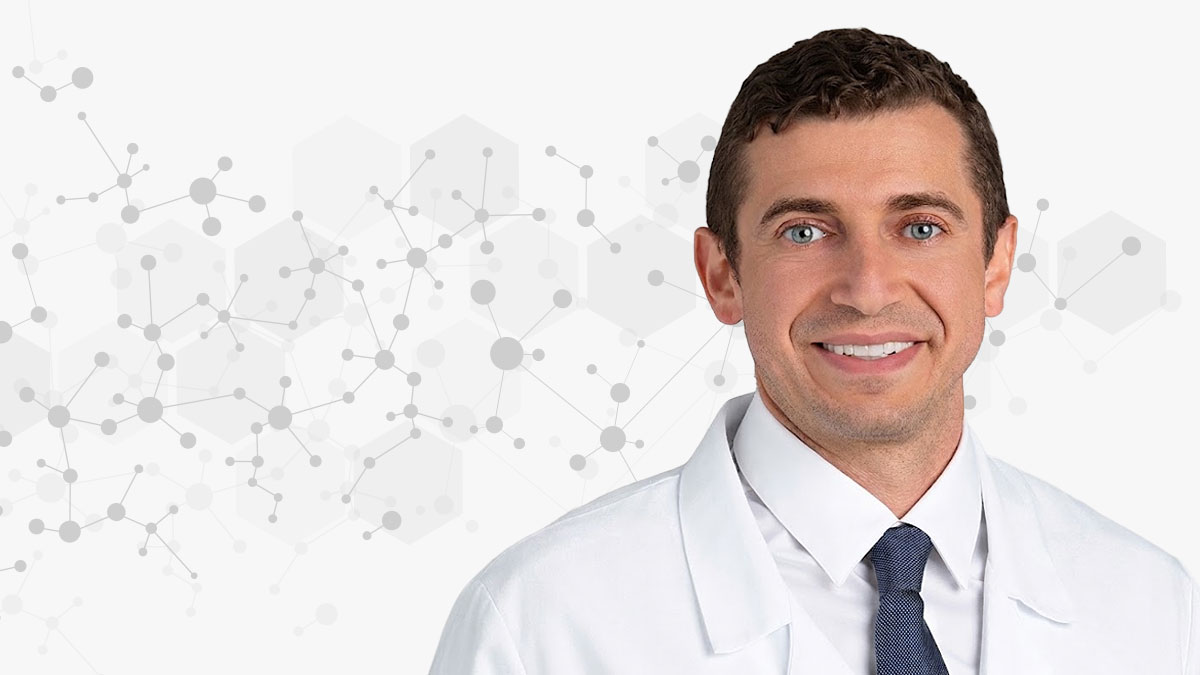
Endoscopic Spine Surgery
Osama Kashlan, MD, explores endoscopic spine surgery, highlighting how this minimally invasive approach enhances visualization, expands surgical access, and offers effective treatment options for a range of spinal pathologies.
Advertisement
Cleveland Clinic is a non-profit academic medical center. Advertising on our site helps support our mission. We do not endorse non-Cleveland Clinic products or services. Policy
Recent Episodes
Advancing Recovery Through Early Mobilization in Neuro Care
Adam Barron, MD, and Natalie Lilly, PT, DPT, explore the evolving evidence behind early mobilization in neurocritical care.
Learnings of having Embedded Psychiatrists in Neurological Clinics
Drew Cumming, MD, reviews the impact of embedded psychiatry in neurology and the benefits of integrating behavioral health expertise into th…
Behavioral Health Protocols for Suicidal Ideation
Brianne Markley, PhD, explains how screening tools, risk assessment and safety planning can help clinicians recognize and respond to suicida…
Video content: This video is available to watch online.
View video online (https://cdnapisec.kaltura.com/p/2207941/sp/220794100/playManifest/entryId/1_muh4lds0/flavorId/1_5f3sgelj/format/url/protocol/https/a.mp4)
Transcript
Neuro Pathways Podcast Series
Release Date: June 1, 2026
Expiration Date: May 31, 2027
Advertisement
Cleveland Clinic is a non-profit academic medical center. Advertising on our site helps support our mission. We do not endorse non-Cleveland Clinic products or services. Policy
Estimated Time of Completion: 30 minutes
Endoscopic Spine Surgery
Osama Kashlan, MD
Description
Each podcast in the Neurological Institute series provides a brief, review of management strategies related to the topic.
Learning Objectives
- Review up to date and clinically pertinent topics related to neurological disease
- Discuss advances in the field of neurological diseases
- Describe options for the treatment and care of various neurological disease
Target Audience
Physicians and Advanced Practice providers in Family Practice, Internal Medicine & Subspecialties, Neurology, Nursing, Pediatrics, Psychology/Psychiatry, Radiology as well as Professors, Researchers, and Students.
ACCREDITATION
In support of improving patient care, Cleveland Clinic Center for Continuing Education is jointly accredited by the Accreditation Council for Continuing Medical Education (ACCME), the Accreditation Council for Pharmacy Education (ACPE), and the American Nurses Credentialing Center (ANCC), to provide continuing education for the healthcare team.
CREDIT DESIGNATION
- American Medical Association (AMA)
Cleveland Clinic Center for Continuing Education designates this enduring material for a maximum of 0.50 AMA PRA Category 1 Credits™. Physicians should claim only the credit commensurate with the extent of their participation in the activity.
Participants claiming CME credit from this activity may submit the credit hours to the American Osteopathic Association for Category 2 credit. - American Nurses Credentialing Center (ANCC)
Cleveland Clinic Center for Continuing Education designates this enduring material for a maximum of 0.50 ANCC contact hours. - Certificate of Participation
A certificate of participation will be provided to other health care professionals for requesting credits in accordance with their professional boards and/or associations. - American Board of Surgery (ABS)
Successful completion of this CME activity enables the learner to earn credit toward the CME requirements of the American Board of Surgery’s Continuous Certification program. It is the CME activity provider's responsibility to submit learner completion information to ACCME for the purpose of granting ABS credit.
Credit will be reported within 30 days of claiming credit.
Advertisement
Podcast Series Director
Andreas Alexopoulos, MD, MPH
Epilepsy Center
Additional Planner/Reviewer
Ari Newman, BSN
Faculty
Osama Kashlan, MD, MPH
Center for Spine and Pain Medicine
Host
Glen Stevens, DO, PhD
Cleveland Clinic Brain Tumor and Neuro-Oncology Center
Agenda
Endoscopic Spine Surgery
Osama Kashlan, MD, MPH
Disclosures
In accordance with the Standards for Integrity and Independence issued by the Accreditation Council for Continuing Medical Education (ACCME), The Cleveland Clinic Center for Continuing Education mitigates all relevant conflicts of interest to ensure CME activities are free of commercial bias.
The following faculty have indicated that they may have a relationship, which in the context of their presentation(s), could be perceived as a potential conflict of interest:
Glen Stevens, DO, PhD
| Company | Relationship |
|---|---|
| Dyna Med | Consulting |
| Company | |
| Dyna Med | |
| Relationship | |
| Consulting |
Osama Kashlan, MD, MPH
| Company | Relationship |
|---|---|
| Joimax | Teaching and Speaking |
| Arthrex | Teaching and Speaking |
| Company | |
| Joimax | |
| Relationship | |
| Teaching and Speaking | |
| Arthrex | |
| Relationship | |
| Teaching and Speaking |
All other individuals have indicated no relationship which, in the context of their involvement, could be perceived as a potential conflict of interest.
CME Disclaimer
The information in this educational activity is provided for general medical education purposes only and is not meant to substitute for the independent medical judgment of a physician relative to diagnostic and treatment options of a specific patient's medical condition. The viewpoints expressed in this CME activity are those of the authors/faculty. They do not represent an endorsement by The Cleveland Clinic Foundation. In no event will The Cleveland Clinic Foundation be liable for any decision made or action taken in reliance upon the information provided through this CME activity.
HOW TO OBTAIN AMA PRA Category 1 Credits™, ANCC Contact Hours, OR CERTIFICATE OF PARTICIPATION:
Go to: Neuro Pathways Podcast June 1, 2026 to log into myCME and begin the activity evaluation and print your certificate If you need assistance, contact the CME office at myCME@ccf.org.
Copyright ©2026 The Cleveland Clinic Foundation. All Rights Reserved.
Introduction:
Neuro Pathways, a Cleveland Clinic podcast exploring the latest research discoveries and clinical advances in the fields of neurology, neurosurgery, neurorehab, and psychiatry.
Glen Stevens, DO, PhD:
Endoscopic spine surgery is transforming how surgeons approach spinal pathology, offering less invasive options while preserving surgical precision. In this episode of Neuro Pathways, we explore the role of endoscopic spine surgery, including when it is most appropriate, how it differs from open and minimally invasive techniques, and what the growing evidence tells us about safety and effectiveness.
I'm your host, Glen Stevens, neurologist/neuro-oncologist in Cleveland Clinic's Neurological Institute. And joining me for today's conversation is Dr. Osama Kashlan. Dr. Kashlan is a spine surgeon at the Center for Spine Health in Cleveland Clinic's Neurological Institute. Osama, welcome to Neuro Pathways.
Osama Kashlan, MD:
Thank you so much. Thank you so much for having me.
Glen Stevens, DO, PhD:
So why don't you just first start by telling us a little bit about yourself, a bit about your background and how you made your way here and what you do.
Advertisement
Osama Kashlan, MD:
So again, I appreciate you all having me on this podcast to discuss something that I'm very passionate about. So, I'm a spine surgeon specializing in minimally invasive spine surgery. I did my residency at the University of Michigan and there learned the basics of doing open and traditional minimally invasive spine surgery.
While I was in fellowship at Emory, I was interviewing for jobs. And at one of the places where I was interviewing, one of the faculty there said, "If you come here, I'll get you set up with a friend of mine who does endoscopic spine surgery." And at that point I said, "What is that? What do you mean endoscopic spine surgery?" And that night looked up a video from that person. It's Albert Telfeian, one of the worldwide experts in endoscopic spine surgery. And I was sold. I said, "I have to learn this. This is the future and I want to deliver the best care to my patients."
And I saw that most of those procedures at that time were being done in East Asia and mostly in South Korea. So I went to a conference in Dubai. It was the Asian Congress of Neurosurgeons. Went to cadaver lab there, and that's when I was sold. The proctor at my station was a very prominent Korean surgeon who does endoscopic spine, Harrison Kim. So, I asked him if I could spend six weeks with him after my fellowship, and that's where the journey began.
Advertisement
Spent six weeks with him in South Korea, which was an incredible experience. And then later on, spent six months learning this at the University of Washington with another one of the worldwide experts, Christoph Hofstetter, and then started delivering that service to patients back home in Michigan. And from there, got recruited to Brooklyn at New York Presbyterian Hospital and then back to the Midwest back home to here to the Cleveland Clinic.
Glen Stevens, DO, PhD:
Well, we're happy to have you. Just before we get into this, are you the only one doing endoscopic in the spine group or are there other individuals?
Osama Kashlan, MD:
So, I'm the main person that's doing it here. There are other people that have started the learning process. And like many people say, so it's a steep learning curve, so people are differing levels of the learning curve. And one of my jobs being here is to take up those younger surgeons and bring them up to do those as well. But I think in terms of answering your question, I'm the person that's mainly doing endoscopic spine.
Glen Stevens, DO, PhD:
Yeah, I think one of the things I've really loved about my career here is that there's always been an interest in development of new technologies. And if people can bring some new expertise that will ultimately help our patients, it's good for everybody. So I appreciate the fact that you're here and you've brought some new technology to the area.
Advertisement
Osama Kashlan, MD:
[inaudible 00:03:49].
Glen Stevens, DO, PhD:
So, thank you very much. And I'll just say as an aside, I did look at a number of videos, YouTube videos from you. And if someone wants some more information of this, just go and look at some YouTube videos of presentations you've given. I've actually learned quite a bit more about spine surgery than I've ever wanted to know.
Osama Kashlan, MD:
It's very flattering. Thank you for saying that.
Glen Stevens, DO, PhD:
I appreciate it. So, tell us a little bit about what is endoscopic spine surgery? And how does it differ from traditional open and other minimally invasive spine surgeries?
Osama Kashlan, MD: So minimally invasive spine surgery is really an approach to taking care of spine patients, that's the way I see it. It's not incision size, it's a lot more than that.
So, in terms of traditional open surgery, those are procedures that are done through larger incisions where we're mostly disrupting the connections of the muscle to get to our lesion or our pathology. Traditional minimally invasive surgery makes incision smaller and instead of detaching muscles, it usually just spreads them apart to get to our lesion. But we're still working usually with a tube, whether it's an inch or a little bit bigger, a little bit smaller, and we're using microscopes. Our eyes are far away from our pathology, and that adds some nuances to it as well.
Endoscopic spine surgery is the next step, I would say in that evolution where you're making incisions that are the size of a number two pencil. And because of the use of these cameras, so we use scopes in many things, laparoscope for general surgery. We use endoscopes for GI stuff. I mean, we're doing scopes in many at different areas of the body. This is the same thing. It's a camera that you put through a tiny little incision in the back and it brings your eyes to the level of your pathology and gives you visualization that you're unable to do, whether it's with loops, with our eyes, or with a microscope. So that's really the difference is that you're making the incision much smaller, obviously, and you're bringing your eyes and your instruments right next to where the pathology is.
Glen Stevens, DO, PhD:
Now I'm going to get a little bit out of my lane, so you'll correct me if I make a mistake here. But I want you to talk a little bit about the approaches. I want you to talk about transforaminal, interlaminar, and Kambin's triangle in a way that our audience could understand it.
Osama Kashlan, MD:
Absolutely, yeah. So, I'd say the number one or number two most important aspect of endoscopic spine surgery that separates it from the other procedures is the transforaminal approach. So when you look at traditional spine surgery, whether it's open or whether it's done with the traditional minimally invasive approaches, most of those approaches are coming directly posterior, directly from the back or maybe off to the side a little bit. But most of them are what I would call an endoscopic surgery interlaminar, interlaminar meaning you're coming in right from the back. And that's what we are used to doing as spine surgeons.
The benefit of endoscopy, so these scopes that we were talking about, they have different angles on them. Some of them are 30 degrees, so it allows you to look around corners in a way that you can't do with a microscope or with your loops. And also because of the small size, they're six or seven millimeter scopes, because they're so small, you're able to get into the spinal canal through the foramen. So that's a way that we can't do without doing a scope because again, the angle of the scope and the fact that they're so small. So we're able to get to disc herniations that are in the center of the canal through the foramen, which we cannot do in any other way.
Glen Stevens, DO, PhD:
Are there some foramen that are naturally bigger than others, so some levels you can do and some are more difficult? I'm sure there's a lot of variability with patients themselves.
Osama Kashlan, MD:
One of the things that's important is Kambin's triangle, like you were mentioning earlier. So Kambin's triangle is this, it's more of a prism that's in the foramen that gives us a measure of how large the space is for our endoscope to go through. So in the thoracolumbar spine, there are times that you have foraminal stenosis, overgrowth in the foramen that makes them smaller and makes it harder for us to access lesions through there, but there are ways to offset that, so instead of going ... So the transforaminal approach, we can ream through or drill through that overgrown bone and the superior articulating process of the joint. So drill through some of the joint to get into the canal. So even when you have a foramen that is not amenable historically to transforaminal approach, you're able to do that if the overgrowth is bony or ligamentous.
However, if you have, let's say, conjoined nerve roots. So, there are these anomalies where you have two nerve roots coming out of the same foramen or nerve roots that come out in different ... Instead of coming in the superior aspect of the frame and they come out in the inferior aspect of the foramen. For those patients then, doing a transforaminal approach is probably not best, but that's honestly the only reason I would say you cannot do that approach yet.
Glen Stevens, DO, PhD:
So, I come see you as a patient. "Oh, my back's killing me." I'm having some radicular symptoms or some other type of problem. "I've heard about this and I'm very excited about it." But what type of procedure or what type of problem would I have that you would say, "You're a good candidate for this," or, "You're not a good candidate for this"? Who's a good candidate for this?
Osama Kashlan, MD:
Yeah. So if someone comes to me initially with symptoms, the most important thing is just to note that this percentage of patients who need surgery, even if it is endoscopic, is very small. Most of the time with physical therapy and with other non-surgical measures, people can feel better without the need for surgery, because at the end of the day, endoscopic spine surgery, it's much less invasive, but it's still surgery and it still has risk.
In terms of pathology that could be treated with endoscopy, really, it's any pathology that's causing compression on the nerve roots, whether it's a disc herniation, whether it's ligamentous hypertrophy, whether it's bony hypertrophy causing central stenosis, lateral recess stenosis, foraminal stenosis. All of those pathologies can be treated with the endoscope. What is holding endoscopy back now from being treated for everything is the fact that not all of us are trained in it. And the technology, sometimes the surgeries do take a little bit longer. So if you have, let's say, three or four sources of compression, sometimes it's just better for the patient to have a non-endoscopic procedure because it just gets them on and off the table faster.
Glen Stevens, DO, PhD:
Can you do fusions?
Osama Kashlan, MD:
So you can do fusions with the endoscope. As of now, in my opinion, the delta, meaning the difference between what we're currently doing now with the traditional minimally invasive fusions and an endoscopic fusion is not so high that it's one of my number one things that I would offer to my patients. But there are other pathologies where the delta is super high and that's why I would learn endoscopy if I was a spine surgeon.
Glen Stevens, DO, PhD:
So typically, I come to see you as a patient and my BMI is 50. And I'm having a problem with a nerve root and you look at my BMI and you're probably not so excited about doing a big open surgery on me. Is endoscopy a better option if I have a high BMI or not necessarily?
Osama Kashlan, MD:
So I would say when you have someone with high BMI, you always want to try to counsel them to lose weight to the limits of what they can. I mean, we all know it's much easier said than done, and we know that it's a cycle. You're laid up because your back hurts, then you gain more weight.
Glen Stevens, DO, PhD:
I forgot to tell you, I'm also a smoker.
Osama Kashlan, MD:
Perfect, smoking. Yeah, so both those. Yeah, so we try to get ... Regardless of what type of surgery you're planning, you want to try to get people to make themselves the best surgical candidates. However, let's say that someone optimized themselves and they are smokers or they are, especially the large BMI. One of the biggest benefits of endoscopy is that, again, because our eyes are at the level of the pathology, once I gain access to wherever I need to be, I don't really care if the patient has a BMI of 15 or 60. So a lot of times that is what the tie breaker is for me between doing something traditionally minimally invasive versus endoscopic, is the patient's BMI.
Glen Stevens, DO, PhD:
Can you only go posteriorly with an endoscope or can you ... I guess you could sort of go far, maybe somewhat laterally, but can you go anteriorly?
Osama Kashlan, MD:
Some people are doing that now. So I think that's in its infancy. And the reason why I think there will be a lot of skeptics about going anterior or lateral, even though there are some surgeons that are doing it, definitely, like you said, is because, again, going back to what I was saying earlier, minimally invasive is an approach, not incision size. So, when I'm coming anteriorly or laterally, even doing it open, we are spreading muscle, we are dissecting tissue planes in a way that respects our natural bodies. So we're already doing things minimally invasively when we're going anteriorly or laterally, even if you make a big incision.
So then using endoscopy there might be helpful. I think more evidence needs to be sorted through. But that's the reason why I think we're already kind of doing things minimally invasive, maybe larger incisions. So I'm not sure that's going to be a big tie breaker or a big delta between what we're doing now and doing it with the endoscope.
Glen Stevens, DO, PhD:
Do we ever combine endoscopy with open non-endoscopy?
Osama Kashlan, MD:
Yes, absolutely. So let's say if someone has two or three pathologies that are a source of symptoms and maybe two of them are more amenable to open procedures or more amenable to traditionally minimally invasive, but one of them is something that can only be done with endoscopy. Those are things that you can definitely combine together and they combine very well.
Glen Stevens, DO, PhD:
Can you do multi-level?
Osama Kashlan, MD:
Yes. So, what's holding us back now from doing five or six or seven levels with the endoscope is honestly the time. So the technology, as it continues to improve, which it will, it's going to make it where we're able to do five or six or seven levels of disease with the endoscope in a way that now is just prohibitive in terms of time that it takes.
Glen Stevens, DO, PhD:
And what kind of cases are a no-go, you go, "We shouldn't do endoscopy here"? Are there specific groups of types of cases?
Osama Kashlan, MD:
So there's nothing that I'd say is like a red line, a no-go. But I think all of us as docs, we have to be honest with ourselves, is what we're doing with this new technology better than what the old technology is or is it not? So if I have someone where the traditional way of treating this is very low morbidity, but is, let's say hours shorter in terms of the surgery or hours shorter of anesthesia time for the patient, then why am I putting that patient through the risk of that if there's no real benefit from doing the less invasive operation? So I think that's really the no-go is putting all the risk factors together to do what's best for that individual patient and not a specific red line where if you have this, you can't do endoscopy.
Glen Stevens, DO, PhD:
Is there a situation where you can do non-general anesthesia with these cases or everybody requires general anesthesia?
Osama Kashlan, MD:
So, surgeons are split, I would say maybe 25%, 75%. There's some surgeons that only do these surgeries awake, and there are surgeons that do these operations only asleep, and then there's a huge conglomerate of surgeons who are in the middle. But yeah, this is definitely very amenable to awake surgery, especially the transforaminal approach because when we're doing that approach, the nerve at risk is that exiting nerve root from that foramen. So, all the time, if you're doing the case with the patient asleep, we monitor the patient's nerves to make sure that we don't injure that exiting root as we're going into the foramen. But if you have the patient awake, there's no better monitoring than a patient telling you, "Ouch."
Glen Stevens, DO, PhD:
Yeah, that's what I was going to ask you is, do you monitor the patients?
Osama Kashlan, MD:
So, I do most of my surgeries asleep because of patient comfort, honestly, not anything more than that. So, for every patient who's asleep, if they're getting a transforaminal approach, they are getting neuromonitoring as well. Even though there is some evidence coming out showing that if you do the trans-SAP approach, which is kind of an approach like a transforaminal, but you go through the bone rather than through the foramen, that you don't really need to monitor those patients. But for the awake patients, I don't monitor at all.
Glen Stevens, DO, PhD:
So, can you walk us through the outcomes, and maybe it's a little hard to know for sure, but the outcomes with endoscopic spine surgery versus open or tubular, minimally invasive spine surgery? I'm sure it's variable on so many factors, but in general.
Osama Kashlan, MD:
So, in general, I think the number one most important thing when a patient is picking their surgeon is the surgeon themself. So, I think the surgeon's skills, their experience, how they're seen in the community, just their perception, I guess, from their colleagues is the most important, and what is the best in their hands. So, I think at the end of the day, long term, all patients do well. What we are helping with with endoscopy and with traditional minimally invasive is the short term.
So for example, I took care of a patient yesterday with a thoracic disc herniation, which traditionally with the open procedure would be a big surgery. They'd be in the hospital for five, seven days, but then they'd be fine at the end of the day. But that patient yesterday went home the same day, so no pain.
So, I think in the short term, patients do better, the lesser invasive you are in terms of the operation. And that's where endoscopy shines. It's in the short term, getting people right back to work, getting them right back to sports, getting them right back to their lives. I think that's the benefit of endoscopy. I think long term, if you do a good surgery, patients will do well in the long term, regardless of what approach you take.
Glen Stevens, DO, PhD:
You want to talk about durotomy rates?
Osama Kashlan, MD:
So, we recently did a review looking at complications from various approaches, whether it's open, minimally invasive, or endoscopic, and saw that they're all about the same, maybe a trend towards lower complications with endoscopy and with minimally invasive approaches and durotomy rates. But the benefit of doing things with the least amount of dead space is that if you get a durotomy in an endoscopic procedure, which happens, it's a risk of surgery, fixing it is much more likely to be successful because there's not as much dead space in that area. So if you're doing an open procedure and you get a durotomy, you better get a pretty good watertight closure there because the second a little bit of CSF leaks through that closure, it's a big area for it to go into.
But then on the other end of the spectrum with endoscopy, when you're doing these surgeries through six, seven millimeter incision and the dead space is almost none, you really could just put dural closure substitute in there and glue in there and you don't even really have to put a stitch through that durotomy to close it up. You really can just kill the dead space, which is already so small.
Glen Stevens, DO, PhD:
Yeah. For those that aren't sure what we're talking about, we're talking about CSF, spinal fluid leaks related to the procedures, which are quite low.
Osama Kashlan, MD:
Quite low for whatever way you do, but I think fixing it is much easier the less the dead space is.
Glen Stevens, DO, PhD:
So, I come in to see you. I'm having pain, radicular type pain, and we do an imaging study and I've got a fairly calcified disc. Is this a good procedure, tougher procedure doing endoscopy with calcified discs? Or can we even tell?
Osama Kashlan, MD:
No, that's a great question. So calcified discs are tougher whichever way you approach them. The benefit of endoscopy for a calcified disc is, so something that we didn't really talk about much until now is these procedures are done under constant irrigation. So you have water not only acting like a retractor and pushing the nerves away, away from where your lesion is, so it gets you not to get durotomies because they're not in your way, it's also a great cooling source.
So what do I mean by that? You are able to drill the calcified discs in a way that is almost impossible to do in other methods of treating these pathologies because the drills that we use in endoscopy are diamond burrs. So they're very, very delicate and any heat that is dissipated from them gets washed out directly by the constant flow of irrigation in there. So endoscopy, I would argue is much safer for calcified discs for those two reasons. You have this retractor with the irrigation and the heat.
Glen Stevens, DO, PhD:
A little more work.
Osama Kashlan, MD:
A lot more work, for sure.
Glen Stevens, DO, PhD:
A lot more work. It's interesting you say that, I would imagine, is there any data to support decreased infection risk because you're constantly flushing?
Osama Kashlan, MD:
Yes. So we looked at this a couple of years ago. It was a multi-center study through multiple countries too. So in Europe, I think Asia and obviously in the US, and we did a propensity analysis and the rates of infection were astronomically lower. I mean, I honestly have never had an infection from an endoscopic case. Maybe I've had one superficial wound thing happen, but never, ever, ever have had an infection. And I think that's very similar to others that do endoscopy.
Glen Stevens, DO, PhD:
So, then it gets to my next question. So, durability, reoperation rates always ... And again, depends on the type of surgery that you're doing. And if you're fusing and levels above, levels below, you can get in trouble. But in general, with what you're using it for, how durable is it?
Osama Kashlan, MD:
So, it depends on the pathology. There are pathologies where endoscopy is very, very durable. But then there are pathologies, and what I'm talking about from that standpoint are pathologies that traditionally as spine surgeons, we fuse those patients. Fusions meaning putting in rods and screws and all that.
So, let's look at an example. So, someone that comes in with stenosis, but a grade one spondylolisthesis, spondylolisthesis meaning slippage between the vertebra, stenosis meaning pressure on the nerves. Traditionally, based on studies that happen here in the US, we fuse those patients because there was a risk of us, if you didn't fuse them, you took care of the stenosis and left the spondylolisthesis alone, that it's going to progress over time. And that rate was up to the upper 20s, low 30s, but that was using open surgery where you're disrupting all your ligaments, you're disrupting so many connections between the bones.
With endoscopy, when you're minimizing that, I think the rates are probably lower than 5%. We don't have that data yet, but that's what I would guess based on my experience. So, for a situation like that, that you're not quote unquote fixing the problem or giving the patient the most robust option, you are going to have a proportion of patients where the spondylolisthesis propagates. But if I tell patients, "If I could give you five years before you get a fusion," that's a victory because once you get a fusion in your back, you have a timeline of the next level going bad over the years. So, if I could give you five years and let's say you're in your 70s, then maybe I saved you a surgery at the back end of your life.
Glen Stevens, DO, PhD:
So, I'm curious, can you do anything that's affecting the spinal cord with endoscope? I'm a tumor guy, so if there's tumors that are there or how far in can you go or is it you're getting too deep and not enough visualization or what can you do with the cord?
Osama Kashlan, MD:
So, there are some incredible surgeons that do endoscopy that are doing extradural tumors, so let's say Mets that are going to the spine with the endoscope, and there are some that are even doing intradural work with the endoscope. In my opinion, at this stage of the technology, again, going back to the delta, the difference between what we're doing now and that is consistently high. I think there are situations where it's great, but I think there are two things that are going to change that in the next five to 10 years.
So the first thing is there's this introduction of biportal endoscopy where you have two ports rather than one. And I think that's going to change the game for these more complex cases in terms of making it where the delta's higher. And the second thing is, I think as a technology improves.
So the two things that are difficult about endoscopy is gaining good hemostasis. So in tumors that are usually bloody, unless I guess they're embolized before, like what happens when you get a little bit of blood there and it gets your screen to become all red, which is what happens. I think once that technology improves in terms of how do we get hemostasis and we add more ports into this situation, I can definitely imagine a point where most of those complicated surgeries are done with endoscopy, but I don't think we're there yet.
Glen Stevens, DO, PhD:
So, it seems like everybody that gets a scan has bilateral L4-5 or 5-S1 foraminal stenosis. Can you do bilateral?
Osama Kashlan, MD:
Yes.
Glen Stevens, DO, PhD:
Can you do one side and then do the other, or do you have to do them, time-wise, you have to do one, come back in three months and we'll do the other one?
Osama Kashlan, MD:
So you could do both through one side. And the reason why you could do that is ... So you could do that even with traditional tubular surgery. It's very difficult. You have to tilt the tube, you have to tilt the patient. Honestly, it's one of them ... There are a lot of skilled people that do it, but to me, it's one of the more difficult things that we do.
But with the endoscope, it's much easier because the endoscopes are angled. So for those types of scopes, it's 15 degrees. So it actually pushes you towards the other side, the contralateral side. And again, because of the irrigation, pushing the dura out of the way, it actually gives you a straight shot to the other side. So you could do one tiny incision to decompress both the lateral recess or whatever on the right side and the left side or left side or right side, whichever side you started on. So you could definitely do both through one incision.
Glen Stevens, DO, PhD:
So, 10 years from now, where's endoscopic surgery?
Osama Kashlan, MD:
So, in my mind, as a spine surgeon, as much as it might put us all out of business, so the asymptote is to do incisionless surgery. So, if you keep that as your goal, maybe some point someone will figure out something to melt the discs or melt the ligaments without-
Glen Stevens, DO, PhD:
Well, we do Gamma Knife for brain tumors now, right?
Osama Kashlan, MD:
There you go. Maybe that's next. So, I think if you think about that being our asymptote, that's what we're aiming for. Naturally, endoscopic spine surgery is the next step or the current step, I'd say current and next step to get to that asymptote.
So, I think in 10 years, the things that will be different is that the technology will be much better. So we're able to do these operations much faster, much more efficiently with less blood loss in terms of causing visualization issues. I think we will have way more spine surgeons doing it because now it is being incorporated into training programs. There is a push from the community to seek out endoscopic spine care. So that's going to really push our institutions to train more surgeons to do this. And at some point, I mean, when, in New York, there was a very prominent surgeon who told me, "40% of my patients ask for endoscopic."
Glen Stevens, DO, PhD:
Yeah, I was going to ask you that. Are you seeing patients now that are asking for it? Or-
Osama Kashlan, MD:
Absolutely, it's growing. I think in more competitive markets, that's the case. Here, I think people come to the Cleveland Clinic brand. I think they know that they're getting the best care regardless of what the approach is. But I think in more competitive markets, it's definitely important for surgeons to be able to offer this.
Glen Stevens, DO, PhD:
One of the folks in our group is very interested in wearables with the brain tumor patients. And we're doing a trial where we're looking at patients using wearables and then trying to determine, can we predict decline or problems, right? The using the left side less than the right side or the walking less. But this would seem to be an obvious thing in your group, have the patient have a wearable maybe even before and after surgery and just how many steps are they taking now or what's going on, which would really tell you, without knowing what they're doing, right? Are you incorporating this or thinking about it? Or maybe you should think about it if you're not.
Osama Kashlan, MD:
Yeah. I mean, I think I've been very lucky to be part of this endoscopic spine research group. It's this multicenter group of surgeons that do endoscopy here in the US and I think now we have someone in Canada. And one of the greatest things that we have, we have this app that patients have, for all these patients that get endoscopic spine surgery. And as part of that app, it does collect their steps. So we have evidence that talks about very similar things to what you're talking about. We don't have a wearable, that's the next thing, but definitely-
Glen Stevens, DO, PhD:
Well, but the way that we sort of look at it is so many patients have their own wearable.
Osama Kashlan, MD:
That's a great point, yeah.
Glen Stevens, DO, PhD:
That You can then look at, can you just incorporate those and then the percent that don't, you supply one. So something to think about.
Osama Kashlan, MD:
Yeah, no, absolutely. That's a great idea.
Glen Stevens, DO, PhD:
So biggest unanswered questions in the field right now?
Osama Kashlan, MD:
So, I think it's a couple of things. I think we need to train more surgeons to learn this procedure. We need to let patients know of these potential options via marketing strategies. We need to make it easier for hospitals and healthcare systems to obtain this technology. Here at Cleveland Clinic, we have it, but if you're a small hospital, how do you make it feasible for those healthcare systems to have this technology in their communities?
Glen Stevens, DO, PhD:
And then your chairman needs to let you sabbatical for six months while you're learning it and cadaver courses till you can't stop.
Osama Kashlan, MD:
Yeah, exactly.
Glen Stevens, DO, PhD:
I mean, it is. I mean, you said it's a steep learning curve, but it's also time, right?
Osama Kashlan, MD:
Yes.
Glen Stevens, DO, PhD:
I mean, you have to really go. And one last question I want to ask you, why Korea? Why South Korea that it grew up there? Anything in particular or just that's where the person was that sort of said, "This is what we should do," and it just took time to come out?
Osama Kashlan, MD:
Yeah. I mean, I think they have a culture there of just, I think it's a very competitive place there. They have a lot of great surgeons. And I think when you're in a situation like that, everybody is trying to just get the step up on others around them. And they're very skilled. I mean, they're very skilled surgeons in any surgery that they do. So I think those two things, just being in a competitive market and pushing each other has gotten them to where they really just relayed that technology to the rest of the world.
Glen Stevens, DO, PhD:
Well, Osama, it's so fascinating. I'm just so fascinated by this that we'll definitely have you come back and a year or so, and you can tell us how many people are doing it now, how the residents are doing with the training and the developments in the field. So, thank you very much for joining us today.
Osama Kashlan, MD:
Thank you so much for having me.
Closing:
This concludes this episode of Neuro Pathways. You can find additional podcast episodes on our website, clevelandclinic.org/neuropodcast, or subscribe to the podcast on iTunes, Google Play, Spotify, or wherever you get your podcasts. And don't forget, you can access real-time updates from experts in Cleveland Clinic's Neurological Institute on our Consult QD website. That's @CleClinicMD, all one word. And thank you for listening.
Recent Episodes
Advancing Recovery Through Early Mobilization in Neuro Care
Adam Barron, MD, and Natalie Lilly, PT, DPT, explore the evolving evidence behind early mobilization in neurocritical care.
Learnings of having Embedded Psychiatrists in Neurological Clinics
Drew Cumming, MD, reviews the impact of embedded psychiatry in neurology and the benefits of integrating behavioral health expertise into th…
Behavioral Health Protocols for Suicidal Ideation
Brianne Markley, PhD, explains how screening tools, risk assessment and safety planning can help clinicians recognize and respond to suicida…
Never miss a moment - subscribe now.
Listen to the Health Essentials Podcast on your favorite streaming platform.
Other Podcasts You May Love
Beyond Leadership
Hosts Jim Pae and Elizabeth Pugel escort you through a network of thought leaders, sharing world-cla…
Beyond the Pages: CCJM Podcast
Beyond the Pages: CCJM Podcast takes the listener more in-depth into Cleveland Clinic Journal of Med…
Butts & Guts
A Cleveland Clinic podcast exploring your digestive and surgical health from end to end. You’ll lear…
Cancer Advances
A Cleveland Clinic podcast for medical professionals exploring the latest innovative research and cl…