



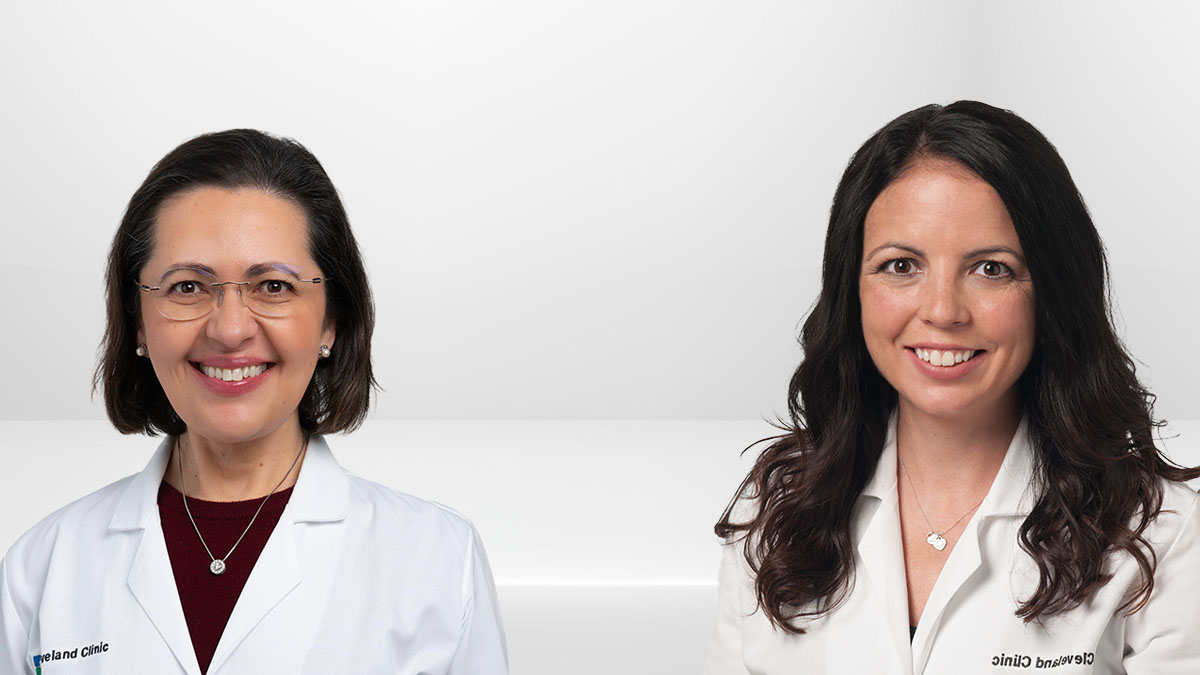
Pregnancy After Heart Transplant
Discover what it takes to navigate pregnancy and parenthood after a heart transplant as Cleveland Clinic cardiologists Maria Mountis, DO, and Karlee Hoffman, DO, share real‑world insight and compassionate guidance. They break down the unique risks, the support systems that make pregnancy possible, and the multidisciplinary care that helps women safely build their families.
Advertisement
Cleveland Clinic is a non-profit academic medical center. Advertising on our site helps support our mission. We do not endorse non-Cleveland Clinic products or services. Policy
Recent Episodes
Ask the Heart Doctor | Genomics: Precision Medicine for Your Heart
In this Ask the Heart Doctor discussion, Cleveland Clinic experts explain cardiovascular genomics and how genetic testing can help identify…
Ask the Heart Doctor | Heart Failure: Surgical Options and Mechanical Support
Heart failure affects millions of people and can range from mild symptoms to advanced disease. In this episode, discuss how heart failure is…
Quick Questions: Mitral Valve Prolapse
Marc Gillinov, MD, explains what mitral valve prolapse is and how it is diagnosed. He also discusses when mitral valve prolapse can lead to…
Video content: This video is available to watch online.
View video online (https://cdnapisec.kaltura.com/p/2207941/sp/220794100/playManifest/entryId/1_j46c2tpw/flavorId/1_5f3sgelj/format/url/protocol/https/a.mp4)
Transcript
Announcer:
Welcome to Love Your Heart, brought to you by Cleveland Clinic's Sydell and Arnold Miller Family Heart, Vascular and Thoracic Institute. This podcast will explore disease prevention, testing, medical and surgical treatments, new innovations and more. Enjoy.
Advertisement
Cleveland Clinic is a non-profit academic medical center. Advertising on our site helps support our mission. We do not endorse non-Cleveland Clinic products or services. Policy
Maria Mountis, DO:
Welcome to this Cleveland Clinic podcast. The topic is parenthood and heart transplant. I'm Dr. Maria Mountis, a cardiologist here at Cleveland Clinic for over 18 years. Joining me is Dr. Karlee Hoffman.
Karlee Hoffman, DO:
Hi, I'm Karlee Hoffman. I'm one of the heart transplant doctors also, and I'm one of the co-directors of our Cardio-Obstetric Clinic. Both of us see many of these patients, so we're excited to chat about it today.
Maria Mountis, DO:
Oh, absolutely. Absolutely. Well, before we dive into some of these questions, tell us a little bit about cardio-obstetrics, because in general, that's still a new field. Even though for us in cardiology, it is something that we're aware of. We're at a large hospital center so we're aware of it, but many places aren't. Tell us a little bit about what is cardio-obstetrics and who are the right patients to come to the clinic.
Karlee Hoffman, DO:
Yeah, for sure. That's a great question because everyone's like, "What is cardio-OB?" The way I describe it is, it's an emerging field within cardiology. It's new over the last five years or so, and it's a true multidisciplinary approach to take care of these women who are high risk with a cardiac disease or cardiac risk factors who want to pursue pregnancy.
Advertisement
Really, in my mind, it fills the gap. We have obstetricians who take amazing care of healthy women and get them through a successful pregnancy. We have great cardiologists who treat all sorts of cardiac diseases. However, there's a gap of patients who are of childbearing age who want to get pregnant, who have a significant cardiac disease. That's where cardio-obstetrics fits this patient lane.
Here at Cleveland Clinic, we have a multidisciplinary clinic. We meet regularly. For instance, for our heart failure patients, we have a heart failure transplant cardiologist. We have the high-risk OB doctors. We have a nurse navigator to help these patients navigate a very complex medical system and situation. We guide these patients all the way from preconception through pregnancy and afterwards.
We take really good care of these patients, and we take care of patients who have congenital heart disease. We have specialists, Dr. Joanna Ghobrial and Dr. Margaret Fuchs ,who do that patient population. We have an EP team like Dr. Peter Aziz and his team. Every subspecialty within this high-risk cardiac disease has a lane for this patient. It's just comprehensive care that takes really good care of these patients throughout their pregnancy and supports them through it.
Maria Mountis, DO:
No, absolutely, and we've been able to see the clinic really just grow. Since you've started this program, it's really grown. You also see patients at Akron as well, so you're able to see some of these cardio-OB patients at Akron as well.
Karlee Hoffman, DO:
Yeah, and it really developed out of a need for where the patients are and to meet them where they're at. These patients have not only high cardiac risk factors, but they have a lot of socioeconomic risks also, and they live in the region. It's difficult for them to get to main campus. Part of the effort of transitioning this cardio-OB clinic to Akron is to just reach a greater area of patients and meet them where they're at. Really, it's not only meeting where they're at, but it's just getting comprehensive care in one day, which is very difficult when you're coordinating multidisciplinary teams. Really, not just the cardiac testing, but the OB testing is all happening under the same day, same roof.
Maria Mountis, DO:
Yeah. I think it's super important, especially going into February and learning that topic of loving your heart, loving life, is that pregnancy is a huge stressor on the body, whether or not you do have heart disease. Pregnancy brings about certain heart conditions. We certainly know that if there is a family history, but you've never been diagnosed with anything, all of a sudden a female or individual becomes pregnant and then they're told, "Oh, you have a weak heart function," or, "I have palpitations, and I'm having these symptoms."
Advertisement
But also, one interesting thing that I've been asking all my female patients is about preeclampsia, and I think that is something I personally experienced as well too. They didn't have something like that at the time. You're trying to navigate, even someone in medicine, trying to navigate the healthcare system and saying, "Well, who takes care of this?" The OB says, "I don't take care of this. Well, maybe I can help with this." But that is really also something that you've been probably seeing a lot of.
Karlee Hoffman, DO:
Yeah. I think there's a lot of attention to adverse pregnancy outcomes like preeclampsia, like gestational diabetes, even preterm birth and preterm delivery or low weight in a preterm birth. All of these we know are long-term cardiovascular risk factors. There's more awareness to this, and there's more awareness even from patients, which is remarkable. There's a lot of social media outlets and a lot of attention educating these patients.
This patient population needs to fit a group of cardiologists that follows them long term, and cardio-obstetrics also follows those patients. Dr. Deirdra Mattina is at Hillcrest, she sees a lot of these patients that have this first stress incident. This first stress test of pregnancy when their cardiac output has to double, and their heart rate goes up, and they really have to meet that demand of pregnancy. A lot of times that is the first stress test. It's the first indicator of long term cardiovascular health. We follow these patients in cardio-OB clinic. We have our prevention team who follows these patients, and it's absolutely important to ask that in the history. We often forget that. Unless you're attuned to it as a cardiologist and you're thinking about women's health, we often forget it. But it should be one of the past medical histories. It should be one of the review systems that we have.
Advertisement
Maria Mountis, DO:
Yeah. It's interesting, you have a patient in front of you and you ask how many pregnancies, and they will say, "I have two kids," and you say, "Well, no, actually how many pregnancies have you had? What complications? Have you had toxemia or blood pressure?" "Oh yeah, I was hospitalized for that." Then, it raises some red flags, and you're like, "Hold on a second. Maybe what they're dealing with is a hypertensive issue and not necessarily an actual genetic predisposition to a cardiomyopathy," because I think we pick that up a lot.
What I find interesting is, you can see women of all ages, sizes, shapes, ethnicities, and they may look like the healthiest individual, but it's like, "Oh wow, they had preeclampsia," or, "Oh, there's a cardiomyopathy, or there's a valve disease that we didn't know about." So it's really phenomenal how you've grown this program.
Karlee Hoffman, DO:
Yeah, and it's also interesting if you ask what you find. I know cardio-obstetrics fits this group. Specifically, our interest is heart transplant, and you've been doing this for a long time. I want to know from you, when someone comes to you who is a transplant patient, what is the conversation when they say, "I want to get pregnant"? Because social media will always say this is what you should be doing. This is what their friends are doing. What is that conversation like when our transplant patients come to you and say, "I want to get pregnant"?
Advertisement
Maria Mountis, DO:
Yeah, this conversation has happened more than I thought. We are transplanting more younger individuals, younger women who are of childbearing age. It depends on what they have read, what they have seen on social media prior to even coming to that appointment and asking that question. Sometimes I'll meet someone, and they'll ask about, "Oh, it's frustrating. I haven't been able to have children." I was like, "Well, what are you talking about? Why do you think that?" "Well, I've always been told you can never have a child." And I said, "Well, it all depends."
It's not something I go and make videos about, saying everyone should be able to have a child, which is not true. Sometimes it is just absolutely too high risk. That's when we look at other options of parenthood, whether that's surrogacy or whether that's adoption, fostering, which are all wonderful ways to become parents. But for a certain individual, they want to carry that child. I've been able to do this a handful of times, and it's always so gratifying. I know that you, when you see the moms come in with their children, it's always just so gratifying.
First thing I think comes down to, what type of person is this person? Are they compliant? Do they take their medications? We look at, from a medical standpoint, have they ever had any rejection? If they've had a history of rejection, maybe in the very beginning ,I'll let that slide. But if this is a recurrent issue, that's not someone that you want to think about pregnancy, just because when we do consider transplant, we have to wean some of the immunosuppressant medications because they are toxic to the embryo and the fetus.
So, this is typically someone that we'd only stay on one medication, tacrolimus. We need someone who is compliant with their medicines. We do know that during the pregnancy, the amount of tacrolimus that is needed increases. So, someone who is going to come in every week or so for blood work to make sure that we update and increase their medication dosage. We have to make sure that someone doesn't have vasculopathy, which is disease of the arteries of the transplanted heart, only because that pregnancy is a stress test. If someone has significant disease of the arteries already, that worries us, and it increases the risk of weakening of the heart muscle.
Then we also take a look at, do they have any other medical problems? Is this purely a transplant that has been doing beautifully? They take their medications, they come to their doctor's appointments, they have a support system. Then we can open up that conversation and say, "We can think about it." But before we even go down this pathway, we take a look at what led to their cardiomyopathy. Is this something genetically that is going to be passed to one of the kids? We also want to make sure that we meet with ethics. I always send a patient to ethics to understand that my obligation is still to take care of the mom, for her to be healthy enough to be able to deliver a healthy child. That's what I found in taking care of these women who are interested or are considering wanting to become pregnant.
Karlee Hoffman, DO:
Yes. There's a lot of factors that go into this. I love that you said that we don't promote this, right?
Maria Mountis, DO:
No, we don't promote it.
Karlee Hoffman, DO:
We absolutely support women, and it's their decision. If their goal is to pursue pregnancy and build their family. Like you said, it's always amazing to me how they've done their homework, right? They've done their homework. They know what they have to do to get there, and we're here to support that if that's their goal, in the right patient at the right time.
It's a team of teams that goes into this preconception counseling, which is obviously the most ideal situation. What about long term? When you’re counseling these patients, what long-term effects do you discuss with them?
Maria Mountis, DO:
One thing is to always keep in mind that anytime we are decreasing their immunosuppression, there's always a fear and always a risk that there could be a rejection. Once that woman delivers, we try and get back on their old immunosuppression regimen to make sure that there is no change to their antibody levels, that their heart function is still the same. That's something we'll do. We'll check their tacrolimus levels, check their echoes on a frequent basis, at least during each trimester. But that is the biggest fear I always have, are we going to get them through without any possible rejection? So, it really is picking the right individual. I'll be honest with you, they will pick themselves out. It is someone who's really done their homework. Every single young woman who's come to our team has said, "I'm going to do this, but I need your support."
Karlee Hoffman, DO:
Yeah. They say, "I want to do this whether you want to or not." Right?
Maria Mountis, DO:
"Whether you want to or not, I'm going to do this."
Karlee Hoffman, DO:
Yeah, yeah.
Maria Mountis, DO:
In general, there's only been one young lady that I said it's really a bad idea. They were in the midst of dialysis. I said, "This is not a good idea. I don't think I can help you with this." Now, again, if you were to get pregnant, obviously, we will help, but it's not a good situation that we want to prevent.
Karlee Hoffman, DO:
I always find it interesting. You touched on a couple of things. The ethics part of this is also really important. I always say it's not just the patient, it's their support system. Because we know, patients who get heart transplants, their life expectancy.
I think it's the elephant in the room that we don't discuss, and it's really hard to discuss the life expectancy of these young women. I know there's some national transplant registries with heart transplants and pregnancy. The average lifespan after pregnancy is 9.8 years. It's how you look at it. I think getting ethics involved and making sure the whole family understands, right? Like you said, the genetic component too. We know a lot of these women who are transplanted, maybe they had postpartum cardiomyopathy or other etiologies of their heart failure, but the etiology of their heart failure is also paramount.
Maria Mountis, DO:
I think we're very fortunate at Cleveland Clinic. We have this entire cardiac genetics section now, so involving them, involving our colleagues, involving pediatric cardiology. We all work together now. Actually, I get more messages from our pediatric team saying, "Oh, I'm seeing your patient's child." And sometimes we didn't even know, we didn't put two and two together.
So, we do the best that we can, and we try and do genetic testing on whoever we can who fits criteria, but it's hard. It's hard to stomach when all of a sudden, you didn't know what particular gene was passed down, and at such a young age, to say the child now needs a transplant.
Karlee Hoffman, DO:
Genetic testing is something I get on everybody. Every patient who comes into my cardio-OB clinic, every young patient, initial cardiomyopathy workup gets genetic testing, because it impacts the family. We have to know what that gene is.
Then, even with our infertility specialists and our high-risk MFMs (maternal and fetal medicine specialists), there's technology, although very expensive, to make different probes and do IVF and choose the embryo that doesn't have that gene. Again, it's expensive, it's not feasible for most people, but the technology is there if they could pursue it.
One of the things I tell my patients, just like you said, is that there are other ways to build your family. It's not just about you having to carry this baby. Surrogacy is very expensive. Even adoption is very expensive, but I've had so many patients who have successfully fostered to adopt, and they have built their families in other ways.
Maria Mountis, DO:
Absolutely.
Karlee Hoffman, DO:
So, I think too, the key part that I think is important for patients is to recognize, and I always commend them when they come before they decide to pursue pregnancy. I encourage them to come for preconception counseling. Let's meet with the heart team, let's meet with the MFM team, and let's talk about everything. Because it's not just cardiology. It's, what is the health of the baby? What is life expectancy? There's a huge emotional impact that comes with this that I think ethics and psychology and psychiatry should be involved in. It's heavy, and it's a lot.
Maria Mountis, DO:
It's a lot of education, because we already see such barriers to care in certain psychosocial populations already, where we're seeing kind of high maternal death, and we don't want that for our patients if we can prevent it. We want to really get these young women through.
The other interesting thing, I don't know if you're seeing a lot more, as women are going through schooling and careers, the age of first pregnancy is really rising. We're seeing a lot of advanced maternal age. Would you counsel them the same way?
Karlee Hoffman, DO:
Yeah. At least in the cardio-OB clinic when we're with the MFMs, the aging population is a risk factor. So, it has to be taken into account. Not only the aging population, but the comorbidities in our aging population. They have more hypertension, they have more diabetes. We're seeing more obesity. All of these are independent risk factors for pursuing pregnancy, let alone the cardiac disease. Just like in our transplant patients, you want all of those comorbidities optimized. If you want the best outcome, you've got to pre-race to get there.
You need to make sure, and our transplant patients are no different. They can't have high blood pressure. It has to be controlled. Their diabetes has to be controlled. Their weight has to be an acceptable range with their BMI.
Our MFM team says, ideally, you would build your family by the age of 40. After that, you're running into other concerns when it comes to genetic factors.
Maria Mountis, DO:
Right. Also, you mentioned about blood pressure being optimized. Part of the problem is, sometimes these women are on medicines that are toxic so then we have to come up with an entire different regimen to make sure that it's safe enough for the pregnancy.
Karlee Hoffman, DO:
Absolutely.
Maria Mountis, DO:
Another topic that comes up too is that, let's say, you do get a woman through. You get them successfully through, but you can't then get back on regular medications because they want that option of breastfeeding. That's not always an option because you're withholding good guideline-directed medical therapy from these women. Then that's also delaying a period of time where they're getting that good medicine and perhaps weakening that heart muscle. That's another stressor. I think really having these good conversations and going from soup to nuts. "This is what's going to happen. If you want a successful pregnancy, if you want to build your family this way, this is what we encourage."
Karlee Hoffman, DO:
The other thing with this patient population, specifically the heart transplant population, we don't have a ton of data. It's a very gray zone. We know these women can get through pregnancy, they can successfully get through pregnancy. Long term, they have an increased risk of rejection. We follow them with echoes and lab work and all the basics, but we really don't know long term what this impact of pregnancy has. I describe it as pregnancy is like a nine-month stress test. So, it's like a marathon followed by the sprint of delivery. Then you have the whole fourth trimester. So, it's just like an ongoing cycle. How do you follow patients after delivery and after they get through a successful delivery in a heart transplant patient?
Maria Mountis, DO:
For the heart transplant patients, for one, we see them in the hospital. Even if I'm not on, I'll certainly make sure that I go to see them because certain things, like you said, during that delivery are very overwhelming for the body, whether that's going to be a planned C-section, whether that's going to be a vaginal delivery, and what medications you also give to help with discomfort. NSAIDs, we know, absolutely can predispose to worsening blood pressure, fluid retention, acute pulmonary edema. So, we’re making sure we’re working closely with the OB folks who are managing these patients.
We'll do that, then check the tacrolimus, immediately going up on their tacrolimus dosing, because we know now that the physiology of pregnancy is kind of starting to come down. The metabolizing of this medication is going to change. Getting an echo, checking BNP levels, these are all kind of surrogate markers of how that heart is tolerating that stress of the pregnancy. Following blood work, following echoes, seeing them within a week or two. Many of these women too, some of the babies end up in the NICU just for a day or two, as long as their weight is okay, just to ensure that there's a stability there. That gives us time to also bring the mom in to make sure that she's doing well.
Again, many are very headstrong and will say, "I'm going to breastfeed, I'm going to do this." And we try and say, "Absolutely, I want you to do what you're comfortable with, but understand that I need to get you back on these good medications to make sure that your heart's going to stay stable." I think at that moment, it brings us so much joy, right? They're seeing their child for the first time. They've already been through so much in their lives as a young woman to have to go through a transplant. I'll see them in that perspective. Then probably at month one and then month two, as long as echo is stable, getting them back on their good medications. Then probably about at the six-month mark, bringing them back in with the transplant team to get all the testing again, get back on their normal regimen of echo and stress testing and all the labs that they need.
Karlee Hoffman, DO:
Yeah. I know one of the questions they always have, or one of the most common questions from other cardiologists or OB is, what type of contraception for this patient? So, if you get the patient through the pregnancy and they deliver, what is your preferred contraception for the transplant patient?
Maria Mountis, DO:
To answer that question, I personally don't have a preferred method. I say, "Oh my gosh, what does OB tell you to do?" Because I'm not the specialist in that. But we do say, especially with some of these medications, that two forms of contraception are needed because of the toxicity of these medications. Many times, the husband will be a trooper afterwards and say, "I'll take responsibility for the contraception." Well, let me ask, actually, what does OB say in your clinic when you're seeing patients?
Karlee Hoffman, DO:
For any heart failure patient or transplant patient, the preferred method is one that's effective and safe.
Maria Mountis, DO:
Yeah.
Karlee Hoffman, DO:
That's true. We avoid the hormonal contraception, like the basic “pill” per se, the estrogen pill, because it can increase high blood pressure and increase the thrombotic state of pregnancy, and we don't want that in our transplant patients. We avoid just the regular contraception, estrogen-progesterone pill. The mini pill, the progestin only, is effective, but you have to take it every day at the same time. That's just impossible for most people, right?
So, what our OBs say and what I recommend is an IUD, because it's safe, it's effective, and it lasts for at least eight years. It doesn't have that hormonal shift that the pill does, and you don't have to rely on someone taking the pill. In transplant patients, there's not an increased risk of infection. Fortunately here, like you said, we rely on our OB team heavily for this. As a cardiologist, we're not the one putting in the IUD or we're not prescribing the birth control, but I think we have to get them to the right hands of the right patient.
Fortunately, here at Cleveland Clinic, we have a high-risk contraception counseling consult that we can place, and they can make sure that the IUD is placed on the admission or immediately after. Again, always in heart transplant patients or just the general heart failure patient population, with education and contraception, I think just the simple question of, "Do you have a pregnancy goal in the next year? Yes or no?" If the answer is, "No, my goal is not to get pregnant," then are you on contraception? And if that's no, then, "Okay, we need to get you on something."
Maria Mountis, DO:
Or if you see them kind of like, "I don't know," then you're like, "Okay, we need to do something."
Karlee Hoffman, DO:
Number one, I think the myth is, they can get pregnant.
Maria Mountis, DO:
Absolutely.
Karlee Hoffman, DO:
Our heart failure patients and heart transplant patients absolutely can get pregnant, because some of them think, "Oh, I have a serious medical condition. I can't get pregnant." No, you can actually get pregnant. If your goal is not to get pregnant, then we need to be on contraception.
Maria Mountis, DO:
Absolutely.
Karlee Hoffman, DO:
Then I will call the OB, and they will get them in immediately, and they can go there. Again, I think it's just being open with the patient, just being honest with them, and as a cardiologist, not shying away from asking these questions that can be sensitive, but are really important for their long-term health.
Maria Mountis, DO:
I think we get to know them so well that they really feel comfortable with us. I think we're in such a privileged and honorable position to be able to ask any of these questions and to have them feel so comfortable with us. It really is an honor to take care of these individuals.
Tell me about pregnancy changes. How does the heart tolerate the changes in pregnancy? You mentioned earlier about the three trimesters of pregnancy. I can tell you my personal experience, you could probably tell your personal experience, but tell us a little bit about the stressors that each trimester has for these patients.
Karlee Hoffman, DO:
Like we said before, pregnancy is the ultimate stress test, and it's usually the first stress test that a young female of childbearing age undergoes.
In order to appropriately perfuse the fetus, the cardiac output has to double. We're asking a lot, right? This is why patients with heart failure, it’s not recommended they get pregnant. Because if you're starting already in a low cardiac output, and you're expecting this to double, it's a lot of stress on the heart. But I would say, a normal physiological response to pregnancy is that the cardiac output has to double. In order for that to happen, your heart rate has to go up and then your vascular resistance has to go down. Your blood pressure has to go down. The normal physiology of pregnancy is high heart rate, low blood pressure to get that appropriate cardiac output to double that can really perfuse the fetus.
That's the goal of us whenever someone has a cardiac condition, is how we can maintain fetal perfusion so that we have a successful outcome with mom and baby. As the trimesters go on, that's where this demand happens. Really, the peak stress of pregnancy is the 28- to 32-week range. That's where we usually check in with the objective testing, like you said, echo, NT-proBNP, EKG, physical examination, to see how their heart is performing at that peak stress of pregnancy.
Then when they deliver, that demand shifts immediately, and there are fluid shifts that occur. Really, the critical time after delivery is 24 to 48 hours. If we're going to see something “bad” per se, and they can't compensate for these acute changes that have to happen, that's usually where we see it. Then the risk of preeclampsia is, although during pregnancy, we also see a lot of times after pregnancy, too. I always say to the patients, our goal is to successfully get you through a delivery, but really, it doesn't stop there.
Maria Mountis, DO:
It doesn't.
Karlee Hoffman, DO:
It's immediately 48 hours after pregnancy, and sometimes we monitor patients in the ICU during this time period. Then really, that fourth trimester up to 12 weeks afterwards, where things are stabilizing, we're trying to get them back on medications and following them really closely. It's a lot. It's absolutely a stress on the heart, and I think that's where they need to follow up with not only their OB, but their cardiologist, and make sure that they're staying stable throughout this critical time period.
Maria Mountis, DO:
Yeah. I think what's important to remember for all these young women, as well, is that many use their OB as their primary care physician. It's so important that they really have good relationships with their OB, that they meet with you or Dr. Mattina or really anyone, any cardiologist at baseline, and then to understand that we're always available. The Cleveland Clinic Cardio-OB Center is available. Someone from the region can call and say, "I have this young woman. I'm just not quite sure what I'm going to do with her. Can you help out?"
Karlee Hoffman, DO:
Absolutely.
Maria Mountis, DO:
I know that I've seen you involved in these cardiogenic shock transfers of very sick individuals, then you're kind of stuck. You're like, "What do I do? Do we put an LVAD (left ventricular assist device) in? Do we put them on ECMO (extracorporeal membrane oxygenation)? Do we do temporary mechanical support until we get this patient to a week in her pregnancy where the baby is very viable?" We can do that here.
Karlee Hoffman, DO:
Yeah, absolutely. We've done it. The OBs always describe it as, here at main campus, we have cardiologists coming out of the woodwork 24/7, and that's so true. If someone needs support, if they're in a regional hospital and they're pregnant or they have a VT arrest or whatever unfortunate situation, we have a way to activate them, get them here quickly, and we can support them any which way.
We have done that with temporary mechanical support, whether it's an Impella pump through their artery, whether it's a balloon pump, whether it's full life support with the ECMO. We've done this as a bridge to viability for the fetus because every day counts. If you're in this periviable period, like 23 to 25 weeks, every day counts. Any way we can support the mom and inch along day by day to improve the fetal outcome, that's what we will do.
Obviously, our main focus is supporting the moms. Again, if the mom's hemodynamically stable, we are perfusing the fetus. A lot of it comes to the patient, too, right? The patients, I've never met such strong-willed patients as we have in this population, where they're pregnant and they have a significant cardiac disease, but they will do anything to buy more time for that fetus and to keep that delivery planning going. We have had moms who are in cardiogenic shock and refusing to deliver because they want to buy time. We support them in our ICU, we put temporary mechanical support things in them like an Impella 5.5, and we buy time.
We work so closely with the ICU teams, with the high-risk MFM teams, palliative care, ethics, the neonatal team. It's like a daily, truly multidisciplinary team that can inch these patients along, and we all decide, do we make the call now? Do we keep going one more day? I'm privileged to be here, and we do this, and we support these women, and I don't think this is possible at too many other places than here. But it's the highest of the highest risk, right?
Maria Mountis, DO:
It is the highest of the highest risk.
Karlee Hoffman, DO:
I think the key is, how do we educate? How do we promote the education to prevent this situation? And then how do we support these women through this?
Maria Mountis, DO:
I always just go back to the basics of, we need good blood pressure control, we need good diabetes control. Everyone at any age needs to know their numbers. Even now we're talking about such a particular specialty, but everything we're talking about is applicable to everyone. You need to know your blood pressure, you need to know your cholesterol, your sugar. I mean, all of this is treatable and preventable.
Karlee Hoffman, DO:
Absolutely.
Maria Mountis, DO:
If you go into a pregnancy healthy, the chances are of delivering a very healthy pregnancy and going through a healthy pregnancy are very high. Even if we have preeclampsia, we can treat all of this. We can monitor for it.
Karlee, one other topic I wanted you to just touch on, if you don't mind, is research. I know that you and Dr. Eileen Hsich are working closely on a national trial here. I was wondering if you could tell us a little bit about that.
Karlee Hoffman, DO:
There’s tons of research going on at the Cleveland Clinic. I'm excited that we have this study for this specific population of postpartum cardiomyopathy patients. The study is called REBIRTH. It is with bromocriptine as a tool in our toolbox to treat postpartum cardiomyopathy. Patients that qualify for this study are anyone who has a drop in their ejection fraction or their heart pump function less than 40% during pregnancy or five months afterwards. These are the patients we want to capture. Bromocriptine is a medication that's actually approved in Europe for treatment of postpartum cardiomyopathy, but is not approved yet in the United States for postpartum cardiomyopathy. This is a proof of concept study. We will wrap this up in the next six months. Hopefully mid-2026, we'll have enough patients enrolled across the nation, and hopefully this will be another tool in our toolbox. It's very exciting, and just like everything at Cleveland Clinic, we're excited to be able to offer this to our patients.
Maria Mountis, DO:
Wonderful. Well, I think that just goes to show we have a lot available here at Cleveland Clinic. We're happy for anyone to reach out to us. Even if there is someone listening who's in the region, who's in the area that wants to enroll one of their patients, if they have a patient that's appropriate, certainly they could reach out to you or reach out to the clinic.
I think this was a really productive session. I always enjoy hearing what you're doing with cardio-obstetrics. We have a lot of young women that ask us about transplant and come to us from other centers. I think this just goes to show how much we love what we do. We really want to help anyone that comes to us, and we're here for everyone.
Karlee Hoffman, DO:
I think we're here to support. That's the key. We're medical professionals. Our job is to educate and give you the information so that you can make your own personal decision of, is this an acceptable risk, or not, to take if you're pursuing pregnancy? So, I think the key is absolutely preconception counseling. Get in with us. There are many ways to get ahold of us, and we'll be more than happy to chat and lay it out.
Maria Mountis, DO:
One last thing is, if anyone does need a consult, we certainly are able to answer any questions. If you give us a call, if someone lives out of state and we don't have a license for that state, we do have the availability of doing a virtual second opinion. That's always a possibility. But we're here to educate. We're here to help. Thank you again for joining us.
Announcer:
Thank you for listening to Love Your Heart. We hope you enjoyed the podcast. For more information or to schedule an appointment at Cleveland Clinic, please call 844.868.4339. That's 844.868.4339. We welcome your comments and feedback. Please contact us at heart@ccf.org. Like what you heard? Subscribe wherever you get your podcasts, or listen at clevelandclinic.org/loveyourheartpodcast.
Recent Episodes
Ask the Heart Doctor | Genomics: Precision Medicine for Your Heart
In this Ask the Heart Doctor discussion, Cleveland Clinic experts explain cardiovascular genomics and how genetic testing can help identify…
Ask the Heart Doctor | Heart Failure: Surgical Options and Mechanical Support
Heart failure affects millions of people and can range from mild symptoms to advanced disease. In this episode, discuss how heart failure is…
Quick Questions: Mitral Valve Prolapse
Marc Gillinov, MD, explains what mitral valve prolapse is and how it is diagnosed. He also discusses when mitral valve prolapse can lead to…
Never miss a moment - subscribe now.
Listen to the Health Essentials Podcast on your favorite streaming platform.
Other Podcasts You May Love
Beyond Leadership
Hosts Jim Pae and Elizabeth Pugel escort you through a network of thought leaders, sharing world-cla…
Beyond the Pages: CCJM Podcast
Beyond the Pages: CCJM Podcast takes the listener more in-depth into Cleveland Clinic Journal of Med…
Butts & Guts
A Cleveland Clinic podcast exploring your digestive and surgical health from end to end. You’ll lear…
Cancer Advances
A Cleveland Clinic podcast for medical professionals exploring the latest innovative research and cl…