



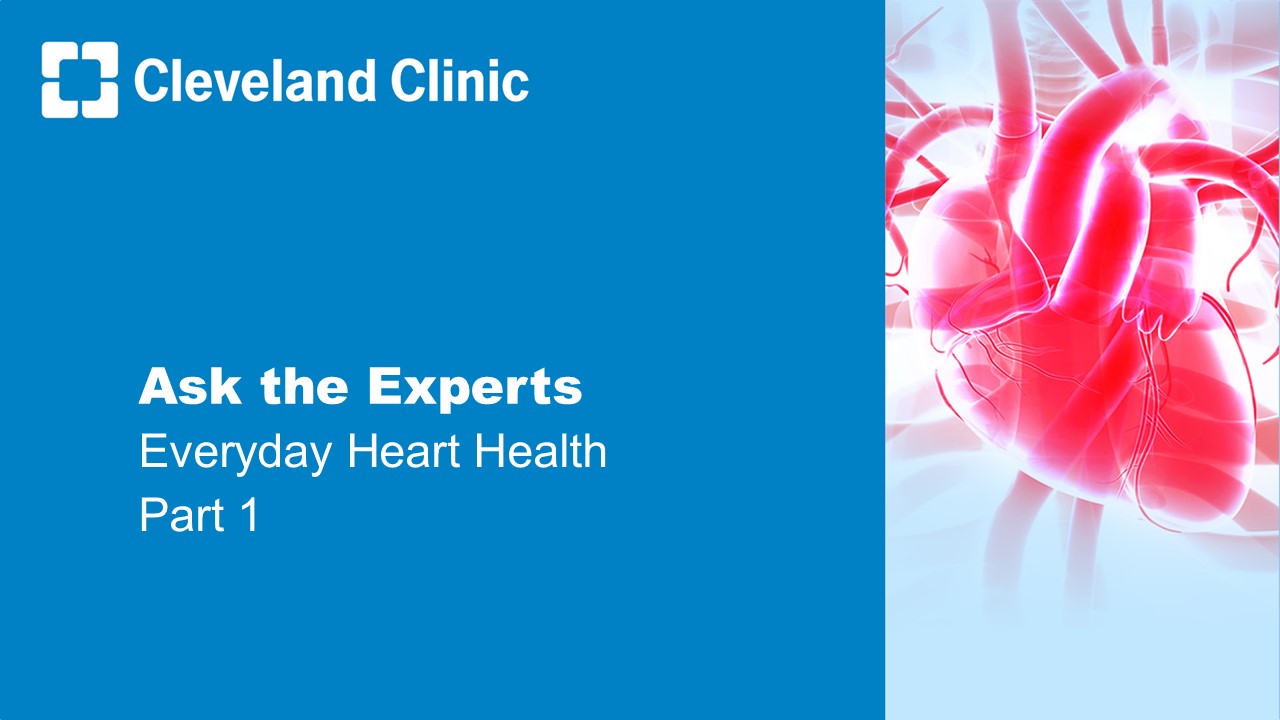
Ask the Experts: Everyday Heart Health Part 1
In part one of this two part series, Cleveland Clinic heart specialists answer your most common questions about staying heart‑healthy at any age. They discuss simple daily habits, ways to lower your risk of heart disease and what steps to take after receiving a heart‑related diagnosis. Listen to Part 2.
Advertisement
Cleveland Clinic is a non-profit academic medical center. Advertising on our site helps support our mission. We do not endorse non-Cleveland Clinic products or services. Policy
Recent Episodes
Understanding High-Risk Aortic Valve Endocarditis
Milind Desai, MD, and Per Wierup, MD, discuss high-risk aortic valve endocarditis, a serious infection that can affect heart valves and lead…
Robotic Heart Valve Surgery
Marc Gillinov, MD, and Per Wierup, MD, discuss how robotic heart valve surgery allows surgeons to repair or replace heart valves through sma…
How Robotic Technology is Changing Heart Bypass Surgery
Donna Kimmaliardjuk, MD, and Gianluca Torregrossa, MD, discuss robotic and totally endoscopic coronary artery bypass grafting (TECAB). These…
Video content: This video is available to watch online.
View video online (https://cdnapisec.kaltura.com/p/2207941/sp/220794100/playManifest/entryId/1_od3h164q/flavorId/1_5f3sgelj/format/url/protocol/https/a.mp4)
Transcript
Announcer:
Welcome to Love Your Heart, brought to you by Cleveland Clinic's Sydell and Arnold Miller Family Heart, Vascular and Thoracic Institute. This podcast will explore disease prevention, testing, medical and surgical treatments, new innovations and more. Enjoy.
Advertisement
Cleveland Clinic is a non-profit academic medical center. Advertising on our site helps support our mission. We do not endorse non-Cleveland Clinic products or services. Policy
Maria Mountis, DO:
I'm Dr. Maria Mountis, a Cleveland Clinic cardiologist. I'm joined by a panel of heart care specialists. We're here to answer your questions and share insights on how to build heart-healthy habits at any age, tips for lowering your risk of heart disease and what to do after a heart diagnosis.
Before we get to our questions, let's meet our panelists. They'll each briefly introduce themselves and share how they personally keep their hearts healthy. We'll start with Dr. Tyler Taigen.
Tyler Taigen, MD:
Thank you very much. My name's Tyler Taigen. I'm a heart rhythm cardiologist, which is a cardiac electrophysiologist. I specialize in patients that have fast or slow heart rhythms, irregular heart rhythms, the most common of which is atrial fibrillation (AFib). I also see patients with pacemakers and defibrillators. I've been practicing for 15 years now and have clinics here at the main campus downtown and also in Twinsburg. I see all different types of patients that I just mentioned at both those locations. Something that I do for my heart is something I started when I was a fellow with my neighbor, which is that I run every morning. We meet at the curb at 5 a.m., so it's cold on days like this. Most days, we'll run five miles. We've got a group of about four, so that's good for my heart and also good for my mind to socialize and see those guys out there every day.
Advertisement
Maria Mountis, DO:
Now, Dr. Grant Reed, please tell the audience about yourself.
Grant Reed, MD:
Thanks for having me. I'm Dr. Grant Reed. I'm an interventional cardiologist at the Cleveland Clinic. Interventional cardiologists are procedural cardiologists. We're not surgeons, but we do the most minimally invasive procedures on the heart, the coronary arteries and valvular heart disease. A big part of my practice is structural heart interventions, which we'll talk a little bit more about today. I practice mostly at Main Campus, but also at Fairview and Hillcrest Hospitals, doing structural heart procedures. One thing that I like to do to keep my heart healthy is spend time with my family. I have three young children who keep me both physically active, but also very emotionally centered. I think that's very important to have people around you that are in your corner and can help you live a heart-healthy life.
Maria Mountis, DO:
Finally, Dr. Ashish Sarraju. Ashish, please tell the audience about yourself.
Ashish Sarraju, MD:
Thank you very much for having me. I am a preventive cardiologist, and that's my area of specialty. In essence, I see folks who either have an interest in reducing their risk for heart disease, mainly coronary artery disease, they have risk factors for coronary artery disease and are interested in improving them and getting them to an optimal level, or they have a family history of cardiovascular disease, and they want advice on how best to optimize their levels. I practice at the main campus here at Cleveland Clinic. I've been practicing for about five years now. Recently, one thing I did for my heart health was to buy a walking pad because it's been so cold out in Cleveland. It allows me to get to 7,000 steps a day without having to brave the cold every day.
Maria Mountis, DO:
Thank you, Ashish.
Again, I'm Dr. Mountis. I've been practicing here at Main Campus for about 18 years. My area of expertise is heart failure and anything related to that. That could be seeing patients who have been diagnosed with a cardiomyopathy or a weakened heart muscle given a diagnosis of heart failure, whether it's with a normal squeeze of the heart or an abnormal squeeze of the heart, and really, any patients that have any type of exposure to toxins that can affect the heart. It may be seeing patients once a year, or it could be really being very involved with patients that they may be very sick and need heart pumps or heart transplants. So, really, a wide spectrum of individuals that I see.
I do see patients primarily at main campus, but I also go to Independence a couple times a month and see patients there, and now most recently, Beachwood for some weekend hours.
The one thing that I do daily to protect my heart is – I don't brave the cold and exercise as some of our panelists here. What I do is make sure I get enough sleep. I try and get to bed by 10:00 or 10:30 and wake up around 5:00, make sure that I get around seven hours of sleep, as we know that sleep health is really important to heart health. And at this time of cold winters in Cleveland, I make sure that my vitamin D level is appropriate, and that I'm up to speed with my immunizations.
Advertisement
Now, it's time to answer your questions. We have received hundreds of questions, so we will attempt to answer as many as we can. I want to open up our first question to Dr. Sarraju. How prevalent are hereditary factors in heart disease? If members of my family have heart disease, should I see a cardiologist even if I don't have symptoms yet?
Ashish Sarraju, MD:
When we think about heart disease, specifically coronary disease, and that's blockages in the arteries that supply the heart muscle, some data suggests that maybe 40 to 50% of coronary disease is heritable, meaning there's some genetic component driving coronary disease there, but this is often not a single gene or a single mutation. This could be many, many hundreds of genes that could be driving this. Sometimes it's hard to get to the bottom of exactly what that genetic issue is.
But if you have a family history of someone who's had a heart attack under the age of 55, if you're a man, under the age of 65, if it was a woman; if you have a family history of high cholesterol at a young age requiring medications; a family history of sudden cardiac death at a young age, these are all conditions that I think would really benefit from seeing a cardiologist early because cardiologists can add to the workup, take a careful history, do appropriate testing, and then start proper measures to reduce your risk as appropriate.
Advertisement
I'll throw in one fact here. There's a condition, for example, called familial hypercholesterolemia or FH, a condition of high cholesterol from a young age. We think that's only diagnosed in 10 to 30% of people. This is highly treatable. You treat that, your heart disease risk is nearly the same as that of someone who's never had it to begin with. It's incumbent for us to hope that individuals who have a family history come and see us so we can get them treated.
Maria Mountis, DO:
One thing that I wanted to just ask following that question is lipoprotein(a). Is that something you could briefly mention with the familial hyperlipidemia?
Ashish Sarraju, MD:
Absolutely. So, lipoprotein(a) or Lp(a) is something that's been in the news a lot. There's a lot of research going on, but in a nutshell, it's a particle similar to LDL, which we know a lot about. It is causative of heart disease, of plaques in the arteries, and also of aortic stenosis, which is the narrowing of the aortic valve.
We don't have approved therapies specifically approved to lower this, but this can explain a family history of heart disease at an early age. If you have that, even if you don't have symptoms, there are opportunities to improve your risk by controlling the other risk factors more aggressively than you otherwise would have if you hadn't tested for this. We encourage testing for lipoprotein(a), especially in people with a family history of early heart disease, because it is still actionable even if we're waiting for the trials to result.
Advertisement
Maria Mountis, DO:
The next question is for Dr. Taigen. Is it normal for a resting heart rate to increase as one ages?
Tyler Taigen, MD:
We get this quite a bit in our clinics, and there are a lot of different factors that go into resting heart rates. It is very common for people to have lower resting heart rates when they're cardiovascularly fit and when they exercise. In general, as we get older, our resting heart rate actually goes up a little bit. That part, with it dropping, from a physiologic standpoint probably doesn't make as much sense.
One of the things though that I look at in my clinic that's important is if someone's having a lower heart rate, and they're feeling tired, then that may be related to a sinus node dysfunction. We call the sinus node the natural pacemaker in our heart, and if that starts to slow down and someone has a lower heart rate without reversible causes, we would check thyroid, we would check metabolic changes, check endocrine disorder.
If there isn't anything with those that we can change, then perhaps that patient would need a pacemaker. If it starts to go up, then we need to try and figure out why it is that someone has a higher heart rate, which could be some other physiologic parameter with that. In general, though, I think it's safe to say that heart rates don't change a whole lot unless there's a physiologic change with conditioning.
Maria Mountis, DO:
How do you counsel patients who focus a lot on their smart watches, that their rates are... “It's always 50 or I see it really go up to 110”. Do you put a lot of weight into that?
Tyler Taigen, MD:
Yeah, this is the new world that I live in because everyone's got a smartwatch. It gives us so much information that, in a sense, there's overload with this. It's just coming at us in ways that we didn't understand before. There are probably answers that are going to come out of this that are different and that will be exciting for us to understand. I would say that all of this is a screening tool. If your watch is telling you that you might have AFib or that you might have a slower heart rate or that the rate is different than what it was before, then it could be worth reaching out with that information to a doctor. But none of it frankly is, strictly speaking, diagnostic. If that were to come up, then we would consider monitoring and so forth, and I'd see them in clinic. By itself, the smartwatch just gives us a hint at what might be going on, but it's not diagnostic.
Maria Mountis, DO:
Thank you. The next question is for Dr. Reed. Can you please explain the calcium score as a screening tool? What can I do to lower my calcium score?
Grant Reed, MD:
Coronary calcium score CT scanning is a very commonly obtained test for the screening of coronary artery disease. Building on the prior question about what we can do to prevent coronary artery disease and heart issues, it's important to screen for that as well. Coronary calcium, this is a specific finding on a CT scan. Usually, the CT scan is obtained for the specific reason of looking for coronary calcium, but sometimes I get referred to patients who have coronary calcium found incidentally on CTs done for other reasons. What this essentially means is that there is some calcium that is correlative with atherosclerotic plaque or cholesterol buildup in the artery. Where there's calcium, there always is some plaque. If there is coronary artery calcium, that does diagnose coronary artery disease.
Now, your burden of calcium can correlate with your extent of coronary artery disease and how narrow the arteries are. So, oftentimes this is the first test that we get when we're looking for coronary artery disease. Then that leads to other additional testing, such as a stress test, an echocardiogram, or perhaps a cardiac catheterization, depending on how symptomatic patients are. Once the calcium's there, it never goes away. That's a question I get asked a lot is, "What can I do to lower the coronary calcium score or do I need to have this done over time and continue to follow this?"
In general, the answer is that once the calcium's there, it's never going away. It doesn't necessarily mean that there is a blockage, but that usually means that additional evaluation is needed, and that you need to work on lowering your risk factors such as your cholesterol, work on your diet, avoidance of smoking and having a heart-healthy lifestyle.
Maria Mountis, DO:
What happens after you've been diagnosed with a heart condition? The first thing I tell people after a diagnosis is to truly not go online and start doing searches because you don't know what websites that you're getting onto and what information, if it's accurate or inaccurate.
One is to really find a practitioner, a cardiologist locally or a second opinion to find out and understand what the condition is. If you've been diagnosed with a cardiomyopathy or a weakened heart muscle, to understand, one, what caused it, and what can I do to move forward and help really have a good life expectancy?
Do I need medications? Do I need preventative cardiology? Do I need electrophysiologists? So, there are multiple things to do when you've been diagnosed, but the first thing is not to panic. Now, there are some times where we say, "Listen, if there is a group of symptoms that you're having, then you need to be seen sooner than later."
So, you're having chest discomfort or shortness of breath that's just not getting better with rest. If your blood pressure is very high or very low or your blood work is very abnormal, those are really things that I would prompt someone to pick up the phone or have your family member or friend guide you through coming and make sure that you have an appointment with a trusted provider and to really develop a good rapport with that individual and to take the medications and whatever therapies are instructed.
Dr. Sarraju, I'm interested in your advice on diet. I see conflicting opinions from experts. What's the best approach?
Ashish Sarraju, MD:
This is such a common question, and it's not an easy question to answer. Overall, I would say if you're thinking about just health in general without a specific goal in mind, then the Mediterranean-style diet has probably the biggest body of evidence behind it for longevity, for reduced heart disease risk and for other benefits as well.
The DASH diet is also very good. That stands for dietary approaches to stop hypertension. For folks who are particularly interested in controlling their blood pressure, the DASH diet is excellent.
There's a lot of overlap between the Mediterranean diet and the DASH diet, and the components of those diets are not going to seem like rocket science to anybody who hears them. Lots of vegetables, lean meats are allowed, avoiding processed foods, focusing on olive oil, reducing salt intake, minimizing alcohol intake.
But then there are sometimes specific dietary approaches depending on your health goals. For example, if I see a patient from an electrophysiology colleague who has atrial fibrillation and would like to lose weight, we may implement a specific dietary approach that focuses on that. So, speaking with someone who has expertise, like a registered dietician or a physician who's comfortable with nutrition, about your specific goals can be very useful, but if you're shooting for general health, I think the Mediterranean diet is a great place to start.
Tyler Taigen, MD:
If I can interject on that, because this comes up all the time with atrial fibrillation, in particular in my world. A lot of the folks that we see with atrial fibrillation have diets that need to be adjusted. A couple of things that I think are most important with that. Number one, alcohol really needs to be zero or very little once you've been diagnosed with atrial fibrillation. The evidence is growing that it probably needs to be zero. If there is obesity, then that needs to be a primary target. Even if you're coming in with atrial fibrillation, and that's what you're thinking about, then many times the take-home with that visit is the focus on diet and perhaps treatment of sleep apnea and avoidance of big triggers like alcohol. That couldn't be more important in our practice as well.
Maria Mountis, DO:
What do you think of the earlier implementation of GLP-1s to really help this cohort of individuals with obesity, sleep apnea, atrial fibrillation, preventatively?
Ashish Sarraju, MD:
Absolutely, I think this is such a hot topic, but let's put aside cost and access completely and pretend that they're not issues. Then I think, yeah, there are a lot of patients who would benefit from GLP-1s to supplement their lifestyle approaches because in some people, modifying the diet works great because there is a lot to modify. But with others in whom there may not be a lot to modify and who may have underlying pathophysiology that is still contributing to obesity, then these medications like GLP-1 receptor agonists, with good counseling, as an adjunct to lifestyle measures – they never replace lifestyle measures, they're always an adjunct – they can be a great choice. We have so many different studies now showing benefits across the spectrum, not only weight loss, cardiovascular risk reduction, liver disease, obstructive sleep apnea, right? So, I think there's a very strong place for them in the treatment pathway.
Maria Mountis, DO:
Dr. Taigen, why does atrial fibrillation come back after an ablation?
Tyler Taigen, MD:
The reality of atrial fibrillation is, when we see folks, we focus on three primary foundations of treatment. One is to make sure we understand what the structure and function of their heart is, because that can impact it, and that would potentially impact the outcome of any rhythm control treatment strategy, including ablation. The other is stroke prevention. We need to really understand what that is with risk factors. Then the third are symptoms. Looking at all of those, we try and come up with some sense of what the likelihood of success is for an atrial fibrillation ablation and whether or not someone would need to have another ablation.
Historically, we haven't done as good a job tying that success and what that really means to a patient's experience. If the idea is that a patient is going to benefit from an ablation, then the likelihood of that is about 95% based on our evaluation. If the idea is, would a patient have a minute or two of atrial fibrillation over a year, then that falls to 70, 75%.
This question really gets at how careful we are looking at this. But in my opinion, it has most to do with what matters to a patient, which is stroke. It's making sure their heart is healthy, and it's making sure that we're taking care of these occurrences that can be really scary. Once we understand all that, it falls into two categories. One is that when we focus on an atrial fibrillation ablation, the idea is to isolate the triggers, the short circuits inside of pulmonary veins. They bring the blood back from the lungs after the blood's picked up oxygen into the heart, and those triggers connect to the back wall in that chamber and cause AFib. We're trying to electrically isolate that.
One reason why we might have a recurrence is that there's not a durable isolation, and there's a growth that connects that trigger back to the heart muscle. The second is that the heart muscle is changing all the time, and the electric connections change, and there may be some other trigger that's not those pulmonary veins later on that's causing this. It ends up as a complicated reason.
The final point that I'll make, though, is that the energy that we use now to do these ablations is different than what we've used in the past. For decades, it's been with thermal energy, which is either heat or cold, cryo or radiofrequency ablation. Now, it's with an electric signal that we can program just for heart tissue. That's something that we've led the clinical trials on here and I think will give us a better result with fewer recurrences and less need to go back in and do second and third ablations.
Maria Mountis, DO:
It's fascinating. Thank you. The next question is for Dr. Reed. Can coronary artery disease be reversed or just stabilized?
Grant Reed, MD:
There are a lot of exciting new advances happening in coronary artery disease, both from the preventative aspect, but also the treatment aspect. Coronary artery disease is most commonly caused by atherosclerotic plaque or cholesterol plaque building up in the arteries. The primary cause of that is dietary, but genetics are a big part of that, too. Your family history plays a big role.
Once you have established coronary artery disease, it is unlikely that there'll be significant regression. However, there are some data, and a lot of data which was led here at the Cleveland Clinic, that with very aggressive measures of lowering the LDL cholesterol as low as possible, there can be some regression of coronary artery plaque burden. Now, clinically, what that means is that you should do all you can to limit to progression so that this doesn't get worse. Then once you have a heart attack, once you have a stent, which is placed, even if it's not a reversible process, you can do all you can to halt it and stop it from getting worse.
With very aggressive dietary measures, such as the Mediterranean diet and statin therapy or other lipid-lowering therapies to get the LDL cholesterol less than 55 milligrams per deciliter or as low as possible and treating other cardiovascular risk factors, then you're going to maximize your opportunity and chances for stabilizing it and hopefully having some element of plaque regression.
Now that hasn't necessarily played out into clinical outcomes yet, but when we do IVUS or intravascular ultrasound-based assessments of coronary arteries in patients with very, very low LDLs, we have noticed some plaque regression. This is an exciting area that hopefully will speed up more research being done because that really is, in many ways, what we're chasing: plaque regression and being able to prevent heart attacks before they happen.
Maria Mountis, DO:
Can you ever recover from heart failure, or once you have it, is it just managed? So, I'll go ahead and take this question. It's a complicated topic. One thing is we have to be careful with the words that we use. Once someone is diagnosed with chronic heart failure, whether that's chronic systolic or diastolic heart failure, it is, in my perspective, a chronic condition where you can have many, many years of stability, but you certainly can have then lows depending on if something re-worsens it. For example, let's say you have coronary disease, and that coronary disease leads to heart failure. Once that coronary disease is stable, and we start someone on good medical therapy – typically, we use a combination of four medications called guideline-directed medical therapy to help stabilize heart function – someone can live a very normal life expectancy, even with an ejection fraction that isn't normal.
So, I never use really the word "cure” when it comes to heart failure. There are cases where there are certain types of insults that once you take away that insult, you can have regression or you can have normalization of heart failure, but once there's been some insult to that heart, there's typically an increased risk that it could happen again. We have about 100 genes that have been linked to a diagnosis of heart failure or a weakened heart muscle, cardiomyopathy, that predisposes you to progression of that heart failure.
So, once you take away insults, whether that be alcohol, whether that is chemotherapy agents, obesity, sleep apnea, you can have normalization, regression of how thick a heart muscle is. You really can have an improvement, but I would never say that it's fully cured. It would be something that is something that you would live with and want to see a cardiologist at least once a year.
Announcer:
Thank you for listening to Love Your Heart. We hope you enjoyed the podcast. For more information or to schedule an appointment at Cleveland Clinic, please call 844.868.4339. That's 844.868.4339. We welcome your comments and feedback. Please contact us at heart@ccf.org. Like what you heard? Subscribe wherever you get your podcasts, or listen at clevelandclinic.org/loveyourheartpodcast.
Recent Episodes
Understanding High-Risk Aortic Valve Endocarditis
Milind Desai, MD, and Per Wierup, MD, discuss high-risk aortic valve endocarditis, a serious infection that can affect heart valves and lead…
Robotic Heart Valve Surgery
Marc Gillinov, MD, and Per Wierup, MD, discuss how robotic heart valve surgery allows surgeons to repair or replace heart valves through sma…
How Robotic Technology is Changing Heart Bypass Surgery
Donna Kimmaliardjuk, MD, and Gianluca Torregrossa, MD, discuss robotic and totally endoscopic coronary artery bypass grafting (TECAB). These…
Never miss a moment - subscribe now.
Listen to the Health Essentials Podcast on your favorite streaming platform.
Other Podcasts You May Love
Beyond Leadership
Hosts Jim Pae and Elizabeth Pugel escort you through a network of thought leaders, sharing world-cla…
Beyond the Pages: CCJM Podcast
Beyond the Pages: CCJM Podcast takes the listener more in-depth into Cleveland Clinic Journal of Med…
Butts & Guts
A Cleveland Clinic podcast exploring your digestive and surgical health from end to end. You’ll lear…
Cancer Advances
A Cleveland Clinic podcast for medical professionals exploring the latest innovative research and cl…