



Vulvar cancer is a rare condition that affects women’s genitalia. It causes symptoms like itching and burning that doesn’t go away. You may feel a lump or an open sore. Early diagnosis, surgery and other treatment often may cure vulvar cancer. Without treatment, the cancer can spread.
Advertisement
Cleveland Clinic is a non-profit academic medical center. Advertising on our site helps support our mission. We do not endorse non-Cleveland Clinic products or services. Policy
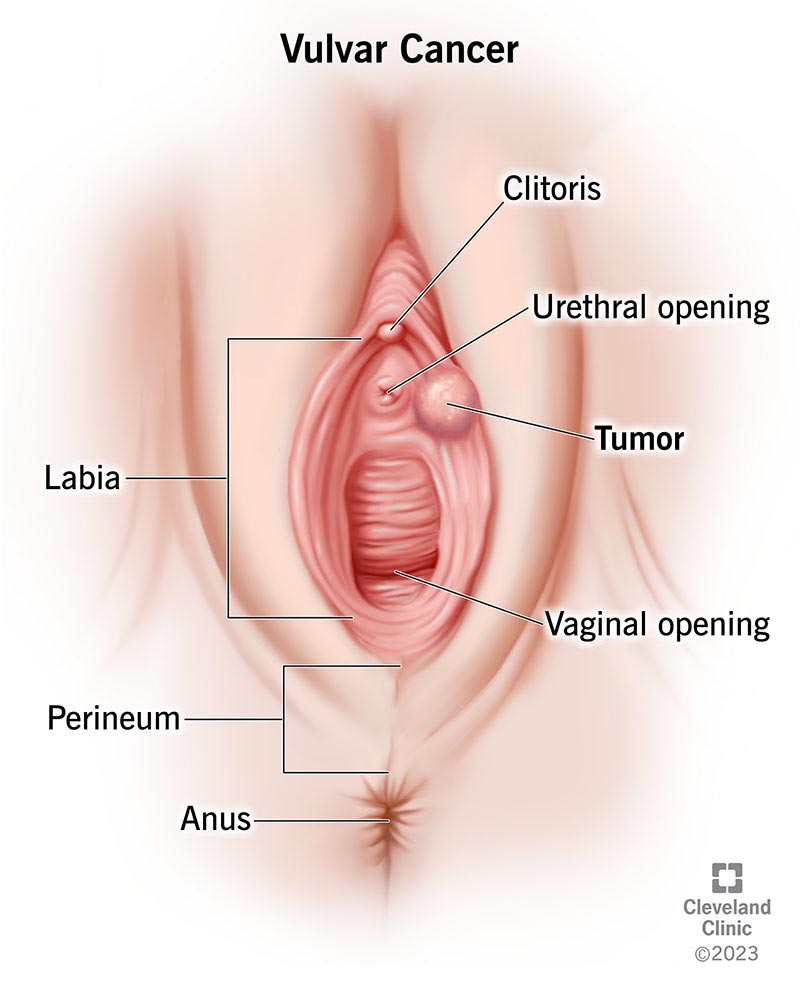
Image content: This image is available to view online.
View image online (https://my.clevelandclinic.org/-/scassets/Images/org/health/articles/6220-vulvar-cancer)
Vulvar cancer is cancer in your vulva, the collective name for all the female external sex organs (genitals). Vulvar cancer usually develops slowly over several years. It typically starts as an abnormal growth in your labia. Your healthcare provider may say you have vulvar intraepithelial neoplasia (VIN). The growth isn’t cancer. But without treatment, VIN can become vulvar cancer.
Advertisement
Cleveland Clinic is a non-profit academic medical center. Advertising on our site helps support our mission. We do not endorse non-Cleveland Clinic products or services. Policy
Vulvar cancer is rare. Each year, between 2 and 3 women out of 100,000 in the U.S. are diagnosed with it.
Surgery to remove the tumor before it spreads may cure vulvar cancer.
Healthcare providers classify this condition by the type of cells that cause it. The most common vulvar cancer types are:
The other types are rare and include:
The condition may cause changes in your vulva, including:
Advertisement
This condition happens when healthy cells change into cancer cells. The cells multiply to form tumors in your vulva. Two common causes are:
Other issues may increase your risk, including:
Without treatment, it can spread to places like your anus, cervix, urethra or rectum. It may spread to more distant parts of your body, like your bones, lymph nodes or lungs. Cancer that spreads is more difficult to treat than localized or regional cancer.
A healthcare provider will ask about your symptoms. They’ll do a pelvic exam to look for changes in your vulva, including unusual skin color, sores or bumps. They may do tests including:
Your provider may do additional tests to check for cancer in other parts of your body, such as:
Cancer staging allows healthcare providers to determine how far cancer has spread. This information guides treatment decisions. There are four main stages:
Advertisement
Surgery is the most common treatment for vulvar cancer. The goal is to remove the cancerous tumor while preserving your ability to have sex. A gynecologic oncologist surgeon will do the procedure. Types of surgery include:
Very rarely, your surgeon may remove your vulva, vagina, bladder and rectum. This procedure is an option if vulvar cancer comes back or surgery and other treatments don’t work.
You may have other treatments, too, such as:
Advertisement
Researchers are studying new treatments for this rare cancer. Ask your cancer care team about clinical trials for vulvar cancer.
Your recovery time will depend on your treatment. It can take up to eight weeks to recover from surgery to remove part or all of your vulva. Your surgeon and cancer care team will explain what you can expect.
Talk to your cancer care team if you have infection symptoms, like:
A vulvectomy to remove a cancerous tumor can be life-changing. Research shows that women feel like the surgery affects how they feel about their body and their sexuality. You may feel anxious and depressed after surgery. These are common emotional reactions. Your cancer care team understands all the ways this experience may affect you. They may recommend mental health support.
It can be if the cancer spreads from your vulva to other areas of your body. The National Cancer Institute (U.S.) tracks the five-year relative survival rate for vulvar and other cancer types. In this case, experts compare five-year survival rates of women who have vulvar cancer and women who don’t. For example, if the five-year relative survival is 80%, women with vulvar cancer are 80% as likely to be alive five years after diagnosis as women who don’t have the condition.
Advertisement
NCI data show that 85% of women with early-stage vulvar cancer were alive five years after their diagnosis. That survival rate drops to 51% when cancer is in nearby lymph nodes and to 21% when it spreads to more distant parts of your body.
You should check your vulva monthly, before or after your period. To do a vulva self-examination, sit down or place one leg on a chair. Use a mirror to see your entire vulva. Use your fingers to check for bumps or lumps. Talk to your healthcare provider if you notice a change, like skin that’s lighter or darker than normal.
There’s no clear cause for this condition. But avoiding HPV infections and not smoking may help reduce your risk. And schedule regular checkups with a gynecologist. They may spot changes that could be early signs of vulvar cancer.
You know your body better than anyone. But you may not think that includes knowing what’s going on with your genitals. It may feel odd to take a close look at this very private part of your body. But regular checks increase the chance you’ll notice changes that could be vulvar cancer. This condition is highly curable when it’s caught early, before it spreads.
You may feel reluctant or embarrassed about sharing concerns with a healthcare provider, but they understand your feelings and will do everything they can to help you feel at ease.



Sign up for our Health Essentials emails for expert guidance on nutrition, fitness, sleep, skin care and more.
Learn more about the Health Library and our editorial process.
Cleveland Clinic’s health articles are based on evidence-backed information and review by medical professionals to ensure accuracy, reliability and up-to-date clinical standards.
Cleveland Clinic’s health articles are based on evidence-backed information and review by medical professionals to ensure accuracy, reliability and up-to-date clinical standards.
Vulvar cancer is rare and often complex. At Cleveland Clinic, we can diagnose and treat this condition and support you through your recovery.
