



A hysterosalpingogram is an X-ray dye test that allows your healthcare provider to see your uterus and fallopian tubes. It can help your provider diagnose fertility problems due to blocked fallopian tubes or uterine structural issues.
Advertisement
Cleveland Clinic is a non-profit academic medical center. Advertising on our site helps support our mission. We do not endorse non-Cleveland Clinic products or services. Policy
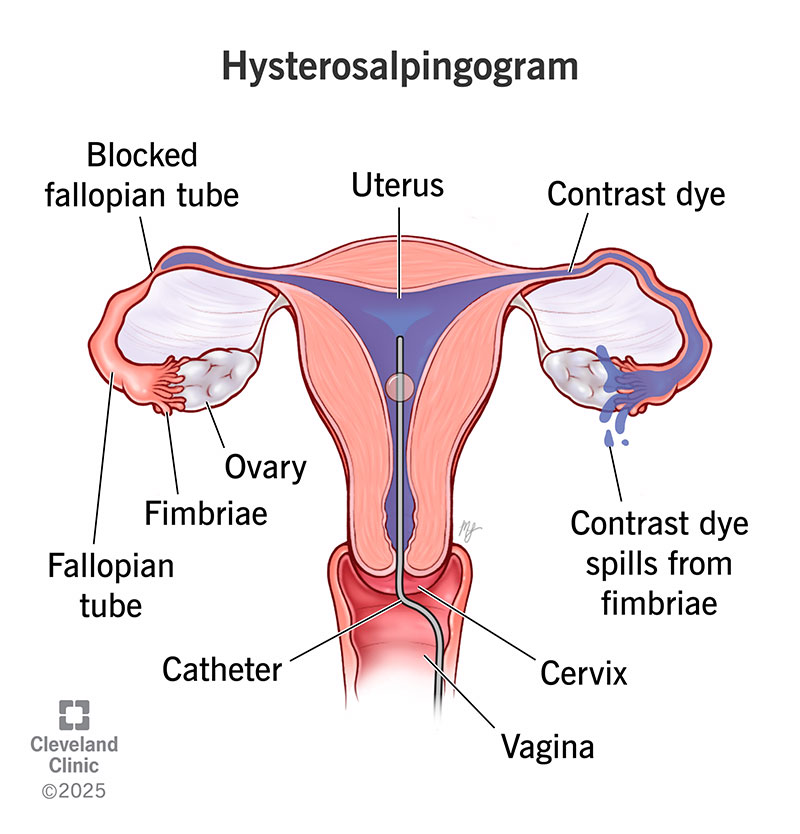
Image content: This image is available to view online.
View image online (https://my.clevelandclinic.org/-/scassets/images/org/health/articles/22254-hysterosalpingogram)
A hysterosalpingogram (HSG) is an imaging procedure that diagnoses certain causes of female infertility. It involves your healthcare provider inserting contrast dye into your uterus and fallopian tubes. Then, they use a series of X-rays (fluoroscopy) to take pictures of the structure of your uterine cavity and fallopian tubes.
Advertisement
Cleveland Clinic is a non-profit academic medical center. Advertising on our site helps support our mission. We do not endorse non-Cleveland Clinic products or services. Policy
It’s pronounced HIS-ter-roh-sal-PING-go-gram.
An HSG can help your provider spot issues in your reproductive anatomy that may prevent you from getting pregnant. These issues include blocked fallopian tubes and an irregularly shaped uterus. Your provider may recommend an HSG alongside other tests that check for causes of infertility, like a pelvic ultrasound, hysteroscopy or MRI.
In some cases, providers may recommend getting an HSG a few months after a tubal ligation. This is to make sure your fallopian tubes are completely blocked.
During an HSG, a dye fills your uterine cavity and fallopian tubes. The dye creates an outline of your uterus and fallopian tubes that stands out on an X-ray.
If the series of X-rays shows the dye flowing through your fallopian tubes, they’re open. The dye should spill out through your fimbriae (the ends of your fallopian tubes). (Your body will absorb it without any issues.) If the dye meets a barrier that prevents the flow, your fallopian tubes are blocked.
Ideally, you’ll schedule the HSG seven to 10 days after the first day of your menstrual period. This timeframe is typically before ovulation, which minimizes the chance that you could be pregnant during the test.
Advertisement
Before the test, tell your healthcare provider if you:
Follow your provider’s instructions to prepare for your procedure. Your provider may recommend that you take:
Arrange for someone to drive you home after the test. You may feel up to driving yourself, or you may experience cramping that makes driving difficult. It’s a good idea to have someone to assist, just in case.
In general, you can expect the following during a hysterosalpingogram:
An HSG usually takes less than five minutes. You can go home on the same day of your procedure.
Mild pain or discomfort is common with an HSG — both during the procedure and afterward. You may feel cramping when your healthcare provider inserts the dye solution into your uterus. You may experience more cramping if your tubes are blocked.
The cramping may last anywhere from five minutes after your procedure to a few hours. It may feel mild or moderate. Taking over-the-counter NSAIDs may help.
Overall, an HSG is a safe test. It uses radiation to record X-ray pictures. But the amount of radiation is minimal.
Rare complications may include:
After the HSG, you may need to wear a pad to catch the extra dye solution as it leaks from your vagina. Often, the discharge is sticky and contains small amounts of blood.
You may also notice side effects, like:
Depending on your comfort, you may go back to your everyday activities immediately after your HSG.
A hysterosalpingogram mainly finds if a fallopian tube blockage or an irregularly shaped uterus may be the cause of infertility.
Advertisement
Conditions that can cause fallopian tube blockage or damage include:
Irregular uterine shapes that an HSG may detect include:
An HSG may also find other uterine conditions, including:
If your results are abnormal, your healthcare provider will recommend additional testing and/or treatment options. Don’t hesitate to ask questions.
Call your healthcare provider if you have any of these symptoms after the HSG:
The dye solution can potentially clear minor blockages and increase your chance of becoming pregnant. Researchers need more studies to prove this theory.
“Tubal flushing” refers to the process of injecting dye into your uterus and fallopian tubes, as with an HSG, but without doing an X-ray. Some studies suggest that tubal flushing improves fertility, especially during the first three to six months following the dye injection.
Advertisement
Still, these studies are of varying quality. Healthcare providers need more research before they can consider HSG to be a fertility treatment as well as a diagnostic procedure.
Generally, it’s safe to try to become pregnant within a few days following an HSG. Ask your healthcare provider to be sure.
A hysterosalpingogram can help your healthcare provider spot irregularities in your uterus or fallopian tubes that might prevent you from becoming pregnant. Blocked fallopian tubes are one of the leading causes of infertility. The results of your HSG can help your provider get one step closer to determining what’s making it difficult for you to conceive. Ask your provider about how your test results will shape your next steps.
Advertisement



Sign up for our Health Essentials emails for expert guidance on nutrition, fitness, sleep, skin care and more.
Learn more about the Health Library and our editorial process.
Cleveland Clinic’s health articles are based on evidence-backed information and review by medical professionals to ensure accuracy, reliability and up-to-date clinical standards.
Cleveland Clinic’s health articles are based on evidence-backed information and review by medical professionals to ensure accuracy, reliability and up-to-date clinical standards.
From routine pelvic exams to high-risk pregnancies, Cleveland Clinic’s Ob/Gyns are here for you at any point in life.
