



Uterus didelphys is a rare congenital condition where you’re born with two uteruses. It’s commonly called a double uterus. It can cause pregnancy complications and painful menstruation. Some people have surgery to treat uterus didelphys, but most cases don’t require treatment.
Advertisement
Cleveland Clinic is a non-profit academic medical center. Advertising on our site helps support our mission. We do not endorse non-Cleveland Clinic products or services. Policy
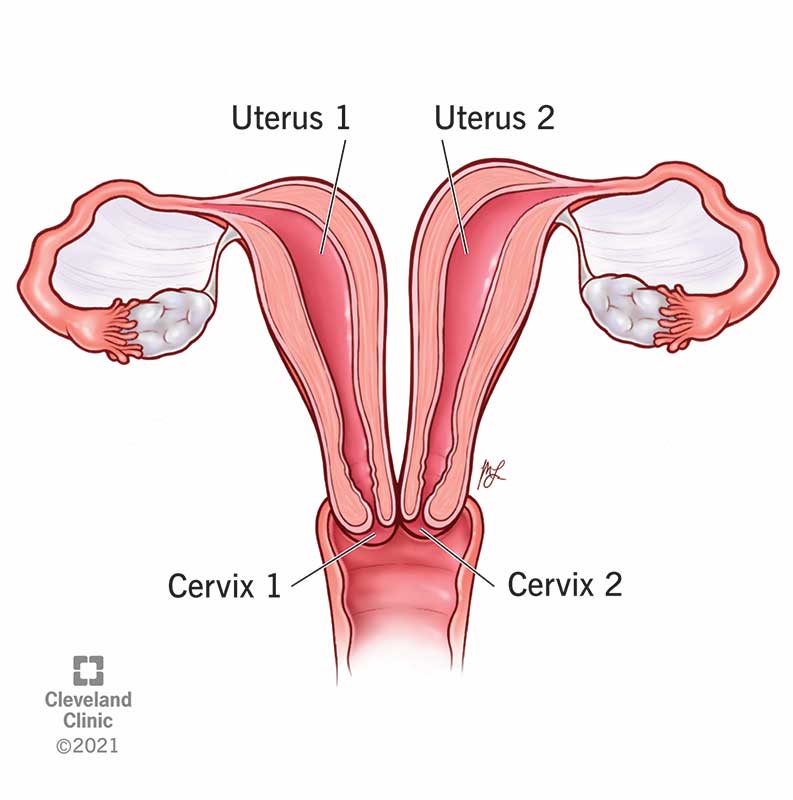
Image content: This image is available to view online.
View image online (https://my.clevelandclinic.org/-/scassets/images/org/health/articles/23301-uterus-didelphys)
Uterus didelphys (or double uterus) is when you have two uteruses. It’s a rare condition that you’re born with. Each uterus has its own fallopian tube and ovary. You may or may not have two vaginas and two cervixes.
Advertisement
Cleveland Clinic is a non-profit academic medical center. Advertising on our site helps support our mission. We do not endorse non-Cleveland Clinic products or services. Policy
Your uterus starts as two ducts. Typically, these ducts fuse together to create your uterus, which is one hollow organ. If you have uterus didelphys, the two ducts don’t fuse. Instead, each duct creates its own uterus, so you’re born with two.
Not necessarily. You could have two vaginas. You can also have one vagina, with a septum (or wall) splitting it into two vaginas. You’ll usually have just one vaginal opening, so you wouldn’t necessarily know you had two vaginas.
Uterus didelphys may not cause any symptoms. Often, a healthcare provider finds it during a pelvic exam.
If you have symptoms, they could include:
Uterus didelphys occurs when two ducts (the Müllerian ducts) don’t fuse properly during fetal development. These ducts usually join to create one uterus. If you have a double uterus, the ducts didn’t join, and each duct turned into its own uterus. Healthcare providers aren’t entirely sure why Müllerian ducts don’t fuse in some people.
A double uterus usually doesn’t cause significant health complications. You and your healthcare provider can work together to manage symptoms of painful periods, pain during sex or heavy menstrual bleeding.
Advertisement
But there are risks during pregnancy. You’re at greater risk for the following complications:
Talk to your healthcare provider if you wish to get pregnant. They can best help you understand the risks of being pregnant with his condition.
Your healthcare provider may diagnose a double uterus during a routine pelvic exam after feeling two cervixes or two vaginas. They’ll likely order additional imaging tests of your uterus to get a closer look. These could include:
Most healthcare providers don’t recommend treating a double uterus unless you have symptoms like recurrent miscarriages or severe pain. If this is the case, your healthcare provider may suggest surgery to fix your double uterus. It involves removing the tissue that divides your uterus (and vagina) in two.
You should contact a healthcare provider anytime you have the following symptoms:
If you have a double uterus, some questions you might ask your provider are:
Yes, you can get pregnant. You may be at an increased risk for pregnancy complications like miscarriage and preterm birth. Your healthcare provider will monitor your pregnancy closely to make sure you and the fetus are healthy.
Generally, a didelphic uterus doesn’t cause infertility.
You won’t have a miscarriage just because you have a double uterus. But your chance of miscarriage is slightly higher. This is because your uterus is smaller, which restricts how the fetus grows. The shape can also affect the placenta and the blood flow within your uterus.
It’s possible, but extremely rare. One study found that the odds of a woman with two uteruses being pregnant in both are 1 in a million.
Usually, yes. If you have two uteruses, both are controlled by the same hormones, so you'll usually have your period from both at the same time. If a partial vaginal septum blocks the flow of blood, your period may last longer or seem like two periods back-to-back.
Uterus didelphys is a condition that happens before you’re born. If you’re pregnant or wish to become pregnant, talk to your healthcare provider about your condition to make sure you can have a safe pregnancy. They may recommend treating your double uterus. Most people with this condition have healthy pregnancies and babies.
Advertisement



Sign up for our Health Essentials emails for expert guidance on nutrition, fitness, sleep, skin care and more.
Learn more about the Health Library and our editorial process.
Cleveland Clinic’s health articles are based on evidence-backed information and review by medical professionals to ensure accuracy, reliability and up-to-date clinical standards.
Cleveland Clinic’s health articles are based on evidence-backed information and review by medical professionals to ensure accuracy, reliability and up-to-date clinical standards.
Cleveland Clinic offers advanced fertility care, along with compassionate, personalized support to guide you through every step of your journey.
