



A heart transplant (cardiac transplantation) is a surgery that replaces your heart with one from an organ donor. This is only done when you’re too sick to survive without a transplant. Because there’s a limited number of donor hearts, you must meet strict criteria to receive one. Many people live at least a decade after their surgery.
Advertisement
Cleveland Clinic is a non-profit academic medical center. Advertising on our site helps support our mission. We do not endorse non-Cleveland Clinic products or services. Policy
Video content: This video is available to watch online.
View video online (https://cdnapisec.kaltura.com/p/2207941/sp/220794100/playManifest/entryId/1_x9ojtf6h/flavorId/1_5f3sgelj/format/url/protocol/https/a.mp4)
Find out how heart transplants work, and what life is like after receiving a new heart. Plus, learn how the surgery happens and what to expect.
A heart transplant is a surgery that replaces your heart with a donated heart from another person. It’s a last-resort treatment for end-stage heart failure. This means your heart has permanent damage or weakness that keeps it from pumping enough blood to your body.
Advertisement
Cleveland Clinic is a non-profit academic medical center. Advertising on our site helps support our mission. We do not endorse non-Cleveland Clinic products or services. Policy
Most people who receive a transplant have heart failure from one of the following:
Heart transplants are possible for children and adults up to age 70 (and in some cases up to age 75).
Although rare, heart transplants are more common now than they used to be. In 2025, surgeons in the U.S. performed 4,587 heart transplants. In 2015, that number was 2,804.
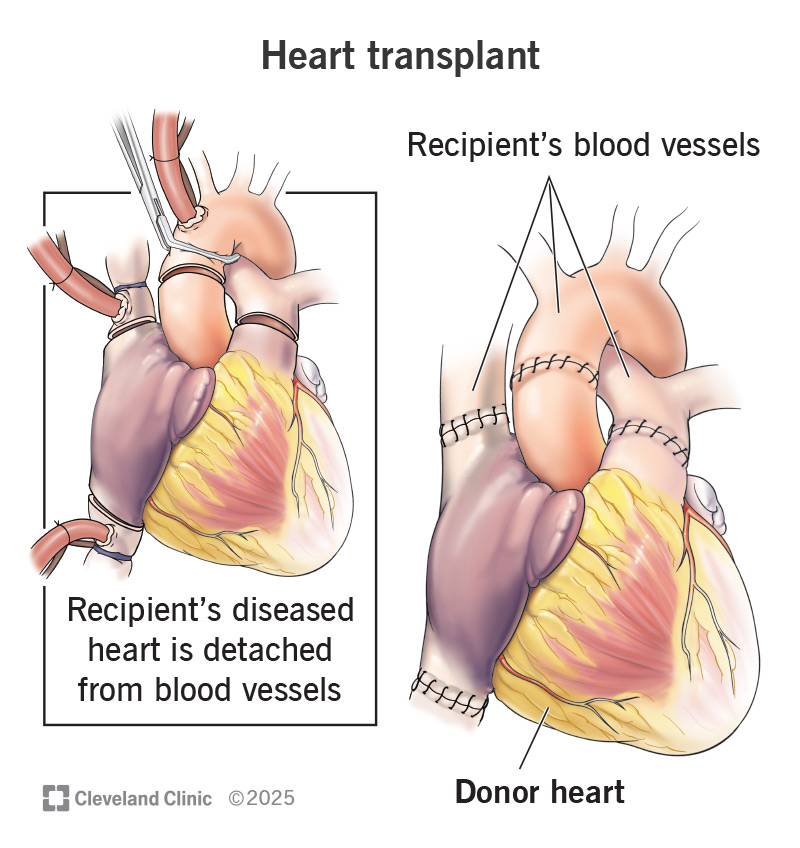
Image content: This image is available to view online.
View image online (https://my.clevelandclinic.org/-/scassets/images/org/health/articles/17087-heart-transplant)
After your cardiologist refers you to a transplant program, you’ll start working with the team there to prepare for surgery. The first step, though, is making sure that you meet the criteria for a heart transplant. If you do, you’ll join the waiting list. While you’re on the waiting list, you’ll receive treatments, like medications or devices, to “bridge” you until transplantation.
Here are the basic steps:
Advertisement
Some people receive a new heart the day they’re added to the list. Others wait months or years. In general, the more urgently you need a heart, the more likely you are to have a shorter wait. But there’s no guarantee.
There are far more people who need a transplant than available hearts. Plus, the donor heart must match your blood type, immune cells and body size.
In the U.S., the United Network for Organ Sharing manages the waiting list and can help you learn more about the process.
During heart transplant surgery, a surgeon detaches your heart from its major blood vessels and then replaces it with a donor heart. It’s a complicated surgery that takes about four to 10 hours. Your care team will perform the following steps:
Your new heart may need help to start beating. If so, your care team may need to use an electrical pacing device. This device works like a pacemaker but doesn’t stay in your body as a permanent pacemaker would.
Possible risks and complications of heart transplant surgery include:
Your care team will closely monitor you for any signs of complications in the days and weeks following your heart transplant. Most deaths due to graft failure occur within 30 days after surgery. Most deaths due to infections occur within the first year.
The biggest advantage of heart transplantation is that it can save your life when you have no other options available. Heart transplantation may be the only option if other treatments:
Advertisement
The biggest disadvantages of heart transplantation are:
The most common risks and complications of heart transplant surgery include:
Other possible complications include:
After surgery, you’ll:
Advertisement
Your incisions should heal in about six to eight weeks. You’ll need several months to fully recover. Heart transplant surgery is complicated and extensive, and those who need a heart are often very sick leading up to the surgery. Recovery times are typically longer than for most heart surgeries.
Survival and life expectancy after a heart transplant depend on many factors, including your age and overall health at the time of the transplantation and any complications that may arise afterward.
Your transplant team can give you the most accurate information based on your situation and your hospital’s outcomes. In general, survival and life expectancy are improving as time goes on. Research shows:
Although a second heart transplant can sometimes be done, surgery and preparation will be more complex than for the first transplant. Some people have received two or three transplants in their lifetime.
Your transplant team will set up a schedule of follow-up visits. These visits are essential for a successful recovery. Your team will talk with you about medications you need to take, as well as when to get preventive dental care, vaccines and routine health screenings.
Advertisement
Call 911 or your local emergency number if you have any of the following symptoms as you recover at home:
Yes. This is called sex-mismatch. In general, females have slightly smaller hearts than males. But your donor heart will be well-matched to you for your size.
No. Research hasn’t shown any changes in psychosocial behavior after a heart transplant.
When you have heart failure, a heart transplant surgery can save your life when medications and devices simply aren’t enough. As you recover, you might feel gratitude for the gift of a donor heart or excitement about the possibilities ahead. But you might also feel sad or overwhelmed — even after a successful surgery.
Talk to your healthcare provider about how you’re feeling. They may recommend support groups where you can connect with others who’ve had organ transplants. A heart transplant is not only lifesaving, but also life-changing. Seeking support and connecting with others can help you feel less alone and more confident on the road ahead.



Sign up for our Health Essentials emails for expert guidance on nutrition, fitness, sleep, skin care and more.
Learn more about the Health Library and our editorial process.
Cleveland Clinic’s health articles are based on evidence-backed information and review by medical professionals to ensure accuracy, reliability and up-to-date clinical standards.
Cleveland Clinic’s health articles are based on evidence-backed information and review by medical professionals to ensure accuracy, reliability and up-to-date clinical standards.
When you need a heart transplant, you’ll want the best care. Cleveland Clinic is recognized as a world leader in cardiovascular care and is here to help you.
