A urinary tract infection is a very common type of infection in your urinary system. It can involve any part of your urinary system. Bacteria — especially E. coli — are the most common cause of UTIs. Symptoms include needing to pee often, pain while peeing and pain in your side or lower back. Antibiotics can treat most UTIs.
Advertisement
Cleveland Clinic is a non-profit academic medical center. Advertising on our site helps support our mission. We do not endorse non-Cleveland Clinic products or services. Policy
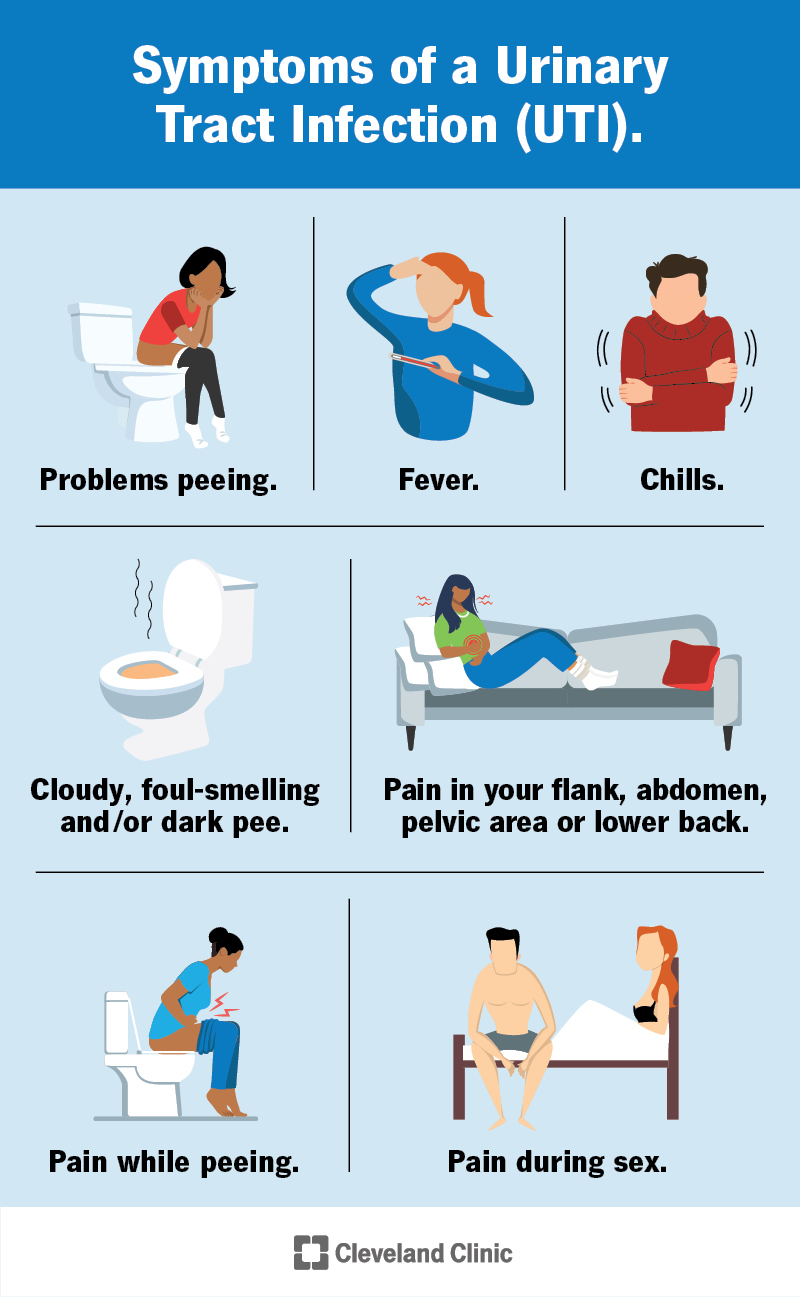
Image content: This image is available to view online.
View image online (https://my.clevelandclinic.org/-/scassets/images/org/health/articles/9135-urinary-tract-infection)
A urinary tract infection (UTI) is an infection of your urinary system. This type of infection can involve your:
Advertisement
Cleveland Clinic is a non-profit academic medical center. Advertising on our site helps support our mission. We do not endorse non-Cleveland Clinic products or services. Policy
Urine (pee) is a byproduct of your blood-filtering system, which your kidneys perform. Your kidneys create pee when they remove waste products and excess water from your blood. Pee usually moves through your urinary system without any contamination. However, bacteria can get into your urinary system, which can cause UTIs.
The urinary tract makes and stores pee. It includes your:
UTIs are very common, especially in females. About half of females will have a UTI at some point during their lives. Males can also get UTIs, as well as children, though they only affect 1% to 2% of children. Healthcare providers treat 8 million to 10 million people each year for UTIs.
Advertisement
Video content: This video is available to watch online.
View video online (https://cdnapisec.kaltura.com/p/2207941/sp/220794100/playManifest/entryId/1_oz7zk300/flavorId/1_5f3sgelj/format/url/protocol/https/a.mp4)
A urinary tract infection is a very common type of infection in your urinary system.
A UTI causes inflammation in the lining of your urinary tract. The inflammation may cause the following problems:
Other UTI-associated symptoms may include:
Microorganisms — usually bacteria — cause urinary tract infections. They typically enter through your urethra and may infect your bladder. The infection can also travel up from your bladder through your ureters and eventually infect your kidneys.
E. coli cause more than 90% of bladder infections. E. coli typically exist in your lower intestines (large intestine).
Anyone can get a urinary tract infection, but you’re more likely to get a UTI if you don't have a penis. This is because your urethra is shorter and closer to your anus, where E. coli bacteria are common.
Yes, it’s possible to get a UTI from your fingers. Your hands can pick up bacteria and other microorganisms whenever you touch a surface. You can accidentally introduce bacteria to your urethra when you go to the bathroom or during sexual acts, including masturbation or fingering.
It’s a good idea to wash your hands before and after going to the bathroom or having sex.
If you have symptoms of a urinary tract infection, talk to a healthcare provider. They’ll ask questions about your symptoms, review your medical history and conduct a physical examination. They can also order tests to help confirm a diagnosis.
A healthcare provider may order the following tests to diagnose a UTI:
If your infection doesn’t respond to treatment, a provider may order the following tests to examine your urinary tract for a disease or injury:
Advertisement
If you get UTIs frequently, a healthcare provider may perform tests to check for other health issues — such as diabetes or an abnormal urinary system — that may contribute to your infections.
The best thing to do for a urinary tract infection is to see a healthcare provider. You need antibiotics to treat a UTI. Your provider will select an antibiotic that works best against the bacteria responsible for your infection.
Once you get a prescription for antibiotics, it’s very important that you follow the directions for taking them. Be sure to take the full course of antibiotics, even if your symptoms go away and you start feeling better. If you don’t finish all your medicine, the infection can return and be more challenging to treat.
If you get UTIs a lot, a provider may recommend that you take antibiotics:
Talk to a provider about your best treatment option if you have a history of frequent UTIs.
Healthcare providers commonly prescribe the following antibiotics to treat UTIs:
Advertisement
If you get UTIs often, a healthcare provider may give you low-dose antibiotics for a short time to prevent the infection from coming back. The provider may recommend this cautious approach to treat frequent UTIs because your body can develop resistance to the antibiotic, and you can get other types of infections, including C. diff colitis. This practice isn’t very common.
Sort of. Every time you use antibiotics to treat a UTI, the infection adapts and can become harder to fight (antibiotic resistance). But the infection becomes immune to the antibiotics, not you. Antibiotics may not always be the best solution. As a result, a healthcare provider may suggest alternative treatments if you get frequent urinary tract infections. These may include:
Advertisement
Cranberry juice that you can buy at the grocery store doesn’t prevent a UTI. However, cranberry extract supplements (vitamin pills) may decrease your chances of getting a UTI.
If you get UTIs often, methenamine hippurate is another nonantibiotic alternative that helps prevent infections.
Minor urinary tract infections can sometimes get better on their own. However, most UTIs need antibiotics to go away. You absolutely need antibiotics if you have a UTI as well as:
Most people feel better within a few days after starting antibiotics to treat a UTI.
The outlook for urinary tract infections is good. Most UTIs usually respond very well to treatment. A UTI can be annoying or uncomfortable before you start treatment. However, once a healthcare provider identifies the bacteria and prescribes the appropriate antibiotic, your symptoms should improve quickly.
It’s important to finish all of the antibiotics that your healthcare provider prescribes. If you have frequent UTIs or your symptoms aren’t improving, your provider may test to see if your infection is resistant to antibiotics. Antibiotic-resistant infections may require IV antibiotics or other treatments.
The following lifestyle changes can help prevent urinary tract infections:
Practicing good hygiene is one of the best ways to help prevent UTIs. This is especially important if you have a vagina because your urethra is much shorter, and it’s easier for E. coli to move from your rectum back into your body. Always wipe from front to back after a bowel movement (pooping) to avoid this.
During your menstrual cycle, it’s also a good idea to regularly change your period products, including pads and tampons. You should also avoid using any deodorants on your vagina.
Drinking extra fluids — especially water — each day can help flush out bacteria from your urinary tract. Healthcare providers recommend drinking six to eight glasses of water daily.
Peeing can play a big role in getting rid of bacteria from your body. Your pee is a waste product, and each time you empty your bladder, you help remove that waste from your body.
Peeing frequently can reduce your risk of developing an infection, especially if you get UTIs a lot.
You should also try to pee right before and right after having sex. Sex can introduce bacteria to your urethra, and peeing before and after sex helps flush it out. If you can’t pee, wash the area with warm water.
You may have an increased risk of developing a UTI if you use a diaphragm for birth control. Talk to a healthcare provider about other birth control options.
If you use lubricant during sex, make sure it’s water-based. You should also avoid spermicide if you have frequent UTIs.
Tight-fitting clothing can create a moist environment, which promotes bacterial growth. You can try loose-fitting clothing and cotton underwear to prevent moisture from accumulating around your urethra.
If you’re postmenopausal, a healthcare provider may suggest a vaginal cream that contains estrogen. These creams may help reduce your risk of developing a UTI by changing the pH of your vagina. Talk to a healthcare provider if you’re postmenopausal and get a lot of UTIs.
Over-the-counter (OTC) supplements — including cranberry extract and probiotics — may also help prevent UTIs. Talk to a healthcare provider before you start taking any supplements.
Call a healthcare provider if you have symptoms of a UTI. Call them again if they diagnosed you with a UTI and your symptoms worsen. You may need a different treatment.
Go to the emergency room if you have a UTI and develop the following symptoms:
A UTI is an infection in your urinary system, which may include your kidneys, ureters, bladder or urethra. Cystitis is a type of UTI. It’s an infection in your bladder, and it’s the most common type of UTI.
A urinary tract infection is a more general type of infection. There are many parts of your urinary tract. A UTI is a term for an infection that takes place throughout your urinary tract.
A bladder infection is a specific infection that makes its way to your bladder and causes inflammation. Another name for a bladder infection is cystitis.
Not all UTIs become bladder infections. It’s important to treat a UTI quickly to prevent the infection from spreading to other areas of your urinary tract. The infection can spread not only to your bladder but also to your kidneys. Kidney infections are a more complicated type of infection. Another name for a kidney infection is pyelonephritis.
Urinary tract infections are when you have an infection in your urinary system. You may feel embarrassed if you have symptoms that affect your genitals or cause incontinence, but it’s OK — you haven’t done anything wrong. A healthcare provider can prescribe antibiotics to treat the infection, and your symptoms should go away in a few days. Follow your provider’s instructions and take your full course of antibiotics to ensure the UTI goes away.



Sign up for our Health Essentials emails for expert guidance on nutrition, fitness, sleep, skin care and more.
Learn more about the Health Library and our editorial process.
Cleveland Clinic’s health articles are based on evidence-backed information and review by medical professionals to ensure accuracy, reliability and up-to-date clinical standards.
Cleveland Clinic’s health articles are based on evidence-backed information and review by medical professionals to ensure accuracy, reliability and up-to-date clinical standards.
Need care fast? Cleveland Clinic’s Express Care and Urgent Care locations treat everything from sprains to sinus infections — no appointment needed.