



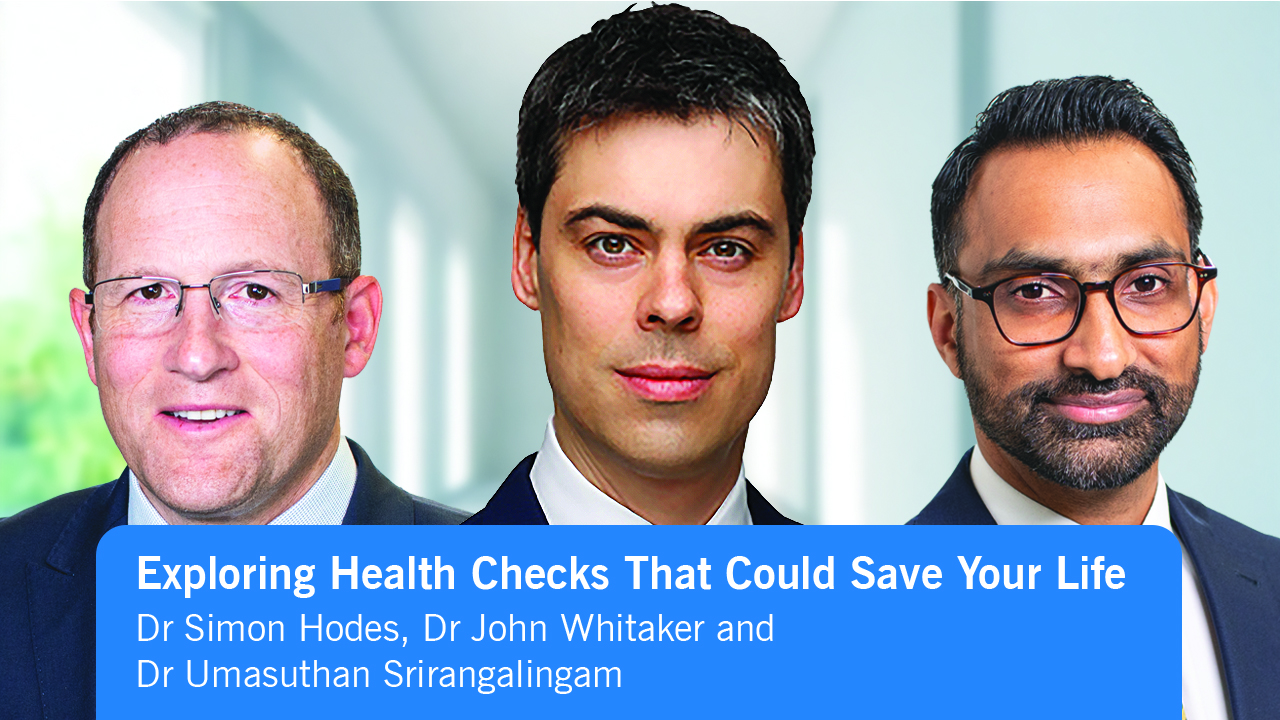
Exploring Health Checks That Could Save Your Life (Part 2) - Dr Simon Hodes, Dr John Whitaker and Dr Umasuthan Srirangalingam
In this episode of Exploring Health with Cleveland Clinic London, host Mr Kash Akhtar, consultant orthopaedic knee surgeon, continues his conversation with our guest about health checks that could save your life. Dr Simon Hodes, a general practitioner at Cleveland Clinic London with a focus on men’s health, preventative medicine, and health screening, shares practical insights from primary care. Dr John Whitaker, consultant cardiologist and cardiac electrophysiologist, specialises in heart rhythm disorders, atrial fibrillation, and cardiac risk assessment. Dr Umasuthan Srirangalingam, consultant physician in endocrinology and diabetes, brings expertise in diabetes, thyroid, and hormonal health.
Advertisement
Cleveland Clinic is a non-profit academic medical center. Advertising on our site helps support our mission. We do not endorse non-Cleveland Clinic products or services. Policy
Recent Episodes
Exploring Stroke with Dr Arvind Chandratheva
In this episode of Exploring Health with Cleveland Clinic London, host Mr Kash Akhtar, Consultant Orthopaedic Knee Surgeon, is joined by Dr…
Exploring Health Checks That Could Save Your Life (Part 1) - Dr Simon Hodes, Dr John Whitaker and Dr Umasuthan Srirangalingam
In this episode of Exploring Health with Cleveland Clinic London, host Mr Kash Akhtar, consultant orthopaedic knee surgeon, is joined by thr…
Exploring Endometriosis – Mernalin’s Story with Mernalin Ervi Sana, Miss Asli Ucyigit and Mr Fevzi Shakir
In this episode of Exploring Health with Cleveland Clinic London, host Mr Kash Akhtar is joined by three guests who bring both clinical expe…
Video content: This video is available to watch online.
View video online (https://cdnapisec.kaltura.com/p/2207941/sp/220794100/playManifest/entryId/1_ixgnjvc1/flavorId/1_5f3sgelj/format/url/protocol/https/a.mp4)
Transcript
Mr Kash Akhtar:
Sri. Another huge area is metabolic and hormonal health. Which conditions are most commonly missed or picked up late in your experience?
Advertisement
Cleveland Clinic is a non-profit academic medical center. Advertising on our site helps support our mission. We do not endorse non-Cleveland Clinic products or services. Policy
Dr Sri:
Yeah. So I think we were talking about thyroid disease, incredibly common, and there can be signs of thyroid disease long before actually the patient gets symptoms. So we know that thyroid disease, there are three kind of issues we have with patients with thyroid issues. One, an overactive thyroid, too much thyroid hormone, an underactive thyroid, not enough thyroid hormone, and we often get nodules in the thyroid. So all of these things, and so the overactive, underactive thyroid, the commonest causes are autoimmune disease. So people are making antibodies to the thyroid gland.
Mr Kash Akhtar:
Attacking their own thyroid.
Dr Sri:
Attacking their own thyroid gland, and it can either stimulate the thyroid, makes too much hormone, or causes inflammation and it slowly becomes underactive. And so again, we were talking about family history, it's a recurring thing. So we don't routinely do screening of thyroid function, but if someone's got a family history of not just thyroid disease, but any autoimmune disease. And so it's worthwhile just thinking about, well, what are those? So Type 1 diabetes, Celiac disease, B12 deficiency, vitiligo, the white patches on the skin, and Addison's disease, all of those are autoimmune diseases. And often if someone's got one autoimmune disease, they may have others. So if you just see the family history or someone's got a thyroid problem, you say, does anyone else in the family have this? And they say, oh yeah, they've got this. So you often see the family history. So that can be incredibly useful.
Advertisement
And remember, again, thyroid disease, if you look at the symptoms, so an under-actified, how did these patients present? And it's things, again, in a kind of very non-specific way. So patients will feel tired, they may complain of brain fog, they will complain of weight gain. It can have effects on the bowel, so constipation, skin is dry, and it kind of affects on mood. In fact, one of the cases which I do remember is I had a guy who was doing his PhD, obviously a very bright guy, and he came in and he said, my supervisor said, I must see an endocrinologist. And he was profoundly hypothyroid, his thyroid function was low. So I came, he was moving slowly, he was speaking slowly, and you could see that his thyroid was clearly having effect and he hadn't particularly noticed it. And he was trying to do a PhD.
Mr Kash Akhtar:
But his supervisor picked it up?
Dr Sri:
Yeah, obviously not making progress. So often it can be that the person themselves actually, again, as we said, just says, oh, you know…
Mr Kash Akhtar:
Well, the symptoms you described, a lot of people would attribute to modern life, or perimenopause, or so many other things.
Dr Sri:
Correct. So I think it's really important. I think there are two important points that one is to when you've got symptoms, to get them investigated. The flip side is also true that patients will come to me and again, in the modern era of the internet and AI tools, which tell them what they've got, they will say, I have definitely got this problem. And the nice thing about endocrinology is you do the test and if the test is normal, it's normal. So I'm often saying, I'm hedging my bets with patients, I'll say to them, look, I'm very happy to do the test, but if the test is normal, it's not that. So that's why, because the symptoms really do overlap, but the test is so easy to do and the treatment is so easy and it can be really transformative.
Mr Kash Akhtar:
And I was going to ask this, but you kept saying test?
Dr Sri:
Yes.
Mr Kash Akhtar:
So testosterone, it's epidemic amongst young men now and men of a certain age, or having it tested and thinking that test TRT or replacement therapy is the cure. That's the reason I can't put on muscle. That's the reason I can't lose weight…
Dr Sri:
Yeah. Well, we were literally just discussing this before the podcast. My heart sink was, as you said, there's a tube station, I can't remember, I was at the same one, the whole station is plastered with a company, I won't name them, just saying, are you tired? Could it be your testosterone? But it was the whole platform.
Dr Simon Hodes:
A whole range of symptoms, weren't there? Every symptom, as you said, modern life, T, T, T.
Dr Sri:
So look, testosterone deficiency is very important. A group of men do get it. But remember, we're in the business of identifying testosterone deficiency, which is not reversible and there isn't a cause for it, which is not in the endocrine system. So we treat those patients where we find that. But it's really…
Mr Kash Akhtar:
It's a small subset, I imagine.
Dr Sri:
It's a small subset, but there are a lot of men with a low testosterone where it's reversible or a cause which you can reverse. And this is often what I'm saying in clinic to the young man who comes along with low testosterone, there's some issues in the way we measure. So remember, testosterone is highest at nine o'clock in the morning, fasting from midnight. If you eat, your testosterone temporarily drops down about 25%, so you must do it fasting nine o'clock in the morning. If you measure your testosterone at five o'clock in the afternoon, it may well be low, but that's totally physiological.
Advertisement
Mr Kash Akhtar:
It's normal.
Dr Sri:
So a number of things. If you don't sleep at night, your testosterone may be low. If you've got intercurrent illness, testosterone will be low. I often say if you go to ICU and measure the testosterone, it will be flat. So that's a stressed response, but it recovers. But if you happen to catch it at that point, you'll say, and this is what happens, people measure a low testosterone and they say, I need testosterone. The classic one which I haven't mentioned is obesity. And this is what we see a lot of. It's useful just to understand the physiology of it and it makes it clear. Men convert testosterone into oestrogen in adipose tissue. It's aromatised. And if the oestrogen levels go too high, that's detected by a gland in the brain, the pituitary gland, and it says there's too much oestrogen. We need to switch this off. And the way it does that, unfortunately, is it switches everything off. So if the testosterone drops down, you make less oestrogen. So a man who is overweight will often have a low testosterone. But the solution is not testosterone. The solution is to lose weight.
Mr Kash Akhtar:
Because otherwise, if they're taking exogenous or external testosterone, the brain is thinking even more so, turn off the body's own production of testosterone?
Advertisement
Dr Sri:
Absolutely. So the other thing I say to young men who are thinking about it's a rabbit hole once you start. So if you are genuinely deficient and there's no other cause that you can reverse, then it's entirely appropriate. And there are health benefits to testosterone. But if you have actually a normal axis, but you've measured a low testosterone and there's one of these factors and you haven't picked that up, and you go on testosterone, there are lots of implications. The body's very clever. It detects what's coming in, and it will adjust what it does. So if I give you testosterone, your body will say, oh, there's testosterone here, we don't need to make any. The testes shrink down, and people don't mention that, testes get smaller, it's bad for fertility. Remember your spermatogenesis gets inhibited, and so sperm counts go down. And there's this risk of red blood cells. So you make more red blood cells when you're on lots of testosterone, so you can get polycythaemia, a high red cell count, sticky blood, which is a risk factor for everything. So it's not without risk.
Mr Kash Akhtar:
Yeah. But will I get jabbed? No, it's not a joke, but on social media, I'm sure there are a lot of men with normal testosterone levels who are taking testosterone from it. I'm sure you see this. Dr Sri: Absolutely. And if you go to the States and you just watch just standard adverts, testosterone is being advertised to the public. And so I do see it's very country dependent. We're fortunate in the UK, the guidelines are very clear, and they're quite stringent, but I think it means that... So I think what is going to happen, especially, again, with social media and people discussing it, is a lot of people in gyms, I'm aware you can get all of these things very easily. But I think people really need to understand, one, the dangers of when you measure the testosterone, is it what you think it is? And two, what are the implications of treatment? If you understand all those things, fine.
Advertisement
We've also got into, and it's an interesting issue, that medicine historically, we would treat disease. if there's a deficiency, we treat it. A lot of patients are coming to us now and saying, oh, actually, I've got a normal testosterone, but I want to optimise my testosterone, and that's where…
Mr Kash Akhtar:
And you would discourage that?
Dr Sri:
Yeah. We treat deficiency. We're not in the business at the moment, and maybe things will change over time of saying. But remember, a lot of lifestyle factors, you can optimise your testosterone by doing natural things, all the things doctors say, which are what patients are saying, but it's all of those things, and you can make a case for sleep, testosterone goes up, losing weight, testosterone goes up, etc.
Mr Kash Akhtar:
Can you explain what metabolic syndrome is?
Dr Sri:
Yeah. So metabolic syndrome is a series of health conditions which align together and essentially increase cardiovascular risk. So the things that we traditionally would include in that would be a slightly high fasting glucose, so the pre-diabetes type of scenario. We get dyslipidaemia or abnormal lipids, so cholesterol. It can be associated with fatty liver, so fat deposits in the liver, and the discussion about waist circumference is very important. So we know that the way fat is distributed is critical, and so patients with metabolic syndrome have this visceral fat, so the fat around the tummy. We talk about different shaped bodies, don't we? There's this thing about apple-shaped and pear-shaped, and that really is talking about where the fat is distributed. So it's that visceral adiposity or fat which kind of predisposes to the metabolic syndrome.
Mr Kash Akhtar:
This metabolic syndrome is responsible for lots and lots of disease in different parts of the body.
Dr Sri:
Correct. So it's really important to just understand that visceral fat, why is fat in that part of the body important? The reason is that it's metabolically active and it generates an inflammatory response, lots of signs of kinds, and we've talked about inflammatory disease being a risk factor for cardiovascular disease. So it increases insulin resistance, you get fat deposition in the liver, you get some spillover into the pancreas, pancreatic cells don't work, insulin production, and it just proceeds from there.
Mr Kash Akhtar:
So it's interesting to summarise that section. If someone feels constantly tired, gaining weight, sleeping badly, doesn't feel themselves, they should think about seeing someone and having some tests done?
Dr Sri:
Absolutely. I think getting some basic hormonal testing, looking at your metabolic profile, all of those things are really important. The tests are relatively easy to do, we've got ways to treat it, and remember, there is this period where disease is silent, but it's having an effect in the body, and if you pick it up then you're reducing the risk of complications in the future.
Mr Kash Akhtar:
So the message is clear that these are not vague or trivial symptoms, sometimes the first sign is something medically quite important?
Dr Sri:
Yeah. I think you should take them seriously, get them checked, but once you've got the testing and if it looks clear, then fine, you can be reassured, and it's life, one life. But you may pick up something where you can actually make a difference.
Mr Kash Akhtar:
Thank you. Simon, we've talked about a lot of screening in terms of cardiovascular factors, in terms of metabolic, endocrine, blood sugar, blood factors. There are other types of screening, there's cancer screening. What are the basics of cancer screening?
Dr Simon Hodes:
So there's no test that will rule out cancer. We are seeing increasingly that there's certain blood tests, there's one called the Galeri, which is worth a Google off or a look, and this is a multi-cancer panel test.
Mr Kash Akhtar:
Is that available now? Because I read about it a few years ago.
Dr Simon Hodes:
It's available in the USA, it's not licenced in the UK. We're always quite kind of cautious inside the UK before we introduce things, and there's just been a huge trial within the NHS looking at how effective it is, and it just actually was out recently as well, and they've decided that they don't feel it's good enough or safe enough to use in the UK, for two reasons, one is it can give false reassurance, people think I'm fine, and also it causes a lot of anxiety. Those cancer tests are not really quite there yet, there's other ones on the market in the UK that people get that can be useful.
Mr Kash Akhtar:
Do you do blood tests for cancer in the cancer screening?
Dr Simon Hodes:
Well, the standard ones that are done for men would be a PSA for prostate cancer, which we've kind of discussed the pros and cons of that, and some sort of smart screening. For women there's a test called a CA125, which is an ovarian cancer screen, which is a useful test. Again, women have symptoms of, often it's very vague, bloating or abdominal pain, sometimes has a change in bowel habit, you'd always do that test, certainly in women over the age of 40, it's something you'd be thinking of as a GP. There is a test called an LDH, which is a lactose dehydrogenase, which is a sort of nonspecific test that can go up in information, can be a marker for some hard tumours like lymphomas, that's useful.
There's some sort of other tests around like a CA119, which are looking for abdominal tumours and pancreas, they're not generally done for screening because it's back to this thing, they talk about false negatives and false positives, the tests can cause a lot of anxiety when they're elevated and they can miss cancer. So they're not generally done in our screens at the Cleveland, but a lot of other places will do them. So it might be in the future they'll improve and there'll be more tests coming out.
Mr Kash Akhtar:
And I guess given your smart screening, you will do the appropriate test if you think there's a concern for something?
Dr Simon Hodes:
Correct, if there's a family history. I think a lot of screening now is done through scanning as well, which we've not talked about, I don't know if you want to touch on that now or not.
Mr Kash Akhtar:
Do please. Yeah.
Dr Simon Hodes:
So in terms of scanning, I think we're moving into an era of MRI scanning a lot more for screening. The thing that's really worth saying to patients, and again, it's something you have to read about, I've discussed with a radiologist, is there are far less specific scans than an MRI. So say, I mean, you probably understand knee MRIs pretty well, I would imagine.
Mr Kash Akhtar:
Yeah. It's my baby.
Dr Simon Hodes:
Exactly, right. But that's a really detailed scan of a knee, probably takes, how long in the scanner?
Mr Kash Akhtar:
20 minutes.
Dr Simon Hodes:
20 minutes, right. So a full body scan can take 35 to 40 minutes, maybe 35 on the new scanners, and they're doing the whole body. So you can work out from that.
Mr Kash Akhtar:
20 minutes to one knee.
Dr Simon Hodes:
Right, exactly. So we're saying it's a far less detailed scan of lots of body parts. So it's a good scan, but it can still miss things. But you literally get brain, thyroid, spine, chest, abdominal cavity. They're amazing scans. Prostate. Doing a dedicated scan of a body part, for example, your brain, your prostate for men, your pelvis for a woman, phenomenal scans, give you a lot of information and reassurance. So they're really good scans. And actually, your algorithm in the NHS, if anybody has a raised PSA now, it's pretty much get an MRI scan. It's what you do. You know, severe headaches or neurological symptoms, you get an MRI brain dedicated. So MRI scans getting there.
Again, the downside is that you're probably, false reassurance is one thing when they're normal, although they're very, very good scans, they're probably not going to miss much. But the flip side is they're so sensitive, they pick up lots of what we call incidental findings. And that means you might pick up a little bit of something, something that then needs to be scanned again down the line every six months or 12 months to see what's going on. So those incidental findings are something to be thought about.
Mr Kash Akhtar:
Really come a long way. I mean, since I was urology SHO, we'd have to do a digital rectal exam on everyone in the clinic. And it's amazing how much things have progressed. I'm glad they have. What about mental health? Does that come into it?
Dr Simon Hodes:
So yeah, mental health is obviously a huge topic. I mean, really, sadly cause of death age 20 to 34, I think in the UK, the leading cause is self-inflicted harm and poisoning. It's a very sad statistic. And I think society is becoming increasingly disconnected while we're becoming more connected through social media. People are living much more kind of isolated lives, living online, whether that's driving mental health a bit more, possibly, I don't know, there's huge talks about banning smartphones in schools, et cetera, which they've gone for in Australia and they're debating in our government now, so that could be good. But mental health, if we see patients, we generally do a screen about the mental health, ask about their mood, where they are. There's different grading scales for things like anxiety and depression, which are very commonly used. And if anyone's listening or watching the podcast, there's go online, PHQ-9 is up there, GAD score for your stress or anxiety levels. Really useful markers just to see if what you've got is out of the norm. There's great resources. The NHS site is very good for mental health. Something called MIND, which is a national charity, has really good resources, 24-7 help through NHS and place like Samaritans. So yeah, that's very, very important.
Mr Kash Akhtar:
Thank you. And what is a personalised health assessment at Cleveland Clinic London? What does that look like? So I'm assuming it's history examination, blood tests, ECG, blood pressure, pulse. What else is there?
Dr Simon Hodes:
Yeah, I mean, you look at it as an MOT, and again, we made this analogy that people do get their car checked once a year, and we spend thousands on our cars, and it's a really good chance, like going to the dentist to get a proper check, you get your blood pressure checked. Obviously, you could do that at home. ECG, an exercise or a stress test of some sort, a panel of blood tests, which would include sort of anaemia markers, iron status profile, thyroid, your diabetes levels, your fasting sugar, your B12, vitamin D, liver, kidney. So it's quite a thorough panel. There's cancer screening in terms of a CA125 for women and a PSA for men. So those are the common things.
In the higher end health checks, we have diagnostics, which include MRI scan of a body part from the brain, prostate, or abdomen. So it depends on what the patient wants. Heart scanning, if it's not been done for five years, over the age of 40, so you'd get normally a CT scan of the heart with or without a contrast dye, a scan of the neck, ultrasound of the abdomen, which is really important. Again, looking at the main blood vessel, the aorta, which can get dilated, have disease, looks at all the internal organs, so, you know, huge amount of information. And I think people leave these checks, obviously, that's the diagnostics, head to toe exam from a GP, and there's an hour with a GP, which is really quality just to get into detail about lifestyle, mental health, sleep we really focus on, nutrition, everything is very, very personalised. The body composition is actually, I think, a big talking point. So these things look like a cross trainer, people see these in the gym, but rather than just measuring your BMI, height and waist, they're measuring your body fat mass, your fat mass percentage, your skeletal muscle, your muscle in different areas, a phenomenal detail.
Mr Kash Akhtar:
Does it burn density as well, or give you an idea of it?
Dr Simon Hodes:
It doesn't, no, but it gives you an idea of where you are. We've had some patients go up and do a formal kind of body density scan, and the results we get on our body composition scores are very similar. Bone density is different, and that's something that is offered at the higher end screens as well. And again, we encourage…
Mr Kash Akhtar:
Via a DEXA scan?
Dr Simon Hodes:
Via a DEXA scan for women over the age of 40, men over the age of 70.
Mr Kash Akhtar:
Which also gives great understanding of body composition.
Dr Simon Hodes:
Well, that's more just for bone health, actually, the body composition from that, and obviously for women, there's a breast screening from age 40, you know, you'd recommend in the private sector a mammogram every year from age 40, it's a bit later in the NHS. Bowel cancer is also common, so there's a Q-fit, which is the poo test, which you will get in the NHS as well, I think from your 40s you get every two years, but in the private sector you get it every year. And a urine test, again, looking for things like blood, infection, proteins. So proteins are a marker for kidney disease, blood can be there with. We've picked up renal cancers and bladder cancers from hidden blood in the urine. So it's back to the same story of the simple checks are going to give you detail about disease at an early stage, often when it's silent, where you can intervene quicker, where you can make changes to your lifestyle to prevent or reverse things and get everything done.
Mr Kash Akhtar:
So remarkably comprehensive and thorough tests, and yet relatively non-invasive other than a blood test, you know, a needle from the blood, there's not much else?
Dr Simon Hodes:
Needle from the blood, some diagnostics, yeah. I mean, patients, generally a lot of them are lucky, they'll get it done through their corporate schemes, they come in once a year, and you get to know patients really well. I've been to the Cleveland now, we opened September 21, so I've seen patients three, four, five times for health screens, and again, they treat it like a dentist appointment or an MOT, they like to know, and they feel very reassured, and you pick up a lot of disease along the way, which is then, can be managed or referred on. So patients find it hugely reassuring, particularly when there's a family history of something, or just to know they can optimise their health, or correct vitamin deficiencies you often pick up, thyroid problems, etc, etc.
Mr Kash Akhtar:
And would you recommend it's done annually?
Dr Simon Hodes:
I think from the age of 40, it's really useful, it's a fairly inexpensive test, we get a lot of patients that come and self-pay. I think it's really rich. I went through it myself with my wife, because I thought it was good. I'm now in my early 50s, and lots of patients, when you graduate as a doctor, everyone's older than you, you're in your 20s, and you think, oh, these are all old people, we've all been there, and suddenly, like, people start getting things, like, oh, crap, they're my age, and now we're seeing, like, proper serious disease of people in my age group. Well, actually, I don't want to, kind of, I'd rather find out I had a heart disease at an early stage and treat it.
Mr Kash Akhtar:
So essentially what you're saying is that good preventive medicine isn't about a blanket approach, but doing the right test for the right person at the right time?
Dr Simon Hodes:
Yeah.
Mr Kash Akhtar:
Perfect. Before we close, we've talked about lifestyle factors that generally make the biggest difference, we talked exercise, nutrition, sleep, stress management, stopping smoking, appropriate alcohol, maintaining muscle mass, healthy weight, is there anything else that you guys would suggest to that?
Dr Simon Hodes:
I was trained as a GP, if you look at the blue zones around the world, these are the places where people live till they're old age.
Mr Kash Akhtar:
Okinawa, Mediterranean, these kind of things.
Dr Simon Hodes:
What are the factors there? So it is about meaningful relationships. It's about a sense of community. It's often about having a faith, I mean, it could be a football team, but it could be a religion. It's about intergenerational living. It's about eating a healthy diet, which is probably largely plant-based with a bit of meat or fish in there. Those are the common factors. They don't have first-world medicine in a lot of these places, but they live to a good old ripe age. And actually, there's this fascinating study, which is the Harvard study of adult development, which has been going since like the 1930s, and they've tracked patients for generations thinking is it the cholesterol, is it the blood pressure, is it the plaque, and actually the leading factor leads to happy, healthy lives, guess what? It's happy, meaningful relationships.
So actually, I think we should prioritise our relationships and all kind of for our well-being, and it sounds really boring, but kind of kindness and gratitude, yoga, meditation, keeping your mind fit, but also prioritising our social interactions as much as anything else, really important for your overall health.
Dr Sri:
Yeah, I would totally agree with that. And I will sometimes, so as an endocrinologist, we might get patients who come along and saying, I'm feeling very tired, brain fog, etc. and it's a young person working in the financial services. They're working till two o'clock in the morning. And they're asking me, is there a hormonal cause for this when it's very clear that actually work-life balance in the modern era is something that we do need to address. And as you're saying, having time to do things that you enjoy, mindfulness, meditation, it doesn't really matter, but just time away from work and getting the balance right, critically important.
Dr John Whitaker:
Paying attention to your mental well-being. Yeah, completely agree.
Mr Kash Akhtar:
Yeah, I love it. I didn't expect it to go there. That's a really nice way to round things up. So today we've talked about the health checks that can pick up serious problems before they become life-changing events. We've covered blood pressure, cholesterol, heart rhythm, diabetes risk, thyroid health, broader preventive care, and why knowing your numbers matters. And the message running through all of this is quite simple. Feeling well is not the same as being well, and prevention gives us the chance to act early rather than when it might be too late.
Thank you to my guests, Dr Simon Hodes, Dr John Whitaker, and Dr Sri. Thank you for sharing your expertise and giving us insight into the preventive and diagnostic care available here at Cleveland Clinic London. I'd encourage everyone watching or listening to think proactively about your health, book the checks that you may have been putting off, and share this episode with someone who needs that reminder because for some people, early detection doesn't just improve your health, it could save your life.
You've been listening to Exploring Health with Cleveland Clinic London. I've been your host, Kash Akhtar. If you'd like to learn more, you'll find links and resources in the show notes and on the Cleveland Clinic London website. And if you found this episode helpful, please subscribe, leave a review, and share it with someone who needs to hear it. Remember, informed health is empowered health. Until next time.
Recent Episodes
Exploring Stroke with Dr Arvind Chandratheva
In this episode of Exploring Health with Cleveland Clinic London, host Mr Kash Akhtar, Consultant Orthopaedic Knee Surgeon, is joined by Dr…
Exploring Health Checks That Could Save Your Life (Part 1) - Dr Simon Hodes, Dr John Whitaker and Dr Umasuthan Srirangalingam
In this episode of Exploring Health with Cleveland Clinic London, host Mr Kash Akhtar, consultant orthopaedic knee surgeon, is joined by thr…
Exploring Endometriosis – Mernalin’s Story with Mernalin Ervi Sana, Miss Asli Ucyigit and Mr Fevzi Shakir
In this episode of Exploring Health with Cleveland Clinic London, host Mr Kash Akhtar is joined by three guests who bring both clinical expe…
Never miss a moment - subscribe now.
Listen to the Health Essentials Podcast on your favorite streaming platform.
Other Podcasts You May Love
Health Essentials
Tune in for practical health advice from Cleveland Clinic experts. What's really the healthiest diet…
Love Your Heart
A Cleveland Clinic podcast to help you learn more about heart and vascular disease and conditions af…
Nurse Essentials
Nurse Essentials is a podcast about all things nursing - from tips for making your next shift easier…
Neuro Pathways
A Cleveland Clinic podcast for medical professionals exploring the latest research discoveries and c…