



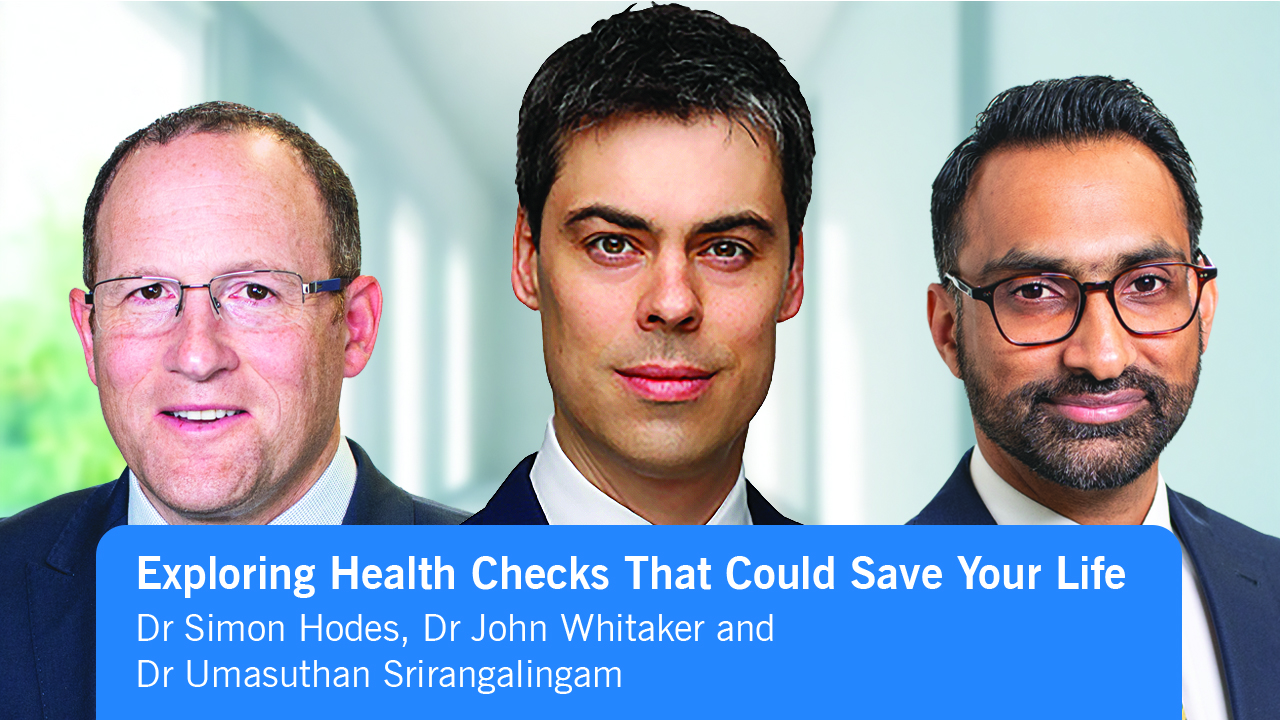
Exploring Health Checks That Could Save Your Life (Part 1) - Dr Simon Hodes, Dr John Whitaker and Dr Umasuthan Srirangalingam
In this episode of Exploring Health with Cleveland Clinic London, host Mr Kash Akhtar, consultant orthopaedic knee surgeon, is joined by three expert guests to discuss health checks that could save your life. Dr Simon Hodes, a general practitioner at Cleveland Clinic London with a focus on men’s health, preventative medicine, and health screening, shares practical insights from primary care. Dr John Whitaker, consultant cardiologist and cardiac electrophysiologist, specialises in heart rhythm disorders, atrial fibrillation, and cardiac risk assessment. Dr Umasuthan Srirangalingam, consultant physician in endocrinology and diabetes, brings expertise in diabetes, thyroid, and hormonal health.
Advertisement
Cleveland Clinic is a non-profit academic medical center. Advertising on our site helps support our mission. We do not endorse non-Cleveland Clinic products or services. Policy
Recent Episodes
Exploring Stroke with Dr Arvind Chandratheva
In this episode of Exploring Health with Cleveland Clinic London, host Mr Kash Akhtar, Consultant Orthopaedic Knee Surgeon, is joined by Dr…
Exploring Health Checks That Could Save Your Life (Part 2) - Dr Simon Hodes, Dr John Whitaker and Dr Umasuthan Srirangalingam
In this episode of Exploring Health with Cleveland Clinic London, host Mr Kash Akhtar, consultant orthopaedic knee surgeon, continues his co…
Exploring Endometriosis – Mernalin’s Story with Mernalin Ervi Sana, Miss Asli Ucyigit and Mr Fevzi Shakir
In this episode of Exploring Health with Cleveland Clinic London, host Mr Kash Akhtar is joined by three guests who bring both clinical expe…
Video content: This video is available to watch online.
View video online (https://cdnapisec.kaltura.com/p/2207941/sp/220794100/playManifest/entryId/1_s32ehorv/flavorId/1_5f3sgelj/format/url/protocol/https/a.mp4)
Transcript
Mr Kash Akhtar:
Welcome to the latest episode of Exploring Health with Cleveland Clinic London. Thank you to Cleveland Clinic Philanthropy UK for supporting this podcast. I'm your host, Kash Akhtar, consultant orthopaedic knee surgeon. Today's episode is about health checks that could save your life because some of the most serious conditions from high blood pressure, cholesterol, and atrial fibrillation to diabetes and thyroid disorders can be present long before someone feels unwell. So today we're talking about what to check, when to check it, and why prevention is one of the most powerful tools we have in medicine.
Advertisement
Cleveland Clinic is a non-profit academic medical center. Advertising on our site helps support our mission. We do not endorse non-Cleveland Clinic products or services. Policy
Joining me today are three expert guests, Dr Simon Hodes, general practitioner at Cleveland Clinic London with particular interest in men's health, preventative medicine, and health screening. Dr John Whitaker, consultant cardiologist and cardiac electrophysiologist who specialises in heart rhythm disorders, atrial fibrillation, and cardiac risk assessment. And Dr Sri, consultant physician in endocrinology and diabetes with expertise in diabetes, thyroid, and hormonal health. Across this episode, we'll cover the health checks people should know about, which conditions are commonly missed, when screening becomes important, and how small actions now can prevent major problems later. Simon, let's start broadly. Why are health checks important?
Dr Simon Hodes:
Well, I think, as you said, prevention is better than cure. So if you can find diseases at an early stage, first of all, you may be able to prevent the developing assault, which is the ideal, so it's like the tip of the iceberg often. Or if you catch things at an early stage that are treatable, outcomes are better if you catch things earlier, so you don't get complications, and that can be any condition from cancer through to high blood pressure. If you get things early, get under control, better outcomes, better treatments, you know, good for your health.
Advertisement
Mr Kash Akhtar:
And Sri, a lot of people think, I feel fine, so I must be fine. Why can that be such a risky assumption?
Dr Sri:
We know that there's lots of diseases which patients can have, actually, for a long period of time before they actually present. So we know that, for instance, 6 million people in the UK have pre-diabetes. The vast majority of them don't know they've got that. Even with diabetes, we know that about 6 million people have got diabetes. About 1.34 million actually don't know they've actually got diabetes, and all the time they're getting the complications. And we know, for instance, diabetes is a good example. You can get the complications with small vessels and big vessels, so it can affect their vision, affect their kidneys, affect their nerves, and that's all the time losing time by not identifying early and treating those.
Mr Kash Akhtar:
So do you think we move too far into this model where people only seek help when something's gone wrong?
Dr Sri:
Yeah, I think the problem, certainly, with hormonal diseases is a lot of the symptoms are very non-specific, and so people can fob them off and say, oh, it's just life. We talk about brain fog, fatigue, weight gain. Lots of people will come along and say, well, that's just it. But actually, there's a lot of overlay with hormonal diseases, so thyroid disease, lots of those symptoms you can get, and it may be a simple thing which is actually relatively easy to diagnose and easy to treat.
Mr Kash Akhtar:
Yeah, and stepping in earlier can really make a difference. John, what are the silent conditions that you worry about as a cardiologist?
Dr John Whitaker:
Yeah, well, we've just been chatting about the key one, I think, is blood pressure. And I think this is something which we're increasingly appreciating, can come on earlier and can do its damage before anyone even thinks to check it, whereas we've got huge amounts of data now which says if we do identify and we treat it and we treat it properly, the outcomes can be really dramatically better, very much in the same vein as the diabetes. If you identify it and you can get some medication, which is also extremely well-tolerated, you can actually change the later part of people's lives hugely.
Mr Kash Akhtar:
And as a cardiologist, what are the important numbers that people should know about themselves?
Dr John Whitaker:
So, blood pressure, the thresholds we're sort of thinking of, anything above 140 mmHg. And that's been revised somewhat recently, so now we even sort of start to pay attention when it's above 135, which represents a shift to a more aggressive point at which we might offer intervention. But again, that's really reflective of what we now recognise as the benefits of having a blood pressure below that. So these are the sort of numbers that we should be paying attention to with regard to blood pressure.
Advertisement
Mr Kash Akhtar:
And is there an ideal blood pressure? Is there a model number?
Dr John Whitaker:
It's a good question and I think that as far as we understand from a cardiovascular perspective, the lower is the better. Now that doesn't mean that we should all be pushing our blood pressure to levels which if we push it too low is going to make us start falling over or give us other symptoms. But the threshold that will give us the best cardiovascular outcomes is going to be as low as is tolerated. Now what that means in practise, it means usually when someone's at 120 over 80, we're pretty happy. But if it drifts down to 110 over 70 and they're fine, then there's no problems, there's no concerns with that.
Mr Kash Akhtar:
And when it comes to pulse heart rate, is there an optimal number for that?
Dr John Whitaker:
Not really. I think that's something that I guess we suddenly have access to sort of vast amounts of data about our heart rate. And I guess that if we've got either a device or a pulse check or something else which is telling us that the heart rate suddenly shot up much higher than what it has been before, then that's an indication to say, all right, well, has something changed in the heart rhythm? Has something changed in your physiology that's driven that heart rate up? But people do have naturally different heart rates and people will live with those their life. And so we frequently meet people who say, look, I've always had a slow pulse. People equally who say always has a slightly higher pulse. So that in itself, and it's an absolute number, isn't something that we're going to say this is immediately a cause for concern unless it falls, I say, above 100 when someone's at rest or say below 50 when we're taking it as well. But those trends are important. I think those are things that we should really be paying attention to.
Advertisement
Mr Kash Akhtar:
I don't mean to put you on the spot, but the thing is the wearables that we have, I mean, you've got a couple on there, the wearables are really quite cardiac intensive.
Dr John Whitaker:
They are. And they give us a whole load of numbers, don't they? So that are meant to estimate our maximum exercise capacity, our overall cardiovascular fitness. And I think for those of us who really want to pay attention, this can be super interesting. But I think what's really important is we acknowledge the limitations of those data. For instance, if we take something like heart rate or heart irregularity, most of the devices that are sort of monitoring those things are doing it via very simple algorithms. Now this can be incredibly helpful. It has a tremendous value as both a screening tool and a monitoring tool for people who have conditions. But at that level, they're not necessarily diagnostic. Rather, I think when the devices are giving you an alert for, say, an irregular heartbeat, which is the most common one that people get, it should be a prompt to say, right, I need to get a diagnostic test. Now that can actually be a single EDCG on an Apple Watch or it can be a 12 EDCG in primary care or even, you know, with a cardiologist. And the key thing about that data is that then needs to be interpreted by the right person.
Advertisement
Things like heart rate variability, some people find it incredibly helpful and they will monitor their fitness and they will watch those trends. But we have to be absolutely clear that those numbers are all derived by proprietary algorithms. They're actually all different between different vendors. So whilst they can be very, very helpful for monitoring trends and they are absolutely useful for certain people for doing that, I'm always a little bit cautious about looking at someone's watch and saying, oh, well, you must be fit, you must be physically active because actually it doesn't always work quite as clearly as that.
Mr Kash Akhtar:
And just to give people who are listening or watching an idea, heart rate variability, is it better if it's smaller or bigger?
Dr John Whitaker:
It's better if it's bigger. It’s meant to indicate more flexible autonomic system, which is meant to reflect your level of cardiovascular fitness.
Mr Kash Akhtar:
Okay. Thank you.
Dr Simon Hodes:
Can I ask a quick supplementary question?
Mr Kash Akhtar:
Yeah, please do.
Dr Simon Hodes:
So people do focus on their resting heart rate, we know that athletes have a lower heart rate. And I mean, lots of patients will trigger the alerts in hospital because they do a lot of running or cardiovascular fitness. So there is probably an association. And what's the evidence about? And the second question was as well, people often get focused on their exercise heart rate, what their max is going to, and also how quickly they recover. And some people use these funny formulas about their age times two plus something. I mean, do you have advice on that for patients?
Dr John Whitaker:
Yeah, absolutely. So there's no question that particularly people who are elite athletes or strong endurance athletes tend to have a lower resting heart rate. And that represents cardiovascular adaptation to the training that they've done. But there's interperson variability as well. And we always need to bear in mind the impact of any drugs that they're prescribed as well. But absolutely fit young people in hospitals, particularly overnight, their heart rate drops to 30, alarms start going off and they get woken up and this is of no concern at all. So in the absence of any symptoms, and importantly, if we're satisfied with the ECG in a young person who is asymptomatic, very little concern about about low heart rates.
I think the exercise capacity is remains a peak heart rate that people can achieve when they're exercising is a very helpful measure. And that's what we test when we do a Bruce protocol exercise test, for instance. But I find that very helpful for assessing someone's functional capacity in an objective way that can be compared a little bit more broadly. And by the same token, recovery after exercises is is also helpful. I personally pay a little bit less attention to that because fewer people give me that data. But I think it's a very good metric and certainly people tell me and it's very clear that when they do recover more quickly or when they have been training more, they recover more quickly. It's very clearly sort of something that people can have insight into themselves.
Mr Kash Akhtar:
And it's interesting you mentioned that I operated a couple of weeks ago on a triathlete whose resting heart rate was 24, and so all the alarms kept going off. And eventually I said to Denise, I can't hear the music, just turn it off. Just watch it. I don't want to hear it.
Dr John Whitaker:
Yeah. And we've had the same things on wards when the alarms, it's very difficult to programme to stop and these poor people don't get any rest when they're in hospital, and this does represent, I mean, this is an extreme of physiologic adaptation, but that's what it is. So yeah, a very interesting sort of observation.
Mr Kash Akhtar:
Yeah. Simon, you do a lot of health screening, at what age should people start thinking seriously about regular screening or health assessments?
Dr Simon Hodes:
Yeah. So if you look at what the NHS offers, the NHS has something called an NHS check, and I would plug that to anyone listening, it's aged 40 to 74 is the parameters. You're not meant to have any sort of preexisting heart or stroke disease. And it's a check of your blood pressure, height and weight, cholesterol, HbA1, which is a diabetes screen, and usually a kidney function. So that's a really useful test. So I think that's reasonable, I think, to think age 40 as a cutoff.
Mr Kash Akhtar:
And anyone can ask their GP for that, can they?
Dr Simon Hodes:
Yeah. So that's really important. It's really not very well known, and it's actually quite a good check. You can have it every few years in the NHS. They often throw out really useful data for patients. For example, as Sri was saying at the beginning, there's a huge number of patients that have what's called pre-diabetes, which is where their blood sugars are drifting towards the diabetes range, but they're not there yet. That's a good area to prevent and target through sort of healthy lifestyle, low GI diet, low carb diet. Exercising, weight loss, you can prevent that shift. So that age is great.
In the private sector, patients tend to bubble up from around the age of 40 to 45 as well. And a lot of patients increasingly come in every year, the way you go to a dentist. And I often say to patients, treat it like your car. I mean, one of my friends said to me, I've got a car that I spend thousands on a year, and I don't spend anything on my health. I'm like, well, that is just crazy. Like, go and get a health check for a few hundred pounds. You can get a set of bloods done so you can know what your numbers. I talk about know your numbers, which is basically your heart rate. I think it's useful. Your blood pressure is super important. That's the leading preventable cause of death globally, I think [inaudible 12:50]. So, lots of patients will run with a high blood pressure they don't know about. We know the data's out there. Your cholesterol is really important, particularly the LDL and your ratio. People often fix on the total number, but actually, again, well, I'm glad there's nods around, but I think the ratio is much more important. It compares your good, which is the HDL to the total cholesterol. Really important. There's a test called a lipoprotein, which is becoming more widely known, useful to know once in your lifetime, at least. So those numbers are good.
And then again, it depends on your situation. If everyone in your family is getting heart disease from age 30 or 40, get your checks done earlier. If you've got familial hypercholesterolemia, you'd actually be checking the kids. So it's a bit of an open-ended question. I think for the average person, I think age 40 is good. We are machines at the end of the day and our bodies wear out and actually things like your thyroid can go or you can build a plaque in your heart, etc. So it depends what level you want to take it. But I think...
Dr John Whitaker:
Can I ask something? Because I think this sort of the incipient pre-diabetes is really interesting. Because we sometimes think it's one of these asymptomatic conditions. Is that your experience? Or do you find that sometimes you make this diagnosis and actually when people are treated, they feel better?
Dr Simon Hodes:
I can talk from a primary care, maybe Shreve from secondary. So what's interesting is there's a test called an HbA1, which is very different from a sugar. So a blood sugar is a dynamic test. It's literally like, I would say, it's a photo. It's what your sugar is doing there. And then HbA1 is looking over your shoulder for three months saying, what's my blood sugar been averaging out pretty much? And that cut off in the UK is 6.0 to cause somebody pre-diabetic goes up to sort of 6.5. In America, they have 5.7.
Mr Kash Akhtar:
On a fasting glucose?
Dr Simon Hodes:
No, no. HbA1, this is a non-fasting three-month average.
Mr Kash Akhtar:
And this is different to HbA1c?
Dr Simon Hodes:
That is the HbA1c, yeah. So in America, they're kind of capturing more people. The same as they're actually got lower blood pressure thresholds. They want to get hold of them. But those patients are largely asymptomatic. But there is evidence that if you leave them, they're going to have a higher chance of progressing to diabetes. So if you can get hold of those patients and say, come on, we can help you with this, and there is a national programme for the PPD, the prevention of diabetes, so anyone you pick up in NHS would instantly get referred into the National Prevention Programme, which is all about education and food choices and exercise, et cetera, to try and reverse that process or prevent it happening.
And as Sri was saying, the higher you're in a glycaemic state, the longer you're exposed to that. It's like having the wrong fuel in your car, it's going to clog the engine up. So you want to get it reversed.
Dr Sri:
And yeah, I would agree with that, Simon. And I think the other important thing to think about is if you can pick these patients up, there's some very nice work in Newcastle. There's a guy called Professor Roy Taylor, where they did a trial called the Direct Trial, where they took patients who had diabetes within six years of diagnosis, obese or overweight. They calorie restricted them quite significantly, so about 800-850 calories for 12 weeks. And what they showed was very beautifully, about 45% of patients' diabetes disappears by just losing weight. So after a year, 45% or so, diabetes reversed. And at two years, it was a bit lower, but about 36%. So, I mean, these are patients with type 2 diabetes, which historically we would have said...
Mr Kash Akhtar:
It's a slippery slope.
Dr Sri:
Yeah, this is for life. So for six years, they showed after, if you restrict calories significantly, you can totally reverse that diagnosis. So that's the power of that...
Mr Kash Akhtar:
And I guess that would be one of the intended and unintended effects of GLP-1 agonists, you know, Mounjaro…
Dr Sri:
Correct. So, I think if you go according to guidelines, guidelines are a bit slightly reactive, aren't they? There's always this discussion about metformin. And I've always thought, if someone's insulin resistant, but they don't have diabetes, for me, it's like metformin, why would you not go on metformin? And it's the same argument with GLP-1s now. And I think obviously there are the guidelines, but I think if we think about benefit, yeah, patients who've got prediabetes, if the weight comes down, it will reverse. So it's the same process, but with medication.
Mr Kash Akhtar:
And Simon mentioned HbA1, what number, what should it be below? Just so I think people listening can have a reference.
Dr Sri:
Yes. So remember, there's a slight change in the units over time, so people will be, there used to be a percentage...
Mr Kash Akhtar:
Because I'm using 20, 30, 40, 41 to 47 or something.
Dr Sri:
Correct. So we've now got millimoles per mole. And the two numbers to remember are under 42 is normal, above 42 is prediabetes, and then above 48 is diabetes. We used to have a percentage. So the percentage of haemoglobin, which was glycosylated. So that was the 6% and 6.5%.
Mr Kash Akhtar:
So you'll see them interchangeably.
Dr Simon Hodes:
I had a patient who actually had an HbA1 of whatever, it was 42 and then came back and it was 6. Like, oh my God, I've done so well. No. No. It's different units because you've got to compare. And it's actually really confusing for patients.
Dr Sri:
I'll have some of that.
Mr Kash Akhtar:
And Simon, when you talk about screening, who should think about doing it earlier because of family history or ethnicity or weight, lifestyle, medical issues?
Dr Simon Hodes:
Yeah. So I think you could use the term smart screening, which is you need to look around you and say, well, what's your family history? So people talk about soil and seed or genetics and epigenetics, but obviously you can do what you want with your body. It depends what you put in it and how it's going to go and how much movement you have in your sleep and all these simple things. But you would want to get screened younger if you've got a family history of a certain problem, for example. I'm talking about prostate screening for a minute because it's hugely topical at the moment. There's a massive national debate about should we be screening all men? And there is something called a National Screening Committee who are the experts on this, and they've currently said no, but they're talking about screening men who've got a BRCA gene, for example, or perhaps from an Afro-Caribbean background at high risk.
I think most GPs and certainly most urologists, if somebody's got a first degree relative with prostate cancer or they're from a black African background or Ashkenazi Jewish or certainly BRCA gene, you would screen them early, probably from 40, 45 and offer them an annual PSA. You know, why wouldn't you? Because it's a very simple blood test to do. And also within the NHS, you've got breast cancer screening and cervical screening. People know the terms. But I think the term screening is very confusing, actually, because there is a national screening, which is really goes on this sort of Wilson and Younger criteria of is this a common enough disease? Is there a good enough test? If you don't want lots of false negatives, false positives, where you...
Mr Kash Akhtar:
Can you intervene in an early stage?
Dr Simon Hodes:
Can you intervene at an early stage? Is there an approved treatment path? Is there a cost benefit ratio? And for the screening programmes we have, clearly they've made that decision. But with prostate cancer, I think they've said it's not quite there yet, but prostate cancer UK would argue otherwise. So it's a really interesting debate.
Dr Sri:
And it's that sort of difference between what you're going to say you should do for the population versus an individual in front of you who you would clearly have a motivation to make a more informed choice because you can on those basis, can't you? Yeah.
Dr Simon Hodes:
Sure. And then with the wearables you're talking about or the ease of having a home blood pressure kit or putting on a flash monitor for your sugar now, there's so much data you can get at home on such an easy level, but you can't necessarily...
Dr Sri:
And it can't be mandated at a policy level, can it, because it's happening anyway. It's like with heart rhythm. This is the wearables are screening everybody, whether they know it, whether they want it or not. Because it's such a low burden intervention that probably, well, it's inescapable, it's happening anyway and we are identifying people who've got arrhythmias but it does; this is the reality of what these devices have done.
Mr Kash Akhtar:
But I think the thing we've got to be mindful of is that a lot of these people are people who are generally health aware and health conscious and financially can afford to buy these devices, not everyone can. And you could argue that the people of more financially challenged are actually the ones that probably need the health interventions the most.
Dr Sri:
I would completely agree with that. And I think that the health inequality, health access inequality is a huge issue. And this is just one dimension of it. So I think that's a completely fair point.
Dr Simon Hodes:
I think there's really interesting data. And if you saw about 10 days ago, the Office of National Statistics brought out their data and it was talking about health span and lifespan within the UK, it's fascinating. And they do this every number of years. And we saw a dip during COVID of expected life because obviously people were dying earlier. But what they found now we've kind of come through COVID is that for most areas, but not all, lifespan is now going up again or projected lifespan, which is great. But there's huge discrepancies of like 20 years within postcodes in the UK, huge. They say, as you get the kind of line across London East, you probably drop a year of life expectancy, each line you go towards Stratford. But what's interesting is they're saying that we are getting chronic disease earlier. Now, whether that's because we're better at diagnosing it because people are coming forward or because we're living in a more sessile, you know, people are sitting around more, people are doing less exercise. We're in an obesogenic society. There is obesity epidemic going on, which drives a lot of chronic disease. Whether those facts are there, but your years of healthy life in the UK are going down.
And again, this would lead us again to say we should be screening because if we can catch people early and say, okay, we can do something about your blood pressure, we can do something about your, your HbA1 or you can catch a cancer early, you can pick up some atheroma on your heart by doing a simple CT scan from age 40, 45 every couple of years. That's good medicine. That's really, that's like where we should be.
Mr Kash Akhtar:
Because if people are living longer, but having lower health span, then actually that means they're living longer with disease.
Dr Simon Hodes:
But again from a governmental point of view in society, you know, we don't want the NHS or the country to be overloaded with people relying on medicines and hospitals. We want to be a healthier nation.
Dr Sri:
Healthy years benefits everyone.
Dr Simon Hodes:
Everyone. You want to watch your grandchildren. You want to contribute. So those people in that kind of silver generation, although they're often kind of bashed, people talking about old people drained, but actually they're the ones with the most disposable income in society. Those silver people are helping the grandchildren get on the housing ladder. They're paying university fees. They're helping with school fees. They're buying cars for people, paying for weddings. They're the ones who've kind of come through the, this huge mortgage thing. So you want to be healthy in your old age. You need to start planning now, in your 20s and 30s and 40s.
Dr Sri:
Protecting those years later on, absolutely. Yeah. And although we have, I think, access to many more tools to do that now, when you do meet the people who were both fortunate enough to enjoy good health, but also who made good choices, you can really see the benefits of that in their late years, don't you?
Mr Kash Akhtar:
So the big message already is that prevention isn't about fear, it's about catching problems early enough to do something about them. John, let's move into heart health because cardiovascular disease remains one of the biggest causes of serious illness and death. I know you touched them earlier, but if you just recap for us the key heart health checks that people should know about.
Dr John Whitaker:
So, I think the things we think about first for an earliest in life of blood pressure and, you know, we talked about when we might look at blood pressure, actually in early adulthood, blood pressure can be checked and should be checked. So 18 onwards, doesn’t need to be checked every year, but at 18 and then every five years or so, I think with regard to the lipids and the other vascular risk factors, then mine seems exactly as Simon's is the 40s, that sort of that, that key threshold when these risk factors start to emerge. And I guess that's the real key about the cardiovascular space is that the greatest benefit for screening and for intervention is in risk factors rather than diseases themselves. So whilst there may well be a role in certain cases for screening for cardiac conditions themselves, actually it's the hypertension, it's the diabetes, it's the hyperlipidemia that really has the greatest impact in terms of early catching and intervention. From the specific cardiac conditions perspective, then atherosclerosis is the biggest one.
Mr Kash Akhtar:
Coronary artery plaques.
Dr John Whitaker:
Coronary artery plaques that predispose to heart attacks. And I think to borrow your phrase, Simon, smart screening there is the key. We don't yet, I don't think, have the knowledge, the understanding to be able to say if and when we should do blanket screening, but there's clearly people in whom it's the right thing to do. And that's a judgement that I think is made in primary care, is made in cardiology clinics in the right set of circumstances, the right set of family background and other factors. And these are even formalised into sort of certain scores that have a lot of data behind them that we can use. My own area, heart rhythm, the benefit of screening in that population is a little bit later. It's sort of when we reach 65.
Mr Kash Akhtar:
So where do ECGs fit in? Who should have one?
Dr John Whitaker:
So the key thing with ECG is anyone who has symptoms should have ECGs.
Mr Kash Akhtar:
Symptoms such as?
Dr John Whitaker:
Symptoms, the most common one is going to be palpitations. And this is such a common symptom that people experience, that does actually mean there's quite a wide range of people who have intrusive palpitations for whom an ECG is helpful. ECG contains a vast amount of information about your overall cardiac state, which can be tremendously helpful for sort of, again, placing your overall picture in context that can be understood by someone who can then interpret your symptoms in the context of that. And it's an easy, noninvasive and vastly valuable test to do. Now, aside from people who are having regular symptoms of palpitations, the ECG is going to be more helpful when you reach that threshold of 40 and you're sort of coming to the point of assessing your overall cardiac status at the time when there might be some early signs that it's going to be causing you problems.
Mr Kash Akhtar:
Thank you. And you mentioned scoring, what is cardiac risk scoring and how does it help personalise prevention?
Dr John Whitaker:
There's a range of scores which have been developed with large amounts of data which take lots of patient factors, lots of test results and aim to make some kind of prediction of your individualised risk of bad cardiac outcome over the course of the next period, whether that's one year, five years or 10 years. And the most common one we use is the Q-risk score and that's going to give you a percentage chance of you suffering a heart attack or stroke in 10 years' time. And this is really helpful because if your overall status identifies you as someone who's at high risk, well, this would lower our threshold for intervening. And there are various sort of thresholds that have been set down as appropriate to intervene. And I'll be really interested to hear what your perspectives are on this because those thresholds are arbitrary and they're entirely arbitrary and people's own interpretation of them is, I think, the key point when we're using these. And so to sort of to take the idea of maximisers and minimisers, some people will say, well, if I've got a 1% chance of a heart attack or stroke in the next 10 years, I want to intervene. I want to improve or modify my risk factors.
Mr Kash Akhtar:
1% sounds pretty good.
Dr John Whitaker:
1% sounds pretty good. Absolutely. But some people will go for that and they will want to bring it right down. But the actual threshold that's dictated is 7.5%, which is much higher. Clearly, some people would want to intervene before then. And there was a study just out last week which showed that actually lots of people would expect for purely for the intervention of taking a statin would want to be at a 20% risk before they would even consider taking a statin, which I thought was fascinating in terms of people's own personal perspective. But I think that's why maybe our role is to equip people to make that decision and say, look, this is what your risk is. These are the things we could modify. This would be the burden of modifying them. Where do you stand? What do you say?
Mr Kash Akhtar:
But one would assume that a statin, two cholesterol would be probably an impactful, but relatively easy way to impact that.
Dr John Whitaker:
Absolutely. Yeah. So a sort of a low burden intervention, which could make a very significant difference, yeah, that would be a straightforward one to do. Of course, modifying things like BMI, exercise habits, alcohol intake, blood pressure, again, coming back.
Mr Kash Akhtar:
And those are a little bit more challenging for some people?
Dr John Whitaker:
Yeah. But I think that we can we can very effectively treat blood pressure very often, particularly if it's caught early and the intervention is systematically introduced and up titrated as necessary. So I think these are things that are relatively straightforward to modify in many cases.
Mr Kash Akhtar:
And Simon, when you do health screening, does Q-risk, is that one of the things?
Dr Simon Hodes:
Yeah, it's one of the tools. I mean, when we, when I talk cholesterol to patients, and this is a conversation I have multiple times every day, I can assure you. I mean, the human condition is amazing, because some patients just don't want to be on tablets. You know, you can look at them, do all the blood tests, they've got a really high cholesterol, high Q-risk, which is a 10 year predicted score and I just don't want to be on tablets, you can explain that, that's it. And other people have a much lower Q-risk and they're desperate to go on tablets. Now, explaining risk to patients, I think some of the hardest things in medicine, because don't forget, you know, we're all going to die of probably cancer, heart disease, metabolic disease, or dementia. Those are the four horsemen that everyone talk about, right? So as you get your...
Mr Kash Akhtar:
And now we add AI to that as well.
Dr Simon Hodes:
AI, yeah, of course. But once you get to your sort of 50s, you're going to have a good few percent Q-risk score, because in the next 10 years from 50, 60, there's a good chance you're going to die of that. And now your statin may cut your risk of cardiovascular disease down by about a third. So if your Q-risk is 1%, you'd have to give an awful lot of patients that statin to stop the one or two heart attacks, whereas if somebody's got a Q-risk over 10%, which is generally where GPs are, 10% is sort of moderate risk, 20% is high risk, that's kind of how we sell it, then that's useful. But the Q-risk is a bit of a crude tool. And interestingly, it includes some conditions like, for example, arthritis, rheumatoid arthritis, includes whether you smoke or not. And I will often on the screen click and say, okay, well, here you are now. But it's like Bruce's bonus. This is what you could have won. You know, if you stop smoking, your Q-risk has gone by a third, and then you can click down, let's push your cholesterol down to four. But wait a second! By losing weight, that's much better for you than going on a statin. Why don't you go and lose some weight and come back?
So I'm very into lifestyle as a GP and say, well, actually, medicines are a part of the jigsaw. But actually, we really need to talk about the foundation pillars of health, which is really your movement, your exercise, your sleep pattern, your stress levels, your nutrition, everything going on the top...
Mr Kash Akhtar:
Which is essentially the port of things for everything in life, cancer, heart disease…
Dr Simon Hodes:
Correct. And it's what it all circles back to. And I had an amazing consultation with a guy the other day, and he came in for a health check, he basically works in a city, he came for a health check, his BMI was pretty much higher end of normal towards obese. But he's exercising regularly. He actually eats really carefully. And when we got into his diet, he has like a big breakfast every day, a very small lunch, and then a decent dinner. I was like, well, do you need breakfast? He goes, well, yeah. I said, well, why? You know, what are you doing all day? You're sitting at a desk. How many steps do you do a day? Well, not a lot. So he's actually already started cutting breakfast down. He's lost weight. I'm not saying that's right for everyone. But these conversations are interesting. But we actually went on to a cardiac scan for him, and he's got a bit of furring on his heart. So actually, that's a game changer. And that information they're not in Q-Risk. The amount of exercise you do is not in Q-Risk 3. But I think there's a Q-Risk 4 coming out and actually, that will include factors like do you exercise? And also, have you got inflammatory conditions like psoriasis and other forms of arthritis? We know that people that have inflammatory conditions, that also is a risk factor for cardiovascular disease. So there's nuances in there.
Mr Kash Akhtar:
So the other thing is that the other day, you mentioned it earlier, I just heard about lipoprotein A, you've got to understand that I'm an orthopaedic surgeon surrounded by physicians here. What is lipoprotein A? What does it do? Sri, can you tell us?
Dr Sri:
Yeah. So lipoprotein A is independent of your cholesterol. So it's an independent cardiovascular risk factor. And so if you've got a raised lipoprotein A along with a high cholesterol, that increases your risk of cardiovascular disease. Historically, the issue was we would see it, but actually there was no way historically to treat it. It was predominantly a genetic factor, whereas cholesterol, we can put someone on a statin. We would historically say, ah, your lipoprotein A is raised, you're at an increased risk of cardiovascular disease, but we can't actually do anything about it historically. Now, some of the newer agents that they've got, so the PCSK9s, etc., can actually lower lipoprotein A.
Mr Kash Akhtar:
Specifically?
Dr Sri:
Yeah. Well, they lower cholesterol, but they also lower that. The PCSK9 inhibitors are given as injections, but they're trialling, so oral PCSK9 agents. So there's going to be a tablet version of that. And there are some newer agents, again, which we're involved in some trials with, which it's going to revolutionise the lipid world and how we target patients.
Mr Kash Akhtar:
And are these now going to replace statins for some people?
Dr Sri:
No. Look, you've got to remember, old is not always bad. Metformin, very old drug, but still one of the best, and that's still the first line agent, despite all these other medications. So I think when you’ve got an old drug, you've got lots of data, you've got lots of patient years of experience, and you can show that it reduces the risk of cardiovascular disease. So statin will always be there. And usually, the nature is add-on, so we've got ezetimibe, and then you've got PCSK9 inhibitors. There's something called benperdoic acid, which for people who are not tolerant of statins, works in a very similar way to statins, but without the theoretical risk of some of the side effects. So there's lots of agents now coming out.
Mr Kash Akhtar:
Okay. And let's say, and I don't mean to labor this point, and I'm not doing it for personal reasons, honest, but let's say there's someone...
Dr Sri:
Your lipoprotein is a problem.
Mr Kash Akhtar:
Yeah. So let's say you've got someone who's got a raised cholesterol that's refractory to weight loss to everything else, and they've got a raised lipoprotein as well. What would you treat them with? Would that be a statin and a PS...
Dr Sri:
So the guidelines are very precise. So we start with statin, then there's data saying that if you add in ezetimibe to a statin, you get better lowering than if you just increase the statin. And then the agents come, so the PCSK9 inhibitors are the next group of drugs. The guidelines are all trying to work out where some of these newer agents fit in, but that would be the line of play.
Mr Kash Akhtar:
Well, that's great, because it's just been statins since I was a lad, and now all of a sudden, there's options.
Dr Sri:
Correct. And I think what I see frequently in primary care is patients with diabetes where they're on one age... I do perioperative diabetes medicine and see some referrals, and I'll see patients coming up who are before surgery and their HbA1c is 100, and it will say diet controlled.
Mr Kash Akhtar:
That's not controlling anything.
Dr Sri:
Correct. So I think not only do you have to identify a disease and treat it, but you have to optimise it. We've got so many agents now on the diabetes side, there's no excuse for having a patient who's not controlled. Of course, you occasionally get patients who are on multiple agents and you can't, but the vast majority of people now with the agents that we've got, you should be able to flatten cholesterol, flatten HbA1c. So most patients, it's treatable.
Mr Kash Akhtar:
John, going back to cardiology, atrial fibrillation, it's a phrase that a lot of people may have heard and they don't necessarily know what it means, and it's a thing that can often be in the background for years. Why is it so important?
Dr John Whitaker:
So atrial fibrillation is the most common heart rhythm disturbance that exists in adults, and it represents an irregularity in the top chains of the heart. So the way I think of it is that rather than having a nice organised pattern of electrical activation in those top chains of the heart, which are responsible for governing the heart rhythm, you've got completely chaotic activity. So kind of like a bag of worms, thousands and thousands of electrical signals, all whizzing around, interacting with each other and causing chaos. We don't understand the patterns of activation enough to really be able to define them properly, but it's complete chaos. And it has sort of two main consequences.
The first is that the atria, those top chains of the heart, they don't contract anymore. So they don't form any muscular squeeze, which means that in particular places in the heart, the blood can pool. And if it pools, because it's not flowing so much, it can clot. And this is really leads us to the most important consequence of atrial fibrillation, because if a blood clot forms in the heart and then it moves, it goes into the circulation, it can fly out of the heart and block a blood vessel distal to it. Now, the most serious consequence of that is a stroke. And this is really the most important consequence of atrial fibrillation. It's why we are so focused on finding it. Strokes associated with atrial fibrillation are a huge problem. About 10% of strokes in the UK are because of AF. And as a result, predominantly of the strokes that AF causes, AF as a single condition is responsible for about 1% of the NHS's budget. So this is a vast public health problem.
The second consequence of AF is that because of those chaotic electrical signals arriving at the main pumping chains of the heart, the heart typically goes rapidly and irregularly. And that can cause symptoms of palpitations, it can cause heart failure if it's untreated and a whole range of other symptoms that can be really quite impactful for patients.
Mr Kash Akhtar:
Breathlessness.
Dr John Whitaker:
Breathlessness, exercise intolerance, chest pains, collapse, really quite intrusive sort of problems for people. So that's why there's a tremendous motivation to actually identify it. And screening can be helpful in the appropriate age group. And that's probably around 60-65 for atrial fibrillation. Because the key thing about it is if we do identify it, we can bring that risk of stroke right down with a blood thinner, with an anticoagulant, which again is a simple intervention to do. And the health benefits for patients with atrial fibrillation can be dramatic. Because if we think of an otherwise fit and well 65-year-old person who's active, who's playing sport, who's working, who's living a completely full life, a stroke for that person can be devastating, utterly devastating if not fatal. So tremendous value in identifying and bringing that risk of stroke down.
Mr Kash Akhtar:
And the advantage of identifying is that you can treat it.
Dr John Whitaker:
You can treat it, exactly. And so you can bring that risk of stroke down, you can protect them from that consequence. Now also, happily, the treatments for the rhythm itself and those symptoms of a rapid and irregular heartbeat, the palpitations, the difficulty breathing, the exercise intolerance, even the heart failure, is also in many cases amenable to interventions, both medications, but increasingly procedures to actually reverse the atrial fibrillation and maintain sinus rhythm.
Mr Kash Akhtar:
And correct the electrical impulses.
Dr John Whitaker:
And correct the electrical impulse, correctly restore that coordinated pattern of activity in the top chains of the heart. And these are some of the most commonly performed procedures in cardiac electrophysiology and they can have a really beneficial effect for people.
Mr Kash Akhtar:
Thank you. Simon, how important and significant is family history in cardiovascular screening?
Dr Simon Hodes:
Hugely. I mean, in any screening, to be honest, if you've got a family history of something, you need to take extra care. If you're asking in particular about cardiovascular-wise, I mean, huge, huge determinant of health, really. Although lifestyle has a huge impact as well.
Mr Kash Akhtar:
And so if there's a family history, that'd be one time where you'd suggest someone maybe get screened earlier?
Dr Simon Hodes:
Yes, it depends on the age of the family. I mean, if somebody had a heart attack in their 80s, that's not going to be as concerning as somebody that's had a heart attack under the age of 50, for example. Certainly people having heart attacks or strokes below the age of 50, I'd always really take as a red flag in a family history. And they're people you'd be really encouraging to get a screen regularly back to knowing your numbers. What's your blood pressure doing? What's your heart rate? What's your heart rhythm? If you've got the ability to check it, what's your BMI? What's your height to waist ratio? BMI is quite a crude tool, but height to waist ratio is great. I'd love to get a program actually where they send everyone a piece of string from the NHS, an NHS piece of string once a year that is your height. It should go around your abdomen twice. And if it doesn't go around twice, then your height to weight ratio is out. It's a very simple test. So a piece of string could save your life. That's where we need to go.
Mr Kash Akhtar:
Sounds good.
Dr Simon Hodes:
That's the most useful tool we've got.
Mr Kash Akhtar:
But it's funny when you talk about all these tests, because obviously the Apple Watch is very proactive in picking up atrial fibrillation, isn't it?
Dr Simon Hodes:
Yeah. So it has two sort of ways of looking for atrial fibrillation. And first of all, it looks at the heartbeat regularity by looking at the blood flow through the capillaries in the skin. It just does that by shining a light onto the blood vessels and capturing the waveform of blood through the skin. And very crudely and simply, it's going to make a judgment as to whether or not it's regular or irregular. So that represents a screening tool that can be turned on in various different ways, but it's just sort of going to say whether or not it thinks the heart is regular or not. And if it's not regular, it's going to say, I think there may be atrial fibrillation. Now that does have benefit as a screening tool, but the benefit is that it can prompt you to undertake a diagnostic test.
Mr Kash Akhtar:
Like an ECG.
Dr Simon Hodes:
Like an ECG. And the Apple Watch itself will record a single lead ECG. So it can be diagnostic in that regard. But that's something that's a little bit more involved to do with the Apple Watch. And so it can also just be a prompt to see your GP and have your pulse taken and then an ECG with them. So I think in that regard, again, in the right age group, this is a tremendously valuable intervention.
Mr Kash Akhtar:
And I guess it can also get it wrong at times?
Dr Simon Hodes:
Yeah, absolutely. And that's a key thing because it can say, well, I think that when it says an atrial fibrillation alert, all it's really saying is that it thinks it's irregular. And there are many less common, but very important irregularities in the heartbeat that are not due to AI. So that's why that diagnostic test is so critically important as part of that journey.
Mr Kash Akhtar:
All I remember atrial fibrillation from my days many years ago is irregularly irregular heartbeat.
Dr Simon Hodes:
Yeah, exactly. And that remains actually one of the key diagnostic features. And what we mean is we mean there is no way to predict what the interval between the subsequent heart rate, heartbeats will be.
Dr Sri:
A patient once described to me as like jazz music. I don't know if you've heard that before.
Dr Simon Hodes:
Yeah, I have actually. And the musically inclined ones always tap it out. And sometimes that can be super helpful in terms of making that distinction as to whether it is going to be truly AF or one of these other symptoms.
Dr Sri:
And the other one is it's like falling down the long flight of stairs.
Dr Simon Hodes:
I've not heard that one, but I like that one.
Dr Sri:
That's your AF.
Mr Kash Akhtar:
So when you're screening someone, at what point do you think, okay, this now needs to be seen by a cardiologist?
Dr Sri:
Yeah, I mean, good question. So again, with the cardiac screen that we're doing in the private sector, again, it's all the basic stuff, the blood pressure, the cholesterol, particularly the LDL, the lipoprotein we're talking about, your HbA1. In terms of cardiac, we tend to do a resting ECG and also a stress ECG of some sort, which could be a treadmill test or the higher end medicals have what's called a cardiopulmonary exercise test where you're on a…
Mr Kash Akhtar:
The CPET, is that the one?
Dr Sri:
CPET, yeah, CPET, which is where you're on an exercise bike, you're wearing an oxygen mask, gives you VO2 max. So it's checking your lung function. It's really high end information. It's great, particularly for athletic patients. The cardiac screen is normally a CT and there's a choice of either a plain CT scan, which is a very quick sort of slice of the heart, which is useful at quite basic or something called a CTCA, which is a coronary angiogram, which is the same CT and then they pop a little dye in and that flashes all the blood flow because the heart's quite selfish, right? The first thing it does is gives it its own blood supply. What a lovely organ, right? So it supplies itself. But the minute that's getting clogged up, then that's the beginning of cardiovascular disease. So the CT plain scans are actually, may miss information, be seen on a CTCA.
Dr Simon Hodes:
Particularly in younger people...
Dr Sri:
Yeah. So we tend to encourage our patients to have a CTCA. And the other important thing to say is I understand is that if you're on a statin, which so many patients are, that hardens the plaques and actually gives you a false reading on the calcium score. So our kind of cardio radiologists have told us to do CTCA on those patients as well. But they are just game changing scans because if you know the inside of your cardiac vessels is clear, particularly if you've got a family history, that's hugely reassuring. But the minute there's a focus, then it's really hard to explain to patients. But the best knowledge I've had is like if you're trying to throw snow at the wall to get a snowball to stick on the wall, the first few bits go. But the minute you've got a bit of snow on the wall, it's going to accumulate. And that's what plaque does. It's a kind of snowball effect in the blood vessels. So the minute you've got that there, you want to push your LDL down.
And the lipoprotein that we're talking about, which is really coming into the fore now, they call it LP little a, it's little ‘a’ in brackets, is very important. It's one of the many risk factors. It's about 80% genetic, so we're told. So it's not your fault if it's high, per se. Same with cholesterol, it's often a genetic thing. But you can mitigate that. So some of the risk calculators, if you go online, if your lipoprotein was a bit high, say, for example, yours was, if you look at your other risk factors by reducing your LDL, you mitigate the fact that your LPA is a bit high. And the cutoff for that is about 75. But once you're getting down to 200 or 300, you probably increase your Q risk by, I don't know, two or three times what it would be otherwise. So it really is worth trying to treat that. And there are specialist medications we're told coming on stream. So it's really important to catch these patients.
Mr Kash Akhtar:
Can I ask a question? In fact, when we're talking about prevention and getting all of these tests, sometimes we might argue, and with all the various devices, the point where we have too much information. And I think the traditional view of the CTCA from a cardiologist, or I heard one cardiologist saying, but I want to know if the person's symptomatic, because if I see a plaque there, but they're asymptomatic. So is there a danger that you get that information, but actually there isn't a symptom attached with it? And then what do you do with that information?
Dr Sri:
Yeah, no, and I think it's a really good question. But the way I would see this is that the benefits of imaging to identify coronary atherosclerosis is in identifying what your future risk of vascular events is. So that distinction about symptoms in the context of atherosclerosis is really whether you're going to use any medications to treat anti-angina, for instance. But I guess historically, this is much less commonly done these days, but would you be doing an intervention? And if you're thinking about doing an intervention, say putting a stent in or something, then symptoms are absolutely critical. And whether that stenosis is significant in terms of obstructing the blood supply. But that's not relevant when we're thinking about an intervention, for instance, a statin to try to suppress that atherosclerosis process. So I think in that regard, as a marker of your overall vascular risk, the demonstration of plaque is regardless of whether or not someone's having symptoms.
Dr Simon Hodes:
They tend to grade them, as we see these reports all the time. And before I worked in the private sector, it's not something I was familiar with at all. But their grade is either clear, sort of, you know, 0 to 25%, 25 to 50%, 50 to 75%. But I had a patient last week who had a CTC and has got quite a significant burden. And I referred him to one of your colleagues, one of the cardiologists, because he needs to be further assessed. Other patients, obviously, are clear. There's a patient last year who had a pretty much critical stenosis. And he was told that if it wasn't fixed within a number of months, or we didn't know how long, he probably would have had a heart attack. And he ended up having a bypass, was the MDT advice. So these are life-saving things. And actually, we live in an era with medicine where you can get this information you would never have had 100 years ago, or 50 years ago, that will prolong and save your life.
Dr Sri:
Yeah, I agree. And it made me think, actually, there was a patient I looked after, something completely different. He was in his early 50s, and no risk factors at all that we were aware of. I was managing for a heart rhythm disturbance, functioning extremely good. And his twin brother, unfortunately, died suddenly. And that was the first, completely asymptomatic, first indication that I had that he perhaps did need a coronary assessment. So he did a CT, 99% stenosis. And unfortunately, one of my colleagues stented it about 48 hours later. But you know, and I think that's to the point...
Dr Sri:
And that was without symptoms again.
Dr Simon Hodes:
That was completely without symptoms and with a heart rhythm disturbance, which took his heart rate up to 200 beats a minute. So he was having a stress test reasonably regularly. And I think it speaks to, first of all, the importance of family history, but also what we don't capture, what we don't know. And sometimes actually looking at the patient in front of us and something that isn't captured by any of the tests that we have prompts us to do something that can be super helpful.
Mr Kash Akhtar:
So to summarise, heart health is a really good example where a few simple checks can identify serious risk long before a crisis happens?
Dr Simon Hodes:
Absolutely agreed.
Recent Episodes
Exploring Stroke with Dr Arvind Chandratheva
In this episode of Exploring Health with Cleveland Clinic London, host Mr Kash Akhtar, Consultant Orthopaedic Knee Surgeon, is joined by Dr…
Exploring Health Checks That Could Save Your Life (Part 2) - Dr Simon Hodes, Dr John Whitaker and Dr Umasuthan Srirangalingam
In this episode of Exploring Health with Cleveland Clinic London, host Mr Kash Akhtar, consultant orthopaedic knee surgeon, continues his co…
Exploring Endometriosis – Mernalin’s Story with Mernalin Ervi Sana, Miss Asli Ucyigit and Mr Fevzi Shakir
In this episode of Exploring Health with Cleveland Clinic London, host Mr Kash Akhtar is joined by three guests who bring both clinical expe…
Never miss a moment - subscribe now.
Listen to the Health Essentials Podcast on your favorite streaming platform.
Other Podcasts You May Love
Health Essentials
Tune in for practical health advice from Cleveland Clinic experts. What's really the healthiest diet…
Love Your Heart
A Cleveland Clinic podcast to help you learn more about heart and vascular disease and conditions af…

Nurse Essentials
Nurse Essentials is a podcast about all things nursing - from tips for making your next shift easier…
Neuro Pathways
A Cleveland Clinic podcast for medical professionals exploring the latest research discoveries and c…