



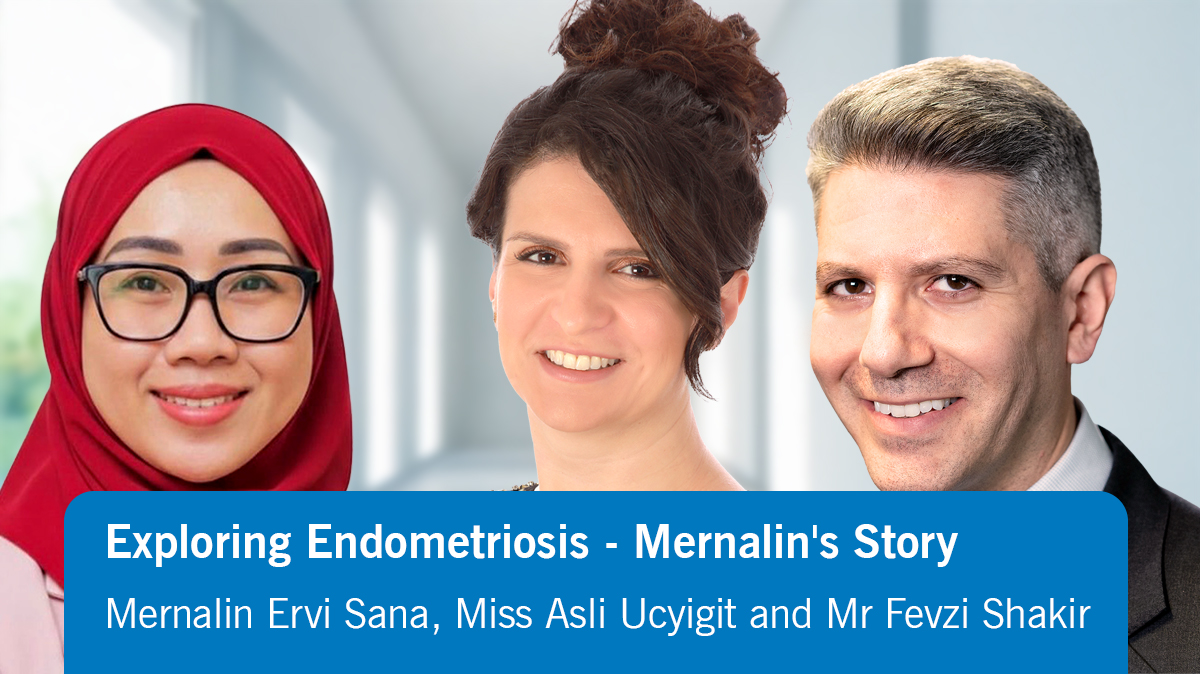
Exploring Endometriosis – Mernalin’s Story with Mernalin Ervi Sana, Miss Asli Ucyigit and Mr Fevzi Shakir
In this episode of Exploring Health with Cleveland Clinic London, host Mr Kash Akhtar is joined by three guests who bring both clinical expertise and lived experience with endometriosis. Mr Fevzi Shakir, a Consultant Gynaecologist specialising in advanced minimally invasive surgery, and Miss Asli Ucyigit, a Consultant Gynaecologist specialising in colposcopy and gynaecological ultrasound, share their clinical insights. Later in the episode, Mernalin Ervi Sana, a Staff Nurse and fellow caregiver at Cleveland Clinic London, joins to share her personal journey living with endometriosis.
Together, they explore this often misunderstood and under-recognised condition, discussing key symptoms, diagnostic approaches, imaging techniques, treatment options, and what life with endometriosis is really like day to day. Whether you are living with endometriosis, supporting someone who is, or working in healthcare, this episode provides practical insights and expert guidance to help understand, manage, and raise awareness of this complex condition.
Advertisement
Cleveland Clinic is a non-profit academic medical center. Advertising on our site helps support our mission. We do not endorse non-Cleveland Clinic products or services. Policy
Recent Episodes
Exploring Stroke with Dr Arvind Chandratheva
In this episode of Exploring Health with Cleveland Clinic London, host Mr Kash Akhtar, Consultant Orthopaedic Knee Surgeon, is joined by Dr…
Exploring Health Checks That Could Save Your Life (Part 2) - Dr Simon Hodes, Dr John Whitaker and Dr Umasuthan Srirangalingam
In this episode of Exploring Health with Cleveland Clinic London, host Mr Kash Akhtar, consultant orthopaedic knee surgeon, continues his co…
Exploring Health Checks That Could Save Your Life (Part 1) - Dr Simon Hodes, Dr John Whitaker and Dr Umasuthan Srirangalingam
In this episode of Exploring Health with Cleveland Clinic London, host Mr Kash Akhtar, consultant orthopaedic knee surgeon, is joined by thr…
Video content: This video is available to watch online.
View video online (https://cdnapisec.kaltura.com/p/2207941/sp/220794100/playManifest/entryId/1_cdyrxvci/flavorId/1_5f3sgelj/format/url/protocol/https/a.mp4)
Transcript
Mr Kash Akhtar:
Welcome to the latest episode of Exploring Health with Cleveland Clinic London. Thank you to Cleveland Clinic Philanthropy UK for supporting this podcast. I'm your host, Kash Akhtar, Consultant Orthopaedic Knee Surgeon. Today's episode focuses on endometriosis, a condition that affects millions of women yet is often misunderstood, under-recognized and diagnosed late.
Advertisement
Cleveland Clinic is a non-profit academic medical center. Advertising on our site helps support our mission. We do not endorse non-Cleveland Clinic products or services. Policy
Joining me today are three people who bring clinical expertise and lived experience. Mr Fevzi Shakir, Consultant Gynaecologist specialising in advanced minimally invasive surgery. Miss Asli Ucyigit, Consultant Gynaecologist specialising in colposcopy and gynaecological ultrasound. And we'll shortly be joined by Mernalin Ervi Sana, a colleague and Staff Nurse who is a fellow caregiver here at Cleveland Clinic London, who is sharing her personal journey with endometriosis. Across this episode, we'll cover symptoms and diagnosis, imaging and treatment options, and what living with endometriosis is really like day to day.
So let's kick us off. Could you please tell us what exactly is endometriosis and how does it affect the body?
Miss Asli Ucyigit:
I think traditionally, endometriosis was perhaps seen as a surgical condition, but I think recently our understanding of it has changed and we are seeing it more as a long-term chronic condition, a chronic inflammatory condition associated with pain, neurosensitization, which means the way you process pain changes over time. So I think the understanding of endometriosis has now shifted somewhat. It's not just a purely surgical disease, it has a whole host of other effects on women.
Advertisement
Mr Kash Akhtar:
Thank you. And Fevzi, what symptoms and signs should women look out for?
Mr Fevzi Shakir:
So it's traditionally associated with period pain, Kash, and that's what most patients really experience, but actually it could be far widespread in terms of how it affects their quality of life. So it could be non-cyclical pain, it could affect their bowel or bladder function. It can present similar to other conditions like IBS as well, and it can also affect their relationships with their partners, especially can have symptoms such as painful intercourse and challenges with fertility and conceiving. So we always say that if patients experience any of those symptoms, then definitely seeking expert medical advice early will hopefully avoid long diagnostic delay.
Mr Kash Akhtar:
And even from my understanding, one of the challenges historically has been this delay in diagnosis. Why is it diagnosed so late?
Miss Asli Ucyigit:
I think that's multifactorial. I like that question. I think a huge part was, as you said, historically, women were often told that painful periods is a normal thing, deal with it: there's nothing wrong with you. But we know now that's not true. If you have painful periods, that's not normal. It's not necessarily acceptable. And I think that drive, that advocacy to encourage women to get investigated, request an ultrasound scan or seek an ultrasound scan is really important now in helping earlier diagnosis. And I think that lacked before.
Mr Kash Akhtar:
And with regards to making the diagnosis, I know you very much specialise in gynaecological ultrasound, what role does ultrasound and imaging play in the diagnosis? Is this an imaging diagnosis?
Miss Asli Ucyigit:
It can be. Absolutely. Again, in the past, I remember when we were training in Obst and Gynae, our Royal College used to say, you know, one of the gold standard ways of diagnosing endometriosis was surgically. Had to put the patient to sleep, take them into theatre, do a laparoscopy and have a look. But that shifted.
Mr Kash Akhtar:
That's kind of where I remember from my SHO training.
Miss Asli Ucyigit:
We're showing our age now, Kash. That shifted a bit now. And I think now with the use of ultrasound scan, but particularly with an element of expertise to it, you can find a lot of subtle signs, indirect signs that really help you put two and two together. And I think this is looking a lot like there might be endometriosis here in this pelvis. And it's a dynamic way of assessing for endometriosis. So you can really ask the patient while you're scanning, where's your pain the most? Let's have a look at that area. Let's see if things are stuck together. Are there adhesions there? So it's an incredibly useful diagnostic tool.
Mr Kash Akhtar:
And is there any role for MRI?
Advertisement
Miss Asli Ucyigit:
There is, of course there is. There's different types of endometriosis. It can be superficial disease or it can be what we call deep infiltrating disease that can be detected on ultrasound. But very often we use MRI as an adjunct. And I think Fevzi will come on to that when you're mapping the disease, particularly if you're considering surgery, MRI is very useful.
Mr Fevzi Shakir:
And I think just to add to some of what Asli said already, you know, it's the normalization of the symptoms I think actually has led to a lot of problems and also how it can mimic other conditions. So it can take a while for patients, general practitioners, primary care physicians to really ascertain where the problem is and direct the patient to the right path. And really that's what we have to try and get away from, as Asli said, it's not normal to take time off work or to be debilitated with the pain. So if it affects quality of life and day to day function, then that's clearly not a normal sign and one that warrants investigation.
And I think now when we talk about surgery, it's more of a option to diagnose and treat the condition. So if patients are wanting a surgical treatment for their endometriosis, then yes, a laparoscopy is still a worthwhile path to take. But there are other treatment options now that we have available to us, such as medical and holistic options, as well as hormonal options, and they can also be used as adjuncts to surgery. So we have a lot more available to us to help treat our patients now than we did maybe about 20 years ago.
Advertisement
Mr Kash Akhtar:
Got you. So we talk about treatments. Can we just talk about medical management? I don't quite know what that would look like versus surgical management.
Mr Fevzi Shakir:
Sure. So the way I like to describe this to patients is really saying, there are non-hormonal options. So when we talk about pain relief and controlling the symptoms that endometriosis gives, simple analgesic can be used. In addition, I always tell patients to acquire a TENS machine. It's very effective, very cheap, very easily and readily available. And we also have access to pelvic pain physicians, which have a lot of experience in managing pelvic pain and can do quite advanced techniques such as hypergastric nerve blocks or ablations, which can really help some patients immensely.
Mr Kash Akhtar:
And are they more of the anaesthetic background pain specialist?
Mr Fevzi Shakir:
Usually, but there are specific ones which actually specialize in the pelvic area as opposed to, say, musculoskeletal pain specialist. So there is a bit of a difference there. And then you've also got your hormonal options. Again, there are lots of different options which have been made available to patients that are now NICE approved. Since 2021, we've had three or four medications in the UK which are now NICE approved specifically for endometriosis. So there's a lot more research, a lot more interest and I think patients have a lot more available. So they really do need to ask for these various different options. It's not just surgery anymore.
Advertisement
Mr Kash Akhtar:
And those medications you mentioned that are NICE approved, could you give us an idea of what kind of class of drug they are? What kind of action they have?
Mr Fevzi Shakir:
Sure. So the ones that have been approved are ones like the fourth-generation progestogens. So they're basically like a progesterone that manipulates the hormonal and menstrual cycle in order to calm and regress some of the endometriosis. And we have good data on that up to about 10 years in Europe and America in terms of the regression it can give for endometriosis. And the other class are like the GnRH analogue, so they in effect switch off the menstrual cycle by reducing the oestrogen and progesterone output from the ovary and some give back a lower dose of that hormone or some actually stop the hormone altogether for a short period in order to calm the symptoms down; sometimes with a view to doing surgery later on or sometimes for a short period just to give the patient some relief whilst they're deciding how to manage their symptoms.
Mr Kash Akhtar:
And that's lovely. Before we move on to whilst we're still on the conservative non-operative management, are there any lifestyle strategies that can help?
Miss Asli Ucyigit:
There are. And I think there's been a big movement recently into looking into this because although we have all these hormonal medications available, that's not a one size fits all treatment. For example, women who are pursuing fertility trying to conceive, those hormonal options won't be an option for them. It stops you getting pregnant. So there have to be alternatives available that they can use. And we're quite lucky at the Cleveland. We have what we call a multidisciplinary team. We have dietitians who we work really closely with. We know that certain diets can help with some of those bowel symptoms that go hand in hand with endometriosis. We have gastrointestinal surgeons who can also look at kind of gut motility, that kind of area. So looking at all these treatments together and really making use of everyone in the team that's available to you can have a huge benefit on a patient's journey.
Mr Kash Akhtar:
And it was interesting when you were talking about some of the pain issues that they have, some of the complex factors that affect daily life, it made me think of some of the musculoskeletal patients that we treat as well. And then there can be a role for psychological support in that situation. Is that something that you use or that was part of the MDT?
Mr Fevzi Shakir:
We definitely have that usually as part of the pain service, Kash. So we do have clinical psychologists which hand in hand work quite closely with these patients because it can affect them significantly. And other holistic aspects can help as well, such as exercise, as Asli said, diet, all of those aspects can lower the vagal response and help really manage the pain. It may not treat the endometriosis, but it all comes together, I think. And all of these factors put together can really make a difference.
Miss Asli Ucyigit:
But even pelvic physiotherapy is crucial, critical in the management of just kind of getting the muscles to relax. And we see that when we do kind of interval scans, women who have been helped with pelvic floor exercises when they come back for a scan, it's less uncomfortable. So it really is something that is worth looking into and considering if you are an endometriosis patient.
Mr Kash Akhtar:
Thank you. And then if we were to talk then, Fevzi, about some of the surgical management, so you mentioned laparoscopy earlier, and I guess you're not doing it for diagnostic purposes anymore, although it is diagnostic, but then it's also therapeutic to proceed, so how would you treat it surgically?
Mr Fevzi Shakir:
So we tend to treat it surgically by excising the disease. There are different thought processes over the years that people have looked at. So ablative techniques through different devices. But now we're tending to go down the route of excision, the data seems to support that. Yes, and cutting out through, starting normal tissue planes, working around the diseased area and excising it. But the challenges that poses are obviously, the vital structures around the pelvis where endometriosis is typically involved. So, commonly involves the nerves, the ureters or around them, and even the vasculature to the uterus, such as the uterine artery and vein. And we commonly see them in those areas. So that's what some of the challenges are in terms of treating it. But modern day techniques have really helped us with that, such as, you know, high definition laparoscopy, 3D laparoscopy, different fluorescence modalities and also robotics. And all of those areas have really helped advance our surgical management.
Mr Kash Akhtar:
Robotics is a thing that we're hearing about increasingly. So there's more of a role now for endometriosis management?
Mr Fevzi Shakir:
Definitely. I mean, it's obviously of interest with the NHS 10 year plan. And there's a lot more advancements with robotic surgery now in terms of the precision it gives, the articulation, the vision is all very superior to traditional laparoscopic techniques. So it is something that's definitely emerging and improving all the time. And everyone is getting quite good results using it, really.
Mr Kash Akhtar:
And when you mentioned the adhesions earlier, so the challenge there when it's stuck to bowel, ureter, all these things, there's so much risk there involved inherently in the surgery. So I guess robotics would be a real advantage for that precision that you get.
Miss Asli Ucyigit:
Absolutely. And there are other surgical adjuncts that you can use when you finish the procedure. I know Fevzi and the team use these quite a lot that you place in the pelvis to help prevent adhesion formation. That's not available in all units, as far as I'm aware.
Mr Kash Akhtar:
What kind of things are that, sorry?
Mr Fevzi Shakir:
Sure. So some of the adhesion barriers that we use, some are gels, some are sprays. And we also have intercede type devices where we actually place an adhesion physical barrier. It's absorbable and will absorb over time but just creates a bit of a barrier just till the tissues heal and hopefully reduce the risk of that inflammation between the two structures forming adhesions. They're not 100%, Kash. You still may get adhesions with them. But I think, if we can do everything to try and reduce this, then hopefully we can improve morbidity associated with adhesions in the future.
Mr Kash Akhtar:
Thank you. And when we talk about key advances or innovations in endometriosis care, could you just give us an idea of what's kind of on the cutting edge, what's on the horizon?
Miss Asli Ucyigit:
There was actually an article in The Independent last week, I don't know if you saw it about early diagnosis of endometriosis and why have we not looked at menstrual fluid sooner. So there's a lot of research now looking at biomarkers, ways of diagnosing conditions, particularly endometriosis through menstrual fluid, even through saliva. Obviously, it's not yet widespread. It's not evidence based, but it's very interesting. And it really will offer women a way to achieve a diagnosis that's non-invasive, easy to access. But we'll see how long that takes to develop. But I thought that was fascinating.
Mr Fevzi Shakir:
So there is a lot, lot more going on with that. And some of those tests Asli talks about are available today. They just haven't been tested in wider communities in real life practice. But the studies look quite promising and they use biomarkers together with AI to use an algorithm and calculate the probability of having endometriosis. But, yeah, initially there's good results and hopefully that will help reduce the diagnostic delay.
But the other area that's also being worked on are non-hormonal medications for endometriosis. So there is some research in the UK, actually, which are currently in phase two trials and they're looking at lactate reduction, antioxidants to try and really reduce that inflammatory process. And hopefully that will help with pain. And some of the data, again, is looking quite promising for patients. So that group that can't have the hormones for various reasons will hopefully have another non-surgical option available soon.
Mr Kash Akhtar:
That'd be great. And I think one of the other, from just general knowledge and reading around the things you hear about endometriosis is that traditionally it was that it's just a thing that women have to deal with. You know, a lot of the time, from what I had been aware of, it is often cyclical and it's kind of that's just what it is. And I think many women for many decades had to just put up and live with it.
Miss Asli Ucyigit:
Absolutely.
Mr Kash Akhtar:
And so I think awareness is really important. So we've got Endometriosis Awareness Month.
Mr Fevzi Shakir:
Yes, they're actually calling it Endometriosis Action Month because they want to actually provide more action in terms of what we can do to improve it. So, we have a lot of charities now which are working quite hard to advocate for the condition. And to put it into context, actually affects about 1.5 million women in the UK and almost 200 million worldwide. So it is quite a huge number, similar to other chronic conditions.
Mr Kash Akhtar:
Yeah, thank you. And Asla, why is, just for the people watching and listening, why is awareness so important?
Miss Asli Ucyigit:
I think if there is a lack of awareness, both in the patient body, but also the medical body, you wouldn't necessarily investigate symptoms like this. Women's health has always been and sadly continues to be a very overlooked aspect of medicine. As we know, many drugs, many surgical pieces of equipment, a lot of medicine has been modelled on men. And unfortunately, historically, women's conditions have just fallen at the wayside and priority, not taken precedence. If we can increase awareness of the condition, and that is happening now, I think now that women get a diagnosis, they talk to their friends about it. People will come and see me and say, well, my friend just got diagnosed. Might I have that condition? Can you please check? The more we talk about it, the more we increase awareness, the more people start asking that question. Actually, my periods aren't quite right, maybe I should get looked at.
Mr Kash Akhtar:
Thank you. And could you just point people for any resources that are available for people and for patients?
Miss Asli Ucyigit:
Absolutely. So we have information available on the Cleveland Clinic website about endometriosis. We also have an organisation called Endometriosis UK, which I think is an invaluable resource. Everything there is lovely to read, easy to understand. It kind of points you in certain directions if you want to do a bit more in-depth reading. It can be very easy to kind of dive into this on social media and hear lots of horror stories sometimes about people's endometriosis journeys. But if you kind of stick to the more evidence-based resources, you will hopefully be pointed in the right direction and get the care and attention that you deserve.
Mr Kash Akhtar:
The next thing I'd like to discuss is when would you encourage someone to seek medical advice?
Miss Asli Ucyigit:
Good question, because a lot of women don't.
Mr Kash Akhtar:
Yeah.
Miss Asli Ucyigit:
I think the main one is if your periods are painful to an extent that you find yourself considering taking pain relief, and this happens repeatedly every cycle, to an extent that it stops you from going to school. We mustn't forget endometriosis can occur in young women as well as in girls. If it stops you going to work, if it affects, as Fevzi said, your activities of daily living, it shouldn't be doing that. Your periods shouldn't be like that. If you find you're in that situation, it's definitely worthwhile seeking help, asking for some imaging and just starting that investigative journey to see is there something there that we can help support you with?
Mr Kash Akhtar:
Thank you. Fevzi, is there anything to add to that?
Mr Fevzi Shakir:
No, I think that's really good advice. You know, if it affects your quality of life and your everyday functioning, I think that's the point that you should really seek help and advocate for yourself, challenge and question your GP or your primary care provider. Whether endometriosis is a possibility, yes, like we said, there are challenges to its diagnosis. It can mimic other conditions. It's not always easy to diagnose. But I think if you challenge and question these and ask for investigations as a bare minimum, then I think that we can hopefully reduce that delay because 7 to 10 years, which is what the current diagnostic delay is for patients, is just not acceptable anymore.
Mr Kash Akhtar:
And I guess a lot of complications such as adhesions and things could set in in that time.
Mr Fevzi Shakir:
Absolutely. And then if they want treatment, it becomes a lot more challenging, a lot more high risk, especially if they go down the surgical route. So really tackling this early has several benefits, mainly for the patient in enjoying the best years of their life.
Mr Kash Akhtar:
So if people experience the symptoms that both of you described, I think it's really important that they are persistent with it if they need to be, hopefully they don't, with more increasing awareness. But then they advocate for themselves or take someone to help advocate along them, alongside them to really get there.
Mr Fevzi Shakir:
Absolutely.
Mr Kash Akhtar:
So now it's my pleasure to be joined by a fellow caregiver, Mernalin Ervisana. Mernalin, thank you for joining us. Would you be kind of take us through your journey from early symptoms to diagnosis?
Mernalin:
I've noticed my symptoms when a little after I've given birth in 2008 to my second child through C-section. At that time, I changed my contraception from the oral pills to the injectable ones. And then I started noticing heavier periods with large clots and it was very painful.
Mr Kash Akhtar:
And that was quite a change from before.
Mernalin:
Yes. And I made myself believe that it was because of the change in contraception. And whenever I talk about it, I'm always told that, well, some women do have painful and heavy periods. So I organized my life around that symptoms. I lived with that symptoms day to day, every cycle. Whenever I have pain, I take painkillers. And whenever I bleed through my clothes or through the furnitures, I change and I clean up. At some point, I was also diagnosed with severe anxiety and depression and had treatment with a psychiatrist because I was always unsure that I would bleed through my clothes and I was always in pain.
Mr Kash Akhtar:
I can understand. That must really impact you. It must be really difficult.
Mernalin:
Yes. And another thing is that I would always know that my period is coming because I have IBS symptoms, like I will have the urgency and the frequent need to go to the toilet. So it's annoying and frustrating because sometimes you're out with family and friends and suddenly you feel all of these symptoms: you just cannot enjoy time out. And sometimes it happens at work. So you're giving care to the patients and you feel all of these symptoms happening all of a sudden, but you still have to provide that safe care. So you try to stand there, still provide the care and then run to the toilet to get changed or to take your painkillers.
Mr Kash Akhtar:
And it is really interesting. You know that I often say that everyone is fighting a battle you know nothing about. This is a thing no one else would ever would have known who worked alongside you.
Mernalin:
Yes. And at work, I remember telling my friends to give me some time off, like just 15 minutes because I'm in pain. And when they would ask me, because we nurses, we like to ask on a scale of 0 to 10, how much would you score your pain? Which is a very difficult question to answer. So I usually say I think it's seven because suffering from that type of pain in many years, you don't know what pain is anymore. You don't know how to describe it or you don't know how to score it.
Mr Kash Akhtar:
Yeah. It resets the scale almost.
Mernalin:
So when I tell them it's 7 to 10, they said, how could you be here with a 7 to 10 pain? I said, yeah, exactly. But I'm here because I have to be here. I have responsibilities. And this is how it is. And I've always been told that that's how it is. You have pain and you have heavy bleeding, and I thought that was just my life. There was one instance during those painful periods and heavy bleeding I was asking myself, like, why is this happening to me? Why do I deserve this? Or maybe when is menopause coming? Maybe I thought maybe menopause would save me from this agony. But I'm not even 40 yet, so how can I be thinking about menopause saving me from this?
Mr Kash Akhtar:
But that just shows how much it's impacting your life.
Mernalin:
Yes. I thought I just had to accept that that's my life. That's it. I have to suffer in pain every cycle. I have to deal with the bleeding. I minimized social gatherings. I minimized attending things. I minimized going out with my families. I preferred staying at home. And sometimes with the pain that I experienced during period, I even experienced like getting up from bed and needing to go back because I feel like the world is swirling around me, that's maybe because of the amount or the extent of the pain that I'm feeling.
Mr Kash Akhtar:
And I mean, that goes back to what Asli was saying earlier. I mean, we were talking about how a lot of women just it becomes normal for them, they have to learn to live with it and they shouldn't have to. But that's how it's been for decades.
Mernalin:
I think I've always also known that there is a possibility of me having endometriosis because my sister and three cousins are diagnosed with endometriosis. However, as a nurse and as a single mother, it's difficult for me to accept the fact that because I'm always the one who's giving care, I'm the caregiver. Then if I accept that thought, the idea that I may have endometriosis, I may be the one needing care. So I try to accept the brushing off of my symptoms or people telling me that that's just menstruation.
And one very interesting situation happened when I was going to work, because I travel one hour from home to work usually, and within the hour I was having my period that day, within that hour, when I reached Victoria Station, which is seven minutes walk to Cleveland Clinic London, I felt thick fluid running on my thigh. And I thought, oh no, this can't be happening, it's just an hour. How can I be bleeding through my pad? And when I reached the hospital, I was late because I had to change. I had to spend time in the toilet to calm myself down. And there was like one thousand thoughts happening in my head.
And I was going to DDSI and I saw Mr. Shakir and I thought to myself, oh, come on, you're already working with these great surgeons, with these great doctors. If you need to speak up, you need to speak up. I mean, there's resources, there are people who can help, you need to speak up. So when I approached Mr. Shakir and I asked him for an advice of what to do on my situation, I actually was scared because...
Mr Kash Akhtar:
He's a scary looking man.
Mernalin:
Yeah, I was scared because I felt like he was really listening to me. Because I was in pain for so many years. At some point, I thought maybe I was just making up this pain. What if this is not real?
Mr Kash Akhtar:
Yeah, it really messes with you.
Mernalin:
Yeah, but he was listening. I told him I was on my period and I'm bleeding a lot and I'm in pain and then he said we need to arrange for a consultation. And I had this same day consultation on that day, had the investigations done and had my treatment. And now I'm not perfectly okay, like zero pain. I really don't know how to define pain anymore. But the amount of discomfort that I have now is nothing compared to the amount of pain and agony that I had before my treatment.
Mernalin:
And before your treatment, can you give us an idea how it was affecting your daily life and work? Because I see you on the wards, you know, we were chatting yesterday and no one would ever know there was anything going on. And being a mother with children, how was that?
Mernalin:
As a mother, you have the responsibility to attend to school activities, to take your children out and to tend to their needs. But when you're always in pain, you cannot be fully there. You have to force yourself to be there, but you're not really there because half of you is trying to control yourself because you're in pain, trying to calm yourself. And then at work, calling in sick for work and worrying that you're letting your team down because you can't be there. And in nursing, when one nurse is not there, it's a big trouble. It’s a big loss.
Mr Kash Akhtar:
No, we see it. It has a huge impact because everyone else has to carry that load. And were there any times where you had no symptoms during the month and you felt completely normal? Or was it always there to some degree?
Mernalin:
So my month would go like this. When I start having the IBS symptoms, that means my period is coming, then my periods are long. Usually before I started noticing all these symptoms, my periods were like seven days and that's it. Then I started having 14 days period, painful period. Then when I'm not on my period, I'm constipated.
Mr Kash Akhtar:
Right.
Mernalin:
And then when I have the IBS, the frequent bowel movements again, I know that my period is coming. So it has been like that for many years.
Mr Kash Akhtar:
So there's always something going on that was impacting you?
Mernalin:
Yes. And because of all of that, I felt very tired. It was tiring. It was tiring. Every month goes on and on that way. You know that you will be in pain again and then that you will be okay, then you will be having frequent bowel movements and then you will be constipated.
Mr Kash Akhtar:
And before you met this hero here, had you spoken to other doctors about it? Had you seen your GP about this or anyone else?
Mernalin:
I have just moved here to the UK four years ago, and I never had a good experience with the GPs.
Mr Kash Akhtar:
Right.
Mernalin:
And also, I think I have long accepted that this is it, even if I will go to the GP, even if I will go to the doctors. I stopped seeing doctors regarding my gynae symptoms when I was diagnosed and treated with anxiety and depression by a psychiatrist. I remember telling my psychiatrist before that my symptoms, my depressive symptoms, my very low moods, evolved around my period. And I asked if there was a connection. I was told there was no connection.
Mr Kash Akhtar:
Right. And yet now in hindsight, it seems that the endometriosis was the thing that triggered all of that?
Mernalin:
Yes, I think so. Because I feel like after my treatment, my mood is better. I don't feel tired. I have better sleep. Because before my treatment, because of the fatigue, I felt like I always needed caffeine. So I drink coffee morning, noontime, afternoon, evening, just to get through the day. And then when night comes, you can't sleep because you had too much caffeine. And then you have insomnia, and then you treat the insomnia, and then you treat the fatigue. And then it goes on and on like that every morning.
Mr Kash Akhtar:
And how long did you have these symptoms before you kind of got a diagnosis and treatment?
Mernalin:
More than 10 years.
Mr Kash Akhtar:
Wow! And Fevzi, from a clinician's perspective, what do patients often struggle with before diagnosis?
Mr Fevzi Shakir:
This is exactly as Merlin said, it can affect people in quite a lot of ways. And it has a lot of confounding factors and problems associated with it. So a lot of patients, as well as the physical pain, they really struggle to have an enjoyable life, go out with their friends, they become withdrawn, they can become tired. And a point that Merlin made was that mental health aspect that it can really impact you. Because being in pain all the time and having such horrible symptoms that impacts your quality of life, will definitely affect your mental health as well. And so it's a lot for someone to cope with all of that and for it to drag on for such a long time.
But I think Merlin's story resonates with me in terms of how other patients are and how other patients present. I know before we talked about diagnosis and new clever techniques. But the most important diagnosis here is the history and listening to the patient. And just by listening to their story, it was immediately obvious to me what was potentially going on with Merlin. And it's always difficult to see people in discomfort and pain, especially a fellow caregiver.
Mr Kash Akhtar:
Do you want to talk us through the diagnosis?
Mr Fevzi Shakir:
Sure. So once we established about the history and it being quite convincing of endometriosis or similar conditions we wanted to check that Merlin wasn't anaemic, because she did describe quite a lot of bleeding. And that's something that a lot of patients have. So obviously, we want to correct that to make them feel better in the first instance. And MRI, we're quite lucky at the Cleveland Clinic, London, that we have really great radiologists, which specialize in women's health and endometriosis in particular to really get that accurate mapping of the disease and really to understand whether it's there and causing the problems that really helps us plan our surgery. Because we have a good Cleveland Clinic MDT as well for endometriosis that we have twice a month, where we discuss all the cases and then make a plan for surgery and see if other specialists are required for the surgery or treatment options. So we don't just talk about the surgery, we talk about other aspects as well. But that's how we reach that conclusion.
Mr Kash Akhtar:
And who's present at the MDT?
Mr Fevzi Shakir:
So we have urologists, we have colorectal surgeons, we have a pain specialist, we have radiologists, we may have gastroenterologists as well. So a whole bunch of us and gynaecologists and many of each type, really.
Mr Kash Akhtar:
Thank you. And then how did you go about deciding on what level to start treatment for Mernalin and where to pitch that?
Mr Fevzi Shakir:
So with Mernalin, we went through all the different options as I would do for all patients. But obviously Mernalin, being a caregiver is well informed about her options. She already had an idea and she's intelligent to know what would work well for her. So we've had approach where we managed not only pain in terms of analgesia to improve the pain, but we talked about a hormonal and surgical option and we got that organized quite quickly for her.
Mr Kash Akhtar:
Thank you. And so you started medication and there was surgery as well?
Mernalin:
Yes, quickly. It was actually very quick.
Mr Kash Akhtar:
That's one of the beauties of clinical in London. Everything's quite quick.
Mernalin:
I had my consultation, I think, on a Tuesday or Wednesday and I decided to go for the surgery because I was already in pain for so many years and desperate to just have an end on that pain and suffering. And so I've chosen the surgical option because I believe in the outcome of the surgical option.
Mr Kash Akhtar:
I guess you've seen it many times looking after patients.
Mernalin:
Yes, correct. Because I work in the surgical world. So I've seen it many times. And yeah, I had my consultation on a Wednesday and my surgery on a Saturday.
Mr Kash Akhtar:
Right. Yeah. What waiting list?
Mernalin:
Yes.
Mr Kash Akhtar:
And can you talk us through the surgery? What did that entail?
Mr Fevzi Shakir:
So the surgery entailed laparoscopy that we did as well as a hysteroscopy to assess the heavy bleeding that Mernalin was having. So we assess all the different organs that have been affected based on Mernalin’s symptoms or any patient's symptoms. And then through the MRI, we're able to map where the disease was located and focus on those areas. But even with imaging, they have some limitations, Kash. So if we see deep disease of endometriosis somewhere in the pelvis, it's likely that they have less deep disease elsewhere as well in the pelvis. So we evaluate the whole pelvis, upper abdomen, diaphragm, any of the sites where endometriosis commonly presents. And then all of that disease was excised. And then we also had a hormonal option, which was like a coil that we could also place that helps with the pain and bleeding in addition. So all of these adjuncts we like to give in addition to surgery just to give further benefit to the patient.
Mr Kash Akhtar:
Thank you. And so now Mernalin, I guess life looks different.
Mernalin:
It does. It really looks different. I can go out more with my family. I'm more comfortable. I'm not as grumpy as I was before.
Mr Fevzi Shakir:
I never noticed that.
Mernalin:
Well, you don't see much of me then. I'm still grumpy, but slightly.
Mr Kash Akhtar:
Yeah, well, you got a 17 year old.
Mernalin:
Yeah, 17 and a 20. So yeah, so I'm not that grumpy anymore. I'm slightly grumpy. I'm more comfortable with my body. Like I said earlier, I'm not as comfortable as like being free. But it's really nothing compared to how I feel before the treatment.
Mr Kash Akhtar:
And what advice would you give to other women who are experiencing similar symptoms?
Mernalin:
Awareness is key, firstly. And be brave, of course. Don't be a coward like myself. Don't allow yourself to be dismissed. Don't allow your symptoms to be brushed off. There are resources out there. There are charities and there are good doctors, Cleveland Clinic London, there are options. You have to be an advocate for yourself. You have to be your own hero and seek for that consultation and for your treatment.
Mr Kash Akhtar:
Thank you. Because as we start to wrap things up, how can family, friends, colleagues better support someone who's experiencing and managing a life with endometriosis?
Mernalin:
Endometriosis isn't just a woman's concern. It is everybody's concern. I will start with my role with the Endometriosis UK. So Mr. Shakir's superhero roles doesn't end with my surgery. As I was recovering from surgery, as a surgical nurse, I thought after discharging our patients after their surgery, because they look well, that's why we discharged them, I thought that's it. Their journey ends there. They will have a good life. But when I was in that situation, when I was recovering from my surgery, I realized first hand that it isn't really that straightforward. You are still recovering from your surgery at home and from the anaesthesia. And I had more time because I was off from work, so I was googling like managing of the symptoms, recovering from surgery.
I found Endometriosis UK and I found Mr. Shakir's work there as well. And I found all the good work that they do for women. They have their web chats. They have a nurse helpline which entertains calls from anyone and they signpost people to the right resources. They give advice. They do not diagnose, of course, and they do not prescribe medications, but they can give advice on how to manage symptoms. And the web chat community is very good. Then I started volunteering for Endometriosis UK because I really appreciate what they do to all these women. I learned a lot. I learned a lot from endometriosis UK and I felt a sense of connection with people who truly understand.
Going back to your question. So it's not just a woman who has the symptoms that needs to be aware. It's everybody as a friend, as a daughter, as a colleague. We have to know all of these symptoms so we can tell our friends, our colleagues when or that they do need to seek consult or to get assessed properly and to get their treatments. And also to recognize all of these symptoms and to acknowledge them as true. Not to question when your colleagues are telling you that they're in pain…
Mr Kash Akhtar:
How bad is it? Is it really bad? So as you say, awareness is the key. The more people know about it, the better. We need to be understanding that people experiencing this are having significant problems that don't just affect bleeding. It can be bowel, it can be bladder, it can be psychological, it can be distress, it can be tiredness because you're not sleeping. You know, you may have lost blood and be anaemic. There's so many factors people need to be aware of and understanding of. And Fevzi, because it's hormonal, is endometriosis a disease that progresses, that recurs or is it a one and done?
Mr Fevzi Shakir:
Again, very good question. So it's a chronic condition, so it can obviously progress if left untreated and can worsen symptoms and like I said, make them a bit more challenging to treat in the future, you know, later on in a patient's journey. But definitely by treating the endometriosis, it can at least normalize the pelvis to some degree. But the hormones are still going on in the background, especially for women in that reproductive stage of their life. And that's why we always talk about adding in hormonal treatments or other non-surgical or non-hormonal options to try and help as much as possible, really to improve, you know, their quality of life quite a lot.
And I have to say that we're all very proud of Mernalin in what she's done in terms of taking her negative experiences that she's had all of these years and turning into a positive one by advocating for others, by joining charities and even organizing and helping to support charity events. She organized a lot of Cleveland Clinic caregivers to come and support races in London where we raise money for Endometriosis UK. So she's done really good work to help the community and others around her.
Mr Kash Akhtar:
Thank you. Mernalin, I just want to thank you for coming and speaking so candidly and sharing your story, because you're going to help thousands, if not tens of thousands of women. So thank you so much for coming and for sharing and for being so open with us.
Mernalin:
Thank you.
Mr Kash Akhtar:
I'd like to finish up by thanking Mernalin, Asli and Fevzi for giving us an insight into their expertise and the services available here at Cleveland Clinic London, as well as the resources that are available to people at home. I would encourage people to share the episode, to be understanding, to raise awareness and seek help early. If experiencing symptoms, looking for answers, you don't need to suffer in silence.
You've been listening to Exploring Health with Cleveland Clinic London. I've been your host Kash Akhtar. If you'd like to learn more, you'll find links and resources in the show notes and on the Cleveland Clinic London website. And if you found this episode helpful, please subscribe, leave a review and share it with someone who needs to hear it. Remember, informed health is empowered health. Until next time.
Visit the Cleveland Clinic London website to learn more about our endometriosis services and the work of Mr Fevzi Shakir and Miss Asli Ucyigit. You can also access resources, information, and support from the charity Endometriosis UK, where Mernalin Ervi Sana is a Support Group Leader.
If you found this episode valuable, please consider subscribing, leaving a review, and sharing it with someone who may benefit.
Exploring Health is supported by Cleveland Clinic Philanthropy UK and is available on all major streaming platforms, including YouTube.
Recent Episodes
Exploring Stroke with Dr Arvind Chandratheva
In this episode of Exploring Health with Cleveland Clinic London, host Mr Kash Akhtar, Consultant Orthopaedic Knee Surgeon, is joined by Dr…
Exploring Health Checks That Could Save Your Life (Part 2) - Dr Simon Hodes, Dr John Whitaker and Dr Umasuthan Srirangalingam
In this episode of Exploring Health with Cleveland Clinic London, host Mr Kash Akhtar, consultant orthopaedic knee surgeon, continues his co…
Exploring Health Checks That Could Save Your Life (Part 1) - Dr Simon Hodes, Dr John Whitaker and Dr Umasuthan Srirangalingam
In this episode of Exploring Health with Cleveland Clinic London, host Mr Kash Akhtar, consultant orthopaedic knee surgeon, is joined by thr…
Never miss a moment - subscribe now.
Listen to the Health Essentials Podcast on your favorite streaming platform.
Other Podcasts You May Love
Health Essentials
Tune in for practical health advice from Cleveland Clinic experts. What's really the healthiest diet…
Love Your Heart
A Cleveland Clinic podcast to help you learn more about heart and vascular disease and conditions af…
Nurse Essentials
Nurse Essentials is a podcast about all things nursing - from tips for making your next shift easier…
Neuro Pathways
A Cleveland Clinic podcast for medical professionals exploring the latest research discoveries and c…