



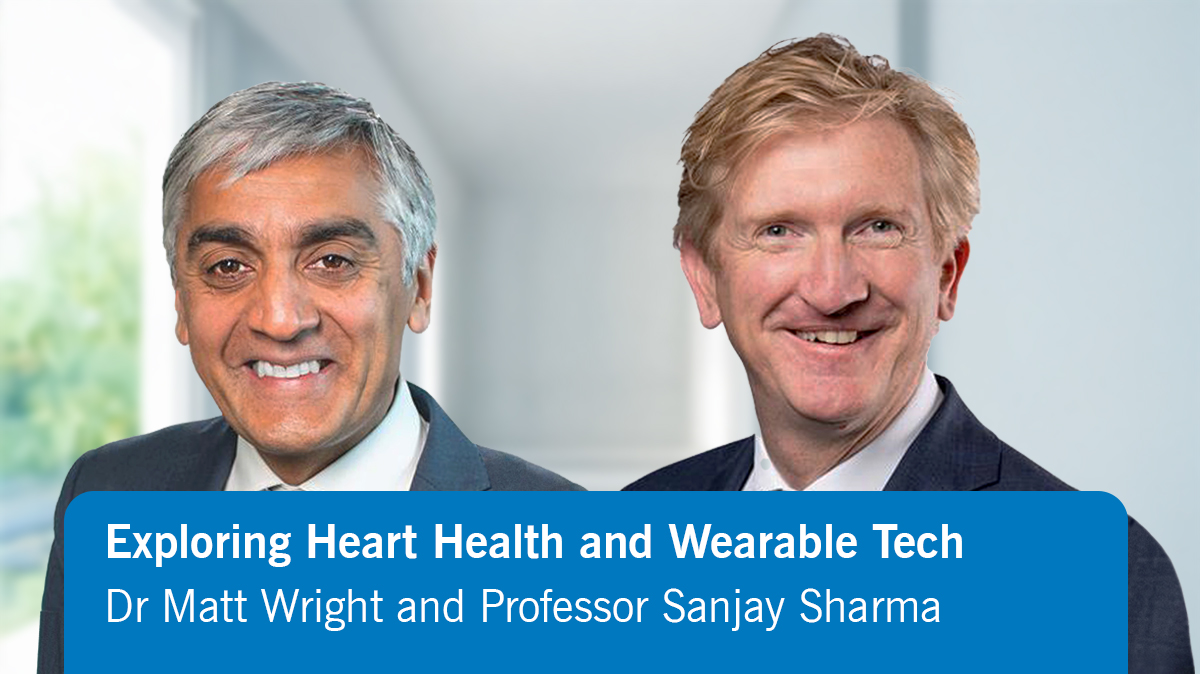
Exploring Heart Health and Wearable Tech with Dr Matt Wright and Professor Sanjay Sharma
In this episode of Exploring Health with Cleveland Clinic London, host Mr Kash Akhtar is joined by Professor Sanjay Sharma, internationally recognised cardiologist and world authority on sports cardiology and sudden cardiac death, and Dr Matt Wright, Consultant Cardiologist and Electrophysiologist specialising in heart rhythm disorders and digital diagnostics.
Together, they explore heart health in the digital age and how wearable technology is reshaping the way we detect, monitor, and prevent serious cardiac conditions. From smartwatches and fitness trackers to advanced remote monitoring, they discuss how these tools support early detection of heart problems, where they deliver genuine clinical value and where they may mislead.
Whether you’ve noticed palpitations on your smartwatch, are thinking about your fitness or family history, or you’re a GP, physio, coach or simply health-curious, this episode offers practical clarity and expert guidance on using wearable technology safely and intelligently.
Advertisement
Cleveland Clinic is a non-profit academic medical center. Advertising on our site helps support our mission. We do not endorse non-Cleveland Clinic products or services. Policy
Recent Episodes
Exploring Stroke with Dr Arvind Chandratheva
In this episode of Exploring Health with Cleveland Clinic London, host Mr Kash Akhtar, Consultant Orthopaedic Knee Surgeon, is joined by Dr…
Exploring Health Checks That Could Save Your Life (Part 2) - Dr Simon Hodes, Dr John Whitaker and Dr Umasuthan Srirangalingam
In this episode of Exploring Health with Cleveland Clinic London, host Mr Kash Akhtar, consultant orthopaedic knee surgeon, continues his co…
Exploring Health Checks That Could Save Your Life (Part 1) - Dr Simon Hodes, Dr John Whitaker and Dr Umasuthan Srirangalingam
In this episode of Exploring Health with Cleveland Clinic London, host Mr Kash Akhtar, consultant orthopaedic knee surgeon, is joined by thr…
Video content: This video is available to watch online.
View video online (https://cdnapisec.kaltura.com/p/2207941/sp/220794100/playManifest/entryId/1_0vr0nyod/flavorId/1_5f3sgelj/format/url/protocol/https/a.mp4)
Transcript
Mr Kash Akhtar:
Welcome to the latest episode of Exploring Health with Cleveland Clinic London. Thank you to Cleveland Clinic Philanthropy UK for supporting this podcast. I'm your host, Kash Akhtar, a Consultant Orthopeadic Knee Surgeon. Today's episode is about heart health in the digital age, and how wearable technology is changing the way we detect, monitor, and prevent serious cardiac problems.
Advertisement
Cleveland Clinic is a non-profit academic medical center. Advertising on our site helps support our mission. We do not endorse non-Cleveland Clinic products or services. Policy
We'll be discussing how wearable devices can support early detection of heart conditions, where they help and where they can mislead how digital health fits into real world clinical care and learn more about Cleveland Clinic London's approach to cutting edge heart care. So if you ever used a smartwatch or fitness tracker, worried about palpitations, fitness, or family history, or if you're a gp, physio coach, or just simply health curious, this episode will give you clarity and the answers you need.
Joining me today are two outstanding experts from Cleveland Clinic London, professor Sanjay Sharma. An internationally recognized cardiologist and a world authority on sports, cardiology and sudden cardiac death, deeply involved in athlete screening and prevention. And Dr Matt Wright, Consultant, Cardiologist and Electrophysiologist who specialises in heart rhythm disorders, monitoring and digital diagnostics at the forefront of integrating wearable data into clinical decision making.
Together we'll explore how digital tools are reshaping heart care and what people actually need to know to use them safely and intelligently. So thank you both for coming.
Dr Matt Wright:
Thank you.
Professor Sanjay Sharma:
Pleasure.
Mr Kash Akhtar:
Let's start with the big picture, Matt. What are the common cardiovascular risks that we see today?
Advertisement
Dr Matt Wright:
Well, I guess the commonest cardiovascular risk will be coronary artery disease, which is where you get fairing up of the heart arteries and cardiovascular sort of disease accounts for 30% of all deaths.
So cardiovascular disease is important. Obviously what I deal with are rhythm disturbances where the heart's meeting irregularly or. Sometimes very fast, other times very slow. Uh, and again, this is a very common cause, not only of death, but also of feeling unwell. So that's what I am predominantly dealing with.
And this fits very well with smart watch detection. So it's very easy to record an ECG, that's a heart rhythm trace. You know, your Apple watches, garmins, smart watches, there's various devices that can tell people what rhythm they're in and if the rhythm's abnormal. And then in terms of general cardiovascular risk, you could look at devices which are measuring your blood pressure based on.
Various algorithms 'cause they're often not the same way that we would record blood pressure. Hmm. And it's important to know the sort of technical details to know what's good and what's potentially not as good with the devices. 'cause we're getting a lot of data. And data is good. It democratises healthcare. It puts it in the hands of people and I think one of the important things that should be drawn out in this sort of conversation is that when people buy smart watches or any of these sort of consumer devices, they are people obviously as doctors, we're used to dealing with patience.
Mr Kash Akhtar:
Yeah.
Dr Matt Wright:
It's very important, I think, to have a very clear distinction of when we're having, what I say to patients or people is we're gonna have a discussion.
We're applying sort of our knowledge to try and explain the data. Rather than someone coming with a condition where they say they're feeling well, they feel breathless. They're going, my heart's going too fast.
Mr Kash Akhtar:
I'm with you. Yeah.
Dr Matt Wright:
So I think it's really important that we keep these things separate.
Mr Kash Akhtar:
Thank you, Sanjay.
How much difference does awareness and early detection really make?
Professor Sanjay Sharma:
I think it's very important, just as we started off by saying that cardiovascular disease takes 30% of the human life in the UK, about 7.6 million people. And of course we know that heart attacks are the most common cause but around 70% of the causes are modifiable.
So things like high blood pressure, diabetes, high cholesterol, smoking, and we've been very good at bringing down the incidences of cardiovascular disease until more recently where things have stagnated a little bit. And indeed, since 2024, the incidence of cardiovascular diseases going up so awareness are very important.
There are big charitable organizations that are talking about how we can actually look after ourselves to actually prevent. Ourselves from having a heart attack. And I think in this respect wearable devices are very good. They give you an idea of your, the amount of physical activity you're performing.
Advertisement
They provide data on heart, heart rate variability, which may be affected by sleep or stress. Uh, they give you some idea of your vascular age, which may raise suspicion that someone may have an underlying. High blood pressure, high cholesterolemia. Both of these conditions, as you know, are silent killers, so people don't know they're actually carrying them.
So I think in that respect these gadgets allow people to detect things early, allow them to be in charge of their own health and prevention of cardiac disease.
Mr Kash Akhtar:
Hmm. And it's fascinating you mentioned vascular age. It's not a metric that I'd ever come across, but my smart scales give it to me every day.
I'm like, oh, okay. So, and, and so that's another, another metric that we're looking at nowadays?
Professor Sanjay Sharma:
I think so. I mean, I think, you know, you can't really tell from a much non-invasive technology that's available to everyone at their fingertips about what your vascular age is like. You'd have to go and see an expert, they'd have to do various tests. But some of these variable devices from, you know, in your, in your digital arteries or your radial artery, can give you some idea of your vascular age, of how stiff your vessels have become with age or with underlying risk factors. I mean, I get quite worried because I always consider myself quite as quite fit because I run quite a lot and whenever I go to David Lloyd, it tells me I'm about 15 years younger than I should be and I get very, very excited.
Advertisement
Mr Kash Akhtar:
Yeah.
Professor Sanjay Sharma:
But when I look at my aura ring, it tells me my vascular age is only a year less than my real age.
Mr Kash Akhtar:
Yeah. And that's one of the challenges we're gonna discuss shortly is trying to make sense of that data. Heart risk. How does it differ between the general population, recreational exercises and elite athletes?
Professor Sanjay Sharma:
Good question. There's no doubt that exercise is probably the best medicine that's ever been invented. I don't think, certainly for the next century, we'll have ever invented anything that gives you better rewards than exercise does. I mean, the important thing is that exercise, it's cheap, it's free, it can be done at any time, and you are in control of when you do it, and it's devoid of some of these.
Undesirable effects of some of the medical therapies we implement such as drugs, and there's overwhelming evidence that people who exercise moderately. Actually reduce their risk of having a heart attack by about 50% in their sixties and seventies and live between three to five years longer than sedentary people.
Now to do this, you don't have to be a marathon runner or a top triathlete. You've just got to be someone who does a moderate amount of exercise on a regular basis every week.
Advertisement
Mr Kash Akhtar:
And it's interesting because the thing that's been, a lot of people used to talk about VO2 max training and, you know, going all out as fast as they can. And increasingly particularly on social media, there's been a lot of talk about zone two cardio. What's your thoughts on zone two cardio? Does that count? Would that, is that exercise that's gonna extend your lifespan?
Professor Sanjay Sharma:
I believe so. Well, zone two would be moderate intensity exercise and the good thing about exercising at zone two is that most people can do it talking, maybe coming up for air every now and then.
Mr Kash Akhtar:
Yeah.
Professor Sanjay Sharma:
And it's not. It's not something that is over in 15 or 20 minutes. You can do it for 30 minutes, 40 minutes, 50 minutes. In fact, if we look at all our top endurance athletes. Including people likes, the likes of the Brownie brothers who were so amazing.
Mr Kash Akhtar:
Triathlon, the tri?
Professor Sanjay Sharma:
Yeah. I mean, they spent so much of their time in zone two and they only push up to zone four, five, 30% of their training. So it's very, very good for improving endurance and increasing maximum oxygen consumption. The only thing is that if we get too drawn in with this zone two, zone three, then people get slightly worried because everyone's different. You know, as you know, maximal heart rates vary from one person to another. We've got this very crude equation that Astrand equation, 220 minus your age, that gets less and less applicable as you become older. And similarly, exercising in zone two becomes more and more difficult as you become older. So people keep staring at their watches thinking, I've gone above 115, I'm going way too fast, I need to go much slower.
Mr Kash Akhtar:
Yeah.
Professor Sanjay Sharma:
So I think there, there, there are some limitations to using smart watches for zone two.
Mr Kash Akhtar:
Yeah. And a lot of people use the rough rule of thumb that if you are able to maintain a conversation whilst exercising, that's usually zone two,
Professor Sanjay Sharma:
Correct? I would say so.
Mr Kash Akhtar:
Matt wearables are everywhere now, but there's a wealth of information that comes out there and then the metrics such as strain, such as high variability, things that a lot of people aren't familiar with. And so I think there is a sense of overwhelm with that data. I mean, you are, you are an expert at what you do, but I think for a lot of people it still can be quite a challenge to really understand what the data means and to then act upon it.
Dr Matt Wright:
These devices are really useful. The data is fantastic. What the difficulty is, is who's interpreting the data.
Mr Kash Akhtar:
Mm.
Dr Matt Wright:
And they've all got pros and cons, you know? And, you know, it's how do you compare that to a medical device? But, uh, you know. I've been able to make diagnoses on airplanes by asking for an Apple watch, in Fortnum and Masons when someone collapsed, with my dad, right after I bought a Kardia. My son said, uh, let's test granddad and we did test granddad and then he's ended up with a pacemaker. Um, so the thing that I always say, because people often come and go, oh, I've got this advice and it says this but they're no good. And you're like, no, no, they're very good. I think this is one of the sort of fundamental questions and perhaps, I don't wanna say a problem, I just think it's a question because in screening in medicine, we have had rules about screening, you know, for 70 years or so. You know, is it an important disease? What's the natural history? Can we alter it with treatment? Is there treatment? Is there a pathway? And so we have very strict rules about screening programs, whereas with these devices, you're putting them in the hands of millions of people, and even a very accurate test is going to generate anxiety, false positives. Because of the sheer vast quantity of people who've got one of these.
Mr Kash Akhtar:
Mm-hmm.
Dr Matt Wright:
Also, with a screening program, we would look at which population of patients we're going to screen. We wouldn't go let's screen for prostate cancer. Let's screen all men, for example. You'd sift the data.
Mr Kash Akhtar:
Yeah.
Dr Matt Wright:
Whereas there's none of that when people can just buy a device and it's really putting into context the information or the data with that person.
Mr Kash Akhtar:
Yeah.
Dr Matt Wright:
So, you know, if Sanjay, you know, sees a footballer who has a rhythm disturbance, let's say they get some AF. Okay. A young fit, healthy person. With some AF it's going to make us interested, but we're gonna treat that person very differently to say a 70-year-old who's got the same amount of AF on a device because they’re completely different people.
Mr Kash Akhtar:
So the risk stratification is very different.
Dr Matt Wright:
Yes
Mr Kash Akhtar:
You know, when you start talking about screening tests, it really gave me, uh, flashbacks and palpitations to med school and I was thinking about type one errors and type two errors and all sorts of thing I've long forgotten. Can you tell me, um, with these wearables, what can they do well and what can't they do?
Dr Matt Wright:
So I think the sensors and the data is very good.
Mr Kash Akhtar:
Mm.
Dr Matt Wright:
So they can, you know, create the primary data really, really well. What they fall down upon, and I don't even want to say fall down, but what they're perhaps a little less good is the diagnostic accuracy.
Mr Kash Akhtar:
Mm-hmm.
Dr Matt Wright:
Because they are set up with very different sort of ways of what they're trying to achieve. They don't want to be wrong.
Mr Kash Akhtar:
Mm-hmm.
Dr Matt Wright:
Which is very different from trying to be right.
Mr Kash Akhtar:
So the sieve, the net, is cast slightly wider.
Dr Matt Wright:
Yeah. So for example, they may say unclassified or possible AF and we could look at the data and you look at the data and you go, no, that's not atrial fibrillation. That's atrial ectopics, or it's ventricular ectopics. It's very easy to see. They might go high heart rate, and we will go, that's a sinus tachycardia. Or we might go, actually, that's atrial tachycardia and we're gonna treat all of these very differently. However, the device isn't telling you about these things. It's just sort of saying that's what it is. Go and see someone.
Mr Kash Akhtar:
Yeah.
Dr Matt Wright:
And there's a chance that you're gonna create anxiety, sort of like, you know. If you've got a fire alarm, it can detect smoke.
Mr Kash Akhtar:
Mm.
Dr Matt Wright:
Okay. It's very good at detecting smoke, but you are putting the context like, oh, there is a fire or burning toast.
Mr Kash Akhtar:
Yeah. Great analogy.
Dr Matt Wright:
And that's what as doctors were doing right, we can interpret the data and I think that's, that's important to be aware of.
Mr Kash Akhtar:
When it comes to risk trackers, smart rings and chess trackers, is there one that's better than the others?
Dr Matt Wright:
Uh, so there was, a study in one of our journals, journal of American College of Cardiology, where they looked at a variety of devices and by and large, they're all pretty similar.
Some, are perhaps a little better than others, the Apple Watch is FDA approved, for example, and can be used and is being used in clinical trials to look at how we manage atrial fibrillation. How we decide should we anticoagulate or not, so you know, I think some brands are very heavily involved in becoming effectively a health device.
Mr Kash Akhtar:
Sanjay, can I ask you how these blood pressure recordings from a wearable, how accurate, how reliable is?
Professor Sanjay Sharma:
They're good. They use photoplethysmography, to give you a blood pressure reading.
Mr Kash Akhtar:
The PPG?
Professor Sanjay Sharma:
Yeah,
Mr Kash Akhtar:
I finally got it. Thank you.
Professor Sanjay Sharma:
So, so, you know, they're very good for people who've got white coat hypertension, for example. Someone comes in to see you with white coat hypertension and you put a 24 your blood pressure monitor on them and it's keeping them awake. It's inflating the cuff's getting inflated every hour.
Mr Kash Akhtar:
Yeah.
Professor Sanjay Sharma:
They're not sleeping properly. They're tense. You may get a satisfactory reading in people who are carefree, but you may still get odd readings in people who are very concerned.
Mr Kash Akhtar:
Mm-hmm.
Professor Sanjay Sharma:
In that case, something like, a wearable strap. Measure your blood pressure every hour and it gives you a 24 hour blood pressure reading as well. So you get a very good idea of you're 24 hour blood pressure control. And as Matt said, you get some idea of the triggers, the sort of things that make you have a high blood pressure, either if you've not slept properly the night before, if you've consumed more alcohol and you should have done more caffeine or if, or there are certain points at work where you are having a lot of stress.
We normally ask people to check their blood pressures first thing in the morning. That's usually probably the best time because that's the time where you'll get up and go. Hormones are sky high, your cortisol levels are high, so you're probably gonna get the best readings in the morning. So we normally ask for three readings, but we, if you're wearing one of these monitors, it gives you a trend of what your blood pressure's doing.
Mr Kash Akhtar:
Yeah.
Professor Sanjay Sharma:
They're good, but there are issues with photoplethysmography. They don't work as well in dark skinned individuals. They don't work well if you've got lots of tattoos over your wrist or something like that. So there are a few issues there as well, you know, depending whether your radial pulses, whether you've got an aberrant radial artery.
Mr Kash Akhtar:
Mm.
Professor Sanjay Sharma:
So there are some limitations there, but I prescribe them a lot in people who are worried about their blood pressure. It allows us to get a much better guide on what's actually going on and also to titrate medications.
Mr Kash Akhtar:
Yeah. And when you prescribe them, you are prescribing a particular medical device?
Professor Sanjay Sharma:
No, I do prescribe a device, clearly, probably for the sake of commercialism I shouldn't probably mention it, but there are plenty of good, wristbands that can be used. They start off with free, you know, you get a free trial for about a month, and I think then you've got to pay a small amount each month to help maintain your blood pressure.
But I think what I love about it is that you are completely in control of your blood pressure.
Mr Kash Akhtar:
Yeah.
Professor Sanjay Sharma:
You know what's going on but again, that really, really does rely, these wearables rely heavily on motivation as well. The motivation of people and the amount they take note of them. I can tell you my own story.
You know, my aura ring told me everything I already knew, but I didn't want to know about it. For example, I don't sleep enough.
Mr Kash Akhtar:
Yeah.
Professor Sanjay Sharma:
I eat very late.
Mr Kash Akhtar:
Yeah.
Professor Sanjay Sharma:
And every morning
Mr Kash Akhtar:
That’s what the whoop did to me as well.
Professor Sanjay Sharma:
Yes. Every morning it would tell you, by the way, your ready score is 70%.
Mr Kash Akhtar:
Yeah.
Professor Sanjay Sharma:
Because your heart rate didn't go down to below normal until about four in the morning.
Mr Kash Akhtar:
Yeah.
Professor Sanjay Sharma:
Assuming you probably consumed alcohol last night or eight late. Of course I knew the answers. Or your sleep. You have only slept four and a half hours tonight. And in the end it gets you quite worked up.
Mr Kash Akhtar:
And it's quite challenging because you got a thing that's saying you're not in your best and you're like, well, I've gotta go and perform today either way, I don't a choice.
Professor Sanjay Sharma:
But what it did, it certainly made sure that my behavior changed.
Mr Kash Akhtar:
Yes.
Professor Sanjay Sharma:
For a little while. I've stopped wearing it now, but I probably will start again. You know, I started coming home a bit earlier. I started eating immediately when I got home.
Mr Kash Akhtar:
Mm. Going to bed early.
Professor Sanjay Sharma:
Exactly. And I knew that if I consumed alcohol that HRV was going to go, going to get to be off the scale. It made me, you know, monitor my alcohol consumption, monitor how much I was sleeping. So I really took notice of sleep hygiene, eating early. So, and that was me being a doctor, knowing all these things anyway.
Mr Kash Akhtar:
Yeah.
Professor Sanjay Sharma:
But, so if you've got someone who's very motivated, who’s got a strong family history of premature cardiovascular disease, I think these devices are excellent for people like that.
Mr Kash Akhtar:
And can I ask, you've mentioned HRV couple of times, heart rate variability. Can you explain what it is and what its significance is?
Professor Sanjay Sharma:
So heart rate variability is the gap between what happens to your heartbeat when you take a breath, breath in, and when you take a breath, breath out. So when you, when you breathe in your heartbeat speeds up because obviously your heart's filling with blood. So your heartbeat's a bit fast and when you breathe out, your heartbeat's a bit slow. And it's the difference between the, the gap between those heartbeats during a breath in and a breath out. And generally people who are very fit have a bigger gap. Compared to people who are not fit. The problem with heart rate variability measurements is that it's almost as if one size fits all. You know, they say that your normal range should be between X and Y and, and that's another situation where some of these wearables can cause a lot of anxiety. I always tell patients that your heart rate variability is your own measure. You use that as your guide, and if that's going down, then there's an issue and I'll come to that in a moment. If it's going up, then that's a good thing.
Mr Kash Akhtar:
You're getting fitter.
Professor Sanjay Sharma:
Yes. So obviously it'll go down if you're not sleeping properly, if you're under a considerable amount of stress, if you're consuming excess coffee, if you're consuming excess alcohol, all sorts of things can make it go down. But there are lots of things that can make it go up, you know? Good sleep, reducing some of these stresses, caffeinated agent stresses and exercising. So that's what we use it for. Obviously athletic coaches use it a lot, they normally use it for, for behavioral reasons, you know sleep. Sleep and allowing enough time for recovery. So it's used a lot in the athletic world, the HRV.
Mr Kash Akhtar:
Okay. How does data from these devices support early detection and preventative care?
Professor Sanjay Sharma:
Well, there are plenty of reasons, let me give you an example. You know, someone says, you know, my heart is constantly 105 beats per minute.
Mr Kash Akhtar:
Hmm.
Professor Sanjay Sharma:
And I understand that's not normal. Now, that may be a sign of an anemic patient or someone whose thyroid is overactive, or someone who's actually got something wrong with their heart, a leaky valve, or poor cardiac function. So I think in that respect, it's very good. Very, very good for oxygen saturation dropping at night. You know, people don't realise they've got obstructive sleep apnea unless they've got someone sleeping next to them and telling them that they're snoring very loud and they stop breathing in the middle of the night. Yet they wake up exhausted. So I think oxygen saturation's going down in, significantly at night. A persistently elevated heart rate and very good at detecting asymptomatic atrial fibrillation as well. There are many people that come to see me saying that my watch tells me I've got atrial fibrillation You look at the trace and sure enough it is. And some of these people have got CHA2DS2-VASc score of two plus. And you know, so it's good for that. So I think very good for atrial fibrillation. Very good for obstructive sleep apnea, for sure. In sport, of course we look after athletes who say, look, I get symptoms, but they don't happen all the time and they'll come and see you. You'll do an ECG, you'll do an echo, you'll do an exercise test, and you put a zio patch on and you find nothing. That doesn't mean there's nothing wrong, it just means that that's the time they didn't get any symptoms.
Mr Kash Akhtar:
Yeah you didn't catch it.
Professor Sanjay Sharma:
Yeah. So then they'll tell you, I only get it if I make a sudden turn on the ball or if I'm diving to the right. And that's where things like the fourth frontier heart rhythm monitor device helped me so much. You know, it's helped us detects ventricular tachycardias. And…
Mr Kash Akhtar:
that's something they're wearing during training, during playing.
Professor Sanjay Sharma:
Yes, absolutely. So we use it for that, we use it a lot for that. And as you know, there are several very good football players that are now playing in our league with serious heart rhythm conditions that have either been ablated or they've got defibrillators in situ. But still, you know, even although defibrillators are amazing, they're lifesaving sometimes we gauge what that ongoing risk is for a shock. And even those people wearing those devices, sending them back to a specialist to look, to see what their ectopic burden is, to see if they're getting ectopic very close to each other. I mean with short coupling intervals that could promote VT or ventricular fibrillation. That's very useful information because if you were getting athletes that were getting something like that, I’d enlist to help us on like Matt and say you know we may we may need to do an ablation here.
Mr Kash Akhtar:
Yeah.
Professor Sanjay Sharma:
To prevent this ICD going off again and again and again.
Mr Kash Akhtar:
And it's interesting when you think of like the most high profile medical emergencies that have happened in football over the last few years. One thinks of Fabrice Muamba, one thinks, um, of Christian Ericksen, one thinks of these sudden cardiac events. They are heart related, aren't they?
Professor Sanjay Sharma:
Absolutely. I mean, you know, before I say anymore. I said exercise is amazing. You know, we should all be doing it. Even people with heart disease should be doing it. We know it's got massive benefits but it is true that there is an exercise paradox that some people may, sustain a myocardial infarction during exercise. Or may even die during exercise from a fatal arrhythmia. We know that your risk of having a heart attack is about 7 times greater during exercise than at any stage at any time of your life and your risk of dropping dead suddenly is 17 times greater during exercise than at any other time in your life. But most people that succumb to these things actually have an underlying cardiac problem. And what exercise does it unmasks the condition? You know, the adrenergic surges and all the other metabolic stresses that go with exercise can sometimes promote ventricular fibrillation.
Mr Kash Akhtar:
Hmm.
Professor Sanjay Sharma:
In an active individual that may not have occurred in a sedentary person.
Mr Kash Akhtar:
And some of those activities, you look at the professional athletes, they've been performing for one or two decades at the highest level, and then all of a sudden it just happens.
Professor Sanjay Sharma:
I think that's the thing that's failed us all. We don't know, you know, what's the straw that broke the camel's back? On February the 12th 2025 versus the last, the 15 years that this individual played.
Mr Kash Akhtar:
Yeah.
Professor Sanjay Sharma:
You know, if you look at someone like Christian Ericksen, why did it happen that day and why had it not happened in the 11 years he played in our Premier League? And why has it not happened since?
Mr Kash Akhtar:
Yeah,
Professor Sanjay Sharma:
So, you know, it takes, it is a combination of lots of things that promote ventricular fibrillation. You know, we can speculate, you know, hydration status, acid-based disturbance, the core temperature, the amount of catecholamines. We don't know exactly what causes it, but something related to exercise can bring it on.
Mr Kash Akhtar:
Thank you. Matt let's move on to how cardiologists use data from wearables in real world practice. When is wearable data genuinely helpful?
Dr Matt Wright:
I think it's always helpful. So, there is data, like it's probably quite old data now, but I think it took seven years to make a diagnosis for an SVT, in ladies, not that long ago.
Mr Kash Akhtar:
Mm-hmm.
Dr Matt Wright:
And they were often classified as being anxious or hysterical, because if you are having an attack of an SVT once every two or three months, the chances of you capturing that on any device, unless it's there all the time are minimal. Whereas now one of the first things I'm doing when someone walks in the room is I'm clocking, do you have a wearable?
Mr Kash Akhtar:
Yeah.
Dr Matt Wright:
And you know, they start talking and then I'll say, can I have your watch, can I have your phone?
Mr Kash Akhtar:
Yeah.
Dr Matt Wright:
I'm a Tottenha Hotspurs supporter and I was,
Mr Kash Akhtar:
I’m sorry to hear that.
Dr Matt Wright:
Yeah. Well, but was at the stadium and I got talking to someone. They had palpitations. I clocked they had a Fitbit, sounds like you've got atrial fibrillation. And she actually goes, oh, that's quite interesting, that's what this thing says.
Mr Kash Akhtar:
Yeah.
Dr Matt Wright:
And I'm like. Yeah. I'd agree. I got the phone, got the trace.
Mr Kash Akhtar:
Yeah.
Dr Matt Wright:
And I actually made a slide of Tottenham and I use it in talks and I say, you know, this is my outpatient clinic.
Mr Kash Akhtar:
Yeah.
Dr Matt Wright:
Um, so
Mr Kash Akhtar:
Are you saying there's a lot of palpitations at Tottenham Hot?
Dr Matt Wright:
There's a lot, a lot of palpitations, a lot, especially in this season.
Professor Sanjay Sharma:
I’m surprised there haven't been so many cardiac arrests.
Dr Matt Wright:
Yeah. So it's one of the first things that I look for because of course I have access to every single monitor I could, I could care for. But the one that you have on your wrist or on your finger is often the most useful. It's a bit like what's the most useful camera you have? Is it like your Nikon SLR.
Mr Kash Akhtar:
It’s the one in your pocket.
Dr Matt Wright:
It's the one in your pocket.
Mr Kash Akhtar:
Yeah.
Dr Matt Wright:
And so I live them. So I'm using it all the time to, you know, if someone has one, I want to look at the data and, and people are genuinely surprised because they're like, I thought it was like nonsense. And your like, no, no, it's not nonsense because it can save you hours of like, okay, let's come do this test. Okay, let's do another one. To the extent where we used to use quite frequently implantable monitors because we were trying to detect things that are quite rare, and…
Mr Kash Akhtar:
So that's an invasive test. You're putting something into in around the heart?
Dr Matt Wright:
Yeah, they've got smaller, but you know, it's still, it's invasive. Whereas now, you can detect disease quite easily with wearables. And what I also think is important is you can monitor disease. So I have a lot of patients with atrial fibrillation clearly, because that's what I spend most of my time doing and there are a variety of ways in which you can treat people with AF. So if they have a wearable, people are always saying, oh, why do I get AF? And they always sort of think, what was the last bad thing that I did?
Mr Kash Akhtar:
Mm.
Dr Matt Wright:
They've decided what's bad.
Mr Kash Akhtar:
Yeah.
Dr Matt Wright:
Okay. And they'll go, oh, that's easy. If I just stop doing that one bad thing.
Mr Kash Akhtar:
Yeah.
Dr Matt Wright:
I'm gonna be okay.
Mr Kash Akhtar:
Yeah. I had a steak and kidney pie.
Dr Matt Wright:
Yeah. It doesn't work like that, as you've just heard from Sanjay, you know, why do people sort of suddenly drop down dead? And it's not just one thing, it's several things. But if you have a wearable and you are tracking your amount of AF. It might help you to go, oh, actually I always get AF on a Friday, but on a Thursday I'm always going out to the pub. It's all, you know, I always go for a run, first thing in the morning, et cetera, et cetera. So it allows you, hopefully to make me modify behavior or to rec recognize your triggers. Also, you can monitor the response to treatment. So I can give someone an antiarrhythmic drug and you can see is it effective or is it not effective. If it's effective, you know, we know that 40% of the time, within a year, it's gonna be ineffective so you can track when that happens. If you're not on drugs, you can detect when it's getting worse and then you can go, right well now it's probably time that we step up treatment
Mr Kash Akhtar:
And intervene. Yeah.
Dr Matt Wright:
So there's detection and then there's monitoring.
Mr Kash Akhtar:
So they have a, so a real active role in telehealth and remote monitoring for managing heart disease.
Dr Matt Wright:
Yeah. I actually get lots of my patients to buy a device because then I can give them medication that they take in an emergency and you know, you can say, right, phone me up, send me the data. So then, you know, it's like a virtual hospital. I've got the ECG, I also know they've got medication and I can then go, right, you should take this one rather than that one.
Mr Kash Akhtar:
Yeah.
Professor Sanjay Sharma:
They're very good for things and I was gonna say that, you know, in the long run, they save an individual a lot of money. So if you look at things like zio patches, zio patches are very expensive. What is a zio patch?
Professor Sanjay Sharma:
It's basically an adhesive leadless, waterproof monitor with a two week battery.
Mr Kash Akhtar:
Where'd you stick it?
Professor Sanjay Sharma:
Oh, normally just around the sternal area. On either side of the sternal…
Mr Kash Akhtar:
Okay. So on the chest.
Professor Sanjay Sharma:
And it's not very visible. You can wear a shirt over it, a t-shirt. It's not, it's not sticking out, but it's got a two week battery and clearly you keep a diary. They don't work in water, you know, they come off. So you should…
Mr Kash Akhtar:
So sweating even then is that a challenge?
Professor Sanjay Sharma:
So they're okay with sweating.
Mr Kash Akhtar:
Okay.
Professor Sanjay Sharma:
They worked well in some of our sports people, you can't swim with them or have a hot bath with them, you can shower, but you know, they're as good as someone's symptoms.
And they're expensive in the private sector. So if someone comes to see you in the private sector, because that's where they're available mainly.
Mr Kash Akhtar:
Yeah.
Professor Sanjay Sharma:
They're expensive. And you can have one Zio patch after another, after another and still not identify the arrhythmia.
Mr Kash Akhtar:
Right.
Professor Sanjay Sharma:
But obviously you've got, you've got this watch at home.
Mr Kash Akhtar:
Hmm.
Professor Sanjay Sharma:
And I certainly do recommend that people either purchase a watch. 400 pounds, 500 pounds or a another heart rhythm monitoring device because in the long run that will save them a lot of money. And I, as Matt says, you know, you've got this little contract with them, a friendly one not financial one, where they send you a link when it happens and there you go, we've got the diagnosis. Then obviously if it's something that's nothing to worry about that's fine, but if it's something that's, you know, now so many of these arrhythmias are curable and I've sent Matt and some of my colleagues, so many athletes where they actually fixed them. So they're completely fixed, and yet that wasn't going to the cardiologist again and again and again drawing blanks. You’ve found the diagnosis, you got the symptom, sent that diagnosis over. We made the diagnosis, we dealt with the arrhythmia.
Mr Kash Akhtar:
I mean, I was a cardiology house officer 20 years ago and it is fascinating to hear you both talking because clearly these have made a revolutionary change for people with, particularly for any kind of electrical pathway disease.
Dr Matt Wright:
Like, like most things, I think it's a choice. I just want the data. You know, as long as you can take an ECG, which is a heart rhythm trace, an electrical trace because you know, there's different qualities of data. You can measure heart rate very easily with what we said PPG, but what I want as an electrophysiologist, I want to see the electrical trace and, you know. Once I see the trace, I can tell you what it is.
Professor Sanjay Sharma:
I think when it comes to preventive cardiology, though, a lot of the devices have got the vital parameters that we need, you know? Heart rate, heart rate variability, oxygen saturation and so I think in, in that, you know, sleep pattern, sleep duration, so we've got all that. So, physical activity, steps. So I think most gadgets have got these features on them.
Mr Kash Akhtar:
Thank you Matt. What reading should give people reassurance and which one should prompt review? When should they go see a cardiologist?
Dr Matt Wright:
So the easiest way, if you're feeling unwell.
Mr Kash Akhtar:
Yeah.
Dr Matt Wright:
If you're feeling unwell and you're getting an alert, don't think that the alert is wrong.
Mr Kash Akhtar:
Yeah.
Dr Matt Wright:
You know, that's so, that's like the highest priority.
Mr Kash Akhtar:
Mm-hmm.
Dr Matt Wright:
If you are feeling well and you have one alert. Then who knows what that means? Like for an expert to look at the information, it would be very easy to tell, but you certainly shouldn't be anxious about it. If you are getting repeated alerts, then you need to take notice because the more data that these devices are collecting, the more times that they think there's a problem, the more likely they are to be wrong. We have about a hundred thousand heartbeats a day.
Mr Kash Akhtar:
Yeah,
Dr Matt Wright:
That is a lot of data to process. Now, if you are, you know, having alerts every single day. It's pretty likely you've got a problem. And as Sanjay says, some of these sort of hidden killers we can actually alter the prognosis for so,
Mr Kash Akhtar:
Or you can cure some of them,
Dr Matt Wright:
You can definitely cure a lot of them. So, you know the device is really the witness. It's not the judge.
Mr Kash Akhtar:
Yeah.
Dr Matt Wright:
You know, you just need the right information.
Mr Kash Akhtar:
Perfect. No, thank you. Are there any common, any common problems you see with wearables?
Dr Matt Wright:
It's not really a problem with the wearable itself. The problem is with the interpretation of the data.
Mr Kash Akhtar:
Okay.
Dr Matt Wright:
So I think the, the only downside that I see is that you can induce an anxiety in people because they think my number is the wrong number
Dr Matt Wright:
And one of the things I'm constantly saying in lectures and to medical students and to doctors and GPs, is don't look at the number. You've got to look at the patient. And we have normal ranges which are there to avoid mistakes but it doesn't mean that if you're outside of the normal range that you've got a problem. Like all of Sanjay's patients are gonna be outside of the normal range. They're gonna have a sinus bradycardia.
Mr Kash Akhtar:
I operated on an elite athlete the other day and the resting pulse was about 29 and it kept sending off the anesthetic machine and that's completely normal for that patient. So yeah, that can be the case.
Professor Sanjay Sharma:
I think the other thing is noise. So obviously when someone's panting or they've got a, they're running, they're cycling hard up a hill. Sometimes the rubbing of the garment can sometimes create noise. And the algorithms will say mainly sinus rhythm and 15% other. And obviously that causes a lot of concern. What was this other rhythm?
Mr Kash Akhtar:
Yeah.
Professor Sanjay Sharma:
So there again, you've gotta interpret that it was just noise and it wasn't, it wasn't abnormal beats. Sometimes it may misinterpret some noise as a superventricular extrasystoles. But that's a, I think that's the main problem in in sporting individuals noise when they're doing something very, very vigorous,
Dr Matt Wright:
And with noise you get that in medical devices as well.
Mr Kash Akhtar:
Yeah.
Dr Matt Wright:
You know, with in textbooks of medicine and in daily practice you'll get called to telemetry. So when someone's being monitored whilst they're in hospital and everyone's all worried and you're like going, the patient's brushing their teeth.
Mr Kash Akhtar:
Yeah.
Dr Matt Wright:
And they've got an abnormal rhythm. But if you look through it, if you look through the noise, you can say they're in normal rhythm.
Mr Kash Akhtar:
Yeah.
Dr Matt Wright:
But you, you know. Or their shivering, they’re cold.
Mr Kash Akhtar:
Yeah.
Dr Matt Wright:
Or they've got Parkinson's and they are shivering. Or they've got a tremor and you know, the alert goes off even on medical devices. So, butwe can understand that. Like we've been trained to look at ECGs to, that's all I do.
Mr Kash Akhtar:
To interpret it and translate it.
Dr Matt Wright:
And so this is where the issue is, the problem isn't the data and it's not the wearable, it's the interpretation of the data.
Mr Kash Akhtar:
Zooming out to heart health beyond the technology, can you just talk about lifestyle fundamentals just to round things up, exercise, sleep, stress, anything you wanna add?
Professor Sanjay Sharma:
Yeah, I mean, I think, obviously being a cardiologist, I'm gonna focus predominantly around cardiology. As I said, at the very onset of the interview that, you know, at least 70% of all causes of cardiovascular disease are modifiable, and that includes physical activity. I was reading only recently that even now 25% of the British population is completely sedentary. I was reading that around 60% of the British population has got a BMI of approaching 30, which surprised me a lot. And I was reading that, this bit didn't surprise me that 1 in 3 people aged over 40 have got high blood pressure.
Mr Kash Akhtar:
Yeah.
Professor Sanjay Sharma:
So obviously in these situations, I believe in physical activity, curbing your alcohol consumption, sleeping properly are really important modifiable risk factors that you've got control of. I'm not gonna go into smoking. That's something that's well known. People shouldn't smoke. And the only thing that none of these things factor in are devices is, in terms of predicting. For example, when we look at charts like qrisk score.
Mr Kash Akhtar:
Yeah.
Professor Sanjay Sharma:
And we use these qrisk scores to say, you know, you need to go on a statin. You should be on a..
Mr Kash Akhtar:
What your chance of having a heart attack aer over the next few years?
Professor Sanjay Sharma:
Yeah. None of them factor in stress and none of them factor in functional capacity.
Mr Kash Akhtar:
Yeah.
Professor Sanjay Sharma:
And functional capacity. You know, if you've got a high functional capacity and you don't endure a lot of stress. Then you're going to do well.
Mr Kash Akhtar:
Yeah.
Professor Sanjay Sharma:
And making it very lighthearted at the end. Happiness. No one factors in happiness.
Mr Kash Akhtar:
Yeah.
Professor Sanjay Sharma:
So generally it's well known that people who are depressed and miserable, people who don't exercise, people who are stressed out and people are not fit, generally do badly. So I think there are lots of things that people need to take on board from this podcast.
Mr Kash Akhtar:
Yeah. And so social networks, personal interpersonal relationships come into this as well, don't they?
Professor Sanjay Sharma:
Very much so, yeah.
Mr Kash Akhtar:
How should people think about heart health as they age?
Professor Sanjay Sharma:
Well, the prevalence of cardiovascular disease increases exponentially in your 7th decade.
Mr Kash Akhtar:
Mm-hmm.
Professor Sanjay Sharma:
And you've gotta prepare for that. Obviously, you've gotta make sure that you are in good shape before you get there.
Mr Kash Akhtar:
Yeah.
Professor Sanjay Sharma:
And I think preparing for heart health starts from the very, very beginning. You know, you've got to monitor your habits. We know the major risk factors for coronary artery disease.
Mr Kash Akhtar:
Yeah, as we discussed.
Professor Sanjay Sharma:
So, cigarette smoking, I think any inhalation agents cause harm.
Mr Kash Akhtar:
Yeah. Even vaping.
Professor Sanjay Sharma:
Even vaping. Clearly we can't measure blood pressure without wearables or lipid profiles, but I think anybody that's got a family history of premature cardiovascular disease or sudden cardiac death should actually have their lipid profile checked their glycemic control checked and monitor their blood pressure. So I think as far as heart health goes, you need to learn to look after yourself from day one, staying fit. Monitoring what you eat, minimising the intake of your saturated fats and your fried foods and increasing your oily food and your oily fish.
Mr Kash Akhtar:
Mm.
Professor Sanjay Sharma:
Is good. So good diet, good physical activity, not smoking.
Mr Kash Akhtar:
Yeah.
Professor Sanjay Sharma:
Staying slim are probably the key things.
Mr Kash Akhtar:
Are there any supplements that cardiologists recommend? You mentioned fish, you know, Omega-3 oils, fish oils, things are these kind of things that have any kind of scientific backing to them?
Professor Sanjay Sharma:
I personally feel it's all in your diet. Yeah. So I don't necessarily prescribe to supplements. Clearly, a lot of the athletes I know take them. A lot of doctors take them. I think the one thing that we all agree is that vitamin D deficiency is associated with lots of problems including cardiovascular disease.
Mr Kash Akhtar:
So many musculoskeletal.
Professor Sanjay Sharma:
Yeah. And so many pigmented people in this country, rely on much more sun to create vitamin D. So that's one thing I do.
Mr Kash Akhtar:
Yeah.
Professor Sanjay Sharma:
So I do promote taking vitamin D and getting your vitamin D level checked.
Mr Kash Akhtar:
Yeah.
Professor Sanjay Sharma:
To ensure that you're in good shape.
Mr Kash Akhtar:
Yeah. As a pigmented person, I take them too. Thank you both. This has been a clear, grounded conversation and area that's often overhyped or misunderstood.
Wearables aren't a replacement for clinical care, but used properly. They can be a powerful tool for awareness and early detection. I'm gonna hide my iPhone from Matt. You've been listening to Exploring Health with Cleveland Clinic, London. I'm your host Kash Akhtar. It's been a pleasure to speak with Sanjay and with Matt.
If you've been listening, watching and you want to take care of your health. Check out the link in the show notes and you can find out more on the Cleveland Clinic London website. And if you found this episode valuable, please subscribe. Leave a review and share it with someone who needs to hear it.
Until next time.
Visit the Cleveland Clinic London website to learn more about cardiology services and the work of Dr Matt Wright and Professor Sanjay Sharma.
If you found this episode valuable, please consider subscribing, leaving a review, and sharing it with someone who may benefit.
Exploring Health is supported by Cleveland Clinic Philanthropy UK and is available on all major streaming platforms, including YouTube.
Recent Episodes
Exploring Stroke with Dr Arvind Chandratheva
In this episode of Exploring Health with Cleveland Clinic London, host Mr Kash Akhtar, Consultant Orthopaedic Knee Surgeon, is joined by Dr…
Exploring Health Checks That Could Save Your Life (Part 2) - Dr Simon Hodes, Dr John Whitaker and Dr Umasuthan Srirangalingam
In this episode of Exploring Health with Cleveland Clinic London, host Mr Kash Akhtar, consultant orthopaedic knee surgeon, continues his co…
Exploring Health Checks That Could Save Your Life (Part 1) - Dr Simon Hodes, Dr John Whitaker and Dr Umasuthan Srirangalingam
In this episode of Exploring Health with Cleveland Clinic London, host Mr Kash Akhtar, consultant orthopaedic knee surgeon, is joined by thr…
Never miss a moment - subscribe now.
Listen to the Health Essentials Podcast on your favorite streaming platform.
Other Podcasts You May Love

Health Essentials
Tune in for practical health advice from Cleveland Clinic experts. What's really the healthiest diet…
Love Your Heart
A Cleveland Clinic podcast to help you learn more about heart and vascular disease and conditions af…
Nurse Essentials
Nurse Essentials is a podcast about all things nursing - from tips for making your next shift easier…
Neuro Pathways
A Cleveland Clinic podcast for medical professionals exploring the latest research discoveries and c…