



Marfan syndrome affects the connective tissue that holds your body together. As the syndrome affects various parts of your body, you’ll need a team of healthcare providers to manage it. The biggest concern is a weakening of the walls in your largest artery. Close monitoring and treatments can help you live a healthy life.
Advertisement
Cleveland Clinic is a non-profit academic medical center. Advertising on our site helps support our mission. We do not endorse non-Cleveland Clinic products or services. Policy
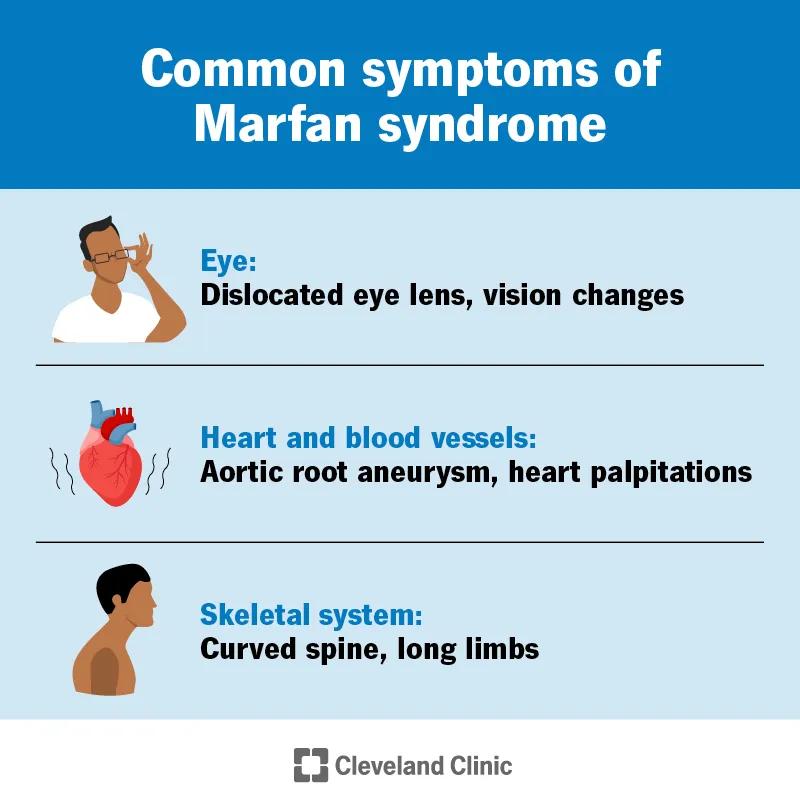
Image content: This image is available to view online.
View image online (https://assets.clevelandclinic.org/transform/1bf47cab-3c14-441a-9c9d-5a68ee530923/HL-26-HVI-8856708-marfan-syndrome-cv)
Marfan syndrome (MFS disease) is a genetic condition that makes your connective tissue too loose and elastic. Connective tissue typically provides strength and flexibility to many structures in your body. Because of this, Marfan syndrome can affect several body systems, including your heart, blood vessels, eyes, bones and joints.
Advertisement
Cleveland Clinic is a non-profit academic medical center. Advertising on our site helps support our mission. We do not endorse non-Cleveland Clinic products or services. Policy
Symptoms vary widely in severity, when they start and how quickly they progress. If you have Marfan syndrome, you usually have long limbs. But the biggest concern is a weakened aorta wall, which can be life-threatening.
Marfan syndrome is present at birth. But you may not get a diagnosis until you’re a teen or young adult. This syndrome is one of the most common inherited connective tissue diseases. It affects 1 in 3,000 to 5,000 people.
A genetic change (variant) causes Marfan syndrome. There’s a change in the fibrillin-1 or FBN1 gene that gives your cells instructions to make fibrillin, a protein. This protein is the main part of elastic fibers in your connective tissue.
In most cases, you inherit Marfan syndrome from a biological parent. You only need to receive the altered gene from one parent to inherit the condition.
In some cases, a new gene change occurs due to an unknown cause.
This syndrome can cause symptoms in many areas of your body.
These may include:
These may include:
Advertisement
These may include:
Marfan syndrome can cause several problems affecting your heart, eyes and lungs.
Cardiovascular complications are the most common issues from Marfan syndrome. They can include:
Eye complications may include:
The changes in lung tissue that happen with Marfan syndrome increase your risk for:
Marfan syndrome can affect tissues all over your body. You may need a team of healthcare providers to confirm the diagnosis and develop a treatment plan.
To start, they’ll:
Healthcare providers typically use a set of criteria to diagnose Marfan syndrome. The main criteria are aortic root aneurysm (dilation) and a dislocated eye lens. A provider may request many tests to help confirm the diagnosis, like:
Advertisement
A blood test can look for changes in the gene that causes most cases of Marfan syndrome or changes in other genes that cause similar symptoms. If you have the genetic variation that causes Marfan syndrome, let your family know. Your parents, siblings and children should get genetic counseling and testing, too.
A genetic counselor can also tell you how likely you are to pass this variation on to your children.
There’s no cure for Marfan syndrome. But various treatments can help manage your symptoms and prevent complications. You’ll need a treatment plan that’s specific to your health issues.
Certain medications can prevent or slow the enlargement of your aorta. They include:
If you get heart valve surgery for Marfan syndrome, you may need additional medication. You’ll have to take antibiotics before dental procedures to prevent infections. And if you have a mechanical valve (metal valve), you’ll be on a blood thinner to prevent strokes.
You’ll need routine medical visits to monitor your:
This way, your care team can track changes and catch any possible complications as soon as they appear. Your team will tell you how often you need these appointments.
Advertisement
Monitoring for MFS disease usually involves imaging tests like those used for diagnosis.
Intense physical activity can strain your aorta and the other connective tissues that this syndrome affects. Because of this, you’ll work closely with a physical therapist to find sports and activities that are safe for you.
Providers generally recommend low- to moderate-intensity physical activity for most people with Marfan syndrome. But you may need less if you have aortic root or valve replacement.
In general, you’ll likely need to avoid:
The goal of surgery for Marfan syndrome is to prevent your aorta from dissecting or rupturing and to treat valve problems.
The most common surgeries and procedures for this disease include:
If you need surgery, you should try to choose a major health system that’s experienced in the type of surgery you’re getting. Your surgical team should be familiar with Marfan syndrome, as well.
In addition to heart and vascular surgeries, you may need surgery to correct scoliosis and problems with your eyes.
Advertisement
See a provider if you have symptoms of this syndrome or if it’s in your family. If you have a Marfan syndrome diagnosis, you should visit your provider every year. This is to catch any symptoms that may be getting worse over time. You should also let your provider know if you’re experiencing side effects from your medications.
If you have Marfan syndrome, you can expect a lot of medical appointments. MFS disease affects everyone differently, so you’ll have your own journey with the syndrome. You’ll work closely with your team of healthcare providers to manage this syndrome as it changes.
Due to increased knowledge of this syndrome and advanced medical treatments, people with Marfan syndrome live much longer today than in the past. The life expectancy of someone with this syndrome is now almost the same as people without it. But life expectancy is much lower in males than in females.
Cardiovascular problems are still the most common cause of death in Marfan syndrome. This is mainly due to sudden death in undiagnosed cases of the syndrome. It’s also more likely to affect people who get a late diagnosis.
Chronic pain and fatigue, as well as limits on physical activity, can impact your mental health. Because of this, you may be at a higher risk of anxiety and depression.
Be sure to seek help from a mental health specialist if you’re having distress related to this disease. Your mental health is just as important as your physical health. Joining a support group may also help.
Life with Marfan syndrome (MFS disease) may feel like spinning through a revolving door of medical appointments. But all those check-ins can help prevent complications of Marfan syndrome so you can live the healthiest life possible. Your healthcare team will be by your side through it all. Lean on them for support and guidance.



Sign up for our Health Essentials emails for expert guidance on nutrition, fitness, sleep, skin care and more.
Learn more about the Health Library and our editorial process.
Cleveland Clinic’s health articles are based on evidence-backed information and review by medical professionals to ensure accuracy, reliability and up-to-date clinical standards.
Cleveland Clinic’s health articles are based on evidence-backed information and review by medical professionals to ensure accuracy, reliability and up-to-date clinical standards.
When you have an inflammatory or autoimmune condition, you need experts by your side. At Cleveland Clinic, we’ll create an individualized treatment plan for you.
