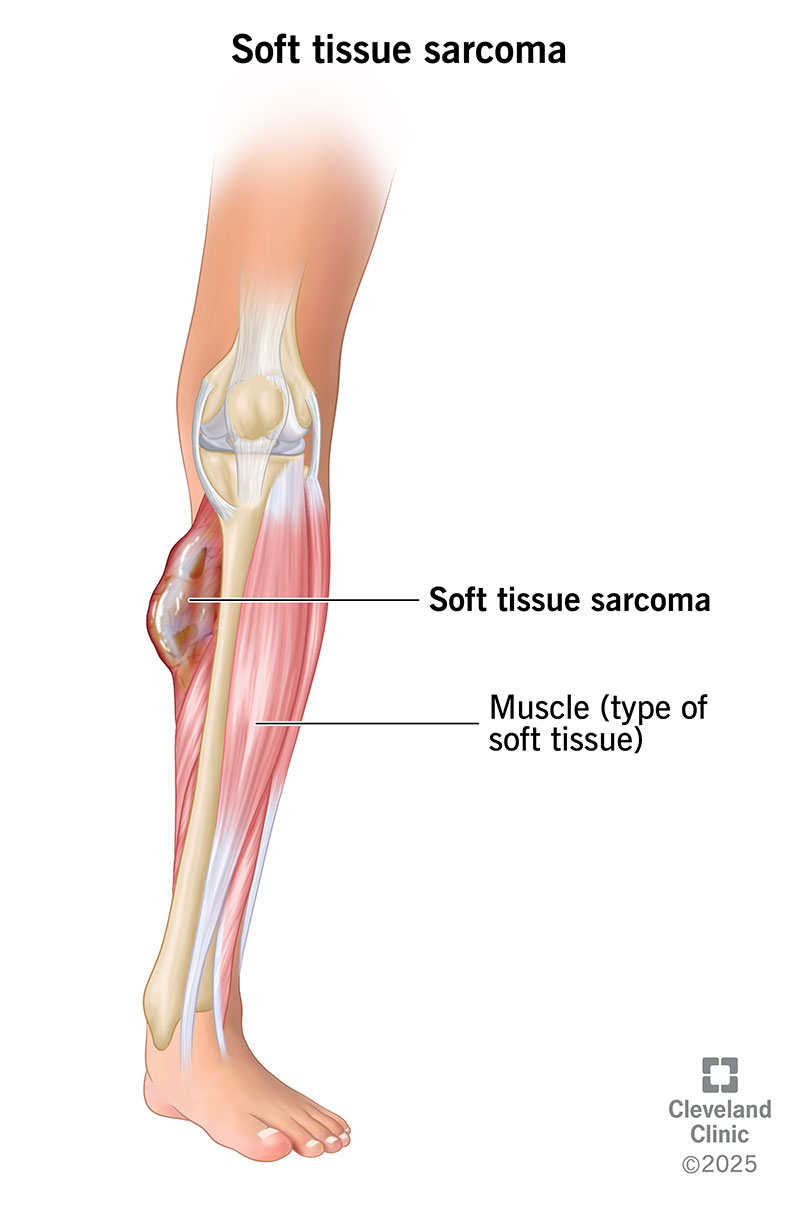
Childhood soft tissue sarcoma is a disease in which
malignant (cancer) cells form in soft tissues of the body.
Soft tissues of the body connect, support, and
surround other body parts and organs. The soft tissues include the following:
- Muscles
- Tendons (bands of tissue that connect muscles to bones).
- Synovial tissues (tissues around joints).
- Fat
- Blood vessels.
- Lymph vessels.
- Nerves
Soft tissue sarcoma may be found anywhere in the body. In children, the tumors form most often
in the arms, legs, or trunk (chest and abdomen).
There are many different types of soft tissue sarcomas.
The cells of each type of sarcoma look different under
a microscope. The soft tissue tumors are grouped based on the type of soft
tissue cell where they first formed.
Rhabdomyosarcoma is the most common type of childhood
soft tissue sarcoma. It begins in muscles that surround bone. Rhabdomyosarcoma
is not discussed in this document. This document is about the other types of
soft tissue sarcoma:
Fibrous (connective) tissue tumors
- Fibromatoses (desmoid tumor).
- Dermatofibrosarcoma.
- Fibrosarcoma.
Fibrohistiocytic tumors
- Malignant fibrous histiocytoma (also called
undifferentiated pleomorphic sarcoma, or spindle cell sarcoma).
Fat tissue tumors
Smooth muscle tumors
Blood and lymph vessel tumors
- Angiosarcoma.
- Lymphangiosarcoma.
- Hemangiopericytoma.
- Hemangioendothelioma.
Peripheral nervous system tumors
- Malignant schwannoma (malignant peripheral nerve sheath tumor).
Bone and cartilage tumors
- Extraosseous osteosarcoma.
- Extraosseous myxoid chondrosarcoma.
- Extraosseus mesenchymal chondrosarcoma.
Tumors with more than one type of tissue
- Malignant mesenchymoma.
- Malignant Triton tumor.
- Malignant ectomesenchymoma.
Tumors of unknown origin (the place where the tumor first formed is not known)
- Alveolar soft part sarcoma.
- Epithelioid sarcoma.
- Clear cell sarcoma (malignant melanoma of soft parts).
- Synovial sarcoma.
- Desmoplastic small round cell tumor.
Besides rhabdomyosarcomas, the most common soft tissue
sarcomas in children are in joint tissue, connective tissue, and nerve tissue.
Soft tissue sarcoma occurs in children and adults.
Soft tissue sarcoma in children may respond differently to treatment, and may
have a better outcome than soft tissue sarcoma in adults.
Having certain diseases and inherited disorders can
increase the risk of developing childhood soft tissue sarcoma.
Anything that increases your risk of getting a disease
is called a risk factor. Having a risk factor does not mean that you will get
cancer; not having risk factors doesn’t mean that you will not get cancer.
People who think they may be at risk should discuss this with their doctor. Risk
factors for childhood soft tissue sarcoma include having the following inherited
disorders:
- Li-Fraumeni syndrome.
- Neurofibromatosis type 1 (NF1).
Other risk factors include the following:
- Having AIDS (acquired immune deficiency syndrome) and Epstein-Barr virus infection.
- Having retinoblastoma in both eyes.
- Past treatment with radiation therapy.
The most common sign of childhood soft tissue
sarcoma is a painless lump or swelling in soft tissues of the body.
A sarcoma may appear as a painless lump under the
skin, often on an arm, a leg, or the trunk. There may be no other symptoms at
first. As the sarcoma grows larger and presses on nearby organs, nerves,
muscles, or blood vessels, symptoms may occur, including pain or weakness.
Other conditions may cause the same symptoms that soft
tissue sarcomas do. A doctor should be consulted if any of these problems occur.
Diagnostic tests and a biopsy are used to detect (find) and diagnose childhood soft tissue sarcoma.
The following tests and procedures may be used:
- Physical exam and history: An exam of the body to check general
signs of health, including checking for signs of disease, such as lumps or
anything else that seems unusual. A history of the patient’s health habits
and past illnesses and treatments will also be taken.
- X-rays: An x-ray is a type of energy beam that can go through the
body onto film, making pictures of areas inside the body. A series of x-rays
may be done to check the lump or painful area.
- MRI (magnetic resonance imaging): A procedure that uses a magnet,
radio waves, and a computer to make a series of detailed pictures of areas
inside the body. This procedure is also called nuclear magnetic resonance
imaging (NMRI).
If these tests show there may be a soft tissue sarcoma, a biopsy is done. One of the following
types of biopsies may be used:
- Fine-needle aspiration (FNA) biopsy: The removal of tissue or fluid
using a thin needle. A pathologist views the tissue or fluid under a
microscope to look for cancer cells.
- Core biopsy: The removal of tissue using a wide needle. A
pathologist views the tissue under a microscope to look for cancer cells.
- Incisional biopsy: The removal of part of a lump or a sample of
tissue. A pathologist views the tissue under a microscope to look for cancer cells.
- Excisional biopsy: The removal of an entire lump or area of tissue
that doesn’t look normal. A pathologist views the tissue under a microscope
to look for cancer cells. An excisional biopsy may be used to completely
remove smaller tumors that are near the surface of the skin.
In order to plan the best treatment, a large sample of
tissue may be removed during the biopsy to find out the type of soft tissue
sarcoma and do laboratory tests. Tissue samples will be taken from the primary
tumor, lymph nodes, and other areas that may have a tumor. A pathologist views
the tissue under a microscope to look for cancer cells and to find out the type
and grade of the tumor. The grade of a tumor depends on how abnormal the cancer
cells look under a microscope and how quickly the cells are dividing. High-grade
tumors usually grow and spread more quickly than low-grade tumors. Because soft
tissue sarcoma can be hard to diagnose, patients should ask to have biopsy
samples checked by a pathologist who has experience in diagnosing soft tissue sarcoma.
One or more of the following laboratory tests may be done to study the tissue samples:
- Cytogenetic analysis: A laboratory test in which cells in a sample
of tissue are viewed under a microscope to look for certain changes in the chromosomes.
- Immunohistochemistry study: A laboratory test in which dyes or
enzymes are added to a blood or bone marrow sample to test for certain
antigens (proteins that stimulate the body's immune response).
- Immunocytochemistry study: A laboratory test that uses different
substances to stain (color) cells in a sample of tissue. This is used to
tell the difference between the different types of soft tissue sarcoma.
- Light and electron microscopy: A laboratory test in which cells in a
sample of tissue are viewed under regular and high-powered microscopes to
look for certain changes in the cells.
Certain factors affect prognosis (chance of recovery) and treatment options.
The prognosis (chance of recovery) and treatment options depend on the following:
- The type of soft tissue sarcoma.
- The stage of the cancer (the amount of tumor remaining after surgery to
remove it or whether the tumor has spread to other places in the body).
- The location, grade, and size of the tumor and how deep under the skin
the tumor is.
- Whether or not the patient also has a condition called neurofibromatosis
type 1 (NF1).
- The age of the patient.
- Whether the cancer has just been diagnosed or has recurred (come back).
Stages of Childhood Soft Tissue Sarcoma
After childhood soft tissue sarcoma has been
diagnosed, tests are done to find out if cancer cells have spread to other parts
of the body.
The process used to find out if cancer has spread
within the soft tissue or to other parts of the body is called staging. There is
no standard staging system for childhood soft tissue sarcoma. Two methods that
are commonly used for staging are based on the amount of tumor remaining after
surgery to remove the tumor and/or the grade and size of the tumor and whether
it has spread to the lymph nodes or other parts of the body. It is important to
know the stage in order to plan treatment.
The following tests and procedures may be used in the staging process:
Sentinel lymph node biopsy may be used to stage
childhood soft tissue sarcoma. This is the removal of the sentinel lymph node
during surgery. The sentinel lymph node is the first lymph node to receive
lymphatic drainage from a tumor. It is the first lymph node the cancer is likely
to spread to from the tumor. A radioactive substance and/or blue dye is injected
near the tumor. The substance or dye flows through the lymph ducts to the lymph
nodes. The first lymph node to receive the substance or dye is removed. A
pathologist views the tissue under a microscope to look for cancer cells. If
cancer cells are not found, it may not be necessary to remove more lymph nodes.
CT scan (CAT scan): A procedure that makes a
series of detailed pictures of areas inside the body, taken from different
angles. The pictures are made by a computer linked to an x-ray machine. A dye
may be injected into a vein or swallowed to help the organs or tissues show up
more clearly. This procedure is also called computed tomography, computerized
tomography, or computerized axial tomography.
The results of the sentinel lymph node biopsy and CT
scan are viewed together with the results of the diagnostic tests and initial
surgery to determine the stage of the soft tissue sarcoma.
h6 There are three ways that cancer spreads in the body.
The three ways that cancer spreads in the body are:
- Through tissue. Cancer invades the surrounding normal tissue.
- Through the lymph system. Cancer invades the lymph system and
travels through the lymph vessels to other places in the body.
- Through the blood. Cancer invades the veins and capillaries and
travels through the blood to other places in the body.
When cancer cells break away from the primary
(original) tumor and travel through the lymph or blood to other places in the
body, another (secondary) tumor may form. This process is called metastasis. The
secondary (metastatic) tumor is the same type of cancer as the primary tumor.
For example, if breast cancer spreads to the bones, the cancer cells in the
bones are actually breast cancer cells. The disease is metastatic breast cancer,
not bone cancer.
One method used to stage childhood soft tissue sarcoma
is based on how much cancer remains after surgery to remove the tumor and
whether the cancer has spread:
Nonmetastatic childhood soft tissue sarcoma
In nonmetastatic childhood soft tissue sarcoma, the
cancer has been partly or completely removed by surgery and has not spread to
other parts of the body.
- Group I: The tumor has been completely removed by surgery.
- Group II: After surgery to remove the tumor, there are remaining
cancer cells that can be seen only with a microscope.
- Group III: After surgery, there is tumor remaining that can be seen
with the eye.
Metastatic childhood soft tissue sarcoma
- Group IV: The cancer has spread from where it started to other parts of
the body (metastasis).
Another method used to stage childhood soft tissue
sarcoma is based on the size of the tumor and whether cancer has spread to lymph
nodes or other parts of the body.
This staging system is based on the following:
- The size of the tumor.
- Whether the tumor has spread to the lymph nodes.
- Whether the tumor has spread to other parts of the body.
Sometimes the stages used for adult soft tissue
sarcoma are used for childhood soft tissue sarcoma:
Stage I
In stage I, the tumor is any size, low-grade (likely to grow and spread
slowly), and may be either superficial (close to the skin's surface) or deep.
Stage II
In stage II, the tumor is high-grade (likely to grow and spread quickly) and either:
- 5 centimeters or smaller and either superficial (close to the skin's
surface) or deep; or
- larger than 5 centimeters and superficial.
Stage III
In stage III, the tumor is high-grade, larger than 5 centimeters, and deep.
Stage IV
In stage IV, the tumor is any size, any grade, and has spread to nearby
lymph nodes and/or to other parts of the body.
Recurrent and Progressive Childhood Soft Tissue Sarcoma
Recurrent childhood soft tissue sarcoma is cancer that
has recurred (come back) after it has been treated. The cancer may come back in
the same place or in other parts of the body. Progressive childhood soft tissue
sarcoma is cancer that did not respond to treatment.
Treatment Option Overview
There are different types of treatment for patients with childhood soft tissue sarcoma.
Different types of treatments are available for
patients with childhood soft tissue sarcoma. Some treatments are standard (the
currently used treatment), and some are being tested in clinical trials. A
treatment clinical trial is a research study meant to help improve current
treatments or obtain information on new treatments for patients with cancer.
When clinical trials show that a new treatment is better than the standard
treatment, the new treatment may become the standard treatment.
Because cancer in children is rare, taking part in a
clinical trial should be considered. Some clinical trials are open only to
patients who have not started treatment.
Children with childhood soft tissue sarcoma should
have their treatment planned by a team of health care providers who are experts
in treating cancer in children.
Treatment will be overseen by a pediatric oncologist,
a doctor who specializes in treating children with cancer. The pediatric
oncologist works with other health care providers who are experts in treating
children with soft tissue sarcoma and who specialize in certain areas of
medicine. These may include a pediatric surgeon with special training in the
removal of soft tissue sarcomas. The following specialists may also be included:
- Radiation oncologist.
- Pediatric hematologist.
- Pediatric nurse specialist.
- Rehabilitation specialist.
- Psychologist.
- Social worker.
Some cancer treatments cause side effects months or years after treatment has ended.
Side effects from cancer treatment that begin during
or after treatment and continue for months or years are called late effects.
Late effects of cancer treatment may include:
- Physical problems.
- Changes in mood, feelings, thinking, learning, or memory.
- Second cancers (new types of cancer).
Some late effects may be treated or controlled. It is
important to talk with your child's doctors about the effects cancer treatment
can have on your child.
Seven types of standard treatment are used:
Surgery
Surgery to completely remove the soft tissue sarcoma is done whenever
possible. If the tumor is very large, radiation therapy or chemotherapy may be
given first, to make the tumor smaller and decrease the amount of tissue that
needs to be removed during surgery. The following types of surgery may be used:
- Wide local excision: Removal of the tumor along with some normal
tissue around it.
- Amputation: Surgery to remove part or all of a limb or appendage,
such as the arm or hand.
- Limb-sparing surgery: Removal of the tumor in an arm or leg without
amputation, so the use and appearance of the limb is saved. Radiation
therapy or chemotherapy may be given first to shrink the tumor. The tumor is
then removed in a wide local excision. Tissue and bone that are removed may
be replaced with a graft using tissue and bone taken from another part of
the patient's body, or with an implant such as artificial bone.
- Lymphadenectomy: Removal of the lymph nodes that contain cancer.
- Thoracotomy: An operation to open the chest. This may be done to
remove cancer that has spread to the lungs.
A second surgery may be needed to:
- remove any remaining cancer cells.
- check the area around where the tumor was removed for cancer cells and
then remove them.
Even if the doctor removes all the cancer that can be
seen at the time of the surgery, some patients may be given radiation therapy or
chemotherapy after surgery to kill any cancer cells that are left. Treatment
given after the surgery, to lower the risk that the cancer will come back, is
called adjuvant therapy.
Radiation therapy
Radiation therapy is a cancer treatment that uses
high-energy x-rays or other types of radiation to kill cancer cells or keep them
from growing. There are two types of radiation therapy. External radiation
therapy uses a machine outside the body to send radiation toward the cancer.
Internal radiation therapy uses a radioactive substance sealed in needles,
seeds, wires, or catheters that are placed directly into or near the cancer. The
way the radiation therapy is given depends on the type and stage of the cancer
being treated.
Chemotherapy
Chemotherapy is a cancer treatment that uses drugs to
stop the growth of cancer cells, either by killing the cells or by stopping them
from dividing. When chemotherapy is taken by mouth or injected into a vein or
muscle, the drugs enter the bloodstream and can reach cancer cells throughout
the body (systemic chemotherapy). When chemotherapy is placed directly into the
spinal column, an organ, or a body cavity such as the abdomen, the drugs mainly
affect cancer cells in those areas (regional chemotherapy). Combination
chemotherapy is the use of more than one anticancer drug. The way the
chemotherapy is given depends on the type and stage of the cancer being treated.
Hormone therapy
Hormone therapy is a cancer treatment that removes
hormones or blocks their action and stops cancer cells from growing. Hormones
are substances made by glands in the body and circulated in the bloodstream.
Some hormones can cause certain cancers to grow. If tests show that the cancer
cells have places where hormones can attach (receptors), drugs, surgery, or
radiation therapy is used to reduce the production of hormones or block them
from working. Antiestrogens (drugs that block estrogen) may be used to treat
childhood soft tissue sarcoma.
Watchful waiting
Watchful waiting is closely monitoring a patient’s
condition without giving any treatment until symptoms appear or change. Watchful
waiting may be done when complete removal of the tumor is not possible, no other
treatments are available, and the tumor does not place any vital organs in danger.
Nonsteroidal anti-inflammatory drugs
Nonsteroidal anti-inflammatory drugs (NSAIDs) are
drugs (such as aspirin, ibuprofen, and naproxen) that are commonly used to
decrease fever, swelling, pain, and redness. In the treatment of soft tissue
sarcomas, an NSAID called sulindac may be used to help block the growth of cancer cells.
Liver transplant
The liver is removed and replaced with a healthy one from a donor.
New types of treatment are being tested in clinical trials.
This section describes treatments that are being
studied in clinical trials. It may not mention every new treatment being
studied. Information about clinical trials is available from the NCI Web site.
Targeted therapy
Targeted therapy is a type of treatment that uses
drugs or other substances to find and attack specific cancer cells without
harming normal cells. Imatinib (Gleevec) is a type of targeted therapy called a
tyrosine kinase inhibitor. It finds and blocks an abnormal protein on cancer
cells that causes them to divide and grow.
Other targeted therapies being studied in clinical
trials include angiogenesis inhibitors. In cancer treatment, angiogenesis
inhibitors prevent the growth of new blood vessels needed for tumors to grow.
Patients may want to think about taking part in a clinical trial.
For some patients, taking part in a clinical trial may
be the best treatment choice. Clinical trials are part of the cancer research
process. Clinical trials are done to find out if new cancer treatments are safe
and effective or better than the standard treatment.
Many of today's standard treatments for cancer are
based on earlier clinical trials. Patients who take part in a clinical trial may
receive the standard treatment or be among the first to receive a new treatment.
Patients who take part in clinical trials also help
improve the way cancer will be treated in the future. Even when clinical trials
do not lead to effective new treatments, they often answer important questions
and help move research forward.
Patients can enter clinical trials before, during, or after starting their cancer treatment.
Some clinical trials only include patients who have
not yet received treatment. Other trials test treatments for patients whose
cancer has not gotten better. There are also clinical trials that test new ways
to stop cancer from recurring (coming back) or reduce the side effects of cancer treatment.
Clinical trials are taking place in many parts of the country.
Follow-up tests may be needed.
Some of the tests that were done to diagnose the
cancer or to find out the stage of the cancer may be repeated. Some tests will
be repeated in order to see how well the treatment is working. Decisions about
whether to continue, change, or stop treatment may be based on the results of
these tests. This is sometimes called re-staging.
Some of the tests will continue to be done from time
to time after treatment has ended. The results of these tests can show if your
condition has changed or if the cancer has recurred (come back). These tests are
sometimes called follow-up tests or check-ups.
Treatment Options for Childhood Soft Tissue Sarcoma
For some types or stages of cancer, there may not be any trials listed. Check with your
doctor for clinical trials that are not listed here but may be right for you.
Nonmetastatic Childhood Soft Tissue Sarcoma
For treatment of fibrosarcoma or hemangiopericytoma
If an infant or young child has fibrosarcoma or hemangiopericytoma, treatment will be surgery
whenever possible. Other treatments may include chemotherapy to reduce the size of the tumor,
followed by surgery.
If an older child or adolescent has fibrosarcoma or
hemangiopericytoma, treatment will be surgery whenever possible. Other
treatments may include the following:
- Chemotherapy followed by radiation therapy, surgery, or both.
- Radiation therapy or chemotherapy after surgery.
- A clinical trial of internal radiation therapy.
- A clinical trial of radiation therapy given during surgery.
For treatment of desmoid tumor
Treatment of desmoid tumor will be surgery whenever
possible. Other treatments may include watchful waiting, chemotherapy, or
surgery followed by internal radiation therapy.
If surgery to completely remove the tumor is not possible, treatment to shrink the tumor before
surgery may include the following:
- External radiation therapy
- A nonsteroidal anti-inflammatory drug (NSAID).
- Antiestrogen therapy.
- Chemotherapy
For treatment of alveolar soft part sarcoma
Treatment of alveolar soft part sarcoma will be
surgery whenever possible. Other treatments may include the following:
- Radiation therapy.
- A clinical trial of surgery followed by watchful waiting, chemotherapy
and/or radiation therapy, based on the grade of the tumor and the amount of
tumor that is removed by surgery. Sometimes chemotherapy may be given before surgery.
For treatment of clear cell sarcoma of soft parts
Treatment of clear cell sarcoma of soft parts will be surgery whenever possible. Other
treatments include radiation therapy after surgery.
For treatment of desmoplastic small round cell tumor
Treatment of desmoplastic small round cell tumor will
be surgery whenever possible. Other treatments may include chemotherapy and
radiation therapy after surgery.
For treatment of extraosseous osteosarcoma
See the NIH's PDQ summary on Osteosarcoma and Malignant Fibrous Histiocytoma of Bone Treatment for
more information on the treatment of extraosseous osteosarcoma.
For treatment of hemangioendothelioma
Treatment of hemangioendothelioma in children younger than one year may include the following:
- Watchful waiting as some tumors will disappear without treatment.
- Treatment for blood clotting disorders.
- Surgery to remove the tumor if there are symptoms.
- Liver transplant (if the tumor is in the liver).
Treatment of hemangioendothelioma in children aged one year and older may include the following:
- Surgery to remove the tumor.
- Treatment for blood clotting disorders.
- Liver transplant (if the tumor is in the liver).
For treatment of malignant peripheral nerve sheath tumor
Treatment of malignant peripheral nerve sheath tumor
will be surgery whenever possible. Other treatments may include radiation
therapy after surgery.
For treatment of synovial sarcoma
Treatment of synovial sarcoma may include the following:
- Surgery with or without chemotherapy.
- Chemotherapy.
For treatment of angiosarcoma and lymphangiosarcoma
Treatment of angiosarcoma and lymphangiosarcoma may include the following:
- Surgery to completely remove the tumor.
- Radiation therapy or chemotherapy after surgery.
For treatment of aggressive fibromatosis, dermatofibrosarcoma, and angiomatoid malignant
fibrous histiocytoma
Treatment of these tumor types will be surgery
whenever possible. Other treatments may include the following:
- Targeted drug therapy with imatinib (Gleevec).
- Radiation therapy after surgery.
For treatment of epithelioid sarcoma, leiomyosarcoma,
liposarcoma, and mesenchymal chondrosarcoma
Treatment of these tumor types will be surgery whenever possible. Other treatments may
include the following:
- Chemotherapy followed by radiation therapy, surgery, or both.
- Radiation therapy or chemotherapy after surgery.
- A clinical trial of internal radiation therapy.
- A clinical trial of radiation therapy given during surgery.
Metastatic Childhood Soft Tissue Sarcoma
Treatment of metastatic childhood soft tissue sarcoma may include the following:
- Combination chemotherapy, radiation therapy, and surgery (thoracotomy)
to remove cancer that has spread to the lungs.
- A clinical trial of combination chemotherapy and granulocyte
colony-stimulating factor (substance that helps the body increase the number
of white blood cells).
- A clinical trial of a targeted therapy.
Recurrent and Progressive Childhood Soft Tissue Sarcoma
Treatment of recurrent or progressive childhood soft
tissue sarcoma may include the following:
- Watchful waiting for some desmoid tumors.
- Surgery followed by radiation therapy, if not already given.
- Surgery to remove the arm or leg with cancer, if radiation therapy was
already given.
- Surgery to remove cancer that has spread to the lungs.
- A clinical trial of new combinations of chemotherapy.
- A clinical trial of targeted drug therapy with imatinib (Gleevec).
Check for U.S. clinical trials from NCI's PDQ Cancer
Clinical Trials Registry that are now accepting patients with childhood soft
tissue sarcoma. For more specific results, refine the search by using other
search features, such as the location of the trial, the type of treatment, or
the name of the drug. General information about clinical trials is available
from the NCI Web site.
For more information from the NCI, please write to this address:
NCI Public Inquiries Office
Suite 3036A
6116 Executive Boulevard, MSC8322
Bethesda, MD 20892-8322
U.S. residents may call the National Cancer Institute's (NCI's)
Cancer Information Service toll-free at 1-800-4-CANCER (1-800-422-6237) Monday
through Friday from 9:00 a.m. to 4:30 p.m. Deaf and hard-of-hearing callers with
TTY equipment may call 1-800-332-8615. Information about ongoing clinical trials is available from
the NCI Web site.
Source: National Institutes of Health; National Cancer Institute
Can't find the health information you’re looking for?
Ask a Health Educator, Live!
Know someone who could use this information?...send them this link.
This information is provided by the Cleveland Clinic and is not intended to replace the medical advice of your doctor or health care provider. Please consult your health care provider for advice about a specific medical condition. This document was last reviewed on: 9/4/2009...#6235