



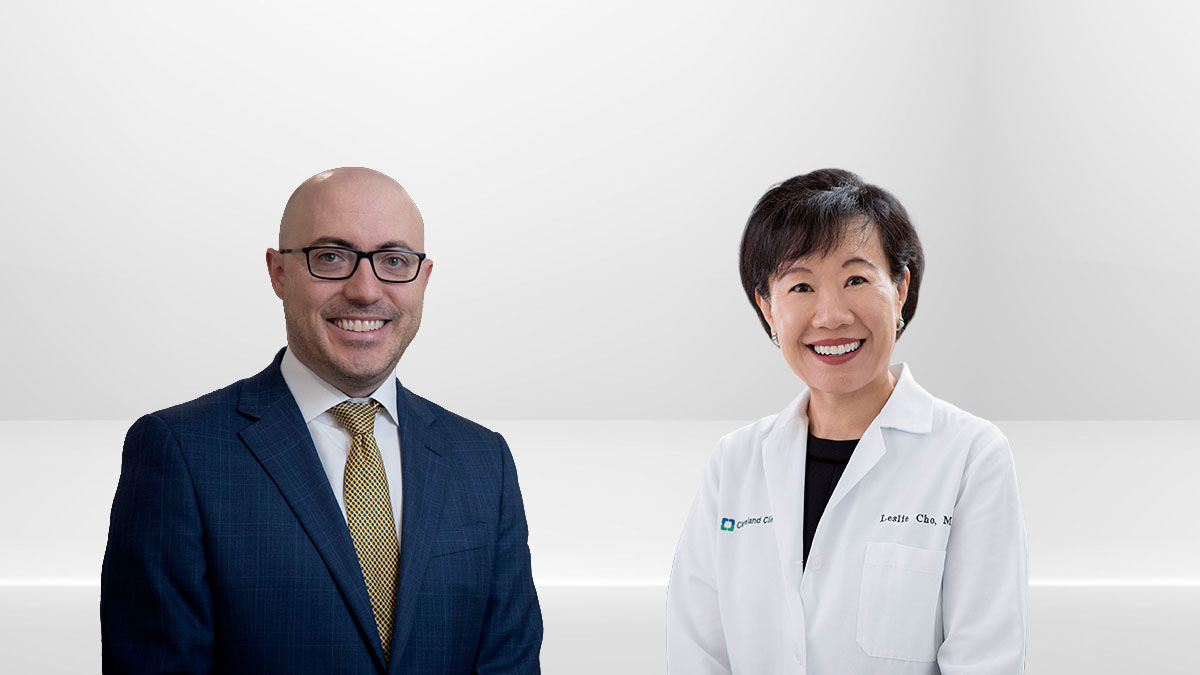
Heart Health Habits to Help You Age Well
How can you live longer and feel better as you age? Leslie Cho, MD, and Luke Laffin, MD, break down what really matters for heart-healthy aging: movement, food, sleep and knowing your numbers. They provide insights informed by a recent Cleveland Clinic heart health survey on Americans’ views of aging well and overlooked heart disease risks.
Advertisement
Cleveland Clinic is a non-profit academic medical center. Advertising on our site helps support our mission. We do not endorse non-Cleveland Clinic products or services. Policy
Recent Episodes
Understanding New Cholesterol Guidelines for Better Heart Health
Ashish Sarraju, MD, and Leslie Cho, MD, discuss the latest cholesterol guidelines and why understanding lifetime risk is key to preventing h…
Quick Questions Abdominal Aortic Aneurysm
Francis Caputo, MD, explains how abdominal aortic aneurysms are monitored and when treatment is recommended based on size, risk and overall…
Encore: Myths on Dieting and Heart Health
This episode is an encore presentation of "Myths on Dieting and Heart Health," which originally premiered on April 15, 2025. With so much d…
Video content: This video is available to watch online.
View video online (https://cdnapisec.kaltura.com/p/2207941/sp/220794100/playManifest/entryId/1_65hm99sn/flavorId/1_5f3sgelj/format/url/protocol/https/a.mp4)
Transcript
Announcer:
Welcome to Love Your Heart, brought to you by Cleveland Clinic's Sydell and Arnold Miller Family Heart, Vascular and Thoracic Institute. This podcast will explore disease prevention, testing, medical and surgical treatments, new innovations and more. Enjoy.
Advertisement
Cleveland Clinic is a non-profit academic medical center. Advertising on our site helps support our mission. We do not endorse non-Cleveland Clinic products or services. Policy
Leslie Cho, MD:
Hi, my name is Leslie Cho. I'm the section head for preventive cardiology and cardiac rehabilitation at Cleveland Clinic. Today, we're joined by Dr. Luke Laffin, who is our esteemed colleague, world-renowned expert in hypertension as well as in cardiovascular disease, to talk about how to strengthen your heart, how to live longer and how to live better. Luke, there's a lot of interest in aging, but also aging well and living your best cardiac health. What's the one thing people can do to live better?
Luke Laffin, MD:
What we really think about here is marrying some healthy lifestyle choices with modern medicine as well. There are all kinds of “longevity experts” out there. This is a really important aspect for people. It's not just the quantity of years. No one wants to make it to 90 and be wheelchair bound and not be able to do things. People really appreciate having the freedom to travel, exercise, do those things and stay mentally sharp as well.
That's really what our survey for Heart Health showed. There are all kinds of things they can do.
I think if I had to distill it down to one thing, it's really being physically active more than anything else.
Leslie Cho, MD:
And what do you think is that physical exercise? Because I know what my favorite is, but what does the data say about best exercise?
Advertisement
Luke Laffin, MD:
Yeah. I mean, really getting that aerobic physical activity or cardio more than anything else. What we generally recommend for most individuals is a minimum of 150 minutes a week of moderate-intensity aerobic physical activity. Really, that means, as you know, we can carry on a conversation while you're doing it. For most people, brisk walk, sometimes a light jog, right? But that's the minimum, and more is definitely better, and we'd always encourage that.
Leslie Cho, MD:
As you get older, probably strength training, some balance and mobility work, just because fall risk is such a high-risk thing that happens to people as they age.
Luke Laffin, MD:
100%. I've really, particularly over the past couple of years, I've been making it a concerted effort to ask my older patients when I see them (by older, I don't mean very old. I mean, even just over 60) to get themselves a few sessions with a personal trainer, so to speak, and it doesn't have to be some long-term relationship. A few sessions to understand, "Okay, this is how I want to improve my core strength, balance, all of that." They can really work, and that's their expertise to do that. Completely anecdotally, I told my parents the same thing. Just earlier this fall, they were visiting. They're both in their 70s, and I've been telling them for three years. They finally did it, and about two weeks after it, my mom was like, "This is amazing." So it's something where it takes a little bit of effort to get into it, but once you do it, people just feel great.
Leslie Cho, MD:
If they can't afford a coach, there's plenty of things on the internet. We have plenty of stuff on our website that they can look at to get that kind of coaching or that kind of advice about how to exercise properly.
Luke Laffin, MD:
Exactly. Exactly. I mean, I think it's really, we know increasingly that physical activity plays such a big role, and as you said, there's all kinds of resources out there on Instagram, YouTube, all those things.
Leslie Cho, MD:
There's so much confusion about how to eat or what to eat to live well, to live longer. There's all this sort of protein mania out there. If you had to pick the best diet for people to live long and well for cardiac fitness and brain fitness, what would you say?
Luke Laffin, MD:
Most of the data would support more of a Mediterranean dietary pattern than anything else. I like to tell my patients that you can Google “heart-healthy diet” out there and you get a thousand books by a thousand different cardiologists. But if you really delve into it, 90 to 95% of what they say is the same, and most of it is the Mediterranean diet. But I mean, as you probably know, some people, that can be difficult as well. Actually, I tell them that there are five major things they need to know, but the biggest one is to eliminate the processed and the ultra-processed foods. If you do that, I think you're the majority of the way there. I don't know if you'd agree with that.
Advertisement
Leslie Cho, MD:
Yeah. I mean, I think the Mediterranean diet has the most data. It's good for your brain, good for your heart. It's actually good for cancer reduction, as you know, because of the inflammation risk. I just think it's a great diet. It's an expensive diet, and we have to be sort of mindful about that. I think it's mainly plant as your source of protein, plant or fish, chicken. And then beef, pork, and lamb, and shrimp and lobster, or not fish, once a week. I think for most people, that's sort of a game-changer. Some people find that very difficult because they're very focused on meat, but we know that less meat probably is better in terms of even a cancer reduction.
Luke Laffin, MD:
Yeah, I completely agree. When I talk to my patients, as you alluded to, there's this misconception sometimes about fish, that shellfish is healthy. It's not. We try to get salmon, tuna in our diet, et cetera. I'm actually a little bit more strict even. I tell patients, if you can get to once a month with red meat, and then everyone rolls their eyes at me and says, "Can I really?" But I say, "Look, it's stepwise progression. You'll get there." A burger every once in a while is not going to kill someone, but a couple of times a week, not the best choice.
Advertisement
Leslie Cho, MD:
Absolutely. Also, I think we have to be mindful about environmental choices, too, that we make as a society. Now, if there is one, just going back to the exercise, if there is one form of exercise like walking, running, weightlifting that's best for your heart, what do you think it would be?
Luke Laffin, MD:
I generally say walking, particularly as people get older. If it's the middle of the winter in Cleveland, you want to do something where you're not outside and ready to slip and all of that, but really, walking is a great source of exercise. That's what my thinking is.
Leslie Cho, MD:
Yeah. I think whatever exercise you want to do is probably the best form of exercise. If you love weight training, you can do low weight, high repetition, things like this. I mean, whatever you want to do. I think the other important thing is having the non-exercise related movements, so having more things to do during the day. For example, maybe getting off the elevator one flight before your destination and walking that rest of the way up in a staircase or parking further away. Patients always tell me like, "Can I have a handicap parking," after their heart attack.
Luke Laffin, MD:
Absolutely not.
Leslie Cho, MD:
I'm like, "No, you need to park the furthest away and walk into the store." But just kind of like that non-exercise related motion, the motion you do every day is, I think, super important, too.
Advertisement
The one thing I always find very shocking is that patients are deathly afraid of stroke. They're afraid of stroke because that quality of life that you spoke to earlier on is so important for them. Now, besides diet and exercise, what are some of the key things that our patients can do to decrease their risk of stroke?
Luke Laffin, MD:
Well, I mean, understanding your numbers, right? I mean, that's sort of a trite saying, but it's very true, right?
Leslie Cho, MD:
Yes.
Luke Laffin, MD:
Talking with your doctor about your cholesterol, your hemoglobin A1C, which is a marker of blood sugar. Blood pressure is probably the most sensitive factor that we have in terms of reducing stroke risk. We know, as we talk about longevity and aging, the natural phenomenon as we get older is that blood pressure goes up. The majority of adults, if they live long enough, they are going to develop hypertension. They've done good studies where if you're completely healthy otherwise, but you have high blood pressure over the age of 75, reducing that blood pressure to right around 120 millimeters of mercury reduces your risk of dying. Not just strokes, just dying in general, and the big trials that they've done stopped early. Increasingly we know, and it's in the guidelines now, that reducing blood pressure also reduces the risk of dementia as well, right?
Leslie Cho, MD:
Yes, yes. So important.
Luke Laffin, MD:
I would argue that equally to stroke is dementia. No one wants to be walking around with that. That actually perks my patient's ears up a little bit. They've heard of stroke, heart attack, et cetera. "Can't you just take me to the cath lab and open it up?" Yeah, but dementia, we don't have any good treatments for, but we do have things that we can do to prevent it.
Leslie Cho, MD:
So, high blood pressure, the other number is, of course, your cholesterol numbers, and then your diabetes, your glucose numbers, your weight, and then, of course, not smoking.
Now, there's been so much information out there about sleep. What is the ideal number of hours for heart health?
Luke Laffin, MD:
Really, what we recommend, and this is increasingly noted over about the past decade, decade and a half, it's about six to eight hours of uninterrupted sleep. That’s what I recommend to my patients. It gets harder as we get older. Sleep gets more disrupted. So it's making a true effort to get those hours of sleep. It's important.
Leslie Cho, MD:
Six to eight hours of continuous sleep is almost an impossible thing when you're raising children, but forget that. As you get older, menopause, decreasing in testosterone, all of these things make you have bad sleep. There are some easy things out there to help you sleep better. So, talk about that.
Luke Laffin, MD:
So definitely, some real lifestyle things that we can do. One is, particularly for men, as they get older, prostate gets bigger, et cetera, but really both sexes, try and decrease fluid intake before you go to bed. Cut off anywhere between 60 and 90 minutes. That can help, so you're not waking up having to urinate. Number two, cool, dark room. People don't want to be warm at night. From a dark perspective, blackout shades are always a great idea as well. Number three, it's really staying in a routine. You don't want to be on your phone or on your computer in bed as well, right? It's fine to watch TV or do those things before bed, but not in the bed. Do it in your family room or living room and then make your way to the bed.
Then, if you wake up in the middle of the night, there's really no point in tossing and turning for an hour or two, right? That just sets you up for a bad day. What I tell my patients, if you're awake for more than about 20, 30 minutes, get up and start your day or do something to change that pattern. Then, ultimately, I don't recommend this first-line or even second-line therapy, but then some people do need a little bit of a sleeping aid, at least for a short period of time, to get back in a better rhythm.
Leslie Cho, MD:
What about things like avoiding alcohol, avoiding caffeine? As you get older, you become super sensitive, and alcohol makes you go to sleep, but doesn't keep you asleep.
Luke Laffin, MD:
Exactly. These are things that everyone has to take on an individual basis to see. However, those are definitely things to do. I mean, I even know as I've gotten older, I can't have any caffeine after noon because I'll be up for the rest of the night, right?
Leslie Cho, MD:
Yeah, yeah, me too.
Luke Laffin, MD:
It's just one of those things that you have to think about.
Leslie Cho, MD:
The other important thing is to be tested for sleep apnea because that might be the reason why you're not getting sleep. Or if your partner is saying that you're snoring or you feel like you're consistently not getting good sleep, maybe talking to your doctor about getting checked for sleep apnea.
Luke Laffin, MD:
Exactly. If you're waking up tired every morning and falling asleep during the day in particular and may have other risk factors like big neck circumference or you're overweight, yeah, it's definitely worthwhile. We have easy screening tools that we can actually send to your house to do a screen and then ultimately get a formal diagnosis if needed.
Leslie Cho, MD:
That's right. Now, just to wrap up, what are you most excited about in terms of upcoming research?
Luke Laffin, MD:
Well, I think there's really sort of three things that I'm really interested in. Number one is increasing use of GLP-1 receptor agonists. We know that a lot of people are using them for weight loss, which is great, and they're feeling better. We know that we're getting increasingly good data on cardiovascular outcomes. I know Dr. Cho here is leading a study looking at those drugs for reduction in atrial fibrillation, for example. People are looking at heart failure and other cardiovascular disease. So, that's number one.
Number two, we know with residual cardiovascular risk, you can have your blood pressure controlled, you can have sugar controlled, cholesterol controlled, but there are other factors that we haven't had good medicines to address. So, like inflammation, we're looking at specific drugs that reduce inflammation and may reduce risk. You're leading the first trial in lipoprotein(a) reduction drugs. Hopefully, we have some data on that soon.
Then finally, it's early, but, we've looked at some data for gene editing drugs that are one and done shots rather than once a month or once every six months. This is a one and done therapy. Those are many years away, but those are for cholesterol. We're looking at blood pressure as well. I think those are really the categories that are the most impactful.
Leslie Cho, MD:
I mean, you've done an amazing trial on the gene editing drug. I mean, I think the great news is that heart disease is preventable. The drugs that are out there or the therapies that are out there really get at that prevention. I think it's a great time to be in cardiology because there are so many exciting things coming up.
You and I both work in preventive cardiology. I like to boast that Cleveland Clinic sees and has the largest preventive cardiology section in the world. Maybe for our audience, why should someone come to see a preventive cardiologist?
Luke Laffin, MD:
Well, I think because obviously, because of what we're talking about today is this longevity and keeping it. We see a variety of patients, right? We see those patients that have maybe already had a heart attack, they've had heart failure, and they don't want to have that again, right? But then, increasingly, we see these folks where, "My dad had a heart attack," or "My mom had a heart attack in their 40s, and I have young kids. I'm in my 30s. I don't want that to happen to me."
As section head and our fearless leader there, you have developed a great group. We have a number of wonderful physicians that can help you out as a patient to really go through your risk factors, talk about in detail, and personalize that lifestyle advice for you, plus or minus medicines. Not everyone needs them, but we can do that.
Then, we have a multidisciplinary team we work with. We have a couple of wonderful dietitians that specifically focus on heart health and how to do that. We have a wonderful team of exercise physiologists. When you go to the gym and they show you those heart rate ranges on the elliptical, for example, those are fine and those are a good start, but we can really personalize that information for you. It's just really a great team. We love seeing patients through all stages of life really to focus on how can we get to 90, 100 years old, stroke and heart attack free.
Leslie Cho, MD:
Absolutely. I mean, I think we have the best section in the world, and the reason, as you alluded to, is we have cardiologists who specialize in diabetes. We have you who specializes in hypertension and really focuses on these high-risk patients. We have people focusing on genetic causes of high cholesterol. We also have psychologists, psychiatrists. I mean, we have pharmacists. It's a holistic approach to treating heart disease.
Oftentimes, we see young patients, I know you do too, that are just demoralized after having a heart attack and feel like, oh my God, their life is going to be completely upended. By the time they come and see us and we develop a plan, they feel like, "I can lead the rest of my life better, longer and healthier." I think that's our goal, to be on a journey with them where they can feel better, live longer, and of course help not just the patient, but the entire family. Well, it was wonderful to talk to you as always.
Luke Laffin, MD:
Thanks, Dr. Cho. Appreciate it.
Leslie Cho, MD:
Thank you everybody for joining us on today's Love Your Heart Podcast.
Announcer:
Thank you for listening to Love Your Heart. We hope you enjoyed the podcast. For more information or to schedule an appointment at Cleveland Clinic, please call 844.868.4339. That's 844.868.4339. We welcome your comments and feedback. Please contact us at heart@ccf.org. Like what you heard? Subscribe wherever you get your podcasts or listen at clevelandclinic.org/loveyourheartpodcast.
Recent Episodes
Understanding New Cholesterol Guidelines for Better Heart Health
Ashish Sarraju, MD, and Leslie Cho, MD, discuss the latest cholesterol guidelines and why understanding lifetime risk is key to preventing h…
Quick Questions Abdominal Aortic Aneurysm
Francis Caputo, MD, explains how abdominal aortic aneurysms are monitored and when treatment is recommended based on size, risk and overall…
Encore: Myths on Dieting and Heart Health
This episode is an encore presentation of "Myths on Dieting and Heart Health," which originally premiered on April 15, 2025. With so much d…
Never miss a moment - subscribe now.
Listen to the Health Essentials Podcast on your favorite streaming platform.
Other Podcasts You May Love
Beyond Leadership
Hosts Jim Pae and Elizabeth Pugel escort you through a network of thought leaders, sharing world-cla…
Beyond the Pages: CCJM Podcast
Beyond the Pages: CCJM Podcast takes the listener more in-depth into Cleveland Clinic Journal of Med…
Butts & Guts
A Cleveland Clinic podcast exploring your digestive and surgical health from end to end. You’ll lear…
Cancer Advances
A Cleveland Clinic podcast for medical professionals exploring the latest innovative research and cl…