



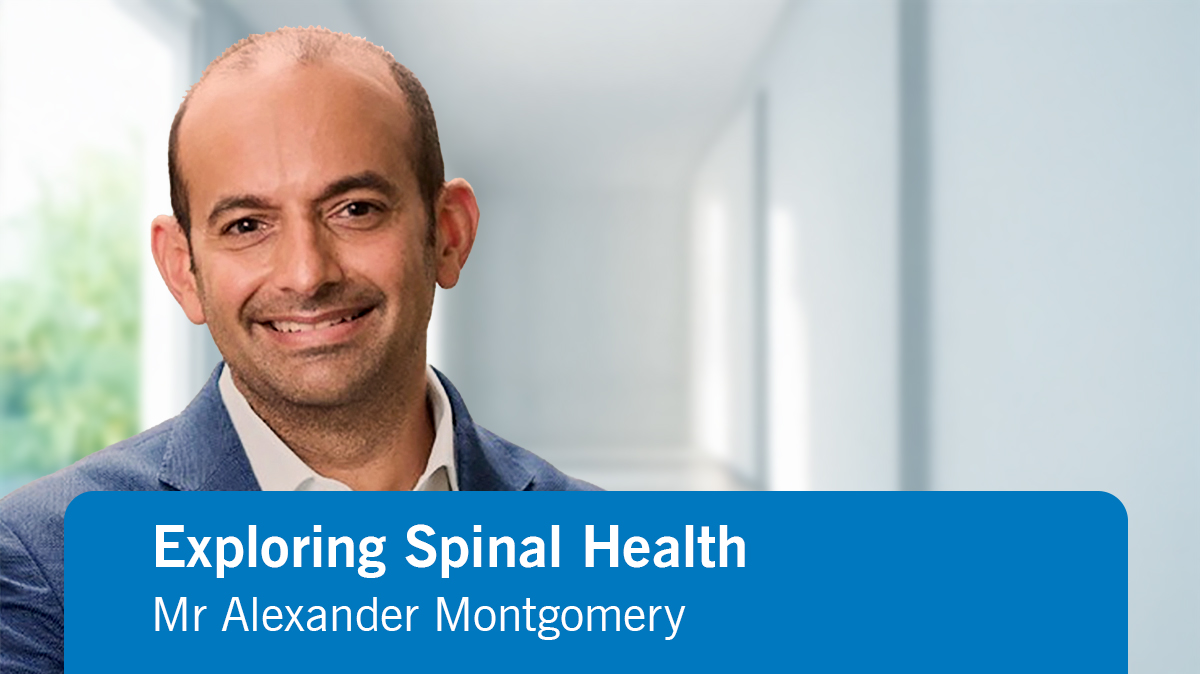
Exploring Spinal Health with Mr Alexander Montgomery
In this episode of Exploring Health with Cleveland Clinic London, host Mr Kash Akhtar, Consultant Orthopaedic Knee Surgeon, is joined by Mr Alexander Montgomery, Consultant Orthopaedic Spine Surgeon and specialist in spinal and sports injuries. Together, they explore how to maintain a healthy spine, what to do when things go wrong, and how spinal injuries are treated from rehabilitation through to surgery.
They share practical strategies for protecting spinal health, improving mobility, and supporting recovery. Whether you’ve experienced back pain, suffered a gym injury, or work as a GP or physiotherapist, this episode is packed with actionable advice and expert insight.
Advertisement
Cleveland Clinic is a non-profit academic medical center. Advertising on our site helps support our mission. We do not endorse non-Cleveland Clinic products or services. Policy
Recent Episodes
Exploring Stroke with Dr Arvind Chandratheva
In this episode of Exploring Health with Cleveland Clinic London, host Mr Kash Akhtar, Consultant Orthopaedic Knee Surgeon, is joined by Dr…
Exploring Health Checks That Could Save Your Life (Part 2) - Dr Simon Hodes, Dr John Whitaker and Dr Umasuthan Srirangalingam
In this episode of Exploring Health with Cleveland Clinic London, host Mr Kash Akhtar, consultant orthopaedic knee surgeon, continues his co…
Exploring Health Checks That Could Save Your Life (Part 1) - Dr Simon Hodes, Dr John Whitaker and Dr Umasuthan Srirangalingam
In this episode of Exploring Health with Cleveland Clinic London, host Mr Kash Akhtar, consultant orthopaedic knee surgeon, is joined by thr…
Video content: This video is available to watch online.
View video online (https://cdnapisec.kaltura.com/p/2207941/sp/220794100/playManifest/entryId/1_nsrcpsz9/flavorId/1_5f3sgelj/format/url/protocol/https/a.mp4)
Transcript
Mr Kash Akhtar
Advertisement
Cleveland Clinic is a non-profit academic medical center. Advertising on our site helps support our mission. We do not endorse non-Cleveland Clinic products or services. Policy
Welcome to the latest edition of Exploring Health with Cleveland Clinic London. Thank you to Cleveland Clinic Philanthropy UK for supporting this podcast. I'm your host Kash Akhtar, consultant orthopaedic knee surgeon. Today's episode is all about spinal health. We'll be discussing how to stay strong, what to do when things go wrong and how spinal injuries are treated from rehab to surgery. So, if you've ever struggled with back pain or a gym injury, or you’re a GP, physio, or just curious, then this episode is full of practical tips and expert insight. Joining me today is Mr Alexander Montgomery, consultant orthopaedic spine surgeon here at Cleveland Clinic London. He's a specialist in spinal injuries and sports injuries and he has worked with athletes from the grassroots to elite level. He's here to help us unpack what really matters when it comes to spine protection, performance and recover.. So Monty, we've never met before, have we?
Mr Alexander Montgomery
Once or twice, like over the last 10 years? NHS, private, one place to another place.
Mr Kash Akhtar
It's a real pleasure to have you here buddy. It's not often I get to chat with mates. We don't even talk about spines, we can just catch up and see how you are?
Advertisement
Mr Alexander Montgomery
Yeah thanks mate!
Mr Kash Akhtar
The plan for today, what I want to do is I want to talk about the common mistakes that people make that can lead to back and neck injuries.
Mr Alexander Montgomery
Yeah.
Mr Kash Akhtar
How to protect your back health long term and when surgery is the right option and when it's not.
Mr Alexander Montgomery
Yeah.
Mr Kash Akhtar
Sound okay?
Mr Alexander Montgomery
Yeah, sounds good.
Mr Kash Akhtar
Can we start simple? I've got into training and lifting in quite a major way recently.
Mr Alexander Montgomery
Yeah.
Mr Kash Akhtar
I mean, I don't like to talk about it and people are basically saying that deadlifts are bad for your back.
Mr Alexander Montgomery
Yeah.
Mr Kash Akhtar
I hear that a lot. I've heard it from neurosurgeons. What's your take on that?
Mr Alexander Montgomery
That's a really common question. It's a really good question to start with. I'll start by putting the positives out that deadlifts and probably kettlebell swings are probably the most efficient way to build your posterior kinetic chain, which is a simple way of talking about kind of back muscles, glute, hamstring, maybe core as well, but you know your posterior kinetic chain. The main stabiliser of your pelvis and your lumbar sacral spine and that's probably surprising to hear. The problem of it is, is that you're at higher risk of injuring yourself from these sports. So with the deadlift, for instance, you need to get your technique absolutely right. You need to have adequate knee range of movement. You need to have adequate hip range. You need to have adequate ankle range of movement and your technique needs to be spot on and you need to build your strength gradually. In every individual has a point of which your technique has to be perfect. So for instance, for me I can go by with a 90%, 80% technique, maybe a few things wrong, up until about 60 kilos. For me, after that point, I need to be perfect. If I'm not perfect, then I risk injuring. Where does it go? Through straight through the L5S1 disc, 19 times out of 20. You know, like most deadlift injuries are L5S1.
Mr Kash Akhtar
So if you deadlift with poor form can you give yourself a disc prolapse?
Mr Alexander Montgomery
Yeah, absolutely.
Mr Kash Akhtar
Right.
Mr Alexander Montgomery
It's probably one of the single most common reasons why you get an acute, sudden prolapse of a normal disc not like gradual degeneration and bulging and then suddenly tipping over and becoming a prolapse which is the most common thing. But an otherwise normal healthy disc suddenly getting prolapsed, the deadlift is probably the most common reason why people get that, but it's an amazing way of building your posterior kinetic chain.
Mr Kash Akhtar
Yeah, techniques is key. I was lifting 100 kilos this morning and I was feeling something in my back and I just thought, well, I better hold off and I was wondering if I should a lifting belt. I don't know if those things actually work, or if they just kind of psychological
Mr Alexander Montgomery
Yeah, so that's a really interesting question as well. So, I've had that conversation with my strength and conditioning coach, who's also doing a PhD in strength and condition for back pain which I’m helping her with so I can talk about this forever. So, I think if you're having to use straps on your hands, if you're having to use a strap around your waist, then you probably shouldn't be doing it.
Advertisement
Mr Kash Akhtar
Right.
Mr Alexander Montgomery
You know, I think you're pushing your body beyond where it's comfortable being. What you just said is what most people don't do, which is they get a slight niggle, I go to the gym as well as you know, I’m there most days doing S&C stuff when I get a slight niggle, I stop. Most people are like ‘Oh no, I've got to push through because my goal is the goal’.
Mr Kash Akhtar
The number is what I’ve got to get to.
Mr Alexander Montgomery
The goal is not your goal. Your goal is to do very gradual, slow improvements month on month, almost so much so that you don't even notice it and that your body doesn't notice it. As you know, there are many parts of this. There is, like your tendons, your muscles, your knees, your hips. There's your proprioceptors, there's your mitochondria, there's your muscle mass. There's so many things that go on. You don't even think about when you’re doing that exercise.
Mr Kash Akhtar
No I think you're right. A lot of people in a real rush to progress and the fact is, anything above 0 compounds. And so, if you have a small incremental increase, that's all that you need, isn't it?
Mr Alexander Montgomery
Yeah.
Mr Kash Akhtar
Advertisement
And there's also an argument to plateau and get stronger at a certain level and then work your way up to the next level and stay there.
Mr Alexander Montgomery
Yeah.
Mr Kash Akhtar
That's good advice.
Mr Alexander Montgomery
I mean, 80% of the time, you're going to be doing 80% of your capability. Yeah, you'll have moments I don't know, once a month, once every six weeks, you go wow, I'm on it today. So today I'm going to push it, But when you're not on it, when you're tired, stressed works, you slept late, these are all the trigger points. You know, they raise your cortisol, they raise your inflammation, they make you stiffer, they make you more susceptible to injury. Now you're doing it, you know exactly what I'm talking about right?
Mr Kash Akhtar
Totally no and I didn't before and you know I recognise because I see it with knee injuries as well.
Mr Alexander Montgomery
Yeah.
Mr Kash Akhtar
You know, it's when something's out of kilter that your more likely to have, when you're not concentrating, when the conditions aren't right, when you haven't warmed up properly, when you are risk of getting an injury to your knee as well.
Mr Alexander Montgomery
So I'll give you a perfect example on the deadlift. So I used to do it, I would be happy to do it now and again, it's just my S&C guy got me on double leg press and said try this instead. I think this suits your body better because it doesn't suit everybody. I've made phenomenal progress in three years from a pathetic 60 kilos to up to 170 now and about six weeks ago I went on and I put it too low. You should always go double leg press high. Put it too low and I was on 110, 120 as a warm up. I guess it was medial meniscus, I felt something go my right knee. Twinge, slight twinge but it kept going. I was like, I'm not, that’s it, forget that.
Advertisement
Mr Kash Akhtar
I can sort that for you.
Mr Alexander Montgomery
That's why I didn't mention it before now.
Mr Kash Akhtar
Come along. Listen, what's the difference between core strength and core stability?
Mr Alexander Montgomery
Yeah, very good point. So core strength is you're just building muscle mass in what people think are the core. It's a bit of an 80s term core. What does core mean? It's like what they use in the 80s to protect your back and to have a six pack. So, you're just building muscle, mass is strength. You know, how much can you do? How much can you lift? If you had an objective way of measuring it, whether it's one of those machines where you bend forward or whatever, that's strength. Stability composes of actually what are you doing to your body? What support are you offering your back or your or your body in that area? You know, for me core strength is 20% of back stability. You imagine it like a rectangle shaped splinted object and the core is, you know, your muscles are just at the front there. You've got your pelvic floor on the bottom, you got diaphragm at the back and then the big stabilisers behind the glute, hamstring and those other muscles and then the other muscles in the back. You've got many parts of that and people forget about the pelvic floor, the diaphragm, these are all parts of that splint. You know, you're more splinted when you breathe in, you know, because you you've got air in your diaphragm.
Mr Kash Akhtar
Yeah so your core’s more rigid.
Mr Alexander Montgomery
Yeah, exactly and so core is what people think of as core, the layperson, I think is your six pack.
Mr Kash Akhtar
Yeah
Mr Alexander Montgomery
Which I think is 20% and you can be too tight on your core as well. It’s a bad balance Flexibility is the key. Always say that with anything range of movement is the key. Without that you can't do anything. Without that you can't activate certain muscles, cause certain muscles only activate in certain positions of range of movement. And then when you have that activation then you can slowly progressively build strength and that's the value of like former Pilates. I'm a great fan of that one.
Mr Kash Akhtar
Yeah, that's the thing. A lot of spine surgeons love reformer Pilates. What is it about reformer as opposed to yoga or normal Pilates that you guys love so much?
Mr Alexander Montgomery
Yeah, so the reformer has the slings and springs, in layman's terms, and you know, they’re boards. They're different machines you can use. And essentially when you use the slings and springs it gives you carryover in range that you can't normally get without the sling and spring. So you get greater range and it provides that resistance on the way back. So you're activating, you come out and you think oh, it's doing nothing, this is rubbish, I'd rather do deadlifts. Then the next morning you wake up and go, oh gosh, what's going on there? And you feel it here and there and everywhere. And there are different aspects to it, and there's loads of different techniques and people have made PHD's out of Pilates. Yoga puts you in certain positions sometimes which are not great for the back, mainly hyperextension. So there's a lot of hyperextension in yoga, certain positions that are not ideal. Mat based polities is fine, totally fine, but it's kind of an extension of Physio. So I think yoga is for the person that doesn't have any spinal issues. If you got rid of your issues, you're now normal, your range is pretty good, then you get a yoga. It makes me laugh that most people go to yoga are hypermobile.
Mr Kash Akhtar
They are. They really are. I see that all the time. I mean, it's almost like self selecting, isn't it?
Mr Alexander Montgomery
Yeah. It's like you don't need yoga. People like need yoga.
Mr Kash Akhtar
Yeah, yeah. Just to put your socks on.
Mr Alexander Montgomery
Yeah.
Mr Kash Akhtar
So you talk about the things that you like? Are there any movements that you warn people not to do?
Mr Alexander Montgomery
Yeah, I mean, it depends what the issue is really and what their body type is. So, I had a well-known professional tennis player who had an auto fusion. So they were born with a fusion at the base of their spine and they're tall and so that creates a hinge at the L45. You the know the bottom layers fused and actually the sacral joint was partially fused, a bit odd. And this person's main exercise was a deadlift and I just said, look, you know, can I watch you do one? You could see the hinge happening at that point because tall person, huge load, hinge point. So really it would be based on their body shape what their symptoms are, what their scans show. There are certain things you shouldn't do I think, like there's this thing called a catch lift. I think it's called, yeah, it's a catch lift. Where they jump…
Mr Kash Akhtar
Yeah.
Mr Alexander Montgomery
And they lift. Except most people actually don't understand what the point of it is. Your feet should be on the ground at all points for a catch lift. You're putting your toes into plantar flexion and you're catch lifting. But actually you see people jumping whole body off the ground, landing, oh my God, that's really bad.
Mr Kash Akhtar
Makes you wince.
Mr Alexander Montgomery
Yeah, I think kettle bell, you need a trainer and you need a trainer who know, kettle bell swing sorry, who knows exactly what they're doing. Again, probably the most efficient way of building your posterior kinetic chain, but actually I would say the easiest way to damage your back. Because you look at. you walk into a gym, there's always someone doing it,
Mr Kash Akhtar
Yeah
Mr Alexander Montgomery
And they're normally doing it wrong.
Mr Kash Akhtar
It's not always under control, is it?
Mr Alexnader Montgomery
No. I think most of the time when I see it, you look at them and I just look away. You just see them hinging at L5S1.
Mr Kash Akhtar
And then going back to your point because it's away from the body there's a large lever arm.
Mr Alexander Montgomery
Yeah.
Mr Kash Akhtar
So the forces are really big aren’t they?
Mr Alexander Montgomery
Massively lever arm, so just keep it simple, like just keep it simple. If you can't do one thing, do another thing, do a lift close to your body. You know and it's nuanced, right? It's not just ohh lift, something like that, keep it, you know, you’ve got to know where your elbows are. You got to know your wrist position and lift close to your body. You know, if you're going to do something away from your body, make sure someone's watching you and your technique is spot on and have a mirror on the side. So that you can see your back, you think that you're keeping your back straight while you're doing a deadlift and you're hinging but actually you're not. You're hunching over and you know, so you need something to reflet on.
Mr Kash Akhtar
Yeah and it also just lets me check my hair.
Mr Alexander Montgomery
Yeah!
Mr Kash Akhtar
So you've talked about things in the gym, if we move outside the gym. What are the most common spinal injuries that you see in sports?
Mr Alexander Montgomery
So yeah, different sports. So let's say in young athletes are anywhere from even 10, but let's say 14 to 23. Obviously the most common game everyone plays here is football. And there's cricket as well, so.
Mr Kash Akhtar
Or soccer, we have an international audience now.
Mr Alexander Montgomery
Yeah. Yeah, that's right. Soccer. So pars stress injuries are, they're common, not just common. We now realise there's an epidemic of them. They're way more common than we ever knew and this is something a research interest of mine which I want to look into.
Mr Kash Akhtar
Could you explain what a pars fracture is?
Mr Alexander Montgomery
Yeah, so the pars is a bit of the bone, it’s the link between the back of your spine and the front of your spine, I guess in simple terms. So, some people are born with a pars defect, which means there's no connection. You think, oh, my God, that's bad. Actually, you don't notice it most of your life, that's a separate thing. You can create a pars stress injury, which is just bone bruising. We what we call edema, which is separate, you can get pain from that. And then there's pars fracture where because of repetitive motion, you get a fracture there over a long period of time, and we now know because as you know, the football clubs, when they come out of the academy, they routinely screen asymptomatic people, people that don't, you know, kids that don't have symptoms and then they find all these pars structures and they're everywhere. There is an epidemic, for instance, in September, in the first days of September, I got about 14 referrals from the premiership for pars stress fractures because they were screening everyone before the season started. It was incredible. And it's not just in this country because lots of 17 year old Brazilians and Argentinians come over because they want Premier League experience, they're not quite at Man City level or Liverpool level.
Mr Kash Akhtar
Thank you.
Mr Alexander Montgomery
Sorry, I thought I’d better mention it.
Mr Kash Akhtar
I appreciate it.
Mr Alexander Montgomery
But they want to play in the team that's going to give them a lot of game time.
Mr Kash Akhtar
Yeah.
Mr Alexander Montgomery
And then they screen them and they go, oh, my God, you've got pars fractures everywhere. They send them to me and they go what do we do, he's got no symptoms? So those are really common pars injuries.
Mr Kash Akhtar
So when we hear the fracture, I think most people listening hear the word fracture, will think something is broken, it needs to be fixed.
Mr Alexander Montgomery
Yeah.
Mr Kash Akhtar
Do they need surgery?
Mr Alexander Montgomery
No, most of them don't need surgery, so something like figures 86% don't need surgery. They do better when you don't do surgery. Which people say well of course, that's true. No. Well some things do better when you do surgery. Well, I won't go into ACL or whatever, but you know it, they do generally better if you don't have to do surgery and something like 86% of them don't have to do it. But it is a bit like an ACL now so when I have a chat with the physios and the sports docs, we look at it as a long term thing now. You can't, you're not going to get back in three months even if its an acute thing. If you're lucky, it's 6 months. I think the average is 5.5 months, so it might take 9 months to get back, you know.
Mr Kash Akhtar
So out of playing and competing 9, 6 to 9 months of rehab?
Mr Alexander Montgomery
Yeah, exactly. So you progress based on symptoms and scan.
Mr Kash Akhtar
And even though there's a disconnect, as you mentioned between the front and the back as it were, that's without having that reconnected. It's OK to build up and go back to sport.
Mr Alexander Montgomery
Yeah, so they can often build up scar tissue around it. So, you get a kind of stable non union. So, it's not bony unified, some of them do bony unified. You can get a stable non union where it's scarred up and those are fairly stable. I know cause I've gone and had to operate and you go wow. This is like this is a lot of scar tissue around here. So you kind of build them up, there's lots you can do. The main thing with pars injuries because it's at the back of your back is avoiding things that do hyperextensions, so a lot of footballis hyperextension, avoiding rotational exercises, so stop start so it's all linear based exercises when you do it.
Mr Kash Akhtar
Until they're better and they can go back in.
Mr Alexander Montgomery
Yeah, exactly. So that's football, collision sports like rugby obviously it's neck injuries are the most common. And if you're a front row, forward, the guy at the front of the scrum. There's a lot of American football data on neck injuries.
Mr Kash Akhtar
When you say neck injuries are we talking about fractures, broken necks?
Mr Alexander Montgomery
Yeah, sorry, good point. So there's different types. So there's, probably the most common is where it slowly wears with time and wear in the spine means the channel actually narrows. The bone grows in response to stress, as you know. The disc might bolster, the combination of two means it's narrow. And in especially the guys who have the most collision with their neck, you can get multiple levels where there's, for abnormal narrowing, where the channels are narrow and you get nerve pinching. There may be no symptoms for a long time and then suddenly something appears.
Mr Kash Akhtar
And if the nerve is being pinched, that's the time where somebody will start to experience pain shooting down their arms, into their hands and possibly even muscular weakness in extreme situations.
Mr Alexander Montgomery
Yeah, exactly. Or the shoulder blades, so don't forget shoulder blades. So, one most common presentations of nerve symptoms from the neck are actually into the shoulder blade, that's sort of C56 C67 area. But that can happen. And then second most common is a disc, an acute disc prolapse. That can happen where an otherwise normal disc prolapses, sometimes you do see that, and the good thing about those ones is most of those recover. Whereas if it's been there a long time, there's long standing, that’s a bit less likely. And then much less common is a fracture in the spine.
Mr Kash Akhtar
Right.
Mr Alexander Montgomery
Occasionally that happens.
Mr Kash Akhtar
Yeah. And can I ask you what stinger is? It's a phrase I've heard a lot, but could you just explain it for everyone?
Mr Alexander Montgomery
Yeah, stinger is a bit of a layman's term. So, stinger.
Mr Kash Akhtar
That’s why I’m here I’m a layman.
Mr Alexander Montgomery
Yeah. Yeah. So something? You're right. Rugby, you know, in rugby and sports like that, they often go ‘oh I got a stinger’ and stinger is just like shooting pain down the arm but I don't think there's an actual definition. But when I've spoken to the sports doctors and the physicians and everything, when you're getting it down both arms or you're getting it in the arm and leg or if you're getting in the arm with weakness, that's not a stinger anymore. You know a stinger implies, I took a hit and I've got nerve pain going down the arm that should resolve, so by definition then stingers should resolve after the hit.
Mr Kash Akhtar
Is there a time limit on that?
Mr Alexander Montgomery
No, I wouldn't say, but there's the usual 4 to 6 weeks for anything that's musculoskeletal.
Mr Kash Akhtar
Standard unit of orthopaedic time.
Mr Alexander Montgomer
Yeah, yeah, yeah.
Mr Kash Akhtar
OK. So, because you hear that phrase quite a bit. And so that would suggest there's been some kind of pull or traction injury, or injury to the nerve in the neck that's caused a shooting pain down the arm but most of those will settle.
Mr Alexander Montgomery
Yeah. So it can be, it's normally a hit, actually rather than traction. You can get traction, so sometimes you see people with normal MRI scans of their neck and they have the stinger down the arm. You scan the brachial plexus and you might see an edema and it may be a stretch, and sometimes I saw one actually of a female rugby player about 4 months ago where she had profound weakness and they were like 1 to 2 out of 5. So very, very weak. And I thought, OK, 1 to 2 out of 5 that significant, they're much more likely to need early surgery. Scan the neck. Nothing there. It was brachial plexus. And it, you know, after about 2 months, it recovered on its own. So yeah, you can get traction, but more often it's a hit to the nerve.
Mr Kash Akhtar
What's interesting is whenever I, as a surgeon talking to other surgeons, we kind of get labelled for operating all the time, ‘oh the surgeon wants to operate’ and yet most of the time is not operating. Most of things you, everything you've discussed pretty much so far has been non-operative management. If we talk about surgery, what are some of the common operations that you do for young supporting patients in the spine?
Mr Alexander Montgomery
Yeah. So most common, to be honest, is the least interventional which is an injection. Why do you do that? Because when you take a hit, when you have a nerve compression or inflamed facet joint, they normally come to you only when initial measures, tablets, physio hasn't worked. So they want a quick reset on their inflammations, so a steroid injection is a good way of reducing inflammation in the joint, or around the nerve, or around the disc and therefore reducing sensitivity and then providing a better environment for rehab, providing a little bit more space in there and also muscles are much more likely to activate if there isn't a trigger from the nerve, you know to them inhibiting them.
Mr Kash Akhtar
So what are you injecting when you do these nerve root injections?
Mr Alexander Montgomery
Yeah good question so general a mixture of local anaesthetic and steroid.
Mr Kash Akhtar
Okay so that's a targeted anti-inflammatory where there's an area of swelling, almost as a little inflammation or a fire around the nerve root and this is just a bucket of water try to put the fire out.
Mr Alexander Montgomery
Yeah, exactly. And, you know, and that analogy is great because sometimes, like, it's a bit like putting salt on a wound, you know, can fire up a bit sometimes beforehand.
Mr Kash Akhtar
Yeah.
Mr Alexander Montgomery
And you can put more local anaesthetic to prevent that flare up, but then the flip side of that is you get a bit of a dead arm or a bit of a dead leg on the day which you know normally, you know, goes down. But yeah, that's the most common thing we do and it gets, the physios and sports docs love it and younger people, fit and active condition people have a much higher rate of success with steroid injections. So you look really good as the guy doing them. We do them under X-ray generally with sedation. So yeah, nearly all of them work on sportsmen. As you become less fit and older and more deconditioned, they are less effective, so it tells you something there.
Mr Kash Akhtar
Yeah, through in the arthritic conditions, it's less effective.
Mr Alexander Montgomery
Yeah, yeah, exactly. But also, if you haven't preconditioned, you haven't done the physio beforehand, you've got a lot more to do afterwards, a lot more ground to cover. So you're kind of given a window, and if you've not got to that point or recovery before it gets reinflated, then you either got to do another one or look an alternative.
Mr Kash Akhtar
OK.
Mr Alexander Montgomery
Next most common probably is a either lumbar or cervical surgery. So a microdiscectomy is probably the next common, is prolapsed disc in the lumbar spine pressing on a nerve and you can do really minimally invasive surgery, you know, through really small incisions to remove the pressure off the nerve. You don't remove the whole disc between the bone. You just take that bit which is compressing the nerve away and then it's like anywhere between half an hour and an hours operation. Get them up the same day. I generally keep them in overnight because that's what we prefer in this country. You know, you get an extra bit of physio, you get a bit of rest from kids at home or whatever, and then and then I start physio really early. As soon as the wounds healed, like 2 1/2, you know 2-2 and1/2 weeks afterwards.
Mr Kash Akhtar
And can we just talk about the disc? So in the spine, in your spinal column you've got the bones and then you've got the squidgy bits in between or they may not be squidgy. How would you, how would you describe the structure of the spine to patients and the disc in particular?
Mr Alexander Montgomery
So the bone is like, almost like a brick. It's the stable hard part of your spine and between each bone, I call it a pillow. It's a cushion. It's a pillow basically. People like that.
Mr Kash Akhtar
Between the bricks.
Mr Alexander Montgomery
Yeah between the bricks. It's a pillow. It's a shock absorber and it’s an amazing thing. That's why when you're a teenager, you think you're just, you know, you just, you can do anything. You know, nothing gets you, unfortunately, such as human biology, that part of ageing is that as early as your late teens or early 20s, there will be a reabsorption of the jelly, if you like, what we call hydrophilic protein and a bit of water from there. So it, there's a slow process of what we call wearing down. It's actually a normal time related process. The primary thing that determines how fast that goes is genetics right by far and then smoking and then activity, whatever activity you're doing, obviously if you're an Olympic weightlifter or a rugby player, it's going to be quicker. And then I show, if there's one that's much flatter and degenerate, I say that one there is like a pillow. This one here is like a gym mat. That one's like a picnic mat…
Mr Kash Akhtar
Right. So they get firmer and flatter?
Mr Alexander Montgomery
Yeah. Firmer and flatter. And therefore, and with the anatomy in front, I can show the facet joints at the back and go part of the function of that pillow is to protect the joint at the back so there’s not much pressure on it. If you've got a flatter pillow or a gym mat or a picnic mat, then there's going to be more stress on the joint. Therefore ,you get facet pain as well.
Mr Kash Akhtar
Right.
Mr Alexander Montgomer
So yeah, I use the word pillow or cushion.
Mr Kash Akhtar
I've not heard that before, but people talk about doughnuts and you know all kinds of different things but I like that.
Mr Alexander Montgomery
Yeah, I think people can't imagine a doughnut in their spine.
Mr Kash Akhtar
No, I think it's when people go, you know, when the jams squirts out, that's the disc prolapse. That’s what I’ve heard people say. So when you doing a discectomy you're, as you say you're moving just a bit of the disc that's pressing on the nerve and so it's actually quite a conserving procedure. You're not taking away the whole disc, which some people are concerned about.
Mr Alexander Montgomery
Yeah, exactly. So that's the thing, like people say ‘Oh, what am I going to do without that piece of disc?’ I just say ‘Oh well it's already out’. It's not doing anything, it’s being annoying, it's sitting in a place where it shouldn't be. It's not doing you any favours. I'm not going to go in and take out the rest of the disc. I'm just going to take out that bit which is compressing the nerve away. It's like, oh, well, can't more herniate? Yep. Unfortunately, there's a 10% risk over 10 years that more disc can herniate but the alternative is I take the whole lot out and you almost certainly get chronic low back pain. And it's much easier dealing with a re-herniation than chronic low back pain.
Mr Kash Akhtar
So we've got injections, we've got microdiscectomy in this neck, cervical spine, lower back and in your lumbar spine.
Mr Alexander Montgomery
Yeah, so in terms of your neck, anterior cervical procedures is the most common thing I do like in rugby players or Olympic sports where you know I did all, before the Olympics or after the Olympics, I did a bunch of different range of people in the sailing, in a wheelchair basketball player and there's quite a lot you do hockey. But rugby really is the main place where you get cervical disc issues, most of it you operate through the front of the neck and people's instant responses ‘oh my God, that sounds horrendous’. Actually it's my favourite operation because all you do is cut the skin and then you don't cut anything after that. It's an operation that's been going since 1969. The approach has not changed as you know, because you have learned it for your FRCS, I’m sure you will have forgotten about it.
Mr Kash Akhtar
Yeah.
Mr Alexander Montgomery
But it hasn't, the approach has not changed. It's the same.
Mr Kash Akhtar
Your just moving things out of the way. You’re not cutting anything.
Mr Alexander Montgomery
50 years, what has changed, as you know, is the implant you put in and even in the last 10 years, there's been a significant change in the quality of the implants that we put in very small implants in the neck.
Mr Kash Akhtar
Could you just mention the implants because you're talking about, so what you're talking about is when someone has a disc prolapse in the neck that's pressing on the nerve or causing pain. You're making an incision in the neck, usually in the skin creases. You won't cut anything else. There's a lot of important structures there. You'll just move those out of the way. Keep them safe. You get to the disc and then you're going do a discectomy then?
Mr Alexander Montgomery
Yeah. Yeah. So that's right, there's a mid line structure. Obviously you got your voice, box, the windpipe, food pipe, vessels, everything like that and you just carefully retract them. If you're used to that, you know it literally takes 7 to 10 minutes to get down to the actual bone in the disc. You check it's the right level through X-ray obviously then you take that disc out and the back of the disc can often be bone as well. So, you might have to shave the bone, you know, bone pressing on nerve and then you make sure it's clear and then you put an implant in.
Mr Kash Akhtar
What are the implants.
Mr Alexander Montgomery
Yeah. So in a younger person who has otherwise normal anatomy, where there's not much in the way of facet degeneration with you know, a disc replacement, I think is the most ideal thing to put in. People were sceptical of it first they said ‘oh, it's you know, non-inferiority, it's more expensive, but it's not that much different. But actually as time has gone on and now they've been going for like, you know, some of them nearly 20 years, it's evident that actually the data on most of them, because very implant dependent, most of them actually with time have a slightly greater benefit than a fusion in the right patient.
Mr Kash Akhtar
And fusion is when you take the disc out and you fuse the bones together with plates and screws and it becomes a rigid construct. Those two level, those two bricks, as it were, the bones, are joined together. What's the advantage of the desk over the over the fusion?
Mr Alexander Montgomery
Yeah. So these days the fusion is a little caged with screws attached to the cage. I don't put a plate on anymore. So that's…
Mr Kash Akhtar
I'm showing my age.
Mr Alexander Montgomery
Yeah. So, no some people still put plates on, but it's much less used now, so that fuses that level as it says on the box, you fuse that level, it doesn't move anymore. You still get full range of movement afterwards, results are still excellent, but there's a higher rate of adjacent level stresses. Stresses through the other level cause. Because let's say the total stress going through your neck in total in your daily activities is 100, whatever the units is, split between those all those levels from C1 to C7. If you take one out it's split between 6. So greater force at each level, especially at the level above or below, generally above and that's the adjacent level. So, there's an accelerated amount of adjacent level degeneration. The theory of the disc replacement because there's movement there is less stress.
Mr Kash Akhtar
Yeah. So there's literally a thing that is like an artificial pillow or a disc that you put in there and it does similar job.
Mr Alexander Montgomery
Yeah, but like all technology, it goes up like that and everyone's really excited about it. Then you say, oh god, there's a problem here, problem there, complication here, new complication. We now have fusions so it went down and then it's now rising up as corrections have been made and we realised that actually it was very implant dependent. There are certain implants have done really well, there's a few that did really badly that been pushed off the market, there's a few that do okay.
Mr Kash Akhtar
But such is medical innovation and you know, progress, as long as the things aren't working and move to the side. Could you tell the difference if someone had a fusion or a disc replacement in terms of their neck range of motion, their head, could you tell?
Mr Alexander Montgomery
No if you if you lined some patients up. So we're all 40 years old, let's say 45 for arguments sake. Probably not. Same surgeon.
Mr Kash Akhtar
OK.
Mr Alexander Montgomery
Yeah, yeah. Because my one level of fusions all get a pretty much get a full range of movement. It's more in the longer term like what's going to happen 10-15 years down the line. Just to be clear, there's quite a lot of people that aren't suitable for disc replacement based on the anatomy, how worn down it is, what the adjacent levels are. In this country, disc replacement is more expensive.
Mr Kash Akhtar
Yeah.
Mr Alexander Montgomery
And it can make the difference, especially in government hospitals where or even insurance based, where the hospital loses money on it. So if you don't need to put one in, then you know and it's not suitable and it doesn't fit the criteria then don't put it in basically.
Mr Kash Akhtar
But your risk of adjacent level disease, the chances of you getting further arthritic change above that level or below that level are they reduced if you do a disc replacement against the diffusion?
Mr Alexander Montgomery
Near in in suitable patients. Obviously, if you have like very arthritic facet joints at that level, then that's going to hurt with the disc replacement because it moves, so you might need resurgence for other reasons. But yeah, it's been shown a number of times now that adjacent level disease symptomatic is reduced with the disc replacement.
Mr Kash Akhtar
Great. Any other operations?
Mr Alexander Montgomery
Yeah, sometimes, especially in rugby, players do posterior cervical surgery.
Mr Kash Akhtar
Yeah, that's what I think you hear about very much.
Mr Alexander Montgomery
Yeah so foraminotomy is literally, the only thing about the back of the neck is this huge musculature…
Mr Kash Akhtar
Especially rugby players.
Mr Alexander Montgomery
Yeah, exactly. So but you know, I think of any orthopaedic or musculoskeletal operation, this has the highest rate of wound breakdown and infection because of the tension. As opposed to the complete opposite here which I can't remember the last elective procedure I did front of the neck where the wound didn't just heal. The back of the neck is the opposite, as thick musculature, a lot more muscle to heal. But again, you can make small incisions and it's literally instead of retracting the midline structures, putting an implant in, worrying about what that does, you're just shaving bone. But all you're doing is creating a bit more space. You're not necessarily dealing with the thing at the front, which is the disc bulge or products which is causing the compression. But you know, historically that’s been used a lot in rugby for instance, because if you got a deadline, you got Rugby World Cup coming up in 3 months time. The foraminotomy is the one that will get you back there and you know you've discussed it with your surgeon and you’ve said look if it recurs again, then I'm happy to deal with it, but I just need to get back on the road then that’s an option.
Mr Kash Akhtar
Good, okay and the foraminotomy is when you go through the back and you're clearing bone around the nerve just to give it space to breathe?
Mr Alexander Montgomery
Yeah, yeah, yeah. So you're literally saving bone above it. Most of the procedure is opening and closing. If you're doing A1 level one side foraminotomy that actual foraminotomy bit takes about 10 minutes. So most of it is set up, you know, you’ve got to get their head in Mayfield tongs which holds the head.
Mr Kash Akhhtar
Yeah.
Mr Alexander Montgomery
You’ve got to do the incision, you’ve got to dissect down the muscle. It bleeds more at the back of the neck and then it takes time to close and because it's got a high rate of wound issues, you’ve got to close it multiple layers. So yeah, as opposed to this which takes like 2 minutes to close.
Mr Kash Akhtar
Got you. Okay any other operations we should know about?
Mr Alexander Montgomery
So yeah, sometimes I repair pars injuries. So I generally try and avoid as much as possible because I think a lot of the people coming through are very young and you know you can only give them an 85% guarantee or whatever it is that they'll get back to their elite sport. At least well as we know, my view on it is just only as a last resort. There are some people that do it earlier. Why? Because we know for sure that it's not only necessarily one side, 1 level, you can get it on the then get it on the other side, you can then get another level. What do you do then? Careers over. Whereas if you treated conservatively and you're successful, then you can still play with all of those. So it's basically one screw you have to do it image guided, preferably with navigation so you know you can use 3D navigation in the theatre to guide the screw through. And then in terms of other surgery like fusions and things generally at the elite sport level, if you're having a fusion, then that's the end of your career. I’ve got one or two exceptions to that. An Olympic triathlete that had a front and you know, a big fusion at the base of their spine front. Through the front and through the back there and qualified for the next Olympics.
Mr Kash Akhtar
Yeah. I see a lot of triathletes they're not normal people.
Mr Alexander Montgomery
No.
Mr Kash Akhtar
You mentioned, what was interesting was you mentioned navigation. So, I want to ask you about the latest techniques or any innovations in spine surgery?
Mr Alexander Montgomery
Yeah so I think now navigation has become more than normal to be able to have a 3D image in the theatre or rather than relying on your radiographer to get a good AP and a good lateral or a good side view, a good front view. So having a 3D image. No technology is without its potential issues.
Mr Kash Akhtar
Or limitations.
Mr Alexander Montgomery
You know, you've got to put a reference point there and you've got to not knock that reference point. I mean, that seems a bit archaic, but that's real. If you knock the reference point, the 3D image goes out of sync.
Mr Kash Akhtar
Right.
Mr Alexander Montgomery
If it accidentally hooks your elbow but once you're aware of the setup and you have it all in the right place and hopefully with technology, you're not so reliant on that.
Mr Kash Akhtar
And navigation is like using sat-nav to basically guide your implant, screws, wires to exactly where you want to put them.
Mr Alexander Montgomery
In a 3D, yeah, so you can see live, you can see from every view, from the top, from the bottom, from the side, that that screw or implants going in the right place.
Mr Kash Akhtar
Because historically there was definitely room for error because you were looking at 2 views of a front view and a side view, not 3D. And so you could still be off.
Mr Alexander Montgomery
Yeah, no exactly. So, you know, for instance, putting screws in, you know, accuracy with putting them with AP, you know, with just X-rays and two views is you know, if you're a decent surgeon it's up to 90%. But the navigation can get you way up from that, 98% there's not 100%. There is robotics, which again took off like that and then you know, one by one, people started having some issues with it or limitations. So it's not that there's a negative with it, it's just that it takes a lot more time. There are studies, of course, that show it's even slightly more accurate but actually if you speak to most spine surgeons now, a lot of them are only using it in certain situations or not using it much at all. And I think that technology is not there to go, I think it's just having, a bit like cervical disc replacement, bit of a lull as people work where it's used. And with technology improvement, I think it'll just take off again. I think most of the spine surgery is about minimally invasive techniques.
Mr Kash Akhtar
Yeah. Historically, it was big incisions, you know, flaying open the back, as it were.
Mr Alexander Montogomery
Yeah.
Mr Kash Akhtar
You know, being slightly uncouth. And now whenever I see spine patients, I saw some of the other day, they were like, tiny little incisions all over his back and I was like, geez, this is getting less and less invasive.
Mr Alexander Montgomery
Yeah mo, exactly, like you know, I mean, you can do a microdiscectomy through that incision, whether it's endoscopic or through a tube or with normal retractors, they're small incisions now. If you're doing a 2 level or 1 level fusion, you know, they used to make you know, whatever that is, 30 centimetre incisions.
Mr Kash Akhtar
That's what I that's what I'm used to from when I was a junior doctor.
Mr Alexander Montgomery
Yeah. If you're doing a lateral fusion, you can do fusion through the side of the spine as well. So that's one of my favourite operations as well, because again, it's much like this one, you're basically cutting the skin and then you're parting muscles, you're transverse, you know, all those muscles there and you're going down to the bone and you're like, oh, is that it? In a thin patient, it's unbelievable. You can literally, have cut only the skin and the fat and that's it. If it's the right patient, right size and all this kind of stuff, you can be doing a putting a big cage in and be done in 50 minutes.
Mr Kash Akhtar
The less you can cut structure, the better…
Mr Alexnader Montgomery
Yeah.
Mr Kash Akhtar
For healing and recovery. What is endoscopic spine surgery?
Mr Alexander Montgomery
Yeah so it's a bit like, you know, doing a knee arthroscopy.
Mr Kash Akhtar
Keyhole.
Mr Alexander Montgomery
And again, it's another technology that took off and I was doing it years and years ago and then it was, I think a lot of people then went off it, you know, if you went into the private hospitals that we were all working at before, you'd find them all sitting in the corner of the room. Because it took off massively and then people realised it was taking too long and it wasn't improving their outcomes. Now, endoscopic surgeries, taking a big lift off again because the indications have increased.
Mr Kash Akhtar
So this means you can do a keyhole discectomy now? If someone got disc prolapse you can you can operate, I mean you’re doing quite small incisions anyway with your microscope but you could go even smaller and do keyhole.
Mr Alexander Montgomery
Yeah, they're very much more. I think you're talking about something, you're talking about one or two millimetres. So for an endoscopic and you know, probably about 18 millimetres is the incision. If I'm doing a micro disc with microscope in a tube or whatever, it's like 20 so you’re talking about like 2 millimetres more. So it's actually not that much in terms of. The other thing, the endoscopic surgery is that you've got to be careful of your indications. So, some of us do see, that's the thing about any technology you got to use it in the right patient at the right time. So, I've seen quite a lot of people come back from endoscopic surgery. But yeah, I think it's definitely one of the ways forward and people are using it for fusions now, but again you know the point of a fusion is, you know when you're going and taking the disc out and putting a cage in there, you've got to actually prep it properly and got to make sure whichever way you're doing it, that you're doing, you're doing the right procedure. Not just doing it through really small incisions.
Mr Kash Akhtar
And there comes a point where you can compromise the outcome for the sake of that.
Mr Alexander Montgomery
Exactly. Yeah. So obviously people focus on the skin incision but minimally invasive surgery actually for me is more about the invasiveness inside. You know, so you might make a, let's say, a skin incision for a fusion that big, but inside you're doing really very little.
Mr Kash Akhtar
Yeah.
Mr Alexander Montgomery
Or you could actually make it that big and you're doing lots of damage inside. But you know, it's the…
Mr Kash Akhtar
Yeah it’s a mystery isn’t it because people do often just look at the size or the scar. I mean, for hip surgery, for instance say hip replacement, so it came down to the length of the incision in the skin.
Mr Alexander Montgomery
Yeah, yeah, so it depends what kind of, because there's muscles there, there's joints there, there’s screws you're putting in. You know what kind of decompression are you doing? Yeah, my discectomy incision now has got smaller and smaller and smaller as the years have gone. You just need enough space to, I treat it like a window. People say, how do you do it? A microdiscectomy in the back with that incision? Because with a microscope, you can look left, you can look right, you don’t need a big window that's more psychological.
Mr Kash Akhtar
And that was more when we were doing more open surgery, before the era of the microscope.
Mr Alexander Montgomery
Yeah. Yeah. I hardly ever do wide open surgery now but you know, when you're doing revision fusions and extensions, yeah, sure. You’ll most often have to open the whole thing up, but you, you know, it's just not often have to do that now because also you can put screws as you know, percutaneously just through many holes.
Mr Kash Akhtar
Yeah.
Mr Alex Montgomery
You know, and that's what I do. 90, 80/90% of the time now.
Mr Kash Akhtar
For members of the public, physios, or GP's listening? What are key things they should look out for as early warning signs for spine issues?
Mr Alexander Montgomery
You know, it's obviously basic things first, so if you got, you know back pain which everybody gets at some point. And you know you've got the right advice and you're taking the right tablets and you've seen the physio and then let's say, for arguments sake, 3 months down the line it's still there, you think, ‘Oh well why, why is that?’ Because you know that 85% of people would have got better.
Mr Kash Akhtar
Yeah what is it, there’s a stat, isn't there 80/90% people are back to normal within 6 weeks after back pain.
Mr Alexander Montgomery
Yes so I think 6 to 8 weeks is about 80%. By kind of 3 or 4 months, it's 85 to 90%, so I think that because of that stat, then it's a good time to MRI scan. Why am I one of those 20% or 50% or 10% that have not got better? So that's not a red flag, but it's like okay let's find out. Is it because actually you know in me, with my body, with that anatomy, it's just one of those ones that's going to take longer or is it there's something else there that I need to know about. And you're better off doing a scan which has no radiation as you know, MRI scans and not X-rays, they're not CT. They're noisy. They're a little bit pricey, but, you know, there's little harm from doing them. So that's one thing and I think with leg pain, similarly.
Mr Kash Akhtar
Why is leg pain important?
Mr Alexander Montgomery
Yeah leg pain is nerve related pain as you know. So, anything compressing the nerve so most of the time it's a disc, it can be joint, it can be bone occasionally it can be cyst like a facet cyst. Sometimes these facets cysts can be really big. And sometimes you do a scan and the spine is normal. Then you go okay, where else is it coming from? Is it coming peripheral like in the buttock in the knee? You know, anywhere else?
Mr Kash Akhtar
So if someone is getting leg pain that suggests that a nerve is being pressed in the spine upstream.
Mr Alexander Montgomery
Most of the time yeah.
Mr Kash Akhtar
And what is the risk of leaving leg pain? Say someone said I can manage the pain, what is the risk of leaving that?
Mr Alexander Montgomery
Yeah, that's a really good question. So, really I guess in the first 3 months there isn't much of a risk, as long as there's no weakness, so that's the main thing neurological weakness and the disc prolapse isn't so big that it's compromising the nerves, the bowel and bladder obviously. But I think there's a decent amount of evidence that shows that once you get to above kind of 5/6months, the chance that you get more irreversible damage to the nerve which gives you longer term pain, slowly very slowly, not just a sharp increase, very slowly increases with time. So then you say, okay, well, when is the best time to consider surgery? You've tried conservative measures, physios, anti-inflammatory. You've done 2 injections or whatever let's say. At what point do you say, okay look, in my experience the pros outweigh the cons in terms of doing surgery. And I think that depends on your age, your activity level. What do you want to get back to?
Mr Kash Akhtar
Yeah.
Mr Alexander Montgomery
So if you're Kash Akhtar and you've just suddenly started lifting 20 kilos for the first time in your life. So, if you're, let's say, you know you want to get back to doing, you're an amateur triathlete, you work in a bank, but you want to do triathlon. You compete 2 or 3 times a year, as you know a lot of our patients do. So, if you want to get back to that level, then you veer towards earlier. So, I'd probably save them at 6 months and say okay we know at this stage if you want the best chance for you to get back to perform at the level you want, then this is probably now the time to intervene. If you want to do another injection, that's fine but just to let you know that the risk of more permanent damage slowly increases with this time. So I give people chance of getting a very good outcome at 3 to 6 months is about 90, I’d say more than 90% in my hands. At 12 months I put it at probably 85%. At 18 months I put it at 70%.
Mr Kash Akhtar
Right.
Mr Alex Montgomery
It's harder to get back to where you want to and it takes a lot longer.
Mr Kash Akhtar
And we see that in knees as well and more so in knees because we're not dealing with nerves, generally, you can leave it be and it’s a lifestyle decision at times, but the longer you leave it, the longer, more deconditioned you are, the longer it takes to get back to that level. With the nerves being squeezed, you can get pain and obviously weakness is the thing, you mentioned weakness. Why is weakness of concern?
Mr Alexander Montgomery
Yeah. Obviously there are different nerve bundles involved in weakness and the timelines are completely different. So if someone comes with pain and weakness, I separate them out and I say there are different management plans for pain and weakness. The pain one we've talked about so you have to go with that. Weakness is really clear and there's a really good paper that's come out by my colleague Ahmed Sadek, which I was part of on foot drop, which is an excellent paper, I t's on LinkedIn under his name that summarises like a mental analysis of all the papers on foot drop. So, what was reassuring about that paper is my experience and also my practise. We know that if you have a foot drop like a weak foot and we know that quite a few people do get better than that for 6 weeks, and that's probably around 50/60%, maybe slightly more than that at times do get better on their own. So, that's why in the UK we wait up to 6 weeks in some countries, Germany, US, whatever, it's not uncommon to see them operate 2 weeks. But you know we're a conservative country so we generally leave that six weeks. What happens at that point? We know at that point that between 6 and 12 weeks it kind of falls off a cliff a bit. So, I would say about 85% of my people roughly, my patients get significant improvement or full power back, if you have surgery around let's say the 5-6 week mark. I’d say at 3 month, for whatever reason, if they come at that point, that probably drops down to 50 and at 6 months, I'd say it's probably 5%. You know, so it kind of falls off cliffs, so your timelines for weakness are much different. So, if a patient comes 4 weeks down the line and they've had weakness, you've got to start bringing in surgery into that conversation. But I say, look, there's still a chance and in my experience, if they get better, they get better between weeks 3 and 6. So, I say, look in my experience it gets better in week 3 and 6, the weakness and when it does… so, I'm going to wait another week and then we're going to book you a date for surgery. If you agree to it and in that week, you're going to let me know if it gets better if it does then we don’t do it.
Mr Kash Akhtar
So to round up and we zoom out, what, what's the best thing people can do to look after their spines? People in their 30s, 40s, 50s?
Mr Alexander Montgomery
Yeah, I think loads of things. I think there are different aspects you can look at. So, I think without a doubt movement is by far the best thing for it. What kind of movement? So low impact activities, you know walking is great, getting on an exercise bike, size, getting on the cross trainer, getting in the swimming pool, front crawl, backstroke, swimming, breaststroke does put a bit of strain on the back with the hyperextension. Get involved in reformer Pilates, you know, get a good strength and conditioning coach. If you've got an issue, go to a physio, if you don't have an issue getting an S&C coach that is really qualified, there are different abilities and different qualifications from them. But whatever exercise you do, build mobility first, then get the right muscles activated, then build in strength. I'm an amazing fan of reformer parties. I think it takes all those boxes and it preps you for life really. But there are different aspects of that because like anything, everything is sleep dependent. You can't do anything without sleep. The most important thing actually above exercise is sleep, because without that you can't exercise properly. Your stress level goes up, cortisol level goes up, inflammation, chance of injury and then with that obviously all the things that raise inflammation like sleep, diet, stress.
Mr Kash Akhtar
Yeah. Nutrition, all these things.
Mr Alexander Montgomery
Nutrition. Yeah, all those kind of things. So I think movement is the key and for a lot of people not us necessarily, we're at a desk sometimes. Most people have a desk space job. You've got to get up and move.
Mr Kash Akhtar
Okay.
Mr Alexander Montgomery
We weren't designed for that. So, yeah movements your answer.
Mr Kash Akhtar
Monty, thank you very much. It’s been an incredibly practical and insightful conversations. You've been listening to Exploring Health with Cleveland Clinic London. I'm Kash Akhtar, it's been a pleasure to have Mr Alexander Montgomery with me on today's episode. If you've been listening or watching and you want to take charge of your health, please check out the links in the show notes for more information. If you found this conversation valuable, please don't forget to subscribe, leave a review and share it with someone who needs to hear this. Until next time. Thank you.
If you found this episode valuable, please consider subscribing, leaving a review, and sharing it with someone who may benefit.
Exploring Health is supported by Cleveland Clinic Philanthropy UK and is available on all major streaming platforms, including YouTube.
Recent Episodes
Exploring Stroke with Dr Arvind Chandratheva
In this episode of Exploring Health with Cleveland Clinic London, host Mr Kash Akhtar, Consultant Orthopaedic Knee Surgeon, is joined by Dr…
Exploring Health Checks That Could Save Your Life (Part 2) - Dr Simon Hodes, Dr John Whitaker and Dr Umasuthan Srirangalingam
In this episode of Exploring Health with Cleveland Clinic London, host Mr Kash Akhtar, consultant orthopaedic knee surgeon, continues his co…
Exploring Health Checks That Could Save Your Life (Part 1) - Dr Simon Hodes, Dr John Whitaker and Dr Umasuthan Srirangalingam
In this episode of Exploring Health with Cleveland Clinic London, host Mr Kash Akhtar, consultant orthopaedic knee surgeon, is joined by thr…
Never miss a moment - subscribe now.
Listen to the Health Essentials Podcast on your favorite streaming platform.
Other Podcasts You May Love

Health Essentials
Tune in for practical health advice from Cleveland Clinic experts. What's really the healthiest diet…

Love Your Heart
A Cleveland Clinic podcast to help you learn more about heart and vascular disease and conditions af…

Nurse Essentials
Nurse Essentials is a podcast about all things nursing - from tips for making your next shift easier…

Neuro Pathways
A Cleveland Clinic podcast for medical professionals exploring the latest research discoveries and c…