



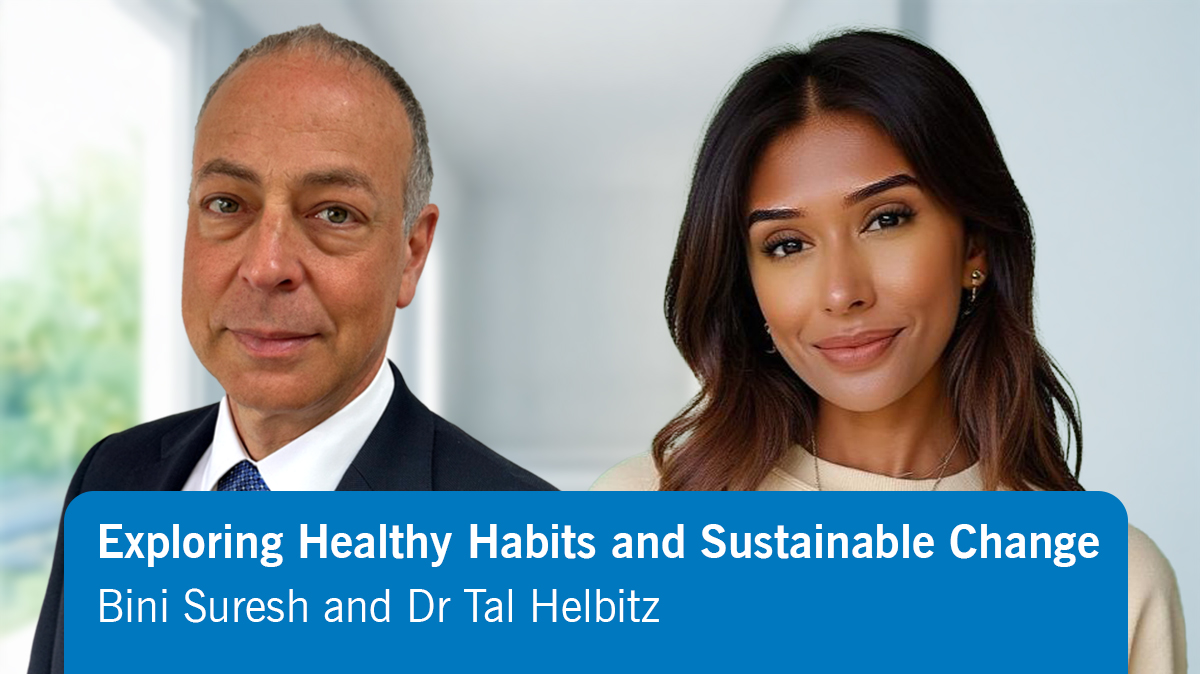
Exploring Healthy Habits and Sustainable Change with Bini Suresh and Dr Tal Helbitz
In this episode of Exploring Health with Cleveland Clinic London, host Bini Suresh, Dietitian, is joined by Dr Tal Helbitz, General Practitioner at Cleveland Clinic London, to explore how to reset your health for the new year by focusing on habits that truly last.
Together, they discuss why traditional New Year’s resolutions often feel overwhelming or fade quickly, and what actually helps people make sustainable, long-term changes. Drawing on their clinical experience, they explore how small, realistic shifts across nutrition, lifestyle, and wellbeing can build momentum and lead to meaningful improvements over time.
Whether you’re feeling motivated, stuck after past resolutions, or simply looking for a healthier approach without the pressure of quick fixes, this episode offers practical guidance and reassurance to help you start the year in a more sustainable way.
Advertisement
Cleveland Clinic is a non-profit academic medical center. Advertising on our site helps support our mission. We do not endorse non-Cleveland Clinic products or services. Policy
Recent Episodes
Exploring Stroke with Dr Arvind Chandratheva
In this episode of Exploring Health with Cleveland Clinic London, host Mr Kash Akhtar, Consultant Orthopaedic Knee Surgeon, is joined by Dr…
Exploring Health Checks That Could Save Your Life (Part 2) - Dr Simon Hodes, Dr John Whitaker and Dr Umasuthan Srirangalingam
In this episode of Exploring Health with Cleveland Clinic London, host Mr Kash Akhtar, consultant orthopaedic knee surgeon, continues his co…
Exploring Health Checks That Could Save Your Life (Part 1) - Dr Simon Hodes, Dr John Whitaker and Dr Umasuthan Srirangalingam
In this episode of Exploring Health with Cleveland Clinic London, host Mr Kash Akhtar, consultant orthopaedic knee surgeon, is joined by thr…
Video content: This video is available to watch online.
View video online (https://cdnapisec.kaltura.com/p/2207941/sp/220794100/playManifest/entryId/1_119m8yxq/flavorId/1_5f3sgelj/format/url/protocol/https/a.mp4)
Transcript
Bini Suresh
Advertisement
Cleveland Clinic is a non-profit academic medical center. Advertising on our site helps support our mission. We do not endorse non-Cleveland Clinic products or services. Policy
Welcome to the latest episode of Exploring Health with Cleveland Clinic London. Thank you to Cleveland Clinic Philanthropy UK for supporting this podcast. I'm your host, Bini Suresh, a dietitian from Cleveland Clinic London. And today we're talking about how to reset your health for the new year, focusing on habits that actually last rather than quick fixes or those unrealistic resolutions. As a new year begins, many of us feel the pressure to change everything all at once. But why do those resolutions often feel so overwhelming or simply fade after a few weeks? And what really helps people make changes that stick? I'm joined today by Dr Tal Helbitz, a GP at Cleveland Clinic London. Tal works very closely with patients to support realistic, long-term health changes, and together we'll explore how small, achievable shifts across nutrition, lifestyle, and well-being can make a meaningful difference over time. So, whether you're feeling a little bit motivated or a bit stuck after past resolutions or simply curious about a healthier approach without the pressure, then this episode is for you. So, let's get started. Tal, why does the new year create so much pressure around health and how can people approach their goals in a much healthier way?
Advertisement
Tal Helbitz
So I think what happens is that people come out of the Christmas period and New Year celebrations after maybe they've indulged a bit too much, maybe they've eaten too much and drank too much, comes January and then they feel they really need to reset. And so they come from a point of view of a health anxiety rather than a period of reflection and thinking, okay, this is a year that's just went by, where have I been and what would I'd like to achieve moving forward. So they come from a health anxiety state and then they want to have a quick fix to sort everything out, to create new habits very quickly that hopefully will be sustainable. But then sometimes they do it too quickly, too soon and too intensive and then they crash with it.
Bini Suresh
Absolutely. I see this all the time. January comes with this huge new year, new you energy as if we're expected to wake up a completely different person on the 1st of January. And that's just not how behaviour works, most of us are still so tired from December…
Tal Helbitz
Absolutely.
Bini Suresh
Barely know what day it is or where the school uniform is. A more simpler, healthier approach is to start where you actually are. And what we know is one or two small shifts that you can repeat is far more effective.
Tal Helbitz
Absolutely.
Bini Suresh
The best way to look at it is if you can't do it on your busiest Tuesday, when everything is going wrong, it probably isn't a sustainable habit. So I know with January, it is prime time for nutrition nonsense. You've got all the juice cleansers, the detox teas, reset your metabolism in seven days, things that sound scientific, but really aren't. And I think the problem with a lot of these diets is they cut out whole food groups, which inevitably is going to lead to nutrient deficiencies, poor concentration, and also fatigue, which doesn't really get you off to a great start for the year. A big one that I see every year is that your body needs detoxing after the Christmas period. Now, my understanding is your liver and your kidneys are doing a great job over the Christmas period and they don't go off duty, what your body really needs after the festive period is actually some hydration, regular meals and fibre. But from a medical perspective, what myths and trends tend to show up this time of year and why can they be quite misleading?
Tal Helbitz
So I agree with you. I think we live in an era where social media is controlling our life and so many people feel that whatever one influencer has suggested online would be the right solution for them moving forward. And the problem is that it's not one-size-fits-all. Each one of us is unique. We come with our own body, our own mental state, perhaps some medical conditions that we have in the background and to all decide that we all do exactly the same thing that particular person recommended online and it would work for us is a bit misleading and creates a lot of time false expectations that I'll achieve whatever is recommended there. And then you start following that program, sometimes it's quite an intense program and you end up really failing and going back to square one. Another thing that you see commonly in January is dry January. We've drank so much just in the time period leading to January now we're going to do a full month of detox, like you said. We let our liver rest and our kidneys get better. But the problem is that you do an intense month that gives you almost a false feeling that now my body is all clean and I don't have any alcohol and I can restart the year again. And then what happens comes February and you start drinking again and you go to your old routines of perhaps sometimes drinking excessively. Where a much better place that would be more sustainable would be that perhaps you didn't go for a full dry January, you just cut down a bit on the alcohol consumption, but you manage to then extend it and prolong it and it can become a new habit of a healthier life for you.
Advertisement
Bini Suresh
Absolutely. Medically, even reducing alcohol rather than stopping completely can have real health benefits for sure. Following on from that, for someone who's listening, who wants to eat better without overhauling their whole life, what are some of the small changes that someone can make longer term?
Tal Helbitz
So, again, it's about moderation. It's about trying to set yourself a goal that is achievable. Start with small changes that you feel that might be easy enough for you, even when it's a busy day at work or you are... had a really manic day with the kids at home and rushing around from one place to another, something that you can implement that doesn't take too much off you. So start with small changes, try and be consistent with them and try and then take them forward beyond just the first month of the year. And in a way, with time, you would see that A, you're able to sustain them longer, but gradually you'll find the health benefits coming on, whether it's the weight that you'd like to lose some kilograms, whether it's your general feeling, whether it's how you sleep, how stressed you are. And don't forget that if you start doing it too in an extreme way, for example, like you suggested, cutting off one type of food fully or maybe very low-calorie diet or some people choose to use injectable therapies nowadays. Those things can be quite extreme and then can affect your well-being. You can find yourself all of a sudden much more irritable, not sleeping well, and that then creates a negative cycle that doesn't help you to achieve what you were aiming for in the 1st place.
Advertisement
Bini Suresh
No, absolutely. I think from a dietetic standpoint, I would always say, try adding something before you start taking things away.
Tal Helbitz
So true.
Bini Suresh
And I think that is something that I would want my patients to remember. Think about what you need to add before you think about what you need to take away. So for example, if your goal is, well, I want to drink a little bit more water, then just have that extra glass maybe after you've brushed your teeth or I want to increase my vegetable intake. Well, throw in a handful to whatever you're cooking on that day and frozen vegetables counts towards that as well. And if you don't have breakfast or you're somebody who skips breakfast most days, then maybe just introduce having breakfast once or twice per week. It doesn't need to be every day. It doesn't need to be extreme and it doesn't need to be very different to where you are right now. You really need to look at where you are and make slight changes to that. And if one of your goals is maybe I would like to eat less from restaurants or eat out a little less, then maybe just increase the amount that you cook at home by one day. That alone improves diet quality.
Advertisement
Tal Helbitz
Absolutely.
Bini Suresh
So from a GP perspective, what are the risks of extreme dieting or suddenly jumping into an intense fitness routine?
Tal Helbitz
So when you go with extreme dieting, sometimes that can affect your well-being that I mentioned before. You can start feeling unwell. You can feel hungry all the time. You can be irritable, tired, lacking energy at the time of the year, especially in the beginning of the year, where you do need a lot of energy. Everyone comes back to work and to your assignments and commitments and that's one element to it. It can affect your sleep. You might not sleep really well because you're hungry, I think when you're not sleeping well, then what happens is it's hard if you to then stick to new routines that you want to implement. Now, some people have, like we said before, some background medical conditions. For example, they can have diabetes. All of a sudden, changing their diet so drastically can really affect their diabetes. Sometimes it can affect their other health conditions, their mental well-being, or other parts of their life that can then become detrimental rather than a positive change for them. Now when we talk about exercising, a lot of people choose, right, come January, I'm signing to a gym and I'm going to now sign up to a lot of exercise activities and that'll be the new me. The problem is that people who haven't exercised regularly before, coming and doing it all too soon, all too intensive, without a gradual approach to it, can then cause them to have more musculoskeletal injuries.
Bini Suresh
Absolutely.
Tal Helbitz
People who might have heart diseases in the background, whether they know about it or whether there's something that's underlying and they're not aware of it yet, but going into a very intense exercise routine can actually be not so beneficial for their health and can be harmful.
Bini Suresh
Yes. Based on what you said, that's why it's very, very important that, you know, I see this a lot, both medical and nutrition advice together is really impactful and helpful. And linked to that Tal, are there any health checks or screenings you'd encourage people to think about at the start of the year?
Tal Helbitz
Yes, I think it's a really good point to perhaps set a meeting with your doctor and start from the basics. Come and get and check your weight, check your blood pressure, perhaps arrange a blood test to check your cholesterol levels, your sugar levels. That would really give you a good starting point to know where I am, reflect on it and see how much I'd like to change and improve my health. You can also look at that point at your mental health and check whether there's anything that you need in that respect. We chatted before about your sleep. That might be a good point to review your sleep and whether you sleep better and talk about your general well-being. In the Cleveland Clinic, we offer a variety of health checks and screening that we provide on a regular basis, not just in January, so feel free to reach out to us. Those health checks can include everything that I mentioned just now and go to different depth depending on what your health goals are. There are ones which are catered to females specifically. There are ones for elderly people. So feel free at whatever age you are, reach out to us and we can provide you with more information about it.
Bini Suresh
That's such an important point, like knowing your baseline, your baseline cholesterol, blood pressure, your blood sugar levels, because that then helps people make informed, safe choices about their habits, their health, rather than following the trends they may see on social media. So I think it's very important. coming to see your GP, having a health assessment done and knowing what your baseline is, absolutely. Tal, why do you think New Year's resolutions so often fade after a few weeks?
Tal Helbitz
I think partly it's because people set unrealistic goals and they might then go too extreme and then find themselves burning out from not being able to sustain such a big change. I think that sometimes they don't really see the effect of small changes that can add to each other and then sustain a better change and try and do it all in one go, such as the dry January that we talked about before, such as perhaps following an extreme diet, just during January, I'll shed 10 kilograms off and then everything will be fine, but then you go back to your routine. So I think that’s one element. The second element is that life is in our way. We still have kids to look after, we still have a job to do. January is not the best month in terms of the sunlight. We're waking, we go to bed and it's dark and we're waking up and it's dark. So really there are sometimes factors around us that are really not in our ability to change and control. And the risk is that when you set yourself unrealistic goals and don't manage to sustain it, you then blame yourself. And I think it's very important to stop and reflect and think, actually, there are things that are not in my control and therefore I need to create or strive to create a change that is achievable, not such a huge change that it'll be so hard to achieve and then failure comes along.
Bini Suresh
Absolutely. I think you make a really important point and I think we make these resolutions in this burst of January enthusiasm. And, you know, we don't really design them for real life, we create these big, shiny new goals, workouts every day, zero sugar, perfect meal prep, and they completely rely on motivation. And I have an interesting way that I look at motivation. Motivation is a little bit like a toddler. It's absolutely adorable and great when it's behaving, but also very unpredictable and definitely not something that I would want dictating and planning my entire life. So you really need to think about when you are setting resolutions, what fits into real life, which is exactly what you were saying. And I think when the excitement of January wears off, can we do it when we've got, you know, school commutes, work, meetings and like I said, the busiest Tuesday where everything's going wrong, can it fit into that? And I think those small little habits and small changes, they're the ones that can survive the chaos.
Tal Helbitz
And I think one other thing to mention, probably, is that when you would like to achieve a change or would like to set a goal, and it can be, we talked a lot about our diet and about our exercise, but it can be about maybe I'd like to be less stressed or I'd like to sleep better or I'd like to be looking at a new career path. They could be from all sorts of avenues in life. A lot of times when you plan a change, it's really good to have someone that you're accountable to. If it's about going to the gym, perhaps it's a friend that can join with you and you can commit with each other to sort of go together. It could be about your meal plans and it can be your partner. Can you plan your meals together? So it's not a last minute thing, you know, that everyone's coming hungry and then opening the fridge and what should we have for dinner? And equally, it can be in other forms, it can be sometimes even your doctor or your dietitian. We can help you with your plan, if it's relating to anything to do with your health, your wellbeing and your nutrition.
Bini Suresh
Absolutely. I love that, having somebody hold you accountable. I think that's so important. When we're talking about habits that stick, what evidence-based strategies actually help habits stick longer term, do you think? I personally love the idea of shrinking habits, making them so small that it's near impossible to fail. So like I mentioned earlier, if you want to drink more water, just have a glass after you've brushed your teeth. Do you want to move more? Maybe a five-minute stretch when the kettle boils, or do you want to have more vegetables? Maybe just throw in a handful of frozen vegetables or whatever you've got in the fridge into whatever you're cooking that day. And also, reducing the friction, making healthy food visible in the cupboards, in the fridge, or having your gym clothes or your workout clothes ready for the next day. In your opinion, what do you think that we could do? What strategies could we put in place?
Tal Helbitz
So I think again, it goes back to the same basics that we mentioned before. It needs to be with small changes. It needs to be achievable. and it needs to be very much consistent. So it's something that you can see yourself doing, whether it's on a week that you're on leave and things are much calmer or equally when you're on a busy week at work or with other commitments at home. And therefore, you can add things into your routine that create the change but don't necessarily make such a drastic change. For example, if you used to travel to work by the train or by a bus, maybe get off a stop or two beforehand and walk a bit. So here you are, all of a sudden you increase your activity without really realising. So instead of, oh, I'm going to now follow 10K steps a day or 15K steps a day that sometimes I see my patients say, and then it's hard and you get disappointed because there were days that you couldn't really achieve it. How about just looking at, this is where I am now, I'll just add another 1000 steps a day or 2000 steps a day by just walking from the tube to work or by taking a flight of stairs rather than taking the lift in your building. So those sort of small things are more likely to be sustainable and achievable.
Bini Suresh
Absolutely. Easy, achievable and like we said, they tend to survive the chaos as well, don't they, of everyday life. So, you touched on this a little bit earlier when we were talking about sleep and stress. How do sleep, stress and everyday life affect somebody's ability to maintain healthy habits?
Tal Helbitz
I think it's really important, sleep has a restorative function. And I think when we're not sleeping well, not only are we waking up the next day feeling tired and groggy and with less concentration than usual, it's also affecting our ability to sort of maintain changes in terms of maybe dietary changes that we wanted to implement, maybe some physical activity that we wanted to introduce. So by not sleeping well, I think what happens also is that stress hormones are rising in your blood. That can affect your sugar levels, that can affect your hunger. So all of a sudden you feel more hungry and all of a sudden you go for the fridge again, you know? So that's the sleep, so I think it's really important to maintain good sleep and to work on improving your sleep. And if that's something that you feel that's been an issue and you haven't managed to sort it for quite a long period of time, there's really great solutions so come and talk to your doctor about it. The stress hormones really can affect, like I said before, our hunger. They cause also ongoing inflammation. So it's making us less healthy compared to someone who perhaps can manage their stress better. And sometimes we might be more prone to common illnesses, to falling in sick and not being able to achieve what we were aiming for to start with. So I think addressing stress as much as we can, the things around us and things that happen to us that's out of our control, but if there's things that we can do, if we feel that stress is an element that really we would like to improve, there are so many things that you can do about that. From physical activity that can reduce stress, from mindfulness, meditation, sometimes yoga, listening to music, or maybe spending some time with friends or family. You need to find something that's right for you, but definitely stress can come in your way when you try to sustain a change.
Bini Suresh
Definitely. You've made so many important points and coming back to what you said around when we're tired and our hunger hormones, you know, they absolutely do change. And then we end up craving more sugar and more carbohydrates and energy dense foods. And when we're stressed, we can slip into that survival mode and our old habits then start to creep back in. And I don't always find that, not always is it a willpower issue, sometimes it can be biology. And I find with, when I'm talking to some of my patients, the most important, powerful nutrition change someone can make isn't always about food, it could simply be going to bed 30 minutes earlier.
Tal Helbitz
Absolutely.
Bini Suresh
If someone listening wanted to start just one sustainable habit this January, what would you recommend?
Tal Helbitz
I really like the idea of physical activity, but introducing it almost in a subtle way into your day-to-day routine. Perhaps take a short walk after your lunch. You know, it can help you to stay a bit more alert. It can help to control your sugar levels so they're not rising too much after the meal and it also promotes towards being more active. So it's something that's sustainable. You can go for a 10-minute walk around the block of where you work, or if it's at home, if you're working from home, or you can do something a bit longer, something that feels not too onerous, that you can achieve, that doesn't need blocking time on your diary, on your busy diary. So I think that's something that's really easy to achieve and can be sustainable with time.
Bini Suresh
No, that is a great, and it is a sustainable habit. I think a sustainable habit that I would recommend is having a default meal. I think it acts as a safety net for a lot of us. So, for me in particular, I would say an omelette is my safety net meal, my default meal. Omelette's great because it contains eggs and eggs is a staple in most people's fridges. Additionally, you can add lots of vegetables to that and whatever you want to use up from the fridge. You can also add frozen vegetables to that, you can add spices, you cannot add spices depending on what your mood is for the day. I think it's, you know, it's a flexible dish and flexibility is key. But having that safety net meal there, it removes that decision fatigue we can all experience at the end of the day, where we're tired, we're exhausted, we've done a million other things. And the last thing we want to think about is what is for supper? What is it that I need to prepare? An omelette is nutritious, it's high in protein, and it's high in fibre. It ticks all those boxes. It's a great meal to have.
Tal Helbitz
That's fantastic.
Bini Suresh
So Tal, have you got any New Year's resolutions or goals for 2026?
Tal Helbitz
Well, my New Year resolution started a few months before the new year, but I can probably give it as an example, I've been thinking for a while that being over 50, I should really start looking after my muscle mass. We know that muscle mass is very important for your health and for your well-being as you grow older. And naturally, our muscle mass tends to go down as we grow older as a physiologic phenomenon. So I committed to I'm joining a weightlifting club and I've been attending a weightlifting club twice a week now for the last four months or so. I come regularly to a group where we have an instructor with us in the gym and it's monitored, it's supervised, it's a gradual approach to building up your muscles in a sustainable way and I'm really pleased with it so far. And yeah, what about you, Bini?
Bini Suresh
Oh I do, not that dissimilar to yours. I'm very aware that as we get older, the impact age has on muscle, as you mentioned, and 50 is creeping up. So I'm very keen to improve my physical strength and that is my focus at the moment. I'm working on different type of exercises to try and prevent that natural muscle loss that's going to be happening. It's inevitable, but I would like to do everything I can to counter that. I have a specific goal in mind, though. I would very much like to be able to do a pull-up. I have never, ever been able to do a pull-up. In 2025, I managed to achieve a push-up. Now it's now it's a pull up. I've never been able to get my chin above that bar, I just hang there. So that is my goal for this year. The next 365 days, I'm going to do whatever exercises I have to do to get me over that bar.
Tal Helbitz
And I'll hold you accountable for that.
Bini Suresh
Yes, I want you to. I very much want you to.
Tal Helbitz
Fantastic.
Bini Suresh
Okay so my last and final question to you today is, if listeners remember only one message about building healthier habits this year, what should it be?
Tal Helbitz
I think it should be creating changes, positive changes that are meaningful for you, but doing it in small, gradual steps that you can maintain over time, that you can keep the consistency in order to see the long-term effect later on. So I would start with something that you can incorporate into your life that doesn't take too much of your time, doesn't need changing a lot in terms of your busy day routines, whether it's at work, whether it's with your family, and trying to do it gradually and stop and reflect perhaps over time and check how you've been doing rather than trying to do it over January and then achieve everything within one month. Sometimes it might be helpful for you to, we spoke about accountability, perhaps to check in with your doctor or check in with your dietitian after a few months to see how you've been doing, how your parameters are? Is your blood pressure better? Has your weight gone down? Are the sugar levels a bit better? So you can come and chat to your doctor, have a look at how things have been, do you need any changes? Do you need to implement any modifications to what you've decided to do or just keep going with what's been working well for you?
Bini Suresh
Absolutely. It's a really important point and health isn't built in January. It can be built in February, March. You know, it's built quietly in the everyday moments and one thing we know is that progress is more important and it should be progress over perfection.
Tal Helbitz
Absolutely.
Bini Suresh
All the time. That's great. Thank you very much!
Tal Helbitz
Thank you!
Bini Suresh
So you've been listening to Exploring Health with Cleveland Clinic London. I'm your host, Bini Suresh, and it's been a real pleasure to be joined by Dr Tal Helbitz. And we've been talking about resetting your health for the new year by building sustainable habits that truly last. If you'd like to learn more about the services available at Cleveland Clinic London, you'll find the links in the episode notes. And if you found this conversation helpful, please consider subscribing, leaving a review, or sharing it with someone that you think may benefit. Until next time, thank you so much for listening.
Visit the Cleveland Clinic London website to learn more about our GP services, health assessments and Dr Tal Helbitz. For more information on dietetic support please email CCLDietetics@ccf.org.
If you found this episode valuable, please consider subscribing, leaving a review, and sharing it with someone who may benefit.
Exploring Health is supported by Cleveland Clinic Philanthropy UK and is available on all major streaming platforms, including YouTube.
Recent Episodes
Exploring Stroke with Dr Arvind Chandratheva
In this episode of Exploring Health with Cleveland Clinic London, host Mr Kash Akhtar, Consultant Orthopaedic Knee Surgeon, is joined by Dr…
Exploring Health Checks That Could Save Your Life (Part 2) - Dr Simon Hodes, Dr John Whitaker and Dr Umasuthan Srirangalingam
In this episode of Exploring Health with Cleveland Clinic London, host Mr Kash Akhtar, consultant orthopaedic knee surgeon, continues his co…
Exploring Health Checks That Could Save Your Life (Part 1) - Dr Simon Hodes, Dr John Whitaker and Dr Umasuthan Srirangalingam
In this episode of Exploring Health with Cleveland Clinic London, host Mr Kash Akhtar, consultant orthopaedic knee surgeon, is joined by thr…
Never miss a moment - subscribe now.
Listen to the Health Essentials Podcast on your favorite streaming platform.
Other Podcasts You May Love
Health Essentials
Tune in for practical health advice from Cleveland Clinic experts. What's really the healthiest diet…
Love Your Heart
A Cleveland Clinic podcast to help you learn more about heart and vascular disease and conditions af…
Nurse Essentials
Nurse Essentials is a podcast about all things nursing - from tips for making your next shift easier…
Neuro Pathways
A Cleveland Clinic podcast for medical professionals exploring the latest research discoveries and c…