



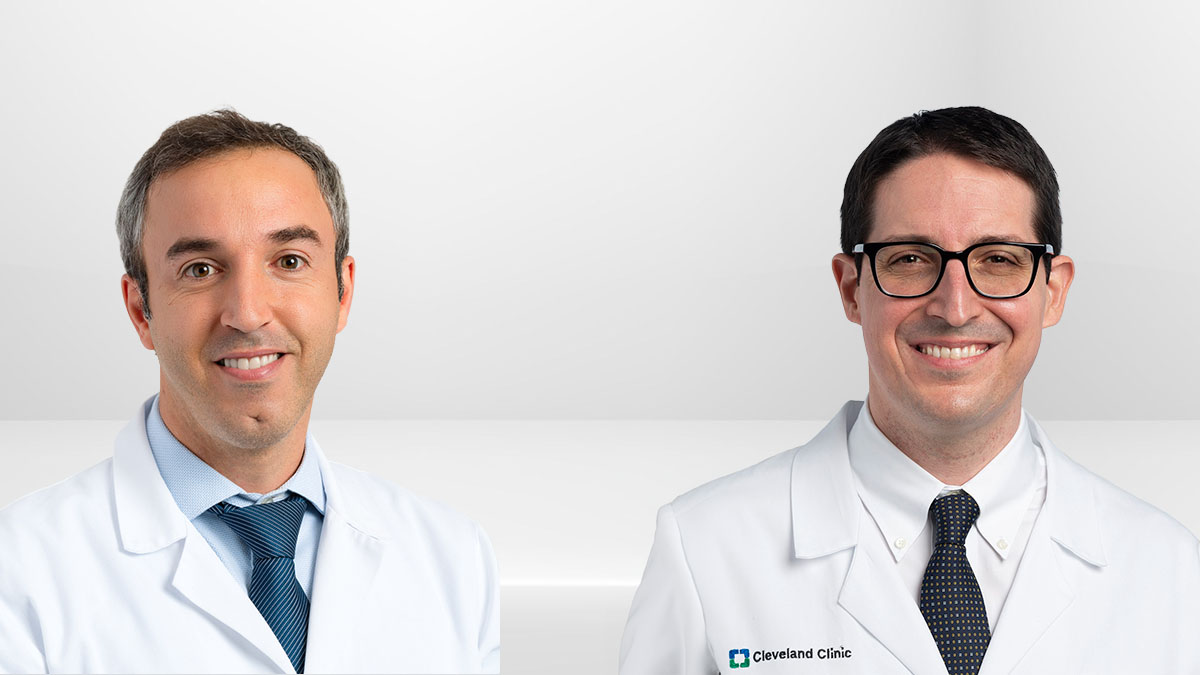
Integrating PFA Into Your Clinical Practice
Pasquale Santangeli, MD, PhD, and Arwa Younis, MD, discuss the clinical application of pulsed field ablation (PFA) for atrial fibrillation and ventricular arrhythmias. The conversation examines safety and efficacy benefits of PFA and the ongoing role of radiofrequency ablation in advanced electrophysiology practice.
Attending the Heart Rhythm Society conference? Visit Cleveland Clinic physicians at Booth #2134.
Looking to refer a patient? Please reach out to our Physician Referral team Mon. - Fri., 8 a.m. - 5 p.m. (ET) at 855.751.2469.
Advertisement
Cleveland Clinic is a non-profit academic medical center. Advertising on our site helps support our mission. We do not endorse non-Cleveland Clinic products or services. Policy
Recent Episodes
Infective Endocarditis Diagnosis and Management
Bo Xu, MD, and Shinya Unai, MD, discuss approaches to diagnosing and treating infective endocarditis, including indications for surgical int…
Expanding Coronary Revascularization With TECAB
Donna Kimmaliardjuk, MD, and Gianluca Torregrossa, MD, discuss the expanding role of robotic coronary artery bypass grafting, including tota…
Stenting, Surgery and Hybrid Strategies for Coronary Disease
Faisal Bakaeen, MD, and Grant Reed, MD, discuss recent advances in the treatment of coronary artery disease, including drug-coated balloons,…
Video content: This video is available to watch online.
View video online (https://cdnapisec.kaltura.com/p/2207941/sp/220794100/playManifest/entryId/1_brfisxuv/flavorId/1_5f3sgelj/format/url/protocol/https/a.mp4)
Transcript
Announcer:
Welcome to Cardiac Consult, brought to you by the Sydell and Arnold Miller Family Heart, Vascular & Thoracic Institute at Cleveland Clinic. This podcast will explore the latest innovations, medical and surgical treatments, diagnostic testing, research, technology and practice improvements.
Advertisement
Cleveland Clinic is a non-profit academic medical center. Advertising on our site helps support our mission. We do not endorse non-Cleveland Clinic products or services. Policy
Pasquale Santangeli, MD, PhD:
Hello, welcome back to the Cardiac Consult podcast. I am Pasquale Santangeli. I'm the Director of the DVT program at Cleveland Clinic.
Arwa Younis, MD:
I'm Arwa Younis. I'm the Co-director of Translational Research and the Co-director of the Research Fellowship here at our EP department.
Pasquale Santangeli, MD, PhD:
We have a very exciting topic today. We will talk about pulsed field ablation. It has been a revolution for EP and for us and for our patients, and how to integrate PFA, which is pulsed field ablation, into our clinical practice. I'll start off by asking Dr. Younis. First of all, you've done a lot of research, basic research to understand what pulsed field ablation really is. Can you give us a summary of what it is, how it works and why you think it's better than what we had so far?
Arwa Younis, MD:
Thank you. I think it's a nice way to start. Up until now, we were targeting cells to kill the cells or to destroy their function by either heating them or cooling them. This type of destruction was labeled as thermal injury. But that is highly unselective. As we know, we target areas that are neighboring lungs, nerves, coronaries, big arteries, the esophagus. It was always challenging to try and perform a safe procedure, an effective procedure that is also safe.
Advertisement
PFA was a revolution. Nothing is new about PFA. Pulsed field ablation or irreversible electroporation is a concept that has existed since the 1980s. It was used by pharma, and it was used by chemotherapy companies to somehow deliver or target cells by just disturbing the membrane of the cell, leading to self-mediated apoptosis. That's what we did. The beauty of our body is that every cell in our body has a different threshold for the cell to go into this apoptosis.
And then we deliver high energy, basically similar to what we did with the thermal, but you deliver very high energy in nanoseconds. I imagine it like shaking the cell. Once you shake the cell, each cell has a different threshold. You are able to disturb the membrane that protects the cell from the potassium and the sodium and the electrolytes that are outside the cell. Now, once this membrane, which is like the protecting border of the cell, is not intact anymore, then these electrolytes go into the cell, and then the cell dies.
The big advantage of it is that you have selective apoptosis, meaning you can target myocardial cells without affecting neighboring organs.
Pasquale Santangeli, MD, PhD:
Yeah, this is great. I think two key points you made are, one being the tissue selectivity, which for atrial fibrillation ablation is a big issue. You said nanoseconds. This is really much faster and more efficient than what we had before. Walk us through the clinical studies for AF, what you have participated in, but also the upcoming studies that are coming, and why this is so exciting for atrial fibrillation.
Arwa Younis, MD:
For now, we have three randomized controlled trials that, in all of them, showed that PFA for the treatment of atrial fibrillation, whether persistent or paroxysmal, was at least as good as RF (radiofrequency) in terms of the efficacy. Now, for us, this is a win because you are introducing a new technology that is, as you highlighted, faster, safer, yet with the same efficacy. Although we know that with time, we gain more experience, and now we know how to pay attention to contact, how to improve our outcomes. I think if you are to do a randomized controlled trial, the same one, the same design five years from now, with the same catheter, we might even have better outcomes than now because people get familiar.
RF has been there for more than 20 years. The other way we have been doing that, like the control arm is something we have been doing for 20 years.
But I want to highlight that in all these trials, what we saw in the animal lab was also true in these clinical trials, meaning no injury for the esophagus, no injury for the veins, no injury for the nerve. These are major elements that are very important for our patients. Furthermore, not just these randomized controlled trials, we have now two big studies. One is MANIFEST-Europe and one is MANIFEST-US. They both together have almost 80,000 patients treated with PFA over the last four years, with very different ways to do it, very different centers, low-volume centers, high-volume centers, referral centers.
Advertisement
The safety aspects that were seen in the animal lab and in the randomized controlled trial are still there, even in these studies. Now, there are some concerns. We have to be mindful of things that we are seeing such how PFA may affect devices, how PFA may affect other things that we were not aware of.
So, I think we still may need to keep our eyes open and be mindful that we don't miss even that rare complication, we want to understand it. But overall, the safety aspect has been very good. The efficacy aspect is really good.
Pasquale Santangeli, MD, PhD:
Yes, one thing to say would be that in our more than 2000 patient experience with a PFA for AFib, we haven't seen any signal for safety in line with these large registries. Three things, though, come to mind, three new things that we have not seen. Of course, the risk of hemolysis being one and the consequences of that coronary vasospasm.
Arwa Younis, MD:
Do you want to expand more about hemolysis?
Pasquale Santangeli, MD, PhD:
Yeah. This is something that it was seen in Europe when they started using [PFA], and we realized that we were not seeing as much in the US, probably because we use intracardiac echo to validate contact with tissue, because when you deliver this large field to the bloodstream, to the blood pool without being in contact with tissue, then of course the blood cells may hemolyze, may die off.
Advertisement
The consequences of that may be, if there is a significant amount of hemolysis, you can also injure the kidney, which has also been reported. We have not seen it here, I think, and many centers in the US also have not seen this, have not experienced this. The other issue that we still have to struggle with is how close we can get to the coronary arteries without causing vasospasm. Vasospasm with PFA is physiologic, so it will happen.
How to prevent it? We do know now that intravenous nitroglycerin, for example, there is a protocol that we use, will prevent most of them. In our experience, all of them, we have not seen a case quite yet. But it's also true that we avoid staying with PFA to ablate right on top of the coronary arteries. This is true for atrial fibrillation and switching gears to VT. Maybe you can walk us through the first animal experiences with VT, both with ischemic, like scar-based, and non-ischemic, like PVCs, locations. What have you found and what can we look forward to in humans?
Arwa Younis, MD:
This goes back to the nanosecond you mentioned and highlighted fairly, that we work in a beating heart, and I try sometimes to explain this to the patients. A beating heart is a very dynamic organ that is in full movement. You want to target, you want to be very precise, so you don't want to go and kill everything and destroy everything. You want to preserve as much healthy tissue as you can and target only the areas where you think these are the source of the arrhythmia.
Advertisement
Now, the way we have been doing it with a thermal injury is that we would need to stay longer. We're talking about two minutes, one and a half minutes, sometimes two and a half minutes at the exact same location in a beating heart, not having too much push and not having too much pull, because if you're barely touching, you're being safe, but you're not efficient. If you're touching too much, you can perforate or have steam pops or things that we used to see with the thermal injury.
Now with the PFA, the whole lesion is created in less than 2.4 seconds. That is really, really quick. In a beating heart, that's sometimes very helpful to get you into these locations. We know that the inside of the left ventricle and the right ventricle is not to be compared with the atrium. The atrium is a flat surface that has holes in it, and this helps us and guides us. The left ventricle and the right ventricle are way more complex.
They have papillary muscles that go from the inside. They have the valves coming in, they have the apparatus of the valve. There are many areas that make our life more difficult to stay located in that area. We have published together that, with the PFA, the shape of these catheters and how fast they are, you can almost target any area in the heart safely, precisely and reproduce it. I think that the outcomes have been deeper than RF because we are more efficient and safe.
I know you are about to present a late-breaker at the upcoming Heart Rhythm Society Conference in Chicago. We are proud to present the data about our own experience using PFA for the ventricle. Do you want to tell me more about it?
Pasquale Santangeli, MD, PhD:
Yeah. I mean, we were really early adopters of this, mostly driven by the work that you have done in the animal lab that showed the safety of this. We were early adopters as soon as we got PFA approved in the US, clinically and commercially. We work with both the AF FARAPULSE catheter in the ventricle – you were the first author for that – but even other technologies.
But for us, it's so appealing because the nature of the VT center, 40% of patients have prior failed ablation and nearly 70% come to us, referred from other EP physicians. They really come for something more. The regular radiofrequency ablation may not be enough to target.
Pulsed field ablation so far has delivered its promises, I would say. First of all, in very sick patients, it's allowed us to complete the procedures in a much quicker time, which is very important for when you have low ejection fraction and heart failure. Doing a procedure that will take normally five, six hours, two hours is a big difference because of course you have less anesthesia time, less risk of decompensation and better outcomes in terms of safety. The second aspect is that most of these catheters have a large footprint platform. You can cover a much larger area in a very efficient way with less irrigation, which is really good for patients.
Of course, for the audience, we actually will have three late-breaker trials about PFA at the HRS. One is atrial fibrillation focused, which will be presented by Oussama Wazni, MD, MBA, and two others on VT with a catheter technology that is very unique. It's able to deliver both PFA or radiofrequency ablation in a large footprint platform. This will be presented next month at HRS.
Arwa Younis, MD:
I want to stop you there because I want to ask you about that dual energy. Do you think there is still room for RF, and why? As a VT expert, can you tell us when do you decide, "Okay, I'm going to use this or I'm going to use PFA”?
Pasquale Santangeli, MD, PhD:
The biggest, I think, limit of a PFA is the fact that when you deliver a lesion, you will have a central area that will be irreversible that is a true lesion and a periphery where it will be reversible electroporation. It will come back over time.
Arwa Younis, MD:
It's like overestimated.
Pasquale Santangeli, MD, PhD:
Correct. The problem is that when it comes back, it comes back about a week later. For us, for VT ablation, it's very hard to assess the endpoints acutely because you may see elimination of electrograms, you may also see elimination of VT and non-inducibility, but then maybe a month later, that area will recover. We have not seen this really with radiofrequency ablation.
So, the way we still like to practice is that we use radiofrequency ablation as a workhorse. In other words, we still try to terminate VT with radiofrequency ablation. Then, if you need more depth or for more efficient procedures, we go with post-field ablation. But as we learn more about lesion geometry in humans and how they evolve over time, I think PFA will eventually replace radiofrequency ablation, but it will take some time. It won't be an overnight switch like we did with atrial fibrillation ablation.
Arwa Younis, MD:
So, for now in the atria for atrial fibrillation, are we mostly using PFA or are we still using RF?
Pasquale Santangeli, MD, PhD:
I think all of us as a group, we switched overnight, just because of the safety profile. The esophageal damage was actually absent with PFA, pulmonary vein stenosis and so forth. It’s also a much more efficient procedure. I think we switched overnight.
The only problem, the only difference would be when you have to ablate close to the annulus, like the tricuspid valve or mitral valve, and the coronary arteries maybe. In those cases, maybe radiofrequency ablation still has a role, so that's why we use the dual-energy catheters sometimes. But most of our procedures, the large majority, are done with PFA for atrial cases.
Arwa Younis, MD:
Yeah. I obviously agree with Dr. Santangeli. I was here as a fellow, and I adopted this from our staff to do PFA. I think for these patients who would need further ablation beyond atrial fibrillation, beyond what we do for the veins and the posterior wall, this is where RF comes in handy. Were we know RF to be safe, these areas are anterior. In the heart, when you look at the heart, you're far away from the food pipe, you're far away from the nerves, you're far away from the lungs, and RF is safe. We don't need to worry about the coronaries. In the last two years, this is the only place we have been using RF for patients with atrial arrhythmias.
Pasquale Santangeli, MD, PhD:
Yes. The other small subgroup of patients would be the patients with SVT, where maybe radiofrequency ablation with a point catheter is still the gold standard for those. I don't know if you agree with that, but yes.
Arwa Younis, MD:
I think when PFA came out, and you and I, we talked about it so many times, many people felt that the technology was safe, so they were overdoing it. I think that led to the hemolysis numbers that we saw. At the end, more is not always better. Sometimes you still want to be targeted and precise. Even if you have a safe tool, you have myocardial destruction. It's always better to be precise and limited than just to say, "Okay, I have a safe catheter that is selective, let's go and destroy the whole area."
Pasquale Santangeli, MD, PhD:
Yes.
Arwa Younis, MD:
So, I completely agree with you. I think for all the SVT, unless it's a recurrence, it's far away from the conduction systems, let's say a patient with a left lateral pathway, a redo, maybe then. With being mindful about the coronary system, it's an annular structure, would shoot the coronary or use nitro, but I think we're not there. I know people are doing it. Some people are doing this for SVT. I think we're still not there.
Pasquale Santangeli, MD, PhD:
Yes. Most of the time, we don't have those challenges with lesion depth. It's more of a mapping issue.
Arwa Younis, MD:
Yes.
Pasquale Santangeli, MD, PhD:
And finally, just a few remarks about where do you think the field is going? In other words, there are so many vendors, so many catheter shapes and so many different recipes for PFA. If you had to open an EP lab tomorrow, I don't want to ask you what type of system, but how do you envision your atrial versus ventricular case mix to go? Is there still a role for radiofrequency? Would you go PFA for all of them? Let's think about 10 years from now.
Arwa Younis, MD:
So, I think overall, this is great news for us, but mainly for our patients, because in anything we do in life, when you have more than someone to offer, the prices will drop. For now, when PFA came out on the market, they were significantly higher than the RF catheters. We're talking about eight, nine times more than the RF catheter. Now it's less. The gap is less, and I think with time it will be even less.
The fact that we will have more than one option is also great because not all of us are the same in terms of the anatomy. The anatomy is different and varies in all of us. The internal anatomy also varies. Not all hearts look the same. To have one catheter that can treat everything is wrong. Whoever thinks that we should have one catheter just to treat ventricle as well as atria is wrong.
In the atria, you care about depth, but not as much as you should care in the ventricle. In the ventricle, you want to have stability, you want it to be larger but more precise. I think the industry now is in the right direction. I personally like the dual energy concept because I think when something works, you should not fight to change it. RF in many areas has been working and was safe. When the RF was working and was safe, and if I have a PVC and I know I'm safe, or an SVT, then I would like to continue using it. Even if a new catheter is out of the market, something is working, don't change it.
So, I think the ability to have dual energy is something appealing. I would like to see more mapping capabilities of these catheters. Somehow, the field adopted PFA quickly, and most of these catheters put more work into the design on how to ablate. So they created different shapes on how to ablate the vein and the posterior wall, but I didn't see much of adding fine signals as we have with some of the high-density mapping catheters, HD grid, mini OCTARAY. These are very high-density catheters. I think at the end, I would like to be an electrophysiologist who looks at the signal and not just follows anatomical structures.
Pasquale Santangeli, MD, PhD:
I think given how powerful these catheters are for ablation, mapping becomes even more relevant to make sure that you direct your therapy only to the areas that are necessary.
We have, for the audience, three ongoing studies now on pulsed field ablation for VT. We're enrolling patients as part of investigator-initiated IDE studies. We're using these early technologies for both PVCs and VT. If there is anyone interested in this technology here, we can adopt it very early for their patients.
Arwa Younis, MD:
If I'm a patient, why do you think this is going to help me?
Pasquale Santangeli, MD, PhD:
I think for atrial fibrillation, it's almost like a no-brainer because you go in, you get your procedure done in about one hour, max two hours, you go home the same day. It's becoming like a routine, a day surgery type of procedure. When I was in training, it used to be several hours. For VT, this is really the same in some ways, much faster, less risky. In terms of fluid overload and heart failure, we can cover a larger area of substrates, so we can be potentially more effective and we can deliver deeper lesions.
But of course, studies are still ongoing. The first one will be presented in April at HRS, so stay tuned.
Arwa Younis, MD:
If I'm a patient who's thinking, "Should I come to Cleveland Clinic or not?" Do you think the fact that Cleveland Clinic is doing these trials and is able to provide these PFA systems to the patient, is this something I should worry about, or is this something I should be happy about? I'm not happy I have the disease, but if I have the opportunity to choose, should I come to Cleveland Clinic or should I do it back home with the old method?
Pasquale Santangeli, MD, PhD:
Well, I mean, I would say that most of these procedures we do are redo procedures already. The fact that we can offer different technologies and more advanced technologies early to patients makes a big difference. Some of these studies come with a lot of background already in utilization, both animal studies and early clinical feasibility studies, so they're all safe. We know that.
So, I would say yes, also for the simpler ones, but we do not need, of course, these big weapons, like PFA for all cases. We published a paper about how important the institutional volume is for patient safety. That was recently published in JACC-EP . We realized that if you are in the third tertile of volume, which is more than 50 a year, and here we do roughly 450 a year, you really have a significant reduction in patient-related complications from the procedure and improvement in outcome.
So, if they don't come here, they should choose somewhere else with high volume, similar to us.
Arwa Younis, MD:
I know you're leading not just the VT program, you're leading by example. I know how much effort you put in every Monday to discuss this patient selection and which tools we should, as early operators, adopt in our practice.
Do you want to tell us more about the selection and that meeting on Monday in which we as a group decide, "Okay, this patient." So, it's not just an operator who decides.
Pasquale Santangeli, MD, PhD:
Yes, we have a very structured way of dealing with these complex cases. Of course, most of the repeat ablations that we receive, of course, we meet them in clinic. But then we discuss with another group of six, seven operators what is the best procedural approach, the best type of energy source to use. By doing that, our preliminary data showed that we have substantially improved the outcomes.
Arwa Younis, MD:
For every patient.
Pasquale Santangeli, MD, PhD:
For every single patient, we do that, yes. That's been very unique to this place. Plus, we do involve other disciplines. We involve imaging, heart failure and sometimes others, like radiotherapy when necessary for bailout cases. It's been really exciting, but it has really guaranteed us very good outcomes and maintained this over time.
Arwa Younis, MD:
And after this multidisciplinary meeting, this is where you decide whether you want to use PFA or RF.
Pasquale Santangeli, MD, PhD:
Correct. We do always discuss that approach.
Thanks, everyone, for attending this podcast. Thank you. Thank you.
Announcer:
Thank you for listening to Cardiac Consult. We hope you enjoyed the podcast. For more information or to refer a patient to Cleveland Clinic, please call 855.751.2469. That's 855.751.2469. We welcome your comments and feedback. Please contact us at heart@ccf.org. Like what you heard? Subscribe wherever you get your podcasts, or listen at clevelandclinic.org/cardiacconsultpodcast.
Recent Episodes
Infective Endocarditis Diagnosis and Management
Bo Xu, MD, and Shinya Unai, MD, discuss approaches to diagnosing and treating infective endocarditis, including indications for surgical int…
Expanding Coronary Revascularization With TECAB
Donna Kimmaliardjuk, MD, and Gianluca Torregrossa, MD, discuss the expanding role of robotic coronary artery bypass grafting, including tota…
Stenting, Surgery and Hybrid Strategies for Coronary Disease
Faisal Bakaeen, MD, and Grant Reed, MD, discuss recent advances in the treatment of coronary artery disease, including drug-coated balloons,…
Never miss a moment - subscribe now.
Listen to the Health Essentials Podcast on your favorite streaming platform.
Other Podcasts You May Love

Butts & Guts
A Cleveland Clinic podcast exploring your digestive and surgical health from end to end. You’ll lear…

Health Essentials
Tune in for practical health advice from Cleveland Clinic experts. What's really the healthiest diet…
Love Your Heart
A Cleveland Clinic podcast to help you learn more about heart and vascular disease and conditions af…
Neuro Pathways
A Cleveland Clinic podcast for medical professionals exploring the latest research discoveries and c…