



A right aortic arch is when the curved part of your child’s aorta is on the right side of their windpipe (trachea), rather than the left as expected. This may not cause any issues. But in some cases, it can form a circle (vascular ring) around your child’s trachea and esophagus, causing symptoms like a cough, noisy breathing and trouble feeding.
Advertisement
Cleveland Clinic is a non-profit academic medical center. Advertising on our site helps support our mission. We do not endorse non-Cleveland Clinic products or services. Policy
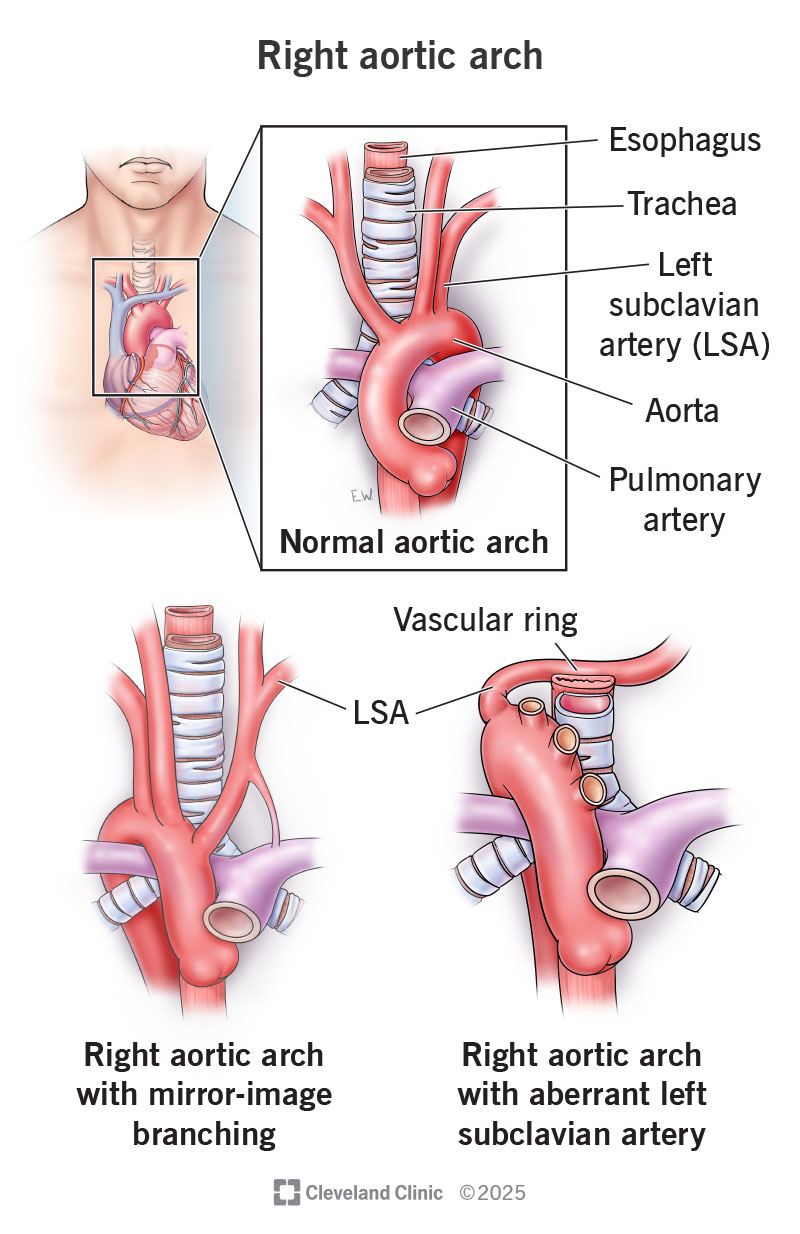
Image content: This image is available to view online.
View image online (https://my.clevelandclinic.org/-/scassets/images/org/health/articles/right-aortic-arch)
A right aortic arch is a congenital (present at birth) change to the anatomy of your child’s largest artery, the aorta. It means the curved part of their aorta (aortic arch) runs to the right of their trachea and behind it. Usually, the arch runs to the left of the trachea and in front of it. This change can also affect the location of arteries that branch from your child’s aortic arch to send blood to their head, neck and arms.
Advertisement
Cleveland Clinic is a non-profit academic medical center. Advertising on our site helps support our mission. We do not endorse non-Cleveland Clinic products or services. Policy
For some people, a right aortic arch is harmless and doesn’t cause symptoms. But for others, it can form a vascular ring. This is a circle of blood vessels that surrounds the trachea and esophagus, and may squeeze them too tightly.
The aortic arch, its branch arteries and remnants of fetal blood vessels form this loop. If this happens, your child may have trouble with breathing or swallowing food. Surgery can repair your child’s aortic arch and relieve their symptoms.
About 1 in 1,000 people have a right aortic arch. Some never know they have it. Others develop symptoms and need treatment. A right aortic arch is the most common cause of a vascular ring.
Experts have identified at least 10 different types, or variants, of right aortic arch. These are based on the exact location of the aortic arch and its branches. These are the two most common types:
Advertisement
Symptoms depend on whether or not the right aortic arch forms a vascular ring. If it doesn’t, or if it forms a loose or “partial” ring, then your child may not have symptoms. But if the arch and its branch vessels form a complete ring, they may squeeze your child’s trachea and esophagus. If this happens, the right aortic arch can cause symptoms like:
Respiratory symptoms usually start between 6 and 12 months of age. These symptoms might get worse when your baby bends their neck. They may improve when your baby stretches out their neck. Digestive issues usually don’t develop until your baby starts eating solid foods.
Some babies don’t have any symptoms. Or they may have mild symptoms that go unnoticed or are linked with other causes. For example, some children chew their food very slowly to avoid gagging. But their parents don’t realize it’s due to a narrowed esophagus. These kids may not get a diagnosis until later in childhood or even adulthood.
Changes during fetal development cause a right aortic arch. The aortic arch forms out of a pair of “primitive” arches during the first trimester of pregnancy. These are called the “right fourth arch” and “left fourth arch.”
Usually, the right one closes off, leaving only the left arch in its expected position. But in babies born with a right aortic arch, the opposite occurs. Instead of closing off, the right fourth arch stays, and the left one goes away. It’s not clear why this happens.
In some cases, gene changes may be responsible. Experts estimate that about 1 to 3 in every 10 people with a right aortic arch have a genetic condition. For example, some people with a right aortic arch also have DiGeorge syndrome. This genetic condition can affect your child’s aorta, heart and many other parts of their body.
Without treatment, some children may lose weight or gain weight more slowly than expected. This can happen if a vascular ring presses on their esophagus and makes eating difficult.
Healthcare providers sometimes diagnose a right aortic arch before birth. A routine prenatal ultrasound may show a possible issue. If this happens, your provider may do another noninvasive test called a fetal echocardiogram. This is an ultrasound that shows the fetal heart and aorta in detail. It can reveal a right aortic arch and other differences in anatomy.
Some babies receive a diagnosis after birth. Most babies with a right aortic arch don’t have any symptoms at birth. Instead, symptoms develop within the first year or two. This leads providers to do some tests.
Advertisement
Tests your child may need include:
Some babies with a right aortic arch also have congenital heart disease. For example, they might have a “hole in their heart.” Or blood vessels leaving their heart might not be fully developed. Specific heart defects linked with a right aortic arch include:
Advertisement
Treatment depends on whether your child has symptoms. If the right aortic arch isn’t causing any problems, your child may not need treatment. But if there’s a vascular ring, your child may need surgery to relieve pressure on their trachea and esophagus. It depends on the anatomy of their aortic arch and branch arteries.
Your child’s care team will explain exactly what will happen during their surgery. In general, a surgeon carefully divides the blood vessels that make up the vascular ring. They then reconnect them at different points. This makes more room for your child’s trachea and esophagus, so they’re no longer squeezed. If your child has heart defects, their surgeon may repair those issues at the same time.
Surgery typically takes place in the first two years of life. But it can also happen later in childhood. Rarely, diagnosis and treatment happen in adulthood.
Call your pediatrician if your child:
If your child is diagnosed with a right aortic arch, their healthcare providers will let you know how often to come in for follow-up visits. They’ll also explain the timeline for treatment and recovery.
Advertisement
Surgery can help your child feel better and grow normally. Research shows that surgery to treat a right aortic arch is highly successful. Nearly all children who have surgery are free of symptoms down the road. Some children still have symptoms for several months after surgery. A small number have symptoms that persist despite surgery. Some need another surgery.
Your child’s care team can tell you more about what to expect in your child’s situation. Their outlook also depends on any other health conditions they have, like heart defects or genetic syndromes.
A right aortic arch is a change to your child’s anatomy that may not cause any issues. But if it does, healthcare providers are prepared to treat it. Your child’s care team will help you understand what surgery will involve and what to expect for recovery. Be sure to ask any questions. Providers know it’s not easy having a child go in for surgery. They want to make your entire family feel as comfortable as possible each step of the way.



Sign up for our Health Essentials emails for expert guidance on nutrition, fitness, sleep, skin care and more.
Learn more about the Health Library and our editorial process.
Cleveland Clinic’s health articles are based on evidence-backed information and review by medical professionals to ensure accuracy, reliability and up-to-date clinical standards.
Cleveland Clinic’s health articles are based on evidence-backed information and review by medical professionals to ensure accuracy, reliability and up-to-date clinical standards.
Cleveland Clinic Children’s providers treat vascular rings in babies and children with compassionate support and excellent results.
