



Ejection fraction (EF) measures how much blood your heart can pump out to your body. The EF formula is how much blood your ventricle pumps out divided by its total amount of blood, then multiplied by 100. In a healthy heart, this is a higher number. A low number means your heart has trouble keeping up with your body’s needs.
Advertisement
Cleveland Clinic is a non-profit academic medical center. Advertising on our site helps support our mission. We do not endorse non-Cleveland Clinic products or services. Policy
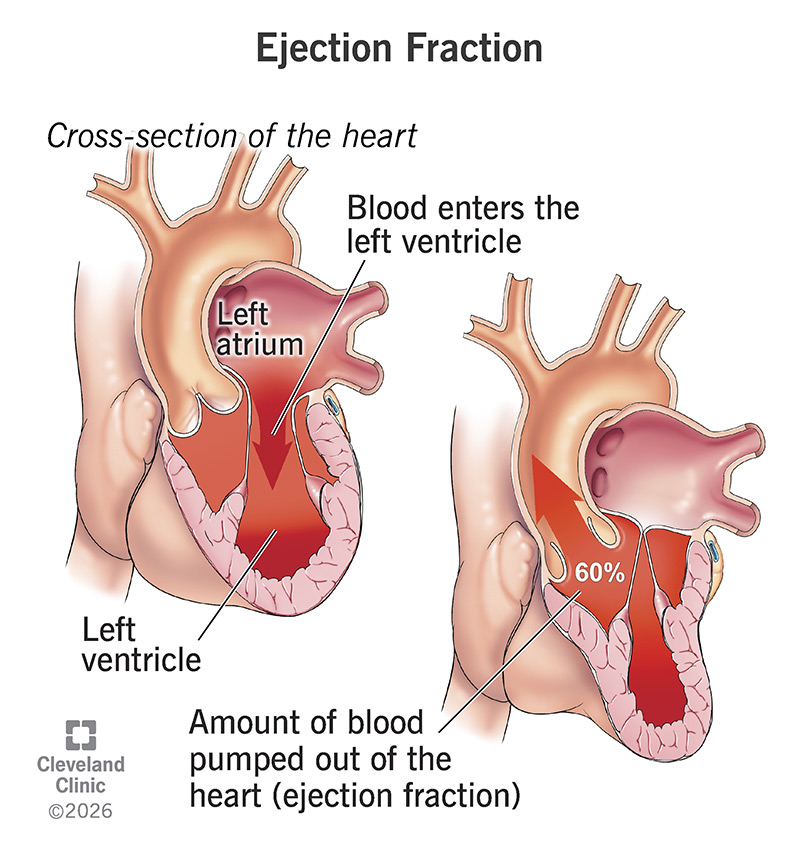
Image content: This image is available to view online.
View image online (https://my.clevelandclinic.org/-/scassets/images/org/health/articles/16950-ejection-fraction)
Ejection fraction (EF) is the percentage of blood your heart’s lower left chamber (left ventricle) pumps out, or ejects, with each beat. The number tells how well and how efficiently your heart can pump blood. A normal ejection fraction is 50% to 70%. With each heartbeat, 50% to 70% of the blood in your left ventricle goes out to your body.
Advertisement
Cleveland Clinic is a non-profit academic medical center. Advertising on our site helps support our mission. We do not endorse non-Cleveland Clinic products or services. Policy
A number lower than 50% means your heart isn’t pumping as well as it should. A low EF is a sign of heart failure and other problems. The lower the ejection fraction, the weaker your heart’s pumping action is. Different treatments can help, depending on how far from normal your ejection fraction is.
| Sex | Normal | Mildly abnormal | Moderately abnormal | Severely abnormal |
|---|---|---|---|---|
| Male | 52% to 72% | 41% to 51% | 30% to 40% | Below 30% |
| Female | 54% to 74% | 41% to 53% | 30% to 40% | Below 30% |
| Sex | ||||
| Male | ||||
| Normal | ||||
| 52% to 72% | ||||
| Mildly abnormal | ||||
| 41% to 51% | ||||
| Moderately abnormal | ||||
| 30% to 40% | ||||
| Severely abnormal | ||||
| Below 30% | ||||
| Female | ||||
| Normal | ||||
| 54% to 74% | ||||
| Mildly abnormal | ||||
| 41% to 53% | ||||
| Moderately abnormal | ||||
| 30% to 40% | ||||
| Severely abnormal | ||||
| Below 30% |
Ejection fraction typically refers to the left side of your heart (left ventricular ejection fraction, or LVEF). It shows how much oxygen-rich blood your left ventricle pumps out to most of your body’s organs with each contraction. LVEF helps define how badly or how well the left side of your heart is working.
Healthcare providers can also take measurements on the right ventricle (right ventricular ejection fraction, or RVEF). This measures the amount of oxygen-poor blood the right side of your heart pumps out to the lungs for oxygen. It’s important if you have right-sided heart failure. But this condition isn’t as common as left-sided heart failure.
The ejection fraction (EF) formula is EF = (SV/EDV) x 100. The last step (multiplying by 100) allows you to show this as a percentage.
Advertisement
There are a few methods for measuring ejection fraction. An echocardiogram is the most common.
Other heart tests that measure ejection fraction include:
An ejection fraction outside of the normal range could mean a variety of things:
Some people with a normal ejection fraction also have heart failure. This is known as heart failure with preserved ejection fraction (HFpEF), or diastolic heart failure.
With HFpEF, the left ventricle holds a lower volume of blood. This is often because thick or stiff heart tissue shrinks the ventricle size. When this happens, the amount of blood that goes out to the body isn’t enough to meet its needs.
You may be at risk for heart failure with preserved ejection fraction if you have:
Conditions that weaken or damage heart muscles make their contractions incomplete and less effective. You need healthy muscles in your lower heart chambers so they can pump blood well.
Your heart may compensate by working harder to do its job. The extra work can lead to swelling or scar tissue buildup that affects the ventricles’ ability to fill and pump. You might not feel the effects of a slightly reduced ejection fraction. But as your heart function declines and your ejection fraction worsens, you can become severely ill.
The lower your ejection fraction, the more severe your heart failure symptoms may be. You might have:
An ejection fraction of 75% or more is rare. It can occur in people with hypertrophic cardiomyopathy. In these cases, a dangerously high EF needs medical care. Sometimes, your EF can be temporarily elevated when you’re dehydrated or sick (like with an infection).
Advertisement
Your ejection fraction is a sign of how well your heart is working. A low ejection fraction typically means you have or are at risk for heart failure. EF helps healthcare providers decide which heart failure treatment is best for you. Checking ejection fraction throughout therapy shows whether your heart function is improving.
It’s helpful to know your ejection fraction if you have or are at risk for a condition that can lead to heart failure.
These conditions include:
Heart failure therapies treat the underlying cause of low ejection fraction. For heart failure due to an abnormal heart rhythm, a biventricular pacemaker may help. If you have heart failure from other causes, like high blood pressure, you may need medications.
There are also specific medications shown to improve EF that your healthcare provider will prescribe regardless of the cause of low ejection fraction.
Advertisement
You can take other steps to relieve strain on your heart and get the most out of treatment. These include:
If your symptoms are fading, it may be a sign that your ejection fraction is improving. You’ll have frequent appointments with your healthcare provider to monitor a low ejection fraction.
It’s essential to go to all appointments, even if you don’t feel sick. Symptoms can worsen or new ones can appear. These issues may be signs of a worsening ejection fraction.
Contact your healthcare provider right away if you have:
The frequency of testing after a heart failure diagnosis depends on a variety of factors, including how low your first ejection fraction reading was. If your EF keeps getting worse, you’ll need it checked more often. If it’s stable, you might not need it checked as often.
Advertisement
Healthcare providers may be concerned about your ejection fraction if you:
Ejection fraction is one of many ways your healthcare providers assess heart failure. Other tests make it possible to pinpoint the cause so you receive the right care.
These tests may include:
Hearing your healthcare provider talk about your ejection fraction (EF) may be confusing. But you can think of it as a measure of heart muscle strength. EF measures how much blood your heart can pump with each heartbeat. A low ejection fraction is typically a sign of heart failure. With treatments and self-care, it’s possible to raise your ejection fraction back into a normal range.



Sign up for our Health Essentials emails for expert guidance on nutrition, fitness, sleep, skin care and more.
Learn more about the Health Library and our editorial process.
Cleveland Clinic’s health articles are based on evidence-backed information and review by medical professionals to ensure accuracy, reliability and up-to-date clinical standards.
Cleveland Clinic’s health articles are based on evidence-backed information and review by medical professionals to ensure accuracy, reliability and up-to-date clinical standards.
Cleveland Clinic can diagnose and treat heart failure of any kind, at any stage, with advanced therapies and compassionate care.
