Acid reflux is when acid from your stomach moves up into your esophagus and even your throat. It can cause unpleasant symptoms like heartburn and nausea. This is a normal but temporary inconvenience. When it’s chronic, it’s called GERD. GERD can damage your GI system over time. Treatment includes at-home adjustments, medication and surgery.
Advertisement
Cleveland Clinic is a non-profit academic medical center. Advertising on our site helps support our mission. We do not endorse non-Cleveland Clinic products or services. Policy
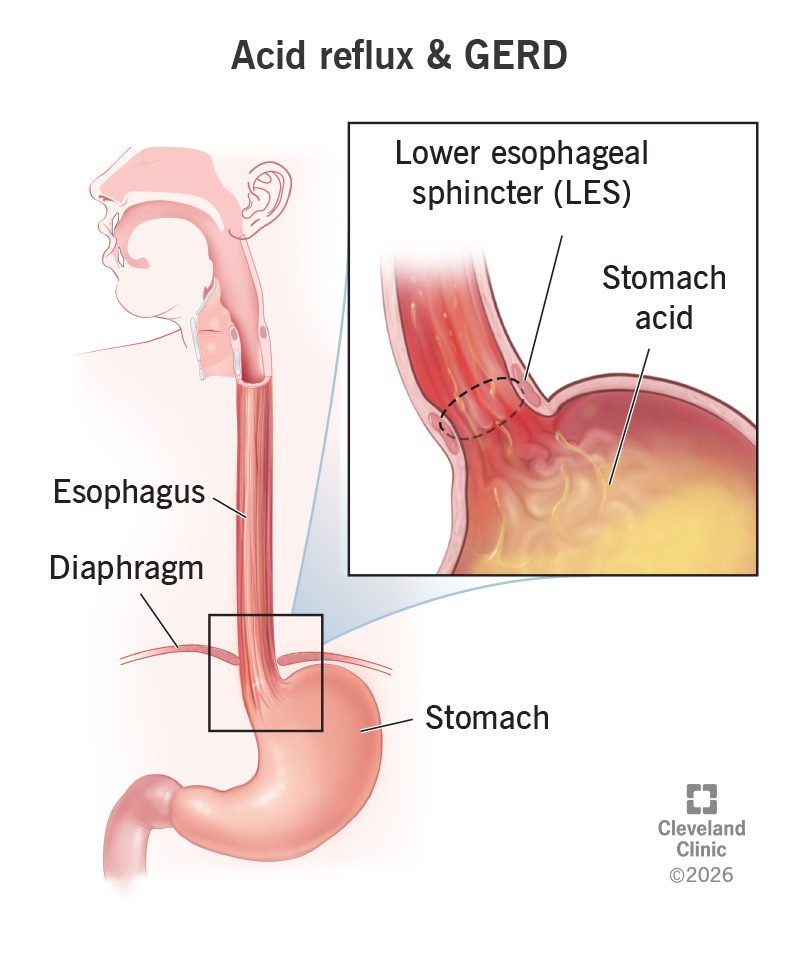
Image content: This image is available to view online.
View image online (https://my.clevelandclinic.org/-/scassets/Images/org/health/articles/17019-acid-reflux-gerd.jpg)
Acid reflux is when stomach acid flows upward into your esophagus and, sometimes, your throat. Normally, these acids flow one way: down. So, your esophagus and throat aren’t built to withstand them. Stomach acid can irritate the tissues there. This can lead to uncomfortable sensations, like heartburn. But most people have occasional reflux. It’s nothing to worry about.
Advertisement
Cleveland Clinic is a non-profit academic medical center. Advertising on our site helps support our mission. We do not endorse non-Cleveland Clinic products or services. Policy
GERD (gastroesophageal reflux disease) is when acid reflux becomes chronic. This means you have reflux episodes twice a week for several weeks straight.
While acid reflux can be annoying but temporary, GERD (also spelled GORD for gastro-oesophageal reflux disease) is a constant, mechanical problem. The systems in place to keep acid moving down aren’t working right.
Acid reflux and GERD are common. GERD affects 1 in 5 people in the United States.
Acid reflux in babies is also normal, especially in their first year of life. They can have GERD, too. But it looks a little different for them.
Symptoms of acid reflux and GERD can include:
Advertisement
GERD symptoms can be worse at night or while lying down. They can also worsen after you:
A weakened or relaxed lower esophageal sphincter (LES) causes acid reflux and GERD. For acid to get into your esophagus and throat, it needs to get past the LES, a special valve at the bottom of your esophagus. Its job is to prevent stomach contents from moving upward.
Some things can temporarily relax your LES, like lying down after a large meal. But if you have GERD, your LES is doing this more often than it should.
Sometimes, occasional acid reflux turns into GERD when its triggers persist or overlap.
Common risk factors for acid reflux and GERD include:
Less common risk factors are:
Many risk factors of acid reflux and GERD are beyond your control. But certain changes to your daily habits can help lower your risk, like not smoking or removing yourself from smoky environments. So can maintaining a weight that’s healthy for you.
Not on their own. But they can contribute to it. In higher doses, chocolate, coffee, alcohol, mint, garlic and onions can relax your LES.
Heavy meals and fatty foods need more stomach acid to break down, and they take longer. They might not have enough time to digest before you go to bed.
Having acid reflux here and there won’t affect your long-term health. But GERD can damage digestive organs above your stomach. This is because your stomach has built-in protection against acid. But your esophagus and throat don’t. Over time, stomach acid can burn and hurt them.
Advertisement
Possible complications include:
A specialist called a gastroenterologist will take a closer look at your situation. They’ll ask about your symptoms and go over your medical history. If that isn’t enough to diagnose GERD, or they want to check for complications, your provider may use:
Advertisement
If you have acid reflux, you may be able to ease your symptoms by adopting some new habits. These can include:
If you need a little extra help in the short term, over-the-counter (OTC) medications for acid reflux include:
Advertisement
Some medications have both antacids and alginates.
Incorporating these habits can help if you have GERD. But your provider may also prescribe medications to reduce your stomach acid. They’re safer to take long term than OTC medications.
Medications for GERD include:
While daily habits and medication can ease the symptoms and effects of GERD, they can’t stop it from happening entirely. A severe case of GERD can still cause problems on medication, even if you can’t feel it.
When this happens, surgery may be the best option. Procedures to treat GERD are minor and have excellent outcomes. You can typically go home the same day. They include:
Reach out to a provider if symptoms are still bothering you after treatment, or if they get worse. If you have acid reflux, this may mean that it’s become chronic. If you have GERD, it could mean that your treatment plan needs an update.
So many things contribute to acid reflux that it can be hard to tell what’s triggering yours. Sometimes, simple tactics like new habits and over-the-counter medications can make symptoms disappear. Other times, acid reflux can get worse.
Talk with a healthcare provider if acid reflux is getting in the way of life. They can see whether it’s causing problems you aren’t aware of.
You may need surgery if you have severe GERD or complications that medications can’t help. Surgery is usually minimally invasive and effective. It might be worth doing to prevent complications or keep them from making things worse.
If it’s happening right now, try:
It’s normal to have acid reflux from time to time. It may be unpleasant, but over-the-counter medication and changes to your normal routine may just do the trick.
If you have reflux more often or your symptoms are disruptive, it may be GERD. Talking with a healthcare provider can shed some light on your situation. They can help find a treatment that works for you.



Sign up for our Health Essentials emails for expert guidance on nutrition, fitness, sleep, skin care and more.
Learn more about the Health Library and our editorial process.
Cleveland Clinic’s health articles are based on evidence-backed information and review by medical professionals to ensure accuracy, reliability and up-to-date clinical standards.
Cleveland Clinic’s health articles are based on evidence-backed information and review by medical professionals to ensure accuracy, reliability and up-to-date clinical standards.
If you have issues with your digestive system, you need a team of experts you can trust. Our gastroenterology specialists at Cleveland Clinic can help.