



LINX is a minimally invasive procedure that helps treat symptoms of GERD. Healthcare providers place a flexible magnetic band around the inside of your esophagus to prevent stomach acid from refluxing back up.
Advertisement
Cleveland Clinic is a non-profit academic medical center. Advertising on our site helps support our mission. We do not endorse non-Cleveland Clinic products or services. Policy
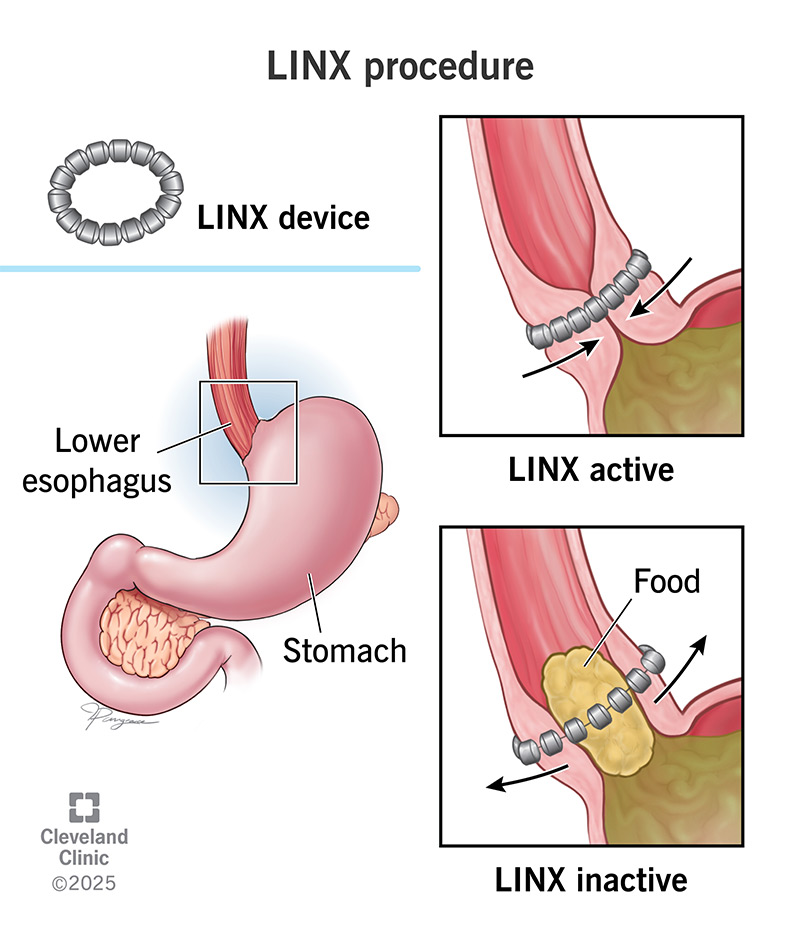
Image content: This image is available to view online.
View image online (https://my.clevelandclinic.org/-/scassets/images/org/health/articles/linx-procedure.jpg)
The LINX procedure is a surgical treatment for severe gastroesophageal reflux disease (GERD). It involves your healthcare provider placing a beaded ring around the lower part of your esophagus. LINX reduces or eliminates uncomfortable symptoms of GERD, like acid reflux and heartburn.
Advertisement
Cleveland Clinic is a non-profit academic medical center. Advertising on our site helps support our mission. We do not endorse non-Cleveland Clinic products or services. Policy
The LINX device looks like a stretchy, beaded bracelet. The beads are magnets wrapped in titanium, strung together on a flexible wire. The LINX device opens to allow food and liquid to go down when you swallow. But the magnetic beads are strong enough to close and prevent stomach acid from coming back up.
LINX may be right for you if you have GERD and:
People with metal allergies shouldn’t get LINX.
The procedure is laparoscopic, which means surgeons use smaller incisions. But it does require general anesthesia. You’ll need someone to drive you home after surgery (you shouldn’t have to stay overnight).
Your healthcare provider will go over what this procedure is like and how to prepare for it. Instructions may include:
You can expect the following during the LINX procedure:
Advertisement
The procedure takes less than an hour.
The biggest benefit of LINX is that it helps you feel better. Most people won’t experience acid reflux or heartburn as frequently or at all afterward.
Other benefits are:
LINX is usually a successful procedure. There aren’t many studies, but initial studies are positive.
Possible risks are:
Less common complications could include:
Ask your healthcare provider if you can safely have an MRI, as this can vary depending on which LINX system you have.
The device begins to work immediately. After you recover, you’ll be able to go home and start eating and drinking as usual. It may be best to start with softer foods. Most people can return to their normal activities within 48 hours.
Your healthcare provider will explain what to expect afterward. Ask them any questions you have about postsurgical care, eating or activity level.
The device is made to last a lifetime, although your provider may need to remove it sooner in some cases. One study found that the risk of removal within seven years was 4.81%. The main reason for removal was difficulty swallowing.
Since the device is a newer treatment, long-term studies are limited.
Contact your provider if you have any questions about the LINX procedure or if you have any complications afterward. Things to watch for post-surgery include:
Having a magnetic ring in your throat may seem strange to think about. But if you’ve tried other treatments for GERD with no success, the LINX system may be an option.
It can reduce or eliminate your symptoms and improve your quality of life. Ask your provider if you’re a good candidate for the LINX system. They can answer your questions and tell you the risks and benefits.
Advertisement



Sign up for our Health Essentials emails for expert guidance on nutrition, fitness, sleep, skin care and more.
Learn more about the Health Library and our editorial process.
Cleveland Clinic’s health articles are based on evidence-backed information and review by medical professionals to ensure accuracy, reliability and up-to-date clinical standards.
Cleveland Clinic’s health articles are based on evidence-backed information and review by medical professionals to ensure accuracy, reliability and up-to-date clinical standards.
Esophageal disorders can cause many symptoms, including heartburn or trouble swallowing. At Cleveland Clinic, we’ll find a treatment that works for you.
