



A person with flat feet has no visible arch in the foot when they stand. All babies have flat feet. Arches form during early childhood. If arches don’t develop — or they collapse later in life (fallen arches) — flat feet can cause pain and affect walking. Orthotics and stretching exercises can help.
Advertisement
Cleveland Clinic is a non-profit academic medical center. Advertising on our site helps support our mission. We do not endorse non-Cleveland Clinic products or services. Policy
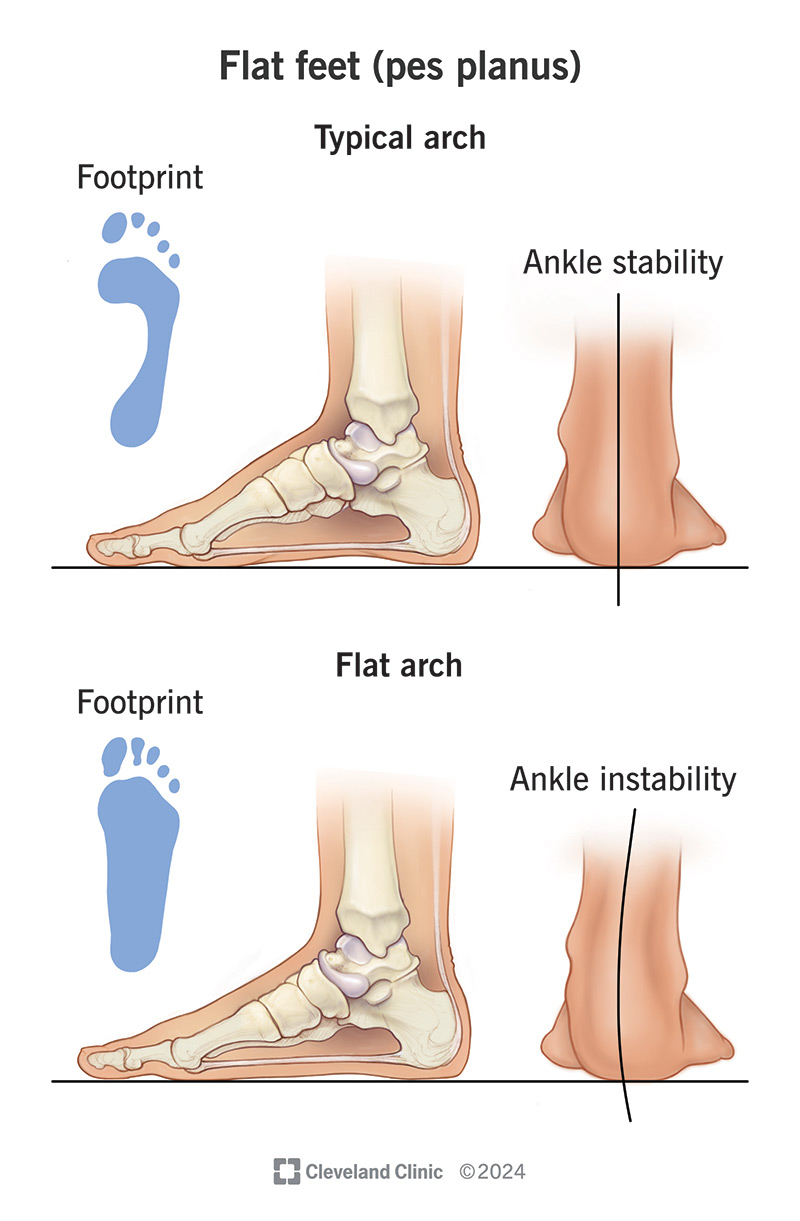
Image content: This image is available to view online.
View image online (https://my.clevelandclinic.org/-/scassets/images/org/health/articles/flat-feet)
Pes planus means having flat feet — or one flat foot — with little-to-no arch in the sole. You may be flat footed from childhood, or your feet may have lost their natural arches due to a medical condition.
Advertisement
Cleveland Clinic is a non-profit academic medical center. Advertising on our site helps support our mission. We do not endorse non-Cleveland Clinic products or services. Policy
Babies are naturally flat footed, but most begin to develop arches when they start walking. If arches never develop, or if they collapse later in life, flat feet can cause pain or other problems with walking.
The arches of your feet play an important role in the mechanics of walking upright. This is why they’re unique to human primates. Your arches are made of bones and connective tissues. They:
Some healthcare providers make a distinction between mildly flat feet that don’t cause any issues and the foot deformity they call pes planus. With pes planus, flat arches cause other changes to your foot.
Pes planus means:
Providers may classify your flat feet as flexible or rigid (sometimes flat or always flat). Flat feet can also be congenital (due to conditions present at birth) or acquired (something that happens later in life).
Advertisement
Types include:
Flat feet (pes planus) don’t always cause symptoms for everyone. But they can change the way you walk. They can also transfer too much stress to parts of your lower body that aren’t prepared to bear it.
Early symptoms might include:
Over time, you might develop:
You might begin to feel pain in your:
You also might be more at risk of secondary conditions like:
Some flat feet causes are congenital (present at birth). Other causes happen later in life, after your arches have formed normally. This is called progressive collapsing foot deformity, or “fallen arches.”
Congenital pes planus is due to conditions present at birth. While all babies are flat footed, some won’t ever develop normal arches. The answer to this is in their genes, which determine their physical traits.
Some families just have flatter arches than others. But genes can also cause genetic disorders or defects that affect how your arches form or prevent them from forming. Some of these conditions include:
Acquired pes planus happens when your arches fall flat after forming normally. Arch collapse can happen slowly or rapidly. Diseases and injuries can cause them. Some of these conditions include:
Advertisement
An orthopedist or podiatrist can recognize pes planus on a physical exam. They’ll observe the shape and position of your foot, how it moves and how you stand and walk on it.
They’ll ask you about your health history and any prior injuries or conditions that may have caused it. They might take images, like a foot X-ray, to confirm pes planus or to look further into the cause.
Many people won’t need any treatment for flat feet. If you don’t have symptoms, there’s no need to fix them. If flat feet cause you occasional, mild aches and pains, you can treat them conservatively with:
But flat feet that cause frequent or significant pain or other complications might need additional treatment. Depending on the cause, some people might need surgery to fix the underlying issue.
Sometimes, a mild and recent case of flat feet will correct itself with conservative treatment. In more severe cases, surgery can potentially fix flat feet. But some of the underlying causes are hard to treat.
When you have a chronic disease that contributes to flat feet, like advanced diabetes, arthritis or a connective tissue disease, it’s not always possible to manage it well enough to preserve your arches.
Advertisement
Yes. Many people with flat feet don’t have noticeable symptoms or need treatment. Your healthcare provider may recommend nonsurgical treatments if pes planus causes foot pain or other problems.
Wearing special footwear and adding some exercises to your daily routine can easily become your new normal. But if they aren’t helping, don’t keep quiet. Some types of pes planus can keep getting worse.
Often, there isn’t anything you can do to prevent flat feet. Staying at a healthy weight may ease pain from flat feet.
Flat feet are common and often no cause for concern. Children with flat feet usually develop arches by about age 10. But sometimes they don’t, and their flat feet may start to cause them discomfort in time.
It’s important to take your symptoms seriously. Some types and causes of flat feet are more severe, and they can cause further problems if left untreated. Consult an orthopedist or podiatrist if you have symptoms.
Advertisement



Sign up for our Health Essentials emails for expert guidance on nutrition, fitness, sleep, skin care and more.
Learn more about the Health Library and our editorial process.
Cleveland Clinic’s health articles are based on evidence-backed information and review by medical professionals to ensure accuracy, reliability and up-to-date clinical standards.
Cleveland Clinic’s health articles are based on evidence-backed information and review by medical professionals to ensure accuracy, reliability and up-to-date clinical standards.
An aching foot or heel can bring your favorite activities to a halt. Cleveland Clinic’s foot pain experts are here to help you heal and get back on your feet.
