



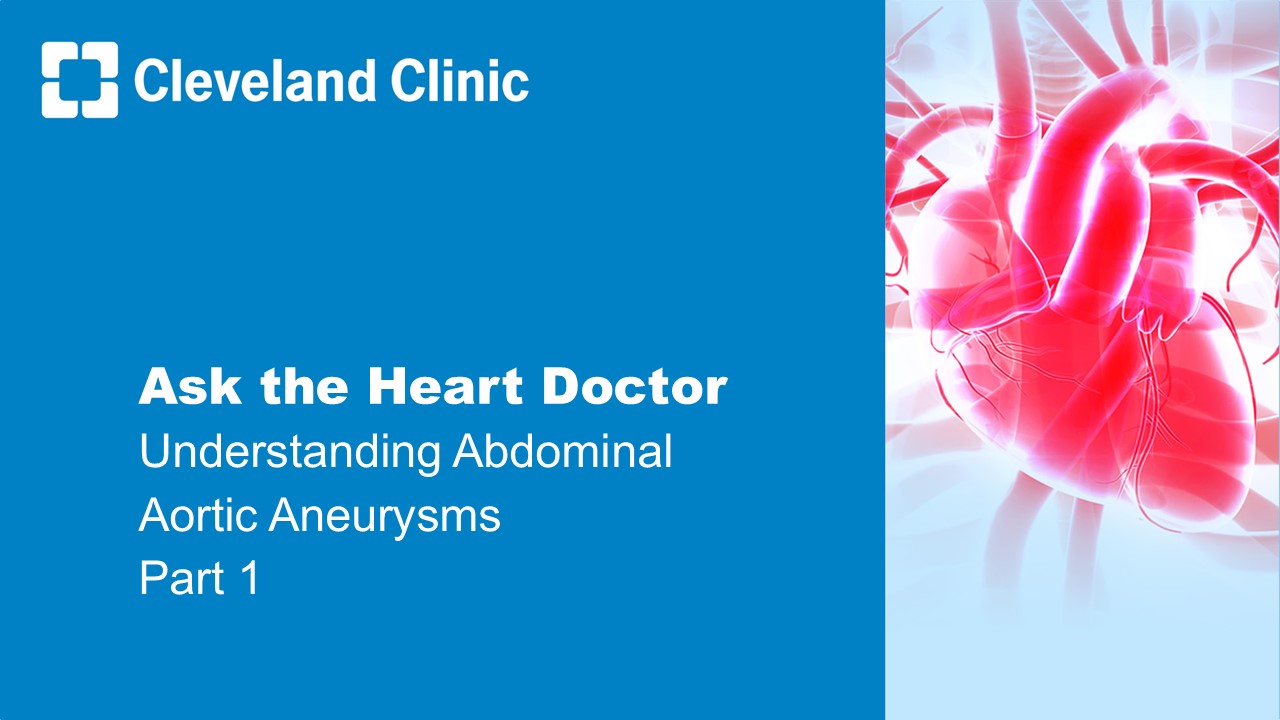
Ask the Heart Doctor - Understanding Abdominal Aortic Aneurysms
Have you or a loved one been diagnosed with an abdominal aortic aneurysm (AAA)? You're not alone, and you're in the right place. Cleveland Clinic’s vascular experts answer questions that real patients asked about abdominal aortic disease. Learn about aneurysm risk factors, genetic links to aortic disease and how lifestyle choices can impact an aneurysm.
Advertisement
Cleveland Clinic is a non-profit academic medical center. Advertising on our site helps support our mission. We do not endorse non-Cleveland Clinic products or services. Policy
Recent Episodes
Understanding Aspirin for Heart Disease Prevention
Luke Laffin, MD, and Vikas Sunder, MD, discuss the latest recommendations for using low-dose aspirin to help prevent heart disease, includin…
Choosing the Right Treatment for Blocked Coronary Arteries
Faisal Bakaeen, MD, and Grant Reed, MD, explain what blocked coronary arteries mean and the risk factors that can lead to coronary artery di…
Robotic Lung Transplantation Explained
Kenneth McCurry, MD, and Gregory Jones, MD, discuss who may need a lung transplant, how patients are evaluated and how transplantation can i…
Video content: This video is available to watch online.
View video online (https://cdnapisec.kaltura.com/p/2207941/sp/220794100/playManifest/entryId/1_gp0t8va6/flavorId/1_5f3sgelj/format/url/protocol/https/a.mp4)
Transcript
Announcer:
Welcome to Love Your Heart, brought to you by Cleveland Clinic's Sydell and Arnold Miller Family Heart, Vascular and Thoracic Institute. This podcast will explore disease prevention, testing, medical and surgical treatments, new innovations and more. Enjoy.
Advertisement
Cleveland Clinic is a non-profit academic medical center. Advertising on our site helps support our mission. We do not endorse non-Cleveland Clinic products or services. Policy
Francis Caputo, MD:
Good morning, and welcome to the Ask the Doctor series here at Cleveland Clinic. My name is Frank Caputo, and I'm the Vascular Surgery Aortic Director here at Cleveland Clinic. I am joined by my esteemed colleagues.
I want to just note that what makes this unique is we have multiple specialties here at the table to give you different opinions and different treatment options on how we manage things. That's what makes Cleveland Clinic great, is the multidisciplinary approach to disease statuses.
I'm here with Dr. Scott Cameron, Dr. Pulkit Chaudhury, Dr. Ali Khalifeh and Dr. Courtney Hanak. Maybe just introduce yourselves as we go down the line, real quick.
Scott Cameron, MD:
Thanks, Dr. Caputo. My name is Scott Cameron. I'm the Section Head of Vascular Medicine. I'm trained in Cardiology as well as Vascular Medicine, and also have a research interest in abdominal aortic aneurysms.
Pulkit Chaudhury, MD:
I'm Pulkit Chaudhury, I am one of the Vascular Cardiologists here at Cleveland Clinic. I'm dual appointed in sections of vascular medicine and cardiology. My interest is in arteriopathy, abdominal aortic aneurysms and all over.
Ali Khalifeh, MD:
I'm Ali Khalifeh. I'm one of the vascular surgeons here at the Cleveland Clinic and partners with Dr. Caputo and Dr. Hanak. Obviously we see a high volume of aortic surgery.
Advertisement
Courtney Hanak, MD:
My name is Courtney Hanak. I'm a Staff Vascular Surgeon here at the Cleveland Clinic. Excited to treat abdominal aortic aneurysms and answer your questions today.
Francis Caputo, MD:
What we have here is a list of questions that you guys asked. We are here to hopefully answer them. I'm just going to start off. Dr. Hanak, real quick, what is the difference between aortic enlargement and aneurysm? What makes an aneurysm? Maybe just give a couple of definitions for us.
Courtney Hanak, MD:
First, I think we need to start by defining what the abdominal aorta, and the aorta in general, is.
You have your heart, which is the pump, and then after that, you have a large blood vessel that sends all of the blood to the rest of the body. When we start talking about enlargement of that area, we call it "ectasia" which is the first thing, which is where the aortic wall is a little bit larger than we expect. There's a normal size of the aorta and that's anything that's less than three centimeters. Above three centimeters, we start to call it an aneurysm.
I like to explain that to my patients. Instead of being a straight tube, you start to think about it like a vase. There's a tube at the top and then an outpouching at the bottom. That outpouching can happen anywhere along the abdominal aorta. We start to classify this as an aneurysm once the wall size becomes greater than 1.5x of what we expect it to be.
So, an abdominal aortic aneurysm, or aneurysm in general, starts to be classified as greater than three centimeters.
Francis Caputo, MD:
Dr. Cameron, you run a world-renowned lab on the pathogenesis of what makes an aneurysm, trying to figure out what makes them worse, what makes them better. Maybe you can go into a little detail about what are things that make an aneurysm, what are risk factors that we can potentially help prevent growth if we find one, maybe help prevent one if you have a family history to that effect?
Scott Cameron, MD:
That's a great question, Dr. Caputo, and it's a question that patients quite often ask us. When I think of aneurysms, I usually tell patients that most of them happen because the artery wall becomes hardened or atherosclerotic. Those are the majority of the aneurysms that we treat.
Certainly, there are patients that we do find abdominal aortic aneurysms in who have connective tissue diseases, such as Marfan syndrome, Ehler-Danlos syndrome, Loeys-Dietz syndrome and there are some other rarer connective tissue disorders. Then very, very occasionally we'll also find some patients that have an inflammatory disorder, such as vasculitis, Takayasu Arteritis would be one. It's highly unusual, but we do sometimes find those.
Advertisement
In terms of their medical management of them, the current guidelines would tell us that it's absolutely critical to have your blood pressure managed within a certain range. We would like your blood pressure to be less than 130 over 80 millimeters of mercury. There are certain medications that are better than others for helping that.
We want to control cholesterol levels. In most patients, that's what we call a Class 1 indication in a patient with an atherosclerotic aneurysm, which means it's the law in medicine. We have to treat that.
Then the third thing is there's an option to give patients what's called an antiplatelet therapy, medications like aspirin or clopidogrel. That's currently a Class 2B indication, which means that in certain situations it's a good idea. We wouldn't do it for all patients, but certainly taking a good look at the patient's history and then other things that are going on in their body might define which medicines we would use if they're not quite ready for surgery.
Francis Caputo, MD:
Dr. Khalifeh, we often say the patient shows up, "I have an aneurysm. Now what to do?"
What sizes do you treat? What sizes do you get worried about? What are we worried about? These aneurysms, what problems do they cause that we're so concerned about fixing?
Advertisement
Ali Khalifeh, MD:
The biggest concern with abdominal aortic aneurysm, is as the aorta grows, that there's weakening of the walls. Studies have shown that the risk becomes significant when the aneurysm is greater than five and a half centimeters in men. There are some exceptions for women at five centimeters. Aneurysms that show rapid growth usually tell us that the wall is weaker, and over the years, it's growing more rapidly than the annual average that we know of, which is usually somewhere around 0.4 centimeters a year.
Most patients will come in, they're anxious, they've gotten the diagnosis by getting a scan or an ultrasound for some other issue, and they are afraid that they're walking around with a ticking time bomb. The first thing I do is I calm them down, and we talk about the risk being a risk over a year. We’ve got to risk stratify, figure out how we can improve their health over wise, do all the steps that Dr. Cameron had mentioned before, and then figure out a treatment plan in the future if they do reach the criteria for repair.
Francis Caputo, MD:
Dr. Chaudhury, a lot of times our patients come in and say, "My dad had an aneurysm, my mom had an aneurysm. There's some family history."
In fact, there are several questions on here about family inheritance of aneurysms. Can you speak to that a little bit? What are the risks of having aneurysms run in families? You have a special interest in arteriopathies, and maybe go into a little bit about that, and the genetic disposition about those.
Advertisement
Pulkit Chaudhury, MD:
Absolutely. Thank you, Dr. Caputo. Again, a fantastic question that we get asked quite a bit in our clinic.
There is definitely a family predisposition to abdominal aortic aneurysms. We know patients with a first-degree relative who has an abdominal aortic aneurysm (parents, siblings, children), you have a higher risk of having an aneurysm. As you know, most aneurysms are asymptomatic, so those are patients at least above the age of 65 and a family history of an aneurysm, they should definitely be screened for an abdominal aortic aneurysm.
There are genetic conditions that are specific for abdominal aortic aneurysms. Those are fairly rare. The broad spectrum, the conditions that Dr. Cameron just mentioned, vascular Ehler-Danlos, Loeys-Dietz syndrome, Marfan syndrome, patients with those genetic conditions tend to have a higher risk of not just abdominal aortic aneurysms, but also thoracic aortic aneurysms.
So, patients with a history or a family member who has one of those conditions should be definitely screened for those conditions periodically.
Francis Caputo, MD:
I agree.
I think that the whole familial genetic component of abdominal aortic aneurysms has still yet to be sussed out. I think that we know there's a connection, we just don't know what it is yet.
I'm going to go down the line. The one question I get asked all the time is, and this is, again, right from you guys, from the patients, "I have an aneurysm, what can I do exercise-wise, work-wise, sex-wise? What can we do physical activity-wise?" Because people get scared, because we know that the risk of these aneurysms is that they rupture.
But do you treat it based on size? Do you do it based on fitness? I'll start with you, Dr. Cameron. What do you tell your patients? What activity level should they do?
Scott Cameron, MD:
It's an excellent practical question, actually, that patients do ask frequently. Part of the answer to that does depend on the size of the aneurysm, as Dr. Khalifeh and Dr. Hanak were indicating.
Certainly in the smaller aneurysms, I tell patients that they can engage in aerobic exercise just as they would as if it wasn't there. Once an aneurysm starts to get a little bit larger, so once you're into the four to five centimeter range, one of the things that I ask patients to be cognizant of is don't lift anything that would cause a lot of abdominal pressure, so more than about 40 or 50 pounds.
This has been studied a few times over the years. No one can really come up with a definitive weight that would be an additional risk for patients, but certainly if someone was an elite lifter of weights, lifting 300 pounds and generating a lot of abdominal pressure, say their aneurysm was 4.55 centimeters, I would say that that's probably not a good idea, because we do have credible data that you cause an increase in what we call "wall shear stress" in those conditions.
But then the second thing that I find quite helpful is there's a blood test available at Cleveland Clinic. We have data coming out jointly between vascular surgery and vascular medicine, which says if we use this blood test, it actually has some predictive ability on the risk of rupture, the rate of growth, and actually if you're a patient that might need earlier surgical intervention.
I think that as these blood tests develop, it allows us to give patients a little clearer picture of what their treatment trajectory might be in the next few years.
Pulkit Chaudhury, MD:
Just to go back to the physical activity part of it, again, very commonly asked questions.
I typically would not restrict, necessarily, cardiovascular exercise. Patients like to go for walks, ride a bike, on a treadmill, I typically would say there’s a minimal restriction when it comes to that. Again, when you're lifting something heavy, I tell patients, "If you're not able to have a conversation through that, if you're really holding your breath and grunting, those are the things that I would probably avoid."
Then one last thing about what patients can do. It's five minutes into this aneurysm conversation and we've not talked about tobacco yet. We know by far the biggest risk factor for abdominal aortic aneurysms is tobacco use, so stopping tobacco or any form of nicotine exposure, that's what I ask them to do.
Ali Khalifeh, MD:
Similarly, I do not discourage them from following cardiovascular activity. I think if they've been active, and they've been doing small Swedish weights, I think that's perfectly fine as long as they continue the same rhythm.
I do caution some patients with the diagnosis if we're trying to go from a sedentary lifestyle to running a marathon. I do tell them, "If you do want to go active, that's fine, just build up your stamina gradually."
Courtney Hanak, MD:
I also agree with the panel. When counseling my patients, I like to talk about the fact that our job as medical professionals is to keep you active doing the things that you love to do for as long as possible. Even when you get diagnosed with an aneurysm, ultimately that's our goal, and that's what we decide when we start to talk about different treatment options as well.
I agree, I want patients to continue to be active, to do the things they love to do, and to enjoy life until we reach that surgical decision-making, and then also talk about that.
As far as diet, eating the regular diet that you've been eating is fine as long as that includes some healthy options. I think ultimately just looking out for your health, taking your medication, seeing your primary care physician and following up with your medical specialist is what I recommend.
Francis Caputo, MD:
I always tell my patients, "You have to live life. You can't have a life without quality of life.” Live your life, keep your activity going and potentially just cater it to the fact that you do have this pathology of having an aneurysm.
Announcer:
Thank you for listening to Love Your Heart. We hope you enjoyed the podcast. For more information, or to schedule an appointment at Cleveland Clinic, please call 844.868.4339. That's 844.868.4339. We welcome your comments and feedback, please contact us at heart@ccf.org. Like what you heard? Subscribe wherever you get your podcasts or listen at clevelandclinic.org/LoveYourHeartpodcast.
Recent Episodes
Understanding Aspirin for Heart Disease Prevention
Luke Laffin, MD, and Vikas Sunder, MD, discuss the latest recommendations for using low-dose aspirin to help prevent heart disease, includin…
Choosing the Right Treatment for Blocked Coronary Arteries
Faisal Bakaeen, MD, and Grant Reed, MD, explain what blocked coronary arteries mean and the risk factors that can lead to coronary artery di…
Robotic Lung Transplantation Explained
Kenneth McCurry, MD, and Gregory Jones, MD, discuss who may need a lung transplant, how patients are evaluated and how transplantation can i…
Never miss a moment - subscribe now.
Listen to the Health Essentials Podcast on your favorite streaming platform.
Other Podcasts You May Love

Beyond Leadership
Hosts Jim Pae and Elizabeth Pugel escort you through a network of thought leaders, sharing world-cla…
Beyond the Pages: CCJM Podcast
Beyond the Pages: CCJM Podcast takes the listener more in-depth into Cleveland Clinic Journal of Med…
Butts & Guts
A Cleveland Clinic podcast exploring your digestive and surgical health from end to end. You’ll lear…
Cancer Advances
A Cleveland Clinic podcast for medical professionals exploring the latest innovative research and cl…