



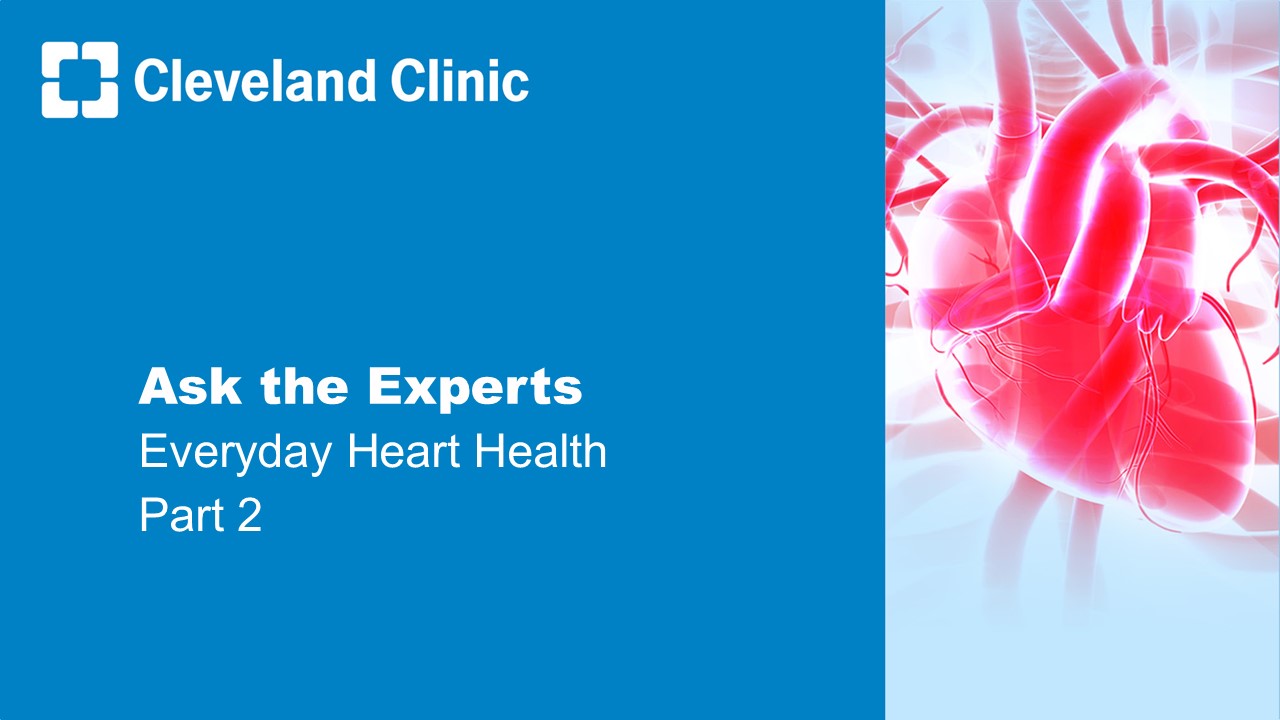
Ask the Experts: Everyday Heart Health Part 2
In part two of this two part series, Cleveland Clinic heart specialists continue their heart health conversation with tips on exercise and managing chronic conditions. Listen to part 1.
Advertisement
Cleveland Clinic is a non-profit academic medical center. Advertising on our site helps support our mission. We do not endorse non-Cleveland Clinic products or services. Policy
Recent Episodes
Encore: AFib After an Ablation
This is an encore episode of "AFib After an Ablation: What to Know", originally published in June 2025. Experiencing persistent or recurrin…
Understanding High-Risk Aortic Valve Endocarditis
Milind Desai, MD, and Per Wierup, MD, discuss high-risk aortic valve endocarditis, a serious infection that can affect heart valves and lead…
Robotic Heart Valve Surgery
Marc Gillinov, MD, and Per Wierup, MD, discuss how robotic heart valve surgery allows surgeons to repair or replace heart valves through sma…
Video content: This video is available to watch online.
View video online (https://cdnapisec.kaltura.com/p/2207941/sp/220794100/playManifest/entryId/1_9hmq291j/flavorId/1_5f3sgelj/format/url/protocol/https/a.mp4)
Transcript
Announcer:
Welcome to Love Your Heart, brought to you by Cleveland Clinic's Sydell and Arnold Miller Family Heart, Vascular and Thoracic Institute. This podcast will explore disease prevention, testing, medical and surgical treatments, new innovations and more. Enjoy.
Advertisement
Cleveland Clinic is a non-profit academic medical center. Advertising on our site helps support our mission. We do not endorse non-Cleveland Clinic products or services. Policy
Maria Mountis, DO:
I'm Dr. Maria Mountis, a Cleveland Clinic cardiologist. I'm joined by a panel of heart care specialists. We're here to answer your questions and share insights on how to build heart-healthy habits at any age, tips for lowering your risk of heart disease and what to do after a heart diagnosis.
So, Dr. Sarraju, please explain exercise guidelines for older adults based on factors like resting heart rate and current fitness level.
Ashish Sarraju, MD:
So, the first thing I'll say is to think about quantity of exercise. So, in general, you want to aim for 150 minutes of moderate intensity exercise per week. Now, how do we define moderate intensity? One rule of thumb is if you can talk to someone, but you can't sing a song while you're doing that exercise, it's probably moderate intensity for you. Now, what that is, is probably going to be different for everybody based on their current level of conditioning. So, that's a good place to start.
Now with all the wearables that we have, we already spoke about a little bit, folks are tracking their heart rates with exercise and at rest. Is there a good goal to aim for? It probably varies with everybody, but in general, if you're looking for a target, it's reasonable to aim for around 50 to 60% of what we call your maximum predicted heart rate, which is quite simply the number 220, from which you would subtract your age. You halve that, and that's a reasonable place to start for exercise, especially if you're just starting out.
Advertisement
But I caution people against trying to aim for a specific number on the watch as your target. You really want to exercise to that moderate intensity level for 150 minutes a week, do resistance exercises two or three times a week, and if you don't have time or feel too tired to do all of that, just move every day. Try to get 7,000 steps a day. If you can't do that, try not to be sedentary every day. So, aiming for, I think, achievable goals to start off makes a lot of sense, but certainly if you have a watch, you can start off with those heart rate goals and then work your way up depending on how your body responds.
Maria Mountis, DO:
One thing that I found very helpful in your section of preventative cardiology is the ability to refer a patient for an exercise prescription. Is that something you can elaborate on?
Ashish Sarraju, MD:
Yes, absolutely. The exercise prescription program is not something that's very common at institutions around the country, but it's a fantastic resource for pretty much anybody. There's no gatekeeping there. You would come in and you would exercise on a treadmill with an EKG monitor. Then you sit down with an exercise physiologist who's an expert, who supervises cardiac rehab patients, so they have a deep understanding of exercise physiology. They create a personalized plan: what heart rate goals to aim for, how much to hydrate, even what sort of exercises to do, what sort of equipment to buy. So, that's a fantastic resource for people who are interested in very specific guidelines. Like I said, there's no gatekeeping. Anyone's a candidate for it at our institution.
Maria Mountis, DO:
Thank you. To talk about exercise again a bit more, Dr. Taigen, what exercise tips do you have for people with atrial fibrillation?
Tyler Taigen, MD:
I think piggybacking on that point is that it matters a lot for atrial fibrillation. It matters to start with something that's structured. So, there was a trial in Australia where they took about 200 patients. Half went into a group where there was a structured program. They were assigned to 150 minutes of exercise a week, and the other half was just told to continue with what they were doing, which could be exercising or perhaps not. These were not folks who were getting on the track and running hard intervals or marathons or anything. Sometimes, it was brisk walking. Sometimes, it was swimming. But it was structured. So, they had someone who was going to help them along. Over six months, they increased the volume from about 150 minutes to somewhere around 200 minutes. All the patients had atrial fibrillation, and the group in the structured program with exercise had half the amount of recurrence as those who weren't in the structured program.
We've always known that this should help, but I think that with that trial, it's absolutely become a part of what I recommend patients do, and not just me saying, "Hey, you should go out and try and get something done." I think having a formal program, whether it's with our program here or something at SilverSneakers, something at the YMCA. I don't know if it matters that much if you're walking or running or even lifting weights. I think all of those things can help. But it's something that you're doing somewhere between two and a half to four hours a week, and really committed to it.
Advertisement
The key to so much of this with exercise is that you can't jump right in and think that you're going to be where you were whenever it was the fittest time of your life. You've got to just stay committed and consistent. Some days aren't going to be that great, and it's just going to feel like you hardly did anything, but you did. You showed up, and you got it done. That's, I think, the most important part of exercise, and it certainly applies to the folks that I see with heart rhythm conditions.
Maria Mountis, DO:
Great advice. Dr. Reed, what should I do to protect my heart after a heart attack?
Grant Reed, MD:
I think just expanding on the discussion that we've had, when you have a heart attack, or you have a major cardiac issue, it's important as patients and as physicians that we use this for motivation, because you have to start somewhere. For a lot of patients, when I recommend regular exercise, you can almost see that they tighten up. They know that recommendation's coming, and they know how hard it is for them. And not everyone can exercise because of orthopedic issues or because of certain chronic health issues that limit them. But I think that when you have a heart-related issue or just in general, in all of our lives, you have to start somewhere.
Advertisement
You have to take that first step and no matter how big or small it is at first, little changes and little things add up. Just like if you were to take someone over the course of a year, and you have a 30 or 40-pound weight gain, it's not like they gained that all at once. Or it's like watching your kids grow, which is something very relevant to me now. You look back on pictures, and you're like, "Wow, when did they get this old?" And you remember when they were still kids, and they'll always be that way to you to some degree. It's the same way for yourself.
Just like big changes can happen negatively very gradually, they can happen favorably as well. So, take that first step. Don't let your health and your medical issues dominate your ability to make positive changes.
So, when I take care of patients that have heart attacks, I think I'm in that unique position. I’m very fortunate to be able to help patients oftentimes with the life-saving intervention, but helping them realize that that was a big event can sometimes be challenging. We've gotten so good at treating heart attacks that patients come in, and then we put a coronary stent in. It takes less than an hour, and they feel oftentimes symptom-free within the first several hours afterwards, and they don't quite realize what happened.
Advertisement
So, it's our job to say this in a compassionate way that this was something which is life-threatening. It's an opportunity to use this as motivation to change your lifestyle. This is why it's such a great field is that we can do these things that tangibly benefit someone's life, and then develop these lifelong relationships that then become a focus on secondary prevention. So, I'm very fortunate to be able to work with patients and meet them before the heart attack happens and talk about prevention with some of the things that we've talked about, but then also to have these lifelong relationships afterwards.
So, once you have a heart attack, there are so many things that you can do, and that you should do. Number one that we should do as physicians is to motivate patients to make strong guideline-directed changes in their life so that they can live a life, hopefully, without another heart attack event. There are several medications that we typically start for patients, but ultimately, as a team between physicians, but also with patients, need to motivate our patients to live a heart-healthy lifestyle, and that's often the most challenging thing.
Maria Mountis, DO:
The next question is for Dr. Sarraju. Are there any supplements the panel recommends for long-term heart health?
Ashish Sarraju, MD:
Our institution, and one of my colleagues, actually led a study about this just a few years ago, where we looked at supplements and how well they reduce LDL cholesterol, which we know causes heart disease, and it's a modifiable target for heart disease. So, the more you lower it, the lower your risk of heart disease. This study looked at some of the most common supplements that folks might be taking, like Coenzyme Q10, red yeast rice, et cetera. Unfortunately, none of them were able to achieve proper LDL lowering, especially when compared with the lowest dose of a statin medication. So, that study, I think, crystallizes into research what a lot of folks have suspected, which is that taking supplements can be a bit of a gamble as to whether it's going to work in the way we think it works.
The side effects of taking supplements, interactions with medications, I think these are things that we can't dismiss. We can't look at supplements as a safer or more natural alternative to prescription medications. So, in general, I don't think we are in a position, or at least I'm in a position, to proactively recommend a supplement for heart health beyond the things we've already talked about, right? Excellent lifestyle, a good diet, which should really supplement you with a lot of good things that are sold as tablets separately, good exercise, excellent risk factor control. I don't think supplements will be able to adequately replace the benefits of doing all of that in a comprehensive manner.
Maria Mountis, DO:
Thank you. Next question. Is the fatigue I'm experiencing normal with chronic heart failure?
That's a little bit of a complicated question because fatigue can be multifactorial. So, when a patient comes in, and they explain to me that they're having fatigue, I have to be a bit of a detective to really understand what they mean by fatigue. Is this new for them? Is this something that's worsening? So, patients with chronic heart failure absolutely can have fatigue. If I am concerned that their trajectory is actually worsening, and I do believe that that fatigue is because of their heart dysfunction, then we go down a certain pathway of trying to understand what their cardiac output is, how much blood flow is leaving the heart. We can assess how much they could do with a right heart catheterization as well as a metabolic stress test. But most of the other fatigue is actually really reversible at times, too.
We'll question whether this is a low blood pressure or a low heart rate issue because of the medications that they're on. By decreasing those medications, we can actually improve some of their fatigue. We'll also be a little bit of a detective and sort out when they go to bed, what their sleep habits are. Many people really stay up at night, just doomscrolling on their phones and not really getting appropriate sleep. We want to ensure that if they do have sleep apnea, they're using their sleep machines. If they've not been tested for sleep apnea, we'll certainly refer them and get them tested. But also we want to make sure that their labs are not abnormal. That could be leading to fatigue, whether that's an abnormal thyroid lab, whether that's abnormal blood counts, abnormal vitamin D level, or kidney dysfunction. Sometimes there is an underpinning of depression or anxiety in many of our patients who experience cardiac disease, including chronic heart failure.
So, it really does require a little bit of digging on our end to sort out fatigue. But in general, if someone is well-managed with a diagnosis of chronic heart failure, they should be having more good days than bad days and once that changes, that's when we have to reassess.
Dr. Taigen, what are the expectations and challenges of living with an implanted pacemaker/defibrillator?
Tyler Taigen, MD:
These are two different things to start with. A pacemaker is a device that we use to control heart rates when they're too low, sometimes to treat heart failure. A defibrillator always has the ability to pace, but by itself, its function is to prevent sudden cardiac death. If a patient has an arrhythmia that comes from the bottom chamber, from the ventricle, then it would see that and deliver a shock.
This is a complicated relationship that we enter into with patients. There are really three key players in this kind of relationship. One is our device clinic. That's where we check all of the pacemakers and defibrillators. That's where all the information is housed. The way things work now is if a patient has a pacemaker or defibrillator or a loop recorder, any electronic device, then that information is sent back to our office remotely, and then we get updates on how well the device is working, whether it's providing the right therapy, whether there's an arrhythmia that we need to treat.
All of that information is then sent to me, and I'm the second part of the team on this. Then I need to make decisions with the patient about where the therapy could change based on that.
The third, which is the most important part of the team, is the patient. The reason for that is this is not the kind of therapy where we just put a pacemaker defibrillator in, and then things are going to get better. These devices have become very complex, and part of that complexity is that it's going to require some tweaking along the way in order to get the optimal benefit. The devices can now see how we breathe, see how we move, make changes with pH, deliver an electric impulse milliseconds apart that would make an enormous difference in someone's overall heart function, how they feel, whether they're really tired when they get up, to get something to eat or whether the device is accommodating for that increased demand and their heart rate increases.
So, all three of those things need to be aligned. In order to get the most out of a pacemaker and defibrillator, a patient really needs to enter into that therapy with that in mind.
Maria Mountis, DO:
When are you too old for a heart procedure? What do the doctors consider?
Grant Reed, MD:
As an interventional cardiologist who treats patients with coronary artery stents and also valvular heart disease interventions like transcatheter aortic valve replacement (TAVR) and other procedures, this is actually a very common question. Oftentimes, I get referred patients who are in their 70s, 80s and 90s, and I would say that age is really a number. You can have a biologic age and a chronologic age. I sometimes will see patients who are in their 70s who have a lot of medical issues and are actually sicker than my 80 or even early 90-year-old patient who may have led a healthy lifestyle and is fortunate to not have health-related issues.
So, I would say that it's less about the age number and more about how functional the patient is, what medical problems they have and what their quality of life is. If they have a good quality of life, and they're functional, and they have a good life expectancy of at least a couple of years, then all interventions should be considered.
However, it's important to, not only, as physicians, be able to say what we can do, but what we should do. That is aligning with the patient's expectations, with their quality of life and what their goals are. That's one of the things that I enjoy the most, counseling patients through some of these tough decisions, because just because we can do something doesn't mean that we have to.
A lot of times, patients have somewhat unrealistic expectations that we can fix absolutely everything. But one of the great things about being here at Cleveland Clinic is that we have, in many cases, helped to develop many of the technologies that can extend patients' lives. We can apply these technologies to patients even when they're elderly, as long as they have a good quality of life, and we can extend that with our therapies.
So, Tyler, what do you think from an EP's perspective?
Tyler Taigen, MD:
I think the electrophysiology interventionalists have very much the same approach, which is that there is really no age that we would say that “that's it”. There's no cutoff for any of these procedures. The answer for any patient is that, if you think you might benefit from one, then you're always welcome to a second opinion. I think that's a good idea, especially here because we see so many folks that have unusual conditions, and sometimes that's age.
Within EP, there is a little bit of a difference with procedures. There are therapeutic procedures that we're doing that should help people feel better and potentially live longer. That would be ablations of atrial fibrillation, for example, sometimes ventricular tachycardias, SVTs, pacemakers when someone's heart rate is too low.
And then, there are procedures that we do that are really prevention. They don't make you feel better. If someone has a low ejection fraction, which is the amount of blood that gets pumped out every time the heart squeezes, they have heart failure. I think that they're at increased risk for sudden cardiac death and might benefit from a defibrillator device, then that's preventative. They're not going to feel better just because I place an ICD (Implantable Cardioverter Defibrillator). So, there is a point where that doesn't make as much sense in a patient who's older.
The same could be said for a WATCHMAN device. That's a procedure that's relatively new over the last couple of years where a patient that has atrial fibrillation, who's at increased risk for a stroke, but can't stay on a blood thinner – either from bleeding or from other reasons why other doctors think that that's not a good idea long term – could benefit from the placement of that kind of device where we block off the area where the clots can form. That's preventative. They're not going to feel better other than they're not on the blood thinner.
So, part of the discussion with this is to really hone in on differences with patients and make sure that we're making good decisions on things that can make you feel better as you get older versus things that are really preventative and are less important, frankly, as you get older, when we need to focus mostly on quality of life and not prevention of things that could happen potentially over 5, 10, 20 years of time.
Maria Mountis, DO:
Dr. Sarraju, what are the latest findings on statins, both the proven benefits and the emerging safety or efficacy concerns, and how should that shape our treatment choices today?
Ashish Sarraju, MD:
Statin therapies are this category of medications that have been around for so long that we've managed to say a lot about them, both in terms of how much they benefit people, including something that Grant was talking about earlier, where folks who received high intensity statin therapies saw some regression of their plaque. So, there are established, proven benefits in reducing cardiovascular risks in stabilizing plaque and in regressing plaque, and that's been shown over tens and hundreds of thousands of patients over decades and multiple studies.
Now, in terms of the side effects, there are a couple that I think are things that we should tell patients about. There is a risk of muscle symptoms. It's probably much lower than what we think it is. In studies where patients did not know what they were taking, in one study, for example, 90% of symptoms that happened with the statin also happened with a placebo pill, and folks didn't know what they were taking. So, there's an element to that that's more complex than we think, right? But muscle symptoms can happen and the vast majority of those are reversible.
There has been concern about memory issues, but really this tends to be most of the time a very rare, maybe a brain fog-type sensation, but that tends to go away very quickly, even if that happens. At very high doses of high-intensity statin therapies, there can be an increase in blood sugar levels, and that's been shown. But for the vast majority of people who have a reason to take a statin, like they have diabetes. They have established heart disease. They have a family history of high risk. Generally, these risks are outweighed by the benefits of reducing the risk. But like with every medication, it's important to discuss the risks and benefits with your physician.
What makes the discussion much more interesting now, as I'm sure we all do in our clinic, is that we have a number of other therapies that can lower LDL cholesterol. We have only pills but injectables that are extremely potent. Of course, there's no free lunch. Everything has its own set of rare side effects, but that creates a much more complex discussion with folks who have had issues with statins, because now we have all these other options available, ezetimibe, PCSK9 inhibitors, inclisiran, bempedoic acid, et cetera, to reduce the LDL cholesterol. So, there are many other options if you're trying statins and find that for some reason they're not agreeing with you. There's a lot of exciting research in this area as well. So, I have no doubt that not only with LDL cholesterol, but also with Lp(a), we're going to be seeing some exciting findings over the next few years, many of which are from Cleveland Clinic.
Maria Mountis, DO:
Dr. Reed, what are some of the new techniques or procedures for treating valve disease?
Grant Reed, MD:
At Cleveland Clinic, we have been really fortunate to lead the way in developing innovative treatments for patients with valvular heart disease, from the early days of valvular heart surgery to now percutaneous therapies based with catheters. So, we can now replace the aortic valve without even making an incision in the body. This is called transcatheter aortic valve replacement or TAVR. This is where a large part of my practice focuses right now. We were involved from the very early days, the earliest days, one of the first US centers to do this, to now spearheading this to being a mainstream therapy, which is approved in patients at all levels of surgical risk. It has changed the therapy of patients with aortic valve stenosis dramatically. So, now we can offer TAVR as a minimally invasive treatment option for patients, and it's just been one of the greatest medical advances that I've seen in my lifetime.
Building on that, we have a wide range of therapies for the mitral valve now. We do mitral valve clip or transcatheter edge-to-edge repair therapy. That is mitral valve clip or another related device. This allows us to put a small device on the mitral valve to decrease its leaking or to improve mitral valve regurgitation. We have upcoming therapies and actually just received our first FDA approval for a transcatheter mitral valve replacement system. This is on the horizon to now fully replace the mitral valve without surgery and will be useful in a subset of patients who have severe mitral valve regurgitation and mitral valve stenosis.
Similarly, now we have therapies to treat the tricuspid valve, where we can do tricuspid valve clipping, repair and replacement therapies. On the horizon, we have a range of different valve therapies undergoing clinical trials, such as bicaval valves or valves which we put in the superior and inferior vena cava to replace the function of the tricuspid valve, to other therapies for interventional heart failure such as intra-atrial shunt therapy to reduce symptoms in patients with heart failure. Many of those therapies are investigational. At Cleveland Clinic, we are referred patients from all over the world who want another opinion and maybe don't have access to these therapies at their local institutions. So, we're just very fortunate to be able to offer this.
So much of this is a team discussion between all of us here, for example. I work with all of you on a daily basis about difficult patients, which I'm just honored to be able to lean on all of you for your opinions. Being able to treat patients in this way in conjunction with our surgical colleagues is just one of the most rewarding and exciting things. So, this is truly where innovation meets patient care, and it's one of the things I think that attracts so many of us at the Cleveland Clinic, so we can focus on things like prevention to help prevent these diseases from happening in the first place, but then once we have to deal with them, we have innovative therapies, which can be tailored to each individual patient.
Maria Mountis, DO:
We have time for one final question. At what point should someone consider getting a second opinion or follow-up at Cleveland Clinic? For example, is it beneficial for someone to have a primary cardiologist in their hometown and then go to Cleveland Clinic as well? I'll let you start, because you really gave us a good overview of who these patients are that come to you for these innovative valve procedures.
Grant Reed, MD:
This is actually a large part of my practice is patients whom I co-manage with other cardiologists. These may be patients who come here for a second opinion initially, who then get a therapy and the love the care that they've received here, so then they become lifelong patients for us. The question of when do you seek a second opinion, I think, is an individual one. However, I would say that in all cases, we're more than willing and happy to offer an opinion about your heart health. Many patients, they just want to be established with the Cleveland Clinic cardiologist in case something happens. I get a lot of second opinions for patients who are for prevention or maybe have had a heart attack, and they just want an opinion about secondary prevention. They're feeling well, but they just want that peace of mind that they have a world expert in their corner, and I'm just honored to be considered that and to help them in that way.
Then we get referred patients with truly complex valvular heart disease or other issues that just don't have another solution. That may be patients here in the Northeast Ohio area, within the state of Ohio, throughout the country and throughout the world. I do co-manage a lot of patients, and that's one of the benefits of being here. Now that we can do virtual visits, it seems to be even more common that I'll be co-managing a patient in California or even overseas sometimes.
We have a robust virtual second opinion program, which is great for patients who are not yet even formal patients of the Cleveland Clinic. It's a major part of my practice, and it's one of the most fun things that I do is serving that role as someone who maybe needs another opinion, already has a cardiologist, has a tough problem to treat and through myself and my colleagues here, many of which are at the table, can come up with a solution that maybe they haven't been offered before.
Maria Mountis, DO:
Thank you, Dr. Reed. How about you, Dr. Taigen?
Tyler Taigen, MD:
Yeah, I think getting a second opinion is as important a thing as is available to us within medicine. I think that's always useful when you're not sure. I mean, honestly, we do this for our family members all the time here, right? It's part of what is great is that someone will call and say, "Hey, my doctor said I have AFib. What do you think?" Or they'll say, "I need a stent," and I'll go find Dr. Reed and ask him what he thinks about that. So, we're doing this with each other all the time.
I think that especially within EP, that makes sense because it can feel a little esoteric. A lot of people have never heard of what an electrophysiologist is and then suddenly someone needs an ablation, and that doesn't make sense, and it feels like it's science fiction almost.
Probably a quarter of what I see are second opinions. Many of those patients end up having whatever they need done here, but a good number I will talk to and say, "I think it's terrific. They're on point, and you should go with what they're doing." I know providing that reassurance is very important to those patients, and I view it as part of the responsibility and honor of being at Cleveland Clinic.
Maria Mountis, DO:
Dr. Sarraju?
Ashish Sarraju, MD:
I absolutely agree with everything that's been said. Medicine is not always black and white. A lot of the medicine is in the gray. One of my former chairs used to say, "We make our money in the gray as cardiologists. We don't make it in the black and white situations." So, when things are gray, a second opinion helps. It helps at least provide reassurance, as Tyler said, that the decisions that are being made are in line with what the patient thinks. Having a second person or a third person sign off on the plan of action can be very helpful, even if nothing changes at all. The model of us being a patient's second cardiologist or even third cardiologist is something that I think we're all very comfortable with. Respecting the relationship that they have with their primary cardiologist and helping and supplementing where we can is a model we're all very comfortable with. So, I don't think there's much gatekeeping there in terms of having people come see us if they're concerned or if their physician is concerned.
Maria Mountis, DO:
Right. I agree. I echo and agree with all of your sentiments. Typically, most people are worried that their local cardiologist will be upset if they're coming in for a second opinion. How I comfort these patients is saying, "We'll all work together. I think you must keep your local cardiologist. Absolutely." But for some things at a smaller hospital, the hospital just doesn't have the capability of all the innovation that we have here in Cleveland. We see this all the time. I'll have patients referred to me for a heart transplant evaluation or LVAD evaluation, and sometimes all they need is tweaking of their medications. They don't need to go down that pathway.
But truly, if they have advanced heart failure, this is the place to be. All the innovations and really working with all of you to try and delay that or to give them other therapies that may delay an LVAD, may delay a transplant. So, it really is an honor, like all of you, to work with you and to really help our patients, especially with the second opinion program, as you mentioned, Dr. Reed.
Before we go, I'd like to say thank you to our panelists today for your expertise and your participation. Cleveland Clinic is nationally ranked and globally recognized as a world leader in cardiovascular care. We provide heart care at many locations across Northeast Ohio and beyond if you need us. We would be honored to see you.
Announcer:
Thank you for listening to Love Your Heart. We hope you enjoyed the podcast. For more information or to schedule an appointment at Cleveland Clinic, please call 844.868.4339. That's 844.868.4339. We welcome your comments and feedback. Please contact us at heart@ccf.org. Like what you heard? Subscribe wherever you get your podcasts, or listen at clevelandclinic.org/loveyourheartpodcast.
Recent Episodes
Encore: AFib After an Ablation
This is an encore episode of "AFib After an Ablation: What to Know", originally published in June 2025. Experiencing persistent or recurrin…
Understanding High-Risk Aortic Valve Endocarditis
Milind Desai, MD, and Per Wierup, MD, discuss high-risk aortic valve endocarditis, a serious infection that can affect heart valves and lead…
Robotic Heart Valve Surgery
Marc Gillinov, MD, and Per Wierup, MD, discuss how robotic heart valve surgery allows surgeons to repair or replace heart valves through sma…
Never miss a moment - subscribe now.
Listen to the Health Essentials Podcast on your favorite streaming platform.
Other Podcasts You May Love
Beyond Leadership
Hosts Jim Pae and Elizabeth Pugel escort you through a network of thought leaders, sharing world-cla…
Beyond the Pages: CCJM Podcast
Beyond the Pages: CCJM Podcast takes the listener more in-depth into Cleveland Clinic Journal of Med…
Butts & Guts
A Cleveland Clinic podcast exploring your digestive and surgical health from end to end. You’ll lear…
Cancer Advances
A Cleveland Clinic podcast for medical professionals exploring the latest innovative research and cl…