



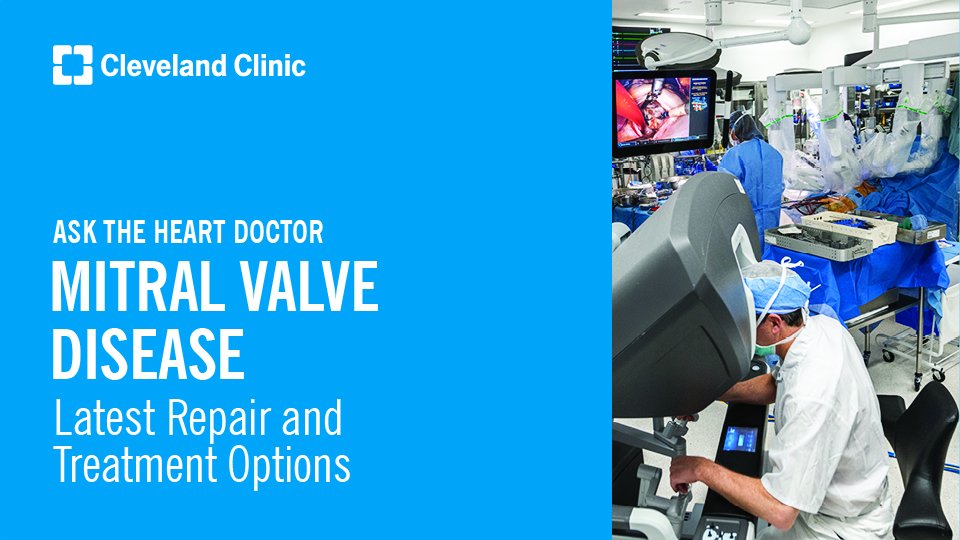
Ask the Heart Doctor: Mitral Valve
Cleveland Clinic heart experts explain mitral valve disease: what regurgitation (leakage) and stenosis (narrowing) are, how they’re found with an ultrasound of the heart and when treatment may be needed. Learn why regular follow-up matters, even if you feel fine, and how today’s treatment options - from minimally invasive surgery to catheter-based procedures - can help you get back to living a full, active life.
Advertisement
Cleveland Clinic is a non-profit academic medical center. Advertising on our site helps support our mission. We do not endorse non-Cleveland Clinic products or services. Policy
Recent Episodes
Encore: AFib After an Ablation
This is an encore episode of "AFib After an Ablation: What to Know", originally published in June 2025. Experiencing persistent or recurrin…
Understanding High-Risk Aortic Valve Endocarditis
Milind Desai, MD, and Per Wierup, MD, discuss high-risk aortic valve endocarditis, a serious infection that can affect heart valves and lead…
Robotic Heart Valve Surgery
Marc Gillinov, MD, and Per Wierup, MD, discuss how robotic heart valve surgery allows surgeons to repair or replace heart valves through sma…
Video content: This video is available to watch online.
View video online (https://cdnapisec.kaltura.com/p/2207941/sp/220794100/playManifest/entryId/1_zhckzhce/flavorId/1_5f3sgelj/format/url/protocol/https/a.mp4)
Transcript
Announcer:
Welcome to Love Your Heart, brought to you by Cleveland Clinic's Sydell and Arnold Miller Family Heart, Vascular, and Thoracic Institute. This podcast will explore disease prevention, testing, medical and surgical treatments, new innovations and more. Enjoy.
Advertisement
Cleveland Clinic is a non-profit academic medical center. Advertising on our site helps support our mission. We do not endorse non-Cleveland Clinic products or services. Policy
Marc Gillinov, MD:
Welcome to our program, Ask the Heart Doctor. We've got a panel of flat-out experts in all forms of heart valve disease. Today, we'll be talking mostly about the mitral valve. We'll just go down the row and introduce ourselves. I'm Marc Gillinov, the Chair of Cardiac Surgery at Cleveland Clinic.
Samir Kapadia, MD:
Hi, I'm Samir Kapadia, Chair of Cardiology at Cleveland Clinic.
Rhonda Miyasaka, MD:
Hi, I'm Rhonda Miyasaka. I'm the head of the TEE lab here at Cleveland Clinic.
Per Wierup, MD, PhD:
Hi, I'm Per Wierup. I'm a cardiac surgeon here at Cleveland Clinic
Amar Krishnaswamy, MD:
Hi, I'm Amar Krishnaswamy. I'm the Section Head of Interventional Cardiology here at Cleveland Clinic.
Marc Gillinov, MD:
This is a true panel of experts. We've had over 200 questions submitted, and we've chosen those that are going to be the most important, the best pieces of information that you need to know. The first one, I think, is fundamental. Rhonda, this is best for you. What are mitral valve regurgitation and stenosis? How do you diagnose and monitor them?
Rhonda Miyasaka, MD:
Those are great questions. The mitral valve is one of the four valves in the heart, and it's a very important valve. Every time the heart pumps blood out to feed your body, the mitral valve is a valve that helps make sure that blood is moving in the forward direction. The mitral valve sometimes will have problems with regurgitation or leakiness, meaning that blood is leaking backwards towards the lungs. Sometimes, the mitral valve can develop stenosis or narrowing, meaning that it's harder for the blood to get from the upper chamber of the heart to the lower chamber of the heart.
Advertisement
In both of these situations, if you have mitral regurgitation or mitral stenosis, this can lead to both symptoms like shortness of breath, congestive heart failure. The first stage is understanding what the diagnosis is and how severe the problem is. Typically, our evaluation starts with a transthoracic echo, which is an ultrasound, or you might be familiar with a sonogram, where we take an ultrasound probe and we can scan your heart from different areas of the chest. This gives us a lot of information about your heart size, your heart function. We're able to look at the heart function of all four valves, and then we can understand if you have a problem with the mitral valve that's mild, moderate or severe. This is the first thing that we look at to understand what other testing we might need, what other physicians you may see, whether a cardiologist or one of our heart surgeons, and it's really the start to the evaluation.
Samir Kapadia, MD:
Wonderful. Just a fun fact is that the mitral valve is the strongest valve in the heart, because it prevents the blood from flowing at the highest pressure. Some people want to think that this is not the strongest valve, but it is the strongest valve of the heart.
Marc Gillinov, MD:
A lot of people have a small leak. Dr. Krishnaswamy, if I have a mild to moderate leak, should I be worried? Should I have something done?
Amar Krishnaswamy, MD:
I don't think that a mild to moderate degree of leak or regurgitation should cause worry in the overall sense. But I think it's wise, if there is a mild to moderate degree of leakage, to have engagement with a cardiology specialist because, depending on the overall situation of the patient, that might inform how frequently that patient should be monitored. Is it an echocardiogram or an ultrasound annually? Is it biannually? It just depends, putting everything else together.
Marc Gillinov, MD:
Let's say that this leak that was mild or moderate for five years – I’ve been getting an echo every other year – it's progressed, and now I have a severe leak, but I feel fine. Should I do anything if I feel fine, Dr. Kapadia?
Samir Kapadia, MD:
Very good question. I think the mitral valve leaks for different reasons. If the leak is related to the fact that the valve is prolapsing or the part of the valve is such that it is broken, the cords, then it is best to repair the valve if the repair is possible. If you knew that your valve was leaking moderately and now it is severe, and there is a structural problem with the valve, then going to the best center where you can 99 or 100% of the time repair the valve may be the best option, even in an asymptomatic patient.
Advertisement
I don't think it is good to wait for symptoms because sometimes the symptoms can come at a very late stage. If you are not exercising, if you're not doing a very careful monitoring, you may mask the symptoms because they come out relatively slowly in you, so you may not even know that you have symptoms. I think it's a great idea to go to a center of excellence where repair is possible in those situations.
Marc Gillinov, MD:
We still do see a lot of people who say, "I feel really well, even though my valve leaks a lot, so I'll do nothing." Think of it this way, though. If you had a small cancer and you felt good, would you say, "I feel good. I'm going to ignore it"? Now, a leaking mitral valve is not like cancer. We can repair that and you'll be as good as new, but don't ignore it.
Then let's say the patient, Dr. Wierup, comes to surgery. The average age is 58 years old. These are young people. The patient comes to surgery. What kind of surgery? Can you offer something less invasive?
Per Wierup, MD, PhD:
We would definitely repair it. Here, it's like 99.5% likelihood of having a nice repair with a good result in the long run. Our go-to strategy is to use a robotic repair, which we can do in most patients. When we're doing this surgery, the risk of dying is way less than one in thousands, so I would say we have outstanding results.
Advertisement
Marc Gillinov, MD:
Dr. Kapadia and Dr. Krishnaswamy, you have another option.
Samir Kapadia, MD:
Yeah. No, we do have another option, and maybe Amar will highlight that, but I just wanted to ask you a question. Many times, people come so-called asymptomatic, meaning they don't have symptoms, but once you repair them, many times they come back and say that, "Now, I feel even better." It is very common for us to see that people say that they're totally asymptomatic, but when you really treat them, they understand that they actually had symptoms before. They did not even recognize that they were more tired or not doing things. It is very important, I think, the asymptomatic part, especially for the structurally abnormal valve.
Maybe Amar can highlight what options we have for the percutaneous therapies.
Amar Krishnaswamy, MD:
Yeah, thanks. The last decade or more has seen an amazing revolution in what we can do with catheter-based therapies for all kinds of valvular heart disease. If we focus on the mitral valve, there's a technology called edge-to-edge repair, which in some ways, is based foundationally in a type of surgery that you used to do. We can bring the two leaflets of the valve together with one of two particular devices. One is called a MitraClip. The other is called a PASCAL, and they both work in very similar ways.
Advertisement
What we've seen, especially in the most recent trials of these devices in pretty large real-world registry outcomes, is that they have almost, you could say, a parity with what we're seeing with surgical results of mitral valve repair in terms of the quality of the repair of that valve. This is most exciting because it's now led the way to clinical trials in which, of course, we're involved, actually comparing these clip-type strategies to surgery in patients at all levels of surgical risk, since commercially, we're only able to do these clipping strategies in patients considered at a high risk for surgery. I think, with improvements in technology, improvements in operator experience and improvements in the imaging that directs our procedures with catheters, we're seeing really tremendous results.
In addition to that, we're closer than ever to technologies we can use to replace the native mitral valve. In fact, the FDA just approved the first technology in this regard called the M3 valve from Edwards. These are a bit more complicated devices to use. Often, we're using them as part of clinical trials when we're doing a catheter-based mitral valve replacement. Ultimately, the decision between a surgical treatment for a patient or a transcatheter therapy is going to be based on a very thorough evaluation clinically by interventional cardiologists, cardiac imagers and cardiac surgeons, as well as CAT scans, echocardiograms and so on.
I think the luxury we have at Cleveland Clinic is that we have the ability as a team, what we call our heart team, to take every patient and look at every possible avenue for what's going to be best and safest for them.
Samir Kapadia, MD:
Just to put this in perspective, in 2004, the first edge-to-edge repair was done by a Cleveland Clinic cardiologist, Dr. Patrick Whitlow, in Venezuela, with Dr. Leonardo Rodriguez. Dr. Rodriguez is still working at Cleveland Clinic, and we just celebrated 22 years. It was before the transcatheter mitral valve replacement that we started the edge-to-edge repair in Cleveland Clinic in 2004, so it is 22 years worth of experience.
It's very interesting to note that almost everybody that worked at that time has retired. Just to put it in perspective, I was there and I'm close there. The idea is that this is very fast-growing. In one lifespan, we saw all these different innovations happening. Cleveland Clinic has always been at the forefront, so this is an exciting time and period for innovations.
Marc Gillinov, MD:
One patient has asked, "Should I get a second opinion if I have a mitral valve issue?" I give a two-part answer to that. The first part is, "Yes, wherever you are, get a second opinion." But the second part is at Cleveland Clinic, this is a “five-person” opinion. Every single person who comes here with a mitral valve issue or an aortic valve issue or any kind of heart issue is going to see more than one specialist across the spectrum. I'd love to hear your comments, but this is the reason I sent my grandmother to the Cleveland Clinic when she needed mitral valve surgery.
Rhonda Miyasaka, MD:
I love that you make that point because I think it's really important. I say the same thing to the patients that we see in clinic. As a team, we have all of the options available to treat the mitral valve, ranging from amazing surgeons to amazing transcatheter procedures. At the end of the day, when we see our patients in clinic, and when our team sees patients, it's all about what's going to be the best treatment for each individual patient. I really love that aspect of the teamwork that we have here.
It's also, as you mentioned, Dr. Kapadia, a really exciting time to be a part of this field, because I know that I learn a lot from everyone else on the team as well. To be at the forefront of all of this medical knowledge and the forefront of new technology and trials is really exciting to be a part of.
Samir Kapadia, MD:
How the Cleveland Clinic is different, I think, is also very important to recognize. We have outstanding cardiac surgery, an outstanding transcatheter system, outstanding imaging, but everybody's super busy. It is not like people are looking to promote their own part of their expertise to the patient. Whoever thinks that the patient will be better treated with whatever different therapies, because it is one team. Cardiology and cardiac surgery work as one team. There's no financial incentive either.
I think, in the big picture, it is a huge benefit for anybody to come to Cleveland Clinic to have a second opinion, which is totally dependent on the patient's benefit rather than anybody else's. Because we see that in other places where one team is more powerful than the other, and then people have opinions that are directed towards one kind of therapy over the other. This is another very important piece I find that people and patients really appreciate, that we work as a team.
Marc Gillinov, MD:
Yes, you're coming here to see a team. You're not coming for a very specific procedure or this doctor or that doctor. You may have somebody in mind, but when you come here, you’re going to see a team that has every available option, and they’re going to get the best outcome.
Dr. Wierup, let's say somebody had a robotic mitral valve repair through a nice little incision. The valve looks perfect. What do you tell that person about the rest of his or her life?
Per Wierup, MD, PhD:
No, we know very well that if you repair the valve, they have a normal life expectancy, as opposed to if we replace the valve. That is a huge difference. Just to comment on the previous also, I mean, we get many patients who have been told at their local hospitals or other big hospitals, but not us, that there's no way you can ever repair this valve. That we do constantly every day. We can, most of the time, also do it minimally invasive robotic. We also get many patients for second opinion who have been turned down because they're deemed too high risk, and then we operate, and they are home doing fine now.
Marc Gillinov, MD:
Dr. Krishnaswamy, you'll see very challenging patients, you, Dr. Kapadia and Dr. Miyasaka, who've had a previous repair, whether surgical or non-surgical. What can you offer the person whose initial repair didn't work?
Amar Krishnaswamy, MD:
It's a great question, and we see that more and more often. In fairness, this might be a patient who had a surgical repair of the valve, or they might have had a transcatheter repair of the valve, and now the valve is leaking again. They're told locally that they might not have an option for a catheter-based treatment or what have you. In truth, a lot of the times, what we find is that because our echocardiographic imaging, specifically the TEE, is so detailed here, it shows us things about the valve that we didn't get by looking at their local studies.
What that tells us is, whether the prior procedure was surgery or transcatheter, that we may have an option to place another clip, or that we have an option to place a new transcatheter valve inside of their surgical ring. There are plenty of options that we might have from a transcatheter perspective, even if they've been told locally that it's not possible.
On the other side of that coin, of course, are the patients where we don't have a great option to treat them with a transcatheter procedure. I think, again, as we've all belabored, we have the luxury of working in a team where we do patients who are at a high risk for transcatheter treatment, and we also do patients who are at a high risk for surgical treatment. With the infrastructure that we have in place, which includes anesthesia teams and intensive care unit teams and so forth, we're able to shepherd those patients through what might otherwise be a very difficult course quite successfully.
Marc Gillinov, MD:
After a successful repair, whether transcatheter or surgery, we expect a normal life expectancy. Patients should, too. How should they monitor the valve, Rhonda?
Rhonda Miyasaka, MD:
That's a great question. After you have a mitral valve repair, whether it's transcatheter or surgical, it is very important that you continue to work with your cardiologist for monitoring, depending on the reason for the repair and the type of repair that we've done. If there are other health issues going on, we often will monitor patients with a visit, blood work, EKG and an echocardiogram about once a year or so, just to make sure that everything's doing well.
Sometimes, if someone is otherwise very healthy, all the imaging tests [are good] and they're feeling great, sometimes we space it out a little bit longer. If someone has other health issues, sometimes we do a little bit shorter intervals, but I think the most important thing is really keeping in touch with your cardiologist to make sure that this is monitored over time.
Samir Kapadia, MD:
I think it is also important to recognize that all these therapies are relatively new, so it is a good idea to have monitoring. I tell my patients at least once a year or once every two years, so if new things have happened, if we've learned something new about the therapy that we started, we can let you know what the best things to do. It is true that over the last 20 years, we have changed our perspectives, ideas and the ways we treat the patient. It is very important that you stay in touch, especially if you are having procedures that are novel, new and cutting edge, which we do every day, so that we can follow you and understand. If there's something new that we learned, we can help extend the durability of the procedure that we do.
Amar Krishnaswamy, MD:
In that regard, an important thing also for patients, and for referring providers, is that we try to maintain a good engagement with the referring providers. If the patient has come to Cleveland Clinic for some kind of a surgery or a procedure, we communicate back to them what we have done. For patients who might find it difficult to make routine travel back to Cleveland, it's actually quite straightforward to have imaging done locally. Then, we can have a virtual visit, whether by telephone or computer. The barrier to having care at Cleveland Clinic shouldn't be that the annual visit becomes an impediment to that initial index care.
Marc Gillinov, MD:
To your point, more than 2,000, probably more than 3,000 patients come here each year from outside of Ohio, and also from more than three dozen different countries to have their hearts and valves treated. We have hotels. We have ways to make this a smooth and easy procedure for you. It's really worth it to get the team, to get the very latest treatments and to have multiple opinions.
I think we've reached the end, so we can maybe each wrap up with one comment. My one comment is: best team in the world. If I need a mitral valve procedure, I'm coming here.
Samir Kapadia, MD:
I think that the most important part is also that we are very passionate. We all love what we do. We are treating people like our family. More importantly, all the facilities and all the infrastructure are state-of-the-art. Cleveland Clinic has always been known as the best valve center, so this is a passion of all of us. This is the reason we are all here, so it's not a coincidence. It's a reality that everybody's attracted to the best place, and that's why we have the best team.
Rhonda Miyasaka, MD:
I think we all truly love what we do. This is an amazing team to be a part of. I think that there's amazing teamwork here among all of us as cardiologists, as surgeons, but it's also teamwork with our patients and with their local cardiologists and providers as well. It's really an amazing place to be, and I hope we'll be meeting many of you down the road in the future.
Per Wierup, MD, PhD:
As you can hear, I'm from Sweden originally. During my long career, I've worked in several countries, but I've worked here for a long time now, and I can surely say that this is by far the best heart hospital in the world.
Amar Krishnaswamy, MD:
I think we can all rest easily at night knowing that the patients that we see every day are truly receiving a multidisciplinary assessment. We know that, at the end of the day, they have gotten exactly what was the best and safest treatment for them. That's a great way to feel when you complete every day.
Announcer:
Thank you for listening to Love Your Heart. We hope you enjoyed the podcast. For more information or to schedule an appointment at Cleveland Clinic, please call 844.868.4339. That's 844.868.4339. We welcome your comments and feedback. Please contact us at heart@ccf.org. Like what you heard? Subscribe wherever you get your podcasts, or listen at clevelandclinic.org/loveyourheartpodcast.
Recent Episodes
Encore: AFib After an Ablation
This is an encore episode of "AFib After an Ablation: What to Know", originally published in June 2025. Experiencing persistent or recurrin…
Understanding High-Risk Aortic Valve Endocarditis
Milind Desai, MD, and Per Wierup, MD, discuss high-risk aortic valve endocarditis, a serious infection that can affect heart valves and lead…
Robotic Heart Valve Surgery
Marc Gillinov, MD, and Per Wierup, MD, discuss how robotic heart valve surgery allows surgeons to repair or replace heart valves through sma…
Never miss a moment - subscribe now.
Listen to the Health Essentials Podcast on your favorite streaming platform.
Other Podcasts You May Love
Beyond Leadership
Hosts Jim Pae and Elizabeth Pugel escort you through a network of thought leaders, sharing world-cla…

Beyond the Pages: CCJM Podcast
Beyond the Pages: CCJM Podcast takes the listener more in-depth into Cleveland Clinic Journal of Med…

Butts & Guts
A Cleveland Clinic podcast exploring your digestive and surgical health from end to end. You’ll lear…

Cancer Advances
A Cleveland Clinic podcast for medical professionals exploring the latest innovative research and cl…