



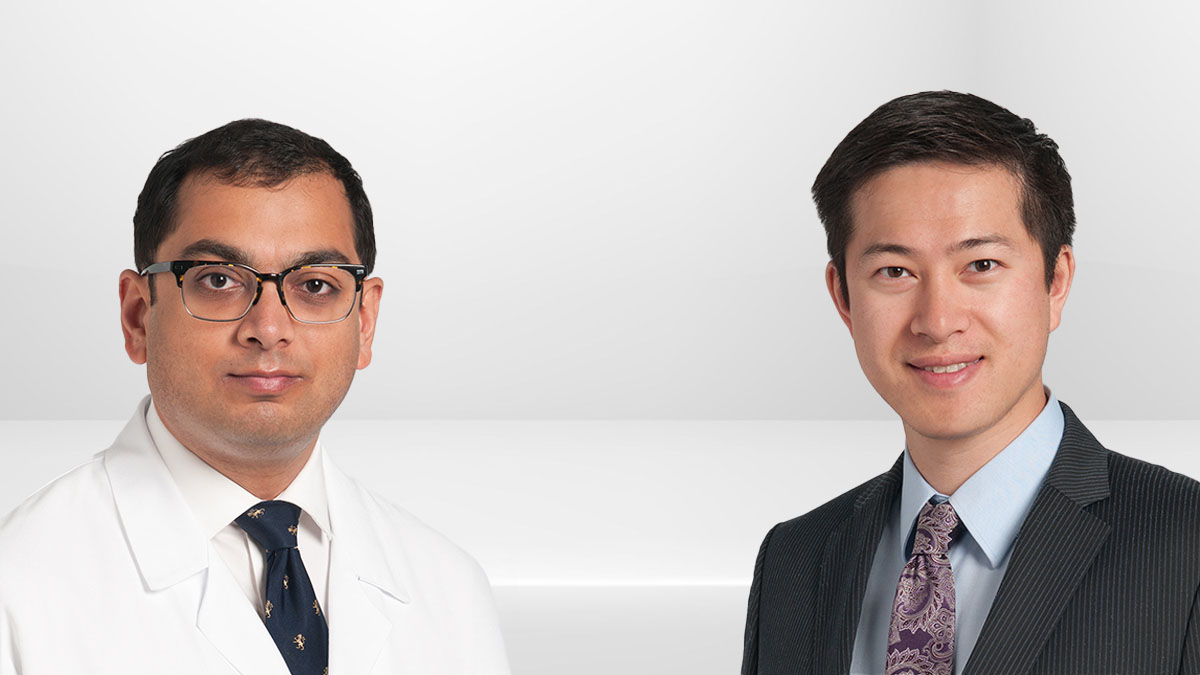
Encore Living Well with LVAD
This episode is an encore presentation of "Living Well with Heart Failure: All About LVAD," which originally premiered in February 2025.
Advertisement
Cleveland Clinic is a non-profit academic medical center. Advertising on our site helps support our mission. We do not endorse non-Cleveland Clinic products or services. Policy
Recent Episodes
Understanding High-Risk Aortic Valve Endocarditis
Milind Desai, MD, and Per Wierup, MD, discuss high-risk aortic valve endocarditis, a serious infection that can affect heart valves and lead…
Robotic Heart Valve Surgery
Marc Gillinov, MD, and Per Wierup, MD, discuss how robotic heart valve surgery allows surgeons to repair or replace heart valves through sma…
How Robotic Technology is Changing Heart Bypass Surgery
Donna Kimmaliardjuk, MD, and Gianluca Torregrossa, MD, discuss robotic and totally endoscopic coronary artery bypass grafting (TECAB). These…
Video content: This video is available to watch online.
View video online (https://cdnapisec.kaltura.com/p/2207941/sp/220794100/playManifest/entryId/1_wl2urs99/flavorId/1_5f3sgelj/format/url/protocol/https/a.mp4)
Transcript
Announcer:
Welcome to Love Your Heart, brought to you by Cleveland Clinic's Sydell and Arnold Miller Family Heart, Vascular and Thoracic Institute. These podcasts will help you learn more about your heart, thoracic and vascular systems, ways to stay healthy and information about diseases and treatment options. Enjoy.
Advertisement
Cleveland Clinic is a non-profit academic medical center. Advertising on our site helps support our mission. We do not endorse non-Cleveland Clinic products or services. Policy
Pavan Bhat, MD:
My name is Dr. Bhat. I'm one of the advanced heart failure physicians here. I'm also Associate Director of our LVAD program.
Michael Tong, MD:
Hi, everyone. My name is Dr. Michael Tong. I'm a cardiac surgeon here at the Cleveland Clinic. I've been here for 13 years. I’m the Surgical Director of our Heart Transplant and LVAD Program. Heart failure is my passion. This is something that I love. This is what I love to do. I love taking care of patients who have heart failure and giving them their lives back. This is something that we truly believe here in Cleveland Clinic. We call ourselves the center of “cardiac recovery” as opposed to “heart failure” because recovering hearts is what we do. Today, we're going to be talking about how we can recover your hearts.
Those of you in the audience, everybody who's listening to us, heart failure is a huge topic. At the far end of the spectrum, we have patients who have very, very weak hearts. When these patients need what we call advanced therapies, such as LVAD or heart transplants, they've gotten to the point where their own hearts have really taken them as far as they can take them. Dr. Bhat, let's talk about what it means for them, the destination therapy for LVAD.
Advertisement
Pavan Bhat, MD:
LVAD therapy, first of all, stands for left ventricular assist device. What this is, is a fully mechanical heart assist device that's actually implanted in your chest. It's a surgical procedure that you, Dr. Tong, are an expert on. It involves a full sternotomy, actually putting this on your heart itself. It helps assist your heart in function. The overall goal of this therapy is to actually get you back to normal life.
Patients with advanced heart failure have severe symptoms, and we see them every single day. They're short of breath, unable to do everyday activities. Our goal is to get you back to living your normal life. you're able to golf, go to your daughter's wedding. We've all heard these stories with our own patients. That's actually our goal with all of our patients, to be honest, to get you back to your normal life.
Now, what an actual LVAD device looks like is the only external part will actually be the battery. You'll see a small driveline and a battery. A lot of patients hook up into a vest that they wear on their person. The actual pump itself is all internal inside the chest. It’s done during the surgical procedure.
Now, when we talk about destination therapy and what that specifically means, all our patients, we evaluate if could they also be a heart transplant candidate. LVAD therapy can be used for both as a bridge to transplant, or if patients are not eligible for transplant, to prolong life for patients who have no other options. Destination therapy is really for patients who are not transplant candidates. Getting them still a long life, even they don't have transplant options. Any thoughts on that?
Michael Tong, MD:
Yeah. Nowadays, patients with LVADs, for a majority of those patients, their long-term life expectancy or their survival after surgery is more or less equivalent to whether they have a LVAD or a transplant. LVAD technology have come so far that for many patients, we expect that they can live at least five years, ten, and sometimes even more.
The surgery itself has also become very standardized and routine. These used to be big operations that took the majority of the day. Now, to do an LVAD typically takes us about 3 to 4 hours for most of our patients. Most of the time, we go through the middle of the chest. Sometimes we go through the side of the chest, and we really want to tailor the operation to what the patients need.
Sometimes that also includes fixing a valve or doing a bypass or other components of the operation. That's really one of the benefits for patients that come to Cleveland Clinic. There are four of us who do LVAD surgeries here at the Cleveland Clinic, and all of us are busy surgeons. We all do about 400 open heart surgeries a year, in addition to our practice and heart failure surgery.
So, when a patient comes to us and they're having a complex surgery, they may have had previous open-heart surgeries in the past. For us, the complexity of the operation really is second nature for us. We specialize in complex operations. We specialize in sick patients. We specialize in multi-time redos, patients who have multiple previous surgeries. When I'm seeing a patient and we're doing an LVAD, and this is the second or third time redo operation, this patient might be one of my simplest patients of the week. That is really it for me, that one of the benefits for patients that come to the Cleveland Clinic, the fact that they're getting very high-end surgical expertise.
Advertisement
At the surgery, nowadays when patients have this operation, once they recover from the surgery, they go to the ICU. Within the ICU, we try to get the patients out of the ICU within about 2 to 3 days. Not everybody will be appropriate for such a quick recovery. But for a majority of the patients, we try to optimize them before surgery so that their surgery can be as smooth as possible, and their post-op course can be as smooth as possible. On average, patients stay in the hospital about two weeks after surgery.
Once they are ready to be discharged from surgery, they will continue to follow up with a heart failure team. That includes our cardiologists. That includes our VAD coordinators and VAD nurses. This is going to be a high-touch post-operative period. We want to see these patients often and frequently to ensure that everything is going well. We want to make sure that all the education is as good as possible and that patients are learning to live with these devices. These are truly life-altering devices, in many ways for the better. But they also require some regular maintenance that needs to be done on a daily basis. There is a lot of education that goes along with it. This is an opportunity for us to make sure that the patients are doing well with the devices.
Advertisement
For the total recovery, typically what I tell patients is that in the first six weeks, they can't drive, and they're limited to about 10 pounds of lifting in the first six weeks. Then they can gradually increase that amount up to about 25 pounds. After about three months or so, then most of the restrictions are lifted. They can continue to exercise in the early period of time, as long as they're not using their upper body. But once they're ready to go home, I encourage them to walk every day and try to build up their strength that way. These patients, let's not forget, often have been living with heart failure for many, many years, and hence, they have some element of deconditioning. It takes time for their bodies to get built, for their strength to get built. That's really what we're trying to accomplish for them.
I want to turn it back to you Dr. Bhat, can you tell our audience a little bit about the multidisciplinary team? It is truly takes a village to take care of these patients. Let's describe the members of our village.
Pavan Bhat, MD:
Of course, like Mike mentioned, it is not just a heart failure doctor. It's not just a surgeon that takes care of these patients. We have a full comprehensive team at Cleveland Clinic. I think the major thing is patients are complex. You know, individual people are complex. There's a lot of different aspects of everyone's life that we all need to evaluate.
Advertisement
As part of your advanced therapy workup, when you’re evaluated for a transplant or LVAD, of course you meet with our surgeon, Dr. Tong, you meet with a heart failure doctor like myself, there's a social worker that's an integral part of our team. We have a large team of LVAD nurse practitioners that are dedicated to be specifically experts on the LVAD device and how to manage this, and they've undergone specialized training just to go undergo that. There are surgical nurses and intensivists that you'll meet in the hospital when you're actually recovering in the post-operative period. Also, there's LVAD nurses to help with your driveline changes and those everyday aspects of LVAD care.
Michael Tong, MD:
As you can hear, for the audience, this is truly a multidisciplinary effort. Our team is probably one of the biggest teams of any team within a hospital, looking after a specialized group of patients. That is really, I feel, one of the benefits, and one of the reasons why we can achieve our outcomes that we have achieved. You look at our LVAD patients nowadays, the five-year survival reaching above 60% is absolutely astounding. I mean, it wasn't long ago, 20 years ago, when we had the REMATCH trial, which compared the first generation of LVADs to the best medicines of the day. Those patients that were treated with the best medicine of the day had a two-year survival of only 8%. Now we've gone from 8% in two years to about 80% in 20 years. I mean, that is a feat that is unmatched by any other specialty in medicine. It's something that, as a field and as our team, we’ve got to be proud of.
For patients, the main message that we want to give you is that if you were diagnosed with heart failure, this is no longer a life-threatening diagnosis. With our team, with modern approaches, with modern devices and surgeries and medications, we can make sure that you can continue to live a good life and live a normal life. We have patients who continue to be very active. Many of our patients go back to work. One of my patients continues to be a tennis coach after his LVAD. These are all success stories that we have on a daily basis here at the Cleveland Clinic.
Pavan Bhat, MD
To echo Mike's thought, in my career the biggest thing I've always thought about LVAD, what I've been so surprised about is what a big difference LVAD has made in terms of the life expectancy and quality of life with heart failure. Going from something that will kill you in two years to having 80% of people surviving, 90%+ is amazing. If we had a chemotherapy that did this, I think everyone would be immediately making headline news with this. Right?
Heart failure patients are sometimes undertreated and not always referred for LVAD therapy. Patients need to be their own advocate and seek a second opinion for those kinds of situations. But I think one thing I've always been impressed by our team is, given our multidisciplinary approach, also our surgical expertise – and Mike's very humble here in terms of his surgical expertise – we're able to give people who have been turned down at other institutions a second chance or a second opinion in a large amount of things.
I think my overall goal for these patients is not just to survive, but actually to thrive. Like Mike said, our goal is not just say you're living X number of years, we're living X number of years really well, doing everything you want to do, going back to your normal life, actually really thriving.
Michael Tong, MD:
If you have further questions, please feel free to reach out to our team. We're always available for you and to answer any questions you may have.
Pavan Bhat, MD:
Thank you for joining us.
Michael Tong, MD:
Thank you for joining us.
Announcer:
Thank you for listening. We hope you enjoyed the podcast. We welcome your comments and feedback. Please contact us at heart@ccf.org. Like what you heard? Subscribe wherever you get your podcasts, or listen at clevelandclinic.org/loveyourheartpodcast.
Recent Episodes
Understanding High-Risk Aortic Valve Endocarditis
Milind Desai, MD, and Per Wierup, MD, discuss high-risk aortic valve endocarditis, a serious infection that can affect heart valves and lead…
Robotic Heart Valve Surgery
Marc Gillinov, MD, and Per Wierup, MD, discuss how robotic heart valve surgery allows surgeons to repair or replace heart valves through sma…
How Robotic Technology is Changing Heart Bypass Surgery
Donna Kimmaliardjuk, MD, and Gianluca Torregrossa, MD, discuss robotic and totally endoscopic coronary artery bypass grafting (TECAB). These…
Never miss a moment - subscribe now.
Listen to the Health Essentials Podcast on your favorite streaming platform.
Other Podcasts You May Love
Beyond Leadership
Hosts Jim Pae and Elizabeth Pugel escort you through a network of thought leaders, sharing world-cla…
Beyond the Pages: CCJM Podcast
Beyond the Pages: CCJM Podcast takes the listener more in-depth into Cleveland Clinic Journal of Med…
Butts & Guts
A Cleveland Clinic podcast exploring your digestive and surgical health from end to end. You’ll lear…
Cancer Advances
A Cleveland Clinic podcast for medical professionals exploring the latest innovative research and cl…