



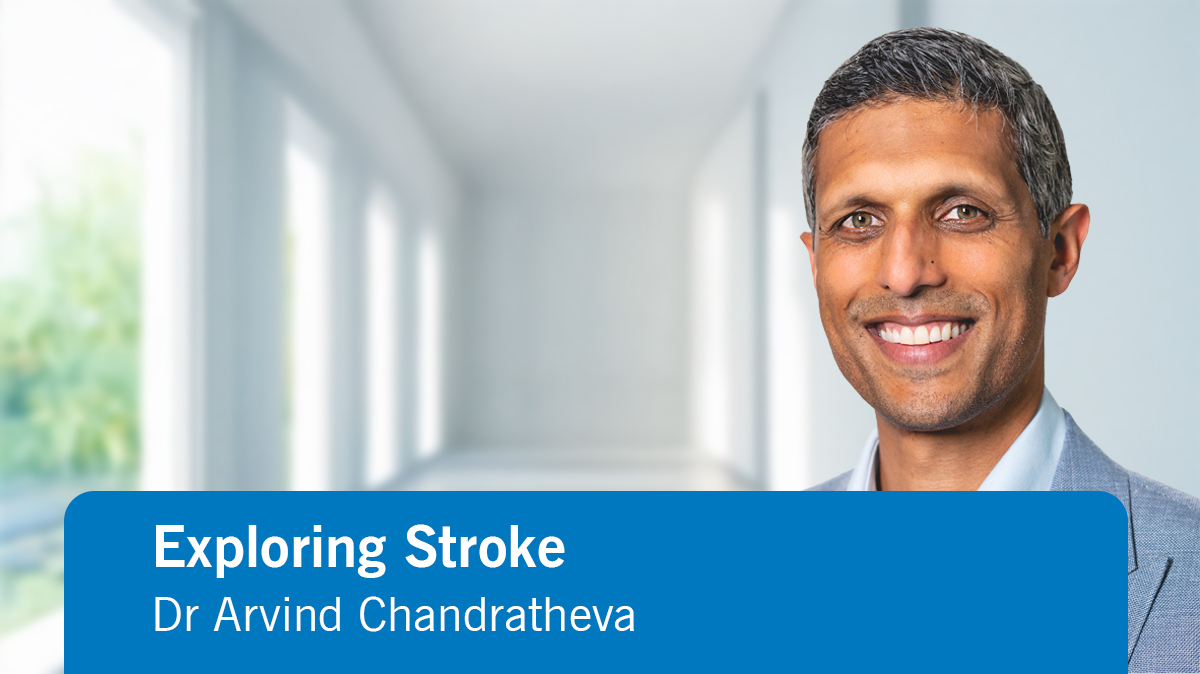
Exploring Stroke with Dr Arvind Chandratheva
In this episode of Exploring Health with Cleveland Clinic London, host Mr Kash Akhtar, Consultant Orthopaedic Knee Surgeon, is joined by Dr Arvind Chandratheva, Consultant Neurologist and Stroke and Rehabilitation Physician, to explore one of the most time-critical medical emergencies, stroke.
Stroke remains a leading cause of death and long-term disability worldwide, yet early recognition and rapid treatment can make a life-changing difference. Marking Stroke Awareness Month, this episode examines what a stroke actually is, what happens in the brain during an event and why every minute matters.
Dr Chandratheva explains the key differences between ischaemic and haemorrhagic stroke, the importance of recognising a Transient Ischaemic Attack (TIA) as a warning sign, and how to identify the FAST symptoms quickly and confidently. The discussion walks through what happens in the critical early window of treatment, who is most at risk and the evidence-based steps individuals can take to reduce their chances of having a stroke.
Advertisement
Cleveland Clinic is a non-profit academic medical center. Advertising on our site helps support our mission. We do not endorse non-Cleveland Clinic products or services. Policy
Recent Episodes
Exploring Health Checks That Could Save Your Life (Part 2) - Dr Simon Hodes, Dr John Whitaker and Dr Umasuthan Srirangalingam
In this episode of Exploring Health with Cleveland Clinic London, host Mr Kash Akhtar, consultant orthopaedic knee surgeon, continues his co…
Exploring Health Checks That Could Save Your Life (Part 1) - Dr Simon Hodes, Dr John Whitaker and Dr Umasuthan Srirangalingam
In this episode of Exploring Health with Cleveland Clinic London, host Mr Kash Akhtar, consultant orthopaedic knee surgeon, is joined by thr…
Exploring Endometriosis – Mernalin’s Story with Mernalin Ervi Sana, Miss Asli Ucyigit and Mr Fevzi Shakir
In this episode of Exploring Health with Cleveland Clinic London, host Mr Kash Akhtar is joined by three guests who bring both clinical expe…
Video content: This video is available to watch online.
View video online (https://cdnapisec.kaltura.com/p/2207941/sp/220794100/playManifest/entryId/1_wxvtkzhb/flavorId/1_5f3sgelj/format/url/protocol/https/a.mp4)
Transcript
Mr Kash Akhtar:
Welcome to the latest episode of Exploring Health with Cleveland Clinic London. Thank you to Cleveland Clinic Philanthropy UK for supporting this podcast. I'm your host, Kash Akhtar, a Consultant Orthopaedic Knee Surgeon.
Advertisement
Cleveland Clinic is a non-profit academic medical center. Advertising on our site helps support our mission. We do not endorse non-Cleveland Clinic products or services. Policy
Today's episode focuses on stroke, a medical emergency that remains one of the leading causes of death and disability, but one where early recognition and fast action can make a life changing difference. As part of Stroke Awareness Month, we're going to talk about what a stroke actually is, how to recognise the warning signs, who is most at risk, what happens in that critical early window, what all of us can do right now to reduce the chances of a stroke happening in the first place.
Joining me today is Dr. Arvind Chandratheva, Consultant Neurologist, stroke and rehabilitation physician at Cleveland Clinic London with extensive expertise in stroke, Transient Ischaemic Attack or TIA and neurorehabilitation. Across this episode, we'll cover what happens in the brain during a stroke, the difference between ischaemic and haemorrhagic stroke, how to recognise the fast signs, who is most at risk and what can be done to prevent stroke and how Cleveland Clinic London supports patients across the full stroke pathway. Arvind, let's start with the basics. What exactly is a stroke?
Dr Arvind Chandratheva:
Great question. So a stroke is when there's interruption to the blood supply in a part of the brain and that leads to damage in that bit of the brain. There are two main types, we call them ischaemic or haemorrhagic. So the vast majority, 80% clot blocks the blood supply to one area and the area that's damaged referred to the stroke area and 20% bleed in the brain and that particular area that's damaged gives the deficits that the patient has.
Advertisement
Mr Kash Akhtar:
Okay. So of that split between haemorrhagic and ischaemic stroke, you say about 20% is haemorrhagic bleeding…
Dr Arvind Chandratheva:
So it bleeds and 80% clot.
Mr Kash Akhtar:
Yeah. So there's a blockage. It's almost as if someone stood on a hosepipe and the blood can't get past it and that bit of brain…
Dr Arvind Chandratheva:
You've been to my clinic, Kash.
Mr Kash Akhtar:
Is that the thing you use?
Dr Arvind Chandratheva:
Yeah. No, absolutely. I use a similar analogy, I don't use a hosepipe, I say it's like a pipe being blocked. It's similar to the plumbing network in your house. One of the pipes, the radiator gets blocked, radiator gets cold and our job is to try and identify where that clot came from.
Mr Kash Akhtar:
And then downstream, there will be effects of... And so I'm assuming if a different part of the brain loses blood supply, there'll be different impact.
Dr Arvind Chandratheva:
Absolutely. Depend on the area of which the blood supply is blocked determines the symptom. It's an arm area, your arm may go weak, face, face droop, speech, speech disturbance. So it absolutely depends on the bit that's affected.
Mr Kash Akhtar:
Could you tell us where a TIA fits into this?
Dr Arvind Chandratheva:
So essentially, TIA, some people describe it as a warning event. The T refers to transient. So it's a brief episode that is the potential warning for a stroke. It can present with the same symptoms, but they're brief; typically minutes rather than hours. And classically similar to a stroke, face, arm, leg involvement or speech disturbance.
Mr Kash Akhtar:
And these symptoms when they come on, how long would they last for a TIA?
Dr Arvind Chandratheva:
So in the textbooks, it would say less than 24 hours, but in practice it's really less than an hour. The key feature is that they tend to be sudden in onset. So it's sudden onset new, we call it neurological symptoms. So weakness, numbness, speech disturbance, loss of vision and eye, balance, difficulties, and typically last less than an hour.
Mr Kash Akhtar:
And why should people take these seriously? Because I think some people would go, well, I had a funny turn, or I'm sure you've had lots of different phrases. Why are they things, I guess is what people refer to as a mini stroke, perhaps? And why should we take those seriously?
Dr Arvind Chandratheva:
I think that's a great question. So most people would have heard of a stroke. And everyone who's heard it wouldn't want one. Less people would have heard of a TIA, but this is a warning. So this gives us an opportunity to prevent a further stroke. It's saying this is an at risk person. If we can try and identify what the potential source of that clot is, and treat the patient appropriately, we might come on to talk about treatment, we could significantly reduce the risk of a stroke, up to 80% potential reduction in risk.
Advertisement
Mr Kash Akhtar:
And when someone loses the blood supply or has a bleed to a certain part of the brain, what happens to that actual bit of brain tissue? Does it die? Does it wither away?
Dr Arvind Chandratheva:
What happens to that bit of brain? So the risk is you're damaging that bit of tissue or neurons. In a stroke, we say you can lose about one to two million neurons per minute. That's a hell of a lot. So ensuring that you get the blood supply back is critical. In a Transient Ischaemic Attack, we think it's happened as a clot comes, and then person gets symptoms, but not enough for it to cause permanent damage. And then there's blood supply that returns, and then they recover. The key bit with that is that it's viewed as a warning, not, oh, I've just had these symptoms. I don't need to see anyone about it.
Mr Kash Akhtar:
And do people lose neurons with a TIA?
Dr Arvind Chandratheva:
They can do. So there can be residual symptoms, but typically it's thought of as transient. If you do an early brain imaging, an MRI scan, for example, you can sometimes see the effects of there having been damage to that bit of tissue. And sometimes that's the clue for us that the symptoms have been related to a TIA. So an MRI early can sometimes help with diagnosis.
Mr Kash Akhtar:
So it's interesting. I was thinking about this just literally while you were talking now. A TIA is almost like someone's kind of drawn something in the sand on the beach and all of a sudden a wave just come and washed it away and you're kind of back to where you were. It's almost refreshed.
Advertisement
Dr Arvind Chandratheva:
Yeah. I think that's a really great description of it.
Mr Kash Akhtar:
It's a shame I'll never get to use it. So the public message, FAST, face, arm, speech, time, is a thing that I keep seeing on sides of buses and at bus stops. Why is that message so important?
Dr Arvind Chandratheva:
I think they represent the commonest manifestations of an acute stroke. So in terms of a public awareness campaign, those are probably the most important symptoms to be aware of as an indicator for an acute stroke. So F for face, as you said, A for arm, S for speech. Now, it is also important to be aware of other sudden onset neurological symptoms that might represent stroke. There's a campaign called B-FAST, also including the B for acute onset balance difficulties, E referring to the eye, so sudden onset visual loss in one eye. And so I think whilst face, arm and speech are the most common and absolutely right for us to be aware of, it is also important to recognise that there may be other acute onset or sudden onset neurological symptoms that represent stroke.
Mr Kash Akhtar:
It was interesting when you mentioned the eye thing there, because I just had a flashback, almost PTSD to my vascular house job.
Dr Arvind Chandratheva:
Bad flashback?
Mr Kash Akhtar:
Yeah. I won't mention the hospital a long time ago with old school training, you know, where the surgeons were like Celancel or Spratt type...
Advertisement
Dr Arvind Chandratheva:
Now, you boy... I'm not that old.
Mr Kash Akhtar:
You boy, what's the bleeding time? And amaurosis fujacs and all these things will come back to me. If someone is having a stroke, they think they're having a stroke or someone around them is having a stroke, what should they do?
Dr Arvind Chandratheva:
I think that's really important and that's probably the crux of what we want to convey. I think if you have those symptoms that are sudden onset face, arm and speech, we've highlighted that trying to ensure we get the blood supply back is so critical. The key message for us would be to call 999. So sudden onset face, arm, speech, we would suggest call 999.
Mr Kash Akhtar:
And forgive my ignorance, for any orthopods out there, F, faces in facial drooping.
Dr Arvind Chandratheva:
Facial droop, arm weakness. So drift of the arm and speech system, classically slurring of speech or difficulty getting the words out.
Mr Kash Akhtar:
And so the T?
Dr Arvind Chandratheva:
Time. Time to act quickly.
Mr Kash Akhtar:
Get them on. Get on it. So someone needs to get to hospital as soon as possible?
Dr Arvind Chandratheva:
Absolutely.
Mr Kash Akhtar:
Because there is this phrase, people talk about time is brain, and it's exactly as you've explained so clearly and succinctly, that the earlier you can reperfuse or get the blood supply back to that bit of brain, the more chance it has of recovering and almost becoming like a TIA than a permanent loss of brain tissue?
Dr Arvind Chandratheva:
That's absolutely right. So we are fortunate to have hyper acute stroke centres throughout the country that have capacity to deliver hyper acute interventions. And ensuring that someone presents in a timely fashion allows most chance of being able to access one of those treatments. They often refer to clock busting or clock removal type treatments.
Mr Kash Akhtar:
In trauma, we talk about the golden hour. Does that apply here? Or is there a certain time window that one would want to act in?
Dr Arvind Chandratheva:
There are time windows. We don't have a golden hour. I think my key message would be as early as possible, which is probably true for the golden hour as well. So the earlier the better. However, there are time limitations to which we can give the hyper acute treatment. So I'm referring to treatments like thrombolysis and thrombectomy. So they are time limited. We have now newer modalities of imaging to extend that time window, but they are definitely time limited. But my key message would be earliest is best.
Mr Kash Akhtar:
Okay. And we'll come back to those in due course in the conversation. Do you ever find people have waited too long for some reason? Maybe the symptoms have improved or fluctuated or they weren't dramatic enough? Because I often see people for orthopaedic issues, I wish you'd come sooner. Is that a thing that you see? Do you feel that people will sometimes dismiss symptoms?
Dr Arvind Chandratheva:
It's such a good point, and we certainly forget that. Absolutely. So it might be that they didn't recognise the symptoms were related to a stroke or thought it might be something else. And there might be another reason. But undoubtedly, we see many people who've waited too long, so they're not in the window for an acute intervention and maybe for treatment.
Mr Kash Akhtar:
What are the most common kind of misunderstandings that people might have about stroke symptoms?
Dr Arvind Chandratheva:
Well, I think the first thing is the point that you quite rightly highlighted, which is those acute on symptoms and nothing to do with the stroke or they're mild, they'll settle down. So I think that's a really important point. I think it's the access to the acute treatments. I think there's other important points to consider as well. So I would say, look, in the UK, we have about 100,000 strokes a year. About 38,000 people die from a stroke here. We have 1.3 million stroke survivors living at any one time. So that brings to mind a couple of things. One is this is really common. We need people to recognise those symptoms, the point you mentioned. Two, about one in four people who have a stroke will have another one in the next 5 to 10 years.
We also really need to think about even if you're out of the window for an acute intervention, we need to make sure you don't have another one. And three, there are 1.3 to 1.4 million stroke survivors. So how do we manage those disabilities? Have you had the right input to manage all the symptoms you now have? So acute intervention, making sure you access it quickly, prevention to make sure you don't get another one, and disability management. I would say those are the three things to be aware of.
Mr Kash Akhtar:
It was interesting when you were talking about the facial droopiness, slurred speech, arm weakness. You think some people might confuse that with someone being drunk?
Dr Arvind Chandratheva:
Absolutely. A bit of balance disturbance. And I would say what we're looking here is an acute or a sudden onset of balance disturbance in the absence of an intoxication. But you're right, the reverse way from someone being reviewed by someone look like, could this be someone who's drunk?
Mr Kash Akhtar:
So the message here is very clear. Stroke is not something to watch and wait. It's a medical emergency and acting fast can protect brain function and save lives.
Dr Arvind Chandratheva:
Yeah.
Mr Kash Akhtar:
So let's talk about risk. What are the biggest risk factors for stroke?
Arvind:
I think this is really important. I think you've had podcasts talking on some of the factors, which I think are really, really important. I break it down into three things. One of the things you can't do anything about, two are lifestyle factors, three are conventional vascular risk factors. So things you can't do anything about, age, we're all getting older, age is a risk factor. And then genetic factors, can't change your genes, ethnic variations, geographic variations.
Lifestyle factors, and I think that is critical. What are the things I can do to promote the best vascular lifestyle for myself? What have we got? A rising obesity epidemic, diet is a critical factor, sleep, sleep hygiene, obstructive sleep apnoea, type of sleep disturbance increases risk, smoking, alcohol, recreational drug use, exercise. So it's a huge range within our control. And I'm sure you'll talk about those risk factors in other podcasts that you do. And then conventional vascular risk factors, hypertension, diabetes, hypercholesterolaemia.
And the interesting thing about a lot of those things is that you don't really feel you've got them. It's not like chest pain, arm pain, knee pain. I've got knee pain, I'm going to go and see Kash. I don't feel necessarily that I've got symptoms that make me think I've got hypertension.
In fact, the tablets make me feel worse. So I think for me, two crucial things, one, identification of them, two, compliance with treatment. How many people do we put on antihypertensives? Maybe lipid lowering therapies, diabetic medications, say I really don't like these, why am I taking them? And so I think that's really important as well.
Mr Kash Akhtar:
I'm with you. And the other thing I guess would be something like atrial fibrillation, abnormal heart rhythms, they seem to be associated with stroke. Can you explain why that might come into play?
Dr Arvind Chandratheva:
Yeah. So when we're thinking about why a stroke occurs, we're looking for the source of the clot. And coming back to your analogy right at the beginning, the hosepipe, my analogy, pipes in a boiler system and radiators in the house, what we're trying to find out is where did that clot come from? The way we break it down is, is it a problem in the large pipes, a furring of the vessels? And that we think about things like hypertension, diabetes, all these life cycles.
Mr Kash Akhtar:
Smoking, cholesterol.
Dr Arvind Chandratheva:
Absolutely. Think about those things. Then the next thing is to look at the boiler or the heart where all the pipes come out of. And what we're looking at is both the structure of the heart and the abnormality in the valves and things like that. But one of the main cardiac causes for clot that increases the risk of stroke is this rhythm disturbance, this abnormal rhythm called atrial fibrillation or paroxysmal atrial fibrillation, which means it comes and goes. We've got this watch on, we have different devices that can now detect it. But what atrial fibrillation does is it increases the risk of clots and those clots pick up and can cause a stroke. The reason it's so important for us to detect it is that we have treatments that reduce the risk of clot from atrial fibrillation by two thirds. Those are called anticoagulants.
Mr Kash Akhtar:
Blood thinners. And it's interesting because these risk factors, as you said, are silent risk factors, so people don't know they have them and they won't know they're a risk necessarily until something happens. And that can be in the brain, in the heart, you know, so many things.
Dr Arvind Chandratheva:
Yeah, absolutely.
Mr Kash Akhtar:
One thing that is increasingly interesting is the fact that strokes predominantly affect older people. But do you often see them in younger adults?
Arvind:
Absolutely. So whilst stroke is common with increasing age, because age is a risk factor, it's absolutely increasing in the young population, 20s, 30s, 40s, absolutely. So one of my PhD students has just finished her PhD and it was all on young stroke. The risk factors and the outcomes of young stroke. If we think about some of the risk factors, one of the main ones we talked about was obesity, which we know is rising.
Mr Kash Akhtar:
Yeah. I see you keep looking at my hot chocolate. I might just move it. It's full of fat as well. It's organic.
Dr Arvind Chandratheva:
Heavy hot chocolate. Hide it out of my way.
Mr Kash Akhtar:
I'm moving it out of the way.
Arvind:
No, but there's got to be balance in life, Kash. But you're absolutely right. But what's interesting is that young stroke risk factors are often similar to older strokes.
Mr Kash Akhtar:
Okay. I was wondering if it was something different.
Dr Arvind Chandratheva:
Well, it probably falls into two groups. So there are the young stroke population who have early hypertension, hypercholesterolaemia, obesity, diet, lifestyle factors. And there is the young stroke population who don't have any risk factors at all. To be honest, I don't really like the term young stroke and old stroke. I think it's not helpful. I refer to it as stroke with the risk factors and stroke without risk factors. Because you can have young people with lots of risk factors, unhealthy lifestyle, obese, but you can have an older person who's super fit, still going to the gym all the time and don't have any risk factors. So it's much more helpful to say stroke with risk factors, stroke without.
Mr Kash Akhtar:
Rather than age.
Dr Arvind Chandratheva:
Rather than age. Absolutely.
Mr Kash Akhtar:
And do recreational drugs, can they cause a stroke?
Arvind:
Absolutely. Yeah. In fact, we would see that quite commonly. And the challenge for us is people might not always be forthcoming about it. And there are many mechanisms by which recreational drugs can cause stroke. It can be from the drug itself. For example, cocaine would be a common one. Its effect on the blood vessels. It can cause inflammation of the blood vessels. It can cause a narrowing of the blood vessels. It can cause a spasm of the blood vessels. It can cause a rise in blood pressure. But also, what we don't always know is what are the drugs cut with, what are they mixed with, and what can be the effect of that, the substances that the drugs are mixed with.
Mr Kash Akhtar:
One of the most important public health messages during Stroke Awareness Month is know your numbers. So if I was to ask you which numbers matter most?
Dr Arvind Chandratheva:
That's a great way to think about it, actually. So I guess we know our height and weight and things like that. But I guess in stroke, one of the things we think about, we think about what's our blood pressure? Which is a really easy thing to get tested, right? You can get it anywhere. They're cheap as chips to get a blood pressure monitor. What's my lipid levels? Okay, cholesterol, LDL, they're different types of lipids, but what are they? And so I would say those are probably, and body mass index would be the things I would say are useful numbers to know about.
Mr Kash Akhtar:
And I guess you'd probably add in HbA1c.
Dr Arvind Chandratheva:
Diabetes, yeah. HbA1c and prediabetes, as you had in your last podcast.
Mr Kash Akhtar:
Yeah. I only know these things, we talked about it recently.
Arvind:
This is like education.
Mr Kash Akhtar:
Yeah, for sure. And this is how I get my CPD, lipoprotein A. And then I might just send that to an orthopod. Is there a particular risk factor which really worries you clinically, because it's either really common or under-diagnosed or really dangerous?
Dr Arvind Chandratheva:
I guess most focus would be around blood pressure. I think there's a cumulative factor having more than one, of course, increases risk. I think the key bit is to identify it. But then the aspect I worry about most is then compliance with treatment and ongoing monitoring. This is not something you just say, oh, I've been diagnosed with hypertension, I'm going to have this tablet, see you later. The ongoing monitoring is really important as well, because it can change over a lifetime.
Mr Kash Akhtar:
For sure. Can stroke risk genuinely be reduced or even significantly reversed if the right action is taken early enough?
Dr Arvind Chandratheva:
That is critically important. So can I give you an example of TIA?
Mr Kash Akhtar:
Love it, please.
Dr Arvind Chandratheva:
So we talked about early mini stroke. So the risk of a further stroke at seven days is 10%. One in 10 will go on to have a major stroke. And then at about 90 days, it's 12 to 15%. And then at 10 years, it's about 20%.
Mr Kash Akhtar:
One in five.
Dr Arvind Chandratheva:
So one in five are going to get another stroke, 10 years. And that's most early. What we know is that if you see the right people, have the right tests and start the right treatment, which is a combination of things that we've touched on already, which is manage the lifestyle factors, blood thinning and looking at your blood pressure, cholesterol, diabetes, you reduce the risk of recurrent stroke by 80%, which is a massive implication and massive incentive to try and see someone, start the right treatment and identify the risk factors.
Mr Kash Akhtar:
So, so much of stroke prevention starts before any symptoms ever happen. So if we can identify these silent risk factors and take them seriously, then we can have a huge impact on people's health and how long they live and the quality of their life?
Dr Arvind Chandratheva:
I think that's quality of life, particularly recurrent stroke, massively. Just out of interest, for someone who's an adult having a stroke, what are the chances that that stroke might actually kill them? Just to give you the example, as a whole in the UK, 100,000 people getting a stroke, 38,000 people die of a stroke a year. And that's not from the 100,000, that's from the whole population.
Mr Kash Akhtar:
So if we talk about prevention, I'll move on to that, so we've talked about blood pressure, so control that, pre-diabetes, diabetes, intervene in with that, high cholesterol, it can be treated in various ways. If you smoke, stop, if you're taking recreational drugs, don't, if you're overweight, find a way to reduce your weight. I don't mean that so flippantly or directly. There are people who can help you and there are ways now, better than ever, to reduce your BMI. And then you've mentioned what we call blood thinners, anti-platelet therapy. Tell me about that, where that fits in all this.
Dr Arvind Chandratheva:
So we started right at the beginning saying this was a clot in 80% of people, of course, that blocked a blood vessel. So then it seems intuitive that the main treatment, or one of the main treatments, would be to give something to thin the blood. And there are different mechanisms by which the blood clots. And one of the main mechanisms, this thing called the platelets, so a clotting substance that causes the blood to stick, and what we tend to give is drugs called anti-platelets. And there are different ones. Most people would have heard of drugs like aspirin, and there are aspirin-like drugs that we give now.
Mr Kash Akhtar:
Okay. So that's for the infarcts, the clot that has blocked your pipe. You mentioned earlier the alternative, the haemorrhagic strokes, so they're people who've bled. And so for those people, you're not going to give them a blood thinner. Is there any way to try and prevent that, particularly if someone had a TIA and you think that's the cause?
Dr Arvind Chandratheva:
So if we think a stroke has been due to a bleed, then generally we would avoid drugs to thin the blood. You're absolutely right. And then the first step is to identify why did they bleed? The two commonest causes of bleeding in the brain in the UK are one, hypertension. So treat the hypertension. And two, there's a condition called, it's a long name, cerebral amyloid angiopathy. And again, the main treatment for that is managing the blood pressure, avoiding things that thin the blood. So you're getting a theme here that managing the blood pressure is critically important across the board.
Mr Kash Akhtar:
I'm with you. The other thing that I recall seeing quite a lot as a vascular house officer in that traumatic period was what we call carotid artery disease. Could you talk about that and just explain to everyone listening or watching what that is and how it can be treated?
Dr Arvind Chandratheva:
That's really important. So again, we've talked about the heart and the boiler and the F, and then we talked about the pipes. So you've essentially got four main blood vessels or pipes that supply the brain. You've got two at the front, two at the back. The two at the front are called the carotids, left and the right. And the two at the back are called vertebrals. A common cause of stroke is narrowing of the front pipes, the carotid arteries. And there is management for people who have narrowing of their carotids causing their stroke. And colleagues who we work with very closely in management of the carotids are called vascular surgeons. So surgeons like yourself. So between us, we would make a management plan.
Mr Kash Akhtar:
So carotid dopplers, is that how you'd go about an ultrasound scan of the neck? Is that how one would go about diagnosing it or has that moved on since those days?
Dr Arvind Chandratheva:
Yeah. So since the early times?
Mr Kash Akhtar:
Yeah, the dark ages…
Dr Arvind Chandratheva:
And to be fair, Doppler is still a mainstay. It's an excellent image for the carotids. But now what we have in our armoury is a range of imaging to help better define what the whole tree looks like from the top of the heart to the top of the head. So we can use MRI, we call MRI angiogram, and we can use CT angiogram. And within those, we have really sophisticated imaging to look at how the vessel wall looks, to look at narrowing. So we can really get a much better picture of where this narrowing is, the degree of furring through the whole vascular tree.
Mr Kash Akhtar:
Okay. What we're talking about here is primary prevention, stopping it from happening in the first place. Then there's this concept of secondary prevention. Could you just explain what that is and how that fits in?
Dr Arvind Chandratheva:
Yeah. Both are crucially important. Primary prevention is when there's never been an event at all. So you've never had a stroke, you've never had a heart attack, and you've just identified risk factors and you're trying to treat them. Secondary prevention is when you're really trying to make an impact. So it means there's been an event of some kind. You've had a TIA, the mini stroke, you've had a stroke, or you've had a heart attack. And what you really want to do is to prevent another one. And that's what we refer to as secondary prevention. And that's what I was talking about in terms of that 80% reduction in risk by looking at the lifestyle and the other risk factors.
Mr Kash Akhtar:
So you'd essentially go back to all the causes of the primary prevention, but it's just applying it after the event if it's not been picked up before.
Dr Arvind Chandratheva:
Absolutely. And often it would be the time that these risk factors are picked up. They may not have been identified in the past.
Mr Kash Akhtar:
Yeah. Because if someone's had a stroke the first time they've come to you, once you've got through the acute treatment, that's when you would then do all the workup. And a lot of the time they won't have had these tests before.
Dr Arvind Chandratheva:
After that hyper acute phase, we're immediately thinking about what are the causes, what are the risk factors, how do we best treat this individual?
Mr Kash Akhtar:
A topic that keeps coming up in this podcast again and again is the role of sleep, the role of nutrition. I'm just trying to understand how it fits in here because to a lot of people listening, they sound like quite broad things, you know, be healthy, make sure you sleep properly. I just want to work out how that fits into causing strokes, stroke prevention, any tips or tricks for people?
Dr Arvind Chandratheva:
It's a really tricky question because we don't have lots of what we call randomised control trials where we've had a whole population and we split them in half and we give half one diet and half another diet. It's really hard to do those kind of studies or even deprive half of sleep and half not. What we're looking at is anecdotal studies where people by nature of their job or profession have been sleep deprived or have had certain diets looking at geographies.
But if I speak in broad terms about advice from national guidance in terms of one sleep and then two diet and then maybe three exercise, which are the sort of big groups. So sleep, I'm sure you will have people who are more experienced in talking about sleep. But what we're increasingly recognising is sleep is restorative in every way. You just feel better when you wake up so you can simply by that analogy think it must be having restorative effects to us. Two, we know there are abnormal sleep patterns which increase the risk of stroke. So one I touched on was obstructive sleep apnoea, a type of snoring you don't feel refreshed when you wake up in the morning, typically linked to obesity.
Diet. There's lots of discussion about Mediterranean diets, low-carb diets, and some of that is slightly related to whether there is diabetes or not and management of that, but I guess that's what we would be talking about. And then exercise, we believe both in haemorrhagic and ischaemic stroke is not only good for recovery, holistically good for your recovery, but also in prevention. But I think it's definitely an area we need to understand better. We need to understand better how to guide people on what to do. And my experience post-stroke is that often people are more cautious, first in terms of exercise. It's often a very receptive time to make changes because a lot of things in relation to diet, sleep and exercise is a habit you've been doing it all your life. So it's suddenly how do you interact that behavioural change?
So what we're trying to do in stroke in our area is think how do we really get people self-managing a little bit more to direct some of those changes that are going to be sustainable in the long term.
Mr Kash Akhtar:
And it's interesting because when you see people, I'm just realising that this is probably quite likely the biggest life event they've ever had. And it's almost the time where people are like, right, I'm changing everything, I'm stopping smoking, I'm going on that diet, I'm joining the gym. I mean, you must see people at a real huge turning point in their lives?
Dr Arvind Chandratheva:
Yeah, it's an incredible opportunity to have that moment to try and impact change. And there are not many situations like that where you could really be part of supporting someone making a difference for the rest of their life. But it's a two-way process. We can give the information and then someone's got to be motivated and receptive to do it. And we have to encourage that sustainable change. It's easier to make short-term changes, harder to keep long-term changes.
Mr Kash Akhtar:
I understood. But when we talk about high blood pressure, diabetes, cholesterol, the fact is that smoking, body weight, BMI, prevention is not vague, it's practical, it's measurable and often highly effective when people know their risk and act early. Let's move on to treatment. If someone is having a suspected stroke, could you talk me through the pathway of what happens when they arrive in a stroke unit, what treatments are given, what investigations are done, in what order and how we would kind of proceed along that as if we were following someone?
Dr Arvind Chandratheva:
So if I could take the ideal pathway, it would be 999, ambulance crew, come into a hyper-acute stroke unit, be assessed by a stroke team, which is often stroke nurses and doctors, and then decide whether there is an opportunity to give clot-busting treatment. Now that's a time-dependent treatment, so it depends where in the timeline from onset of symptoms. There will then be brain imaging to determine if it was a clot or a bleed.
Mr Kash Akhtar:
And that would be an MRI scan?
Dr Arvind Chandratheva:
Typically a CT scan straight away and we'll decide if it's a clot or a bleed.
Mr Kash Akhtar:
With or without contrast in that stage?
Arvind:
It would depend. So in some centres it would be without contrast, in a lot of centres it would be with contrast and to look at the blood vessels as well. So you typically do a CT scan of the head and then you'd want to have a look at the blood vessels at the same time as well. Is there a clot in the blood vessels? So you'd have a CT head, what we call a CT angiogram, and then if it's a clot, decide whether we give something called thrombolysis, a medication to try and bust the clot or refer to one of our interventional neuroradiology colleagues, another clinician who tries and removes the clot with a procedure.
Mr Kash Akhtar:
Yeah. These podcasts are really interesting for me because I get flashbacks to different moments in my career. And right now I'm thinking of being an A&E SHO, emergency department junior doctor at St Mary's in early 2000s and having to give someone streptokinase for a heart attack and trying to thrombolyse. And so similarly you're talking about someone giving intravenous drip over a period of hours to thin the blood to try and... That's not going to dissolve the clot that's there necessarily?
Dr Arvind Chandratheva:
That's the idea. So it is absolutely the idea. So it's not over hours. So we're moving to drugs that can be given over minutes rather than an hour and hopefully nationally we'll move towards the drug that we'll get. And the idea really is lysing the clot, we call it thrombolysis.
Mr Kash Akhtar:
Yeah, so you're talking about clot busting, it is actively stopping that. But dissolving that clot, trying to get the blood flow back to the brain. And if someone's had the infarct, the lack of blood to the brain, then how does that get treated?
Dr Arvind Chandratheva:
So if the person is eligible for the thrombolysis or the thrombectomy, which is where we go in and remove the clot, and then after that occurs we would follow up the next day with a follow-up scan. And the follow-up scan and the clinical assessment would determine what the residual, what we call deficit or impairments or injury are, both on the scan radiologically and by us assessing them.
Mr Kash Akhtar:
So if we think of it very broadly speaking, there's a bleed, there's a clot, we're going to bust that clot. Or there's a bleed. And so how would you treat the haemorrhagic stroke?
Arvind:
So I would say similarly for the clot, haemorrhagic, time is really important. And we manage them with that same fast pathway. Mortality is really high following a haemorrhagic stroke, about 40% death in a month, so it's really high. And what's a massive game changer to that is being seen early by the right team, making sure we aggressively reduce blood pressure, make sure we prevent and early identify any signs of swelling or pressure in the brain, and then make sure we treat infections, clots in the legs and really make sure there are no complications.
Mr Kash Akhtar:
Thank you. When we talk about removing clots, the thrombectomy, how's that done?
Dr Arvind Chandratheva:
So that's typically a procedure done by our radiology colleagues. And what they will do is often it would be a general anaesthetic, and then we're going through the groin, put a needle through the groin, pass a wire up right up into the brain, identify the clot using dye, and then there are devices to try and remove the clot.
Mr Kash Akhtar:
And physically pull it out?
Dr Arvind Chandratheva:
Physically pull it out, yeah, absolutely right.
Mr Kash Akhtar:
Awesome. How important is multidisciplinary approach in stroke care?
Dr Arvind Chandratheva:
We can't do it without it. This is amongst, I think we were talking about this first bit, which is the hyper acute treatment, and we've touched on prevention. And now this bit, you touched on it. Now they've got the impairments, despite all that treatment that we've done at the beginning. What do we do now? And that's critical. So we have a team of nurses, occupational therapists, physiotherapists, speech and language therapists, psychologists and doctors, who work really closely across the board. And it depends on what the individual has. As we said before, it depends where the clot is. So is it weakness? Is it numbness? Is it walking? Is it bladder? Is it bowel? Is it cognitive? Is it mood? Is it anxiety? We broadly differentiate it into motor and non-motor symptoms.
And what I think is really important to mention today is there's a lot of hidden disabilities as a result of stroke. So some people can look really well after a stroke, but they can have a lot of other additional, what we call non-motor symptoms. So mood, anxiety, pain, difficulty adjusting back to life, difficulty with return to work. And having those identified and explored early, being signposted to the right people is really important.
Mr Kash Akhtar:
And you talk about mood, there are certain, depending on which part of brain is affected, that can affect personality, memory, mental health.
Dr Arvind Chandratheva:
Massively important. I wouldn't even say depending on the area of the brain, actually. And what we're increasingly recognising is sometimes it's irrespective of the area of the brain that these non-motor symptoms are really prevalent. When we looked at young stroke patients who were inverted commas, physically okay after their stroke, there were really high rates of mood and anxiety, up to 50%. Really high rates of non-specific pain, really high rates of sphincter difficulties, what I mean by bowel and bladder difficulties, really high rates of relationship difficulties afterwards. So the psychology for the cognitive mood, anxiety, are really important as well. So that's part of the whole MDT approach to trying holistically manage someone after a stroke.
Mr Kash Akhtar:
One of the strengths of Cleveland Clinic London, one of the things I've enjoyed the most is the integrated pathway and the connection between specialities, you know, just being able to have conversations with people who are really at the top of their game. Where does the Cleveland Clinic London stroke management, does it fit in the acute phase, does it fit in the recovery, rehabilitative phase?
Dr Arvind Chandratheva:
So the hyper-acute phase in the UK is managed through the hyper-acute stroke centres.
Mr Kash Akhtar:
Via 999.
Dr Arvind Chandratheva:
Via 999. After that is where Cleveland Clinic London would fit in because you've got a team of clinicians, I mentioned the vascular surgeons, neurologists, stroke physicians, orthopaedic surgeons, believe it or not, for shoulders. And so you've got a range of people who commonly work together, cardiologists. Additional to that, you've got a large neuro-rehab unit, you've got access to excellent gym equipment to try and build that intensity because what you want is intensity of rehabilitation in that early phase.
Mr Kash Akhtar:
That's that huge gym on the second floor.
Dr Arvind Chandratheva:
It's a huge gym with all the robotics.
Mr Kash Akhtar:
Amazing, like I've seen a treadmill with like a robot exoskeleton.
Dr Arvind Chandratheva:
Absolutely, absolutely.
Mr Kash Akhtar:
What does that do exactly?
Dr Arvind Chandratheva:
So what we're trying to do is have different ways of moving the joints and introducing that intensity of rehabilitation for people who simply can't do it on their own. So it's trying to start those early pathways to hopefully build up to them doing it on their own.
Mr Kash Akhtar:
Because it looks like you would strap someone with this robot exoskeleton, stand them on a treadmill, there's some sort of screen showing them what they're doing and then it helps them walk.
Dr Arvind Chandratheva:
Yeah. So there's, as you say, exoskeleton type support along with prompting, along with, I mean, this is not something you can just do on your own. Can't just go to a gym and have this kind of thing. You need experienced therapy clinicians to guide you appropriately using the equipment. I think that's really critical. You need the people who are accessing the movement in the right way to prevent injury. What you don't want is to get an injury in this early phase. What you do want is the right kind of intensity.
Mr Kash Akhtar:
Yeah. I've seen kind of recumbent bicycle type things where you strap someone in and it gets their legs cycling.
Dr Arvind Chandratheva:
A hundred percent, yeah.
Mr Kash Akhtar:
Something with gloves, tell me about that.
Dr Arvind Chandratheva:
So there are one of the areas, the A bit, the arm weakness, that's really disabling, really frustrating. And there are the complications associated with that. The pain, the stiffness, the weakness. And one of the critical steps to recovery of that is starting movement. And what you want is intensity, repetition and the right kind of movements. And what these gloves do is electronically assist with the right movements, encourage repetitive movements and support in the right kind of movement. So we're very fortunate to have access to this.
Mr Kash Akhtar:
So the patients put their hands in?
Dr Arvind Chandratheva:
There are different types. One is you can put your hands in, guided by video, stimulated, supported by robotics.
Mr Kash Akhtar:
There's also a kind of a full working kitchen.
Dr Arvind Chandratheva:
There's a full working kitchen, absolutely. That's not just for orthopaedic snacks.
Mr Kash Akhtar:
I've seen it on a tour and I did think that if using a washing machine was a test, I'd fail. I wouldn't get discharged. But it is amazing the setup and there's a whole host of people there. And there's a lot of neurorehabilitation offering, isn't there at Cleveland? There's a fair number of beds set aside for it.
Dr Arvind Chandratheva:
Absolutely. So it was set up for a 42 bedded neurorehabilitation unit. There's access to the big gym. There's a smaller gym nearby. But the most important aspect to that is that the appropriate neurotherapy team attached to that, neuronursing team attached to that. You want people who are knowing exactly what you need at that moment in time. And managing stroke patients is important because everyone is slightly different. So one cannot apply the same program for each patient.
Mr Kash Akhtar:
It has to be bespoken each time. So there's so many... It's almost like an a la carte, you know, a bit of this, a bit of that, a bit of that. The focus to each deficiency.
Dr Arvind Chandratheva:
And one of the biggest impairments after stroke is fatigue. Now, people find that hard to realise because they can't see it. Even if you show them on a scan... I mean, it's much easier if you've had a knee injury. You can see it. You can't walk. You feel knackered. And that's just with a knee injury. Imagine if you've had a brain injury. I think people don't recognise the impact of both physical and cognitive fatigue.
Mr Kash Akhtar:
So a lot of the thing about the full pathway model at Cleveland Clinic then is a lot of it comes into preventing the next event and supporting recovery where all the different teams fit in across, so you get care across the whole pathway. Before we close, what are the most important things that you would want anyone watching or listening to remember from today?
Dr Arvind Chandratheva:
I think I would like people to most remember the key signs. To remember time is brain. To remember that there are strategies that we can do to prevent injury in the hyper-acute phase. And then the importance of the lifestyle and vascular risk factors that contribute to recurrent stroke. And finally, that if you have had a stroke, there are teams that are there interested and willing to support your recovery.
Mr Kash Akhtar:
So today we've talked about what stroke is, why every minute matters, how to recognise the warning signs, who is most at risk, and what can be done to prevent it. The key messages are simple. Know the fast signs, know your numbers, control your risk factors, and if stroke is suspected, act immediately because you could save a life. Thank you to Dr. Arvind Chandratheva for joining us and for sharing your expertise on stroke, urgent treatment and prevention. And thank you for giving us an insight into the expertise and services available here at Cleveland Clinic London, from acute stroke assessment through to longer term prevention and rehabilitation. I'd encourage everyone watching or listening to share this episode, learn the fast signs and seek medical advice early if they're worried about stroke risk or possible warning symptoms. Because with stroke, rapid action can change everything.
You've been listening to Exploring Health with Cleveland Clinic London. I've been your host Kash Akhtar. If you'd like to learn more, you'll find link and resources in the show notes and on the Cleveland Clinic London website. And if you found this episode helpful, please subscribe, leave a review and share it with someone who needs to hear it. Remember, informed health is empowered health. Until next time.
The episode also outlines how Cleveland Clinic London supports stroke patients, from post-acute care through to specialist rehabilitation and recovery. Visit the Cleveland Clinic London website to learn more about our post-acute stroke care, our acute rehabilitation for stroke care and the work of Dr Arvind Chandratheva.
If you found this episode valuable, please consider subscribing, leaving a review, and sharing it with someone who may benefit.
Exploring Health is supported by Cleveland Clinic Philanthropy UK and is available on all major streaming platforms, including YouTube.
Recent Episodes
Exploring Health Checks That Could Save Your Life (Part 2) - Dr Simon Hodes, Dr John Whitaker and Dr Umasuthan Srirangalingam
In this episode of Exploring Health with Cleveland Clinic London, host Mr Kash Akhtar, consultant orthopaedic knee surgeon, continues his co…
Exploring Health Checks That Could Save Your Life (Part 1) - Dr Simon Hodes, Dr John Whitaker and Dr Umasuthan Srirangalingam
In this episode of Exploring Health with Cleveland Clinic London, host Mr Kash Akhtar, consultant orthopaedic knee surgeon, is joined by thr…
Exploring Endometriosis – Mernalin’s Story with Mernalin Ervi Sana, Miss Asli Ucyigit and Mr Fevzi Shakir
In this episode of Exploring Health with Cleveland Clinic London, host Mr Kash Akhtar is joined by three guests who bring both clinical expe…
Never miss a moment - subscribe now.
Listen to the Health Essentials Podcast on your favorite streaming platform.
Other Podcasts You May Love
Health Essentials
Tune in for practical health advice from Cleveland Clinic experts. What's really the healthiest diet…
Love Your Heart
A Cleveland Clinic podcast to help you learn more about heart and vascular disease and conditions af…
Nurse Essentials
Nurse Essentials is a podcast about all things nursing - from tips for making your next shift easier…
Neuro Pathways
A Cleveland Clinic podcast for medical professionals exploring the latest research discoveries and c…