



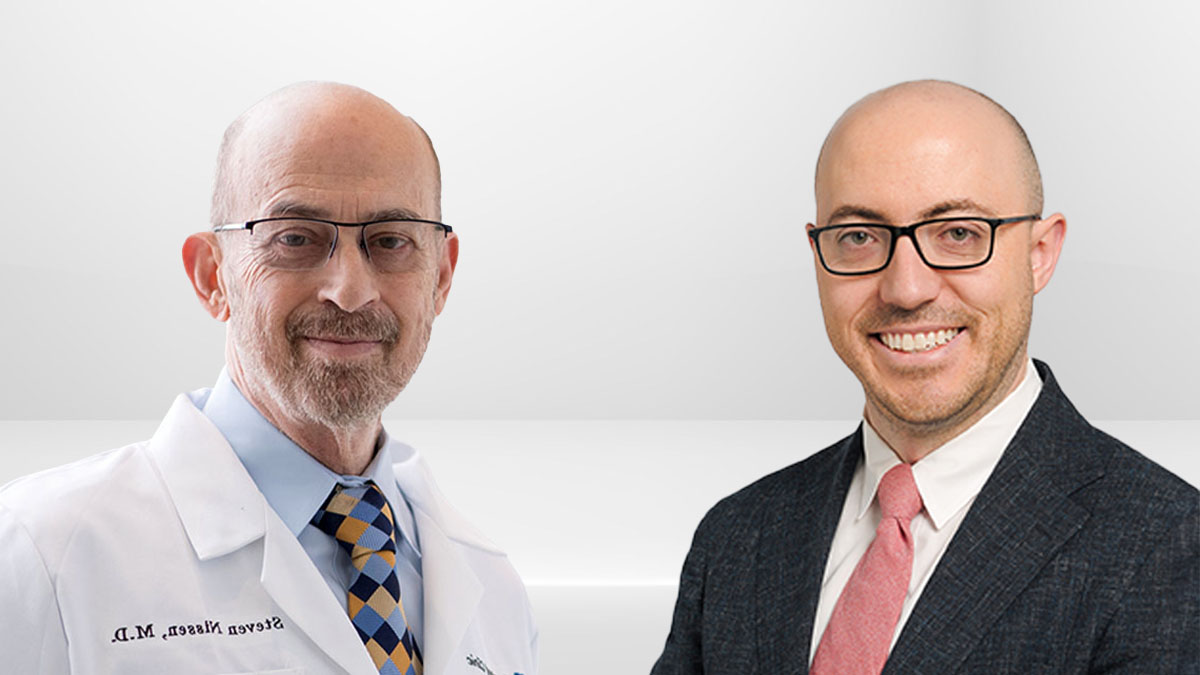
Research: Gene Editing for Lifelong Lipid Control
Steven Nissen, MD, and Luke Laffin, MD, discuss a groundbreaking Phase 1 trial of a CRISPR-Cas9 gene-editing therapy targeting ANGPTL3. They explore its potential as a one-time treatment to significantly lower LDL cholesterol and triglycerides, with promising safety and efficacy data that could reshape lipid management.
Looking to refer a patient? Please reach out to our Physician Referral team Mon. - Fri., 8 a.m. - 5 p.m. (ET) at 855.751.2469.
Advertisement
Cleveland Clinic is a non-profit academic medical center. Advertising on our site helps support our mission. We do not endorse non-Cleveland Clinic products or services. Policy
Recent Episodes
Talking Tall Rounds®: Updates on Less Invasive Cardiac Surgery
In this excerpt from Tall Rounds®, Gianluca Torregrossa, MD, discusses minimally invasive and totally endoscopic coronary artery bypass graf…
CTX310 and the Future of Gene Editing for Lipid Disorders
Steven Nissen, MD, and Luke Laffin, MD, discuss one-year follow-up data for CTX310, a CRISPR-Cas9 gene-editing therapy targeting ANGPTL3 to…
Evaluating Kylo-11 for Long-Acting Lipoprotein(a) Suppression
Steven Nissen, MD, and Ashish Sarraju, MD, discuss early clinical data on Kylo-11, a novel therapy that produced substantial reductions in l…
Video content: This video is available to watch online.
View video online (https://cdnapisec.kaltura.com/p/2207941/sp/220794100/playManifest/entryId/1_bssk8aoh/flavorId/1_5f3sgelj/format/url/protocol/https/a.mp4)
Transcript
Announcer:
Welcome to Cardiac Consult, brought to you by the Sydell and Arnold Miller Family Heart, Vascular and Thoracic Institute at Cleveland Clinic. This podcast will explore the latest innovations, medical and surgical treatments, diagnostic testing, research, technology and practice improvements.
Advertisement
Cleveland Clinic is a non-profit academic medical center. Advertising on our site helps support our mission. We do not endorse non-Cleveland Clinic products or services. Policy
Steven Nissen, MD:
I’m Dr. Steve Nissen. I'm the Chief Academic Officer of the Heart, Vascular and Thoracic Institute at the Cleveland Clinic. With me is Dr. Luke Laffin, who is a clinical trialist and preventive cardiologist in the Preventive Section of the Department of Cardiology.
Dr. Laffin, the research that we're publishing has been labeled by the American Heart Association as groundbreaking research. What makes it groundbreaking?
Luke Laffin, MD:
It's groundbreaking because, really, what we're looking at is gene editing, which is a potential for a one-and-done therapy to decrease levels of cholesterol throughout one's lifetime.
Steven Nissen, MD:
That's a big problem. The approach that's being used, how does this work?
Luke Laffin, MD:
Within the realm of gene editing, this is something called CRISPR-Cas9 therapy. The way to sort of think about it is its molecular scissors. What happens is a patient gets an infusion over anywhere between about an hour and a half and four and a half hours, and what's in the drug itself is directed towards the liver, where the drug is taken up by the hepatocytes. Then it goes and it “snips” essentially the DNA and creates a non-functional mutation in a specific gene.
Steven Nissen, MD:
There are people that have a loss of function for this gene out there in the communities. It's not very common, but there are people like that. What do we know about them?
Advertisement
Luke Laffin, MD:
These were some groundbreaking studies published within about the last decade or so. The gene is ANGPTL3, and we know that people that are born with a non-functional mutation have lifelong levels of low LDL cholesterol, low triglycerides and most importantly, a low lifetime risk for atherosclerotic cardiovascular disease without any apparent harmful effects.
Steven Nissen, MD:
Okay. So, this is a Phase 1 study. Could you explain a little bit more about how the study was conducted, where it was conducted and in whom?
Luke Laffin, MD:
The primary objective of any Phase 1 study is to look for safety. This was conducted at six sites in Australia, New Zealand, and the United Kingdom. We enrolled 15 participants with either high LDL cholesterol, high triglycerides, or the combination of both, which is high LDL and triglycerides, otherwise known as a mixed dyslipidemia. This was a single ascending dose study, meaning we started at a very low dose, which was 0.1 milligrams per kilogram, treated three participants at that dose, and went up to 0.3, 0.6, 0.7, and ultimately, 0.8 where four participants were treated.
Steven Nissen, MD:
Now, how's the drug given? Is it oral? Is it subcutaneous? Is it intravenous?
Luke Laffin, MD:
It's an intravenous infusion, and that took place in a clinic or a hospital setting. It was given over about an hour and a half to four and a half hours. Participants were pre-treated with steroids and antihistamines as well, to decrease the risk for allergic reactions, and then they were observed for 24 hours following the infusion.
Steven Nissen, MD:
At the lowest dose, what did you see?
Luke Laffin, MD:
We saw that the infusion was safe, but we really didn't see any changes in atherogenic lipoproteins: LDL cholesterol, triglycerides. That's pretty typical, as you know, of these studies where we start with a low dose really to establish, is this at least safe?
Steven Nissen, MD:
Now, when you got to the top dose of 0.8 milligrams per kilogram, what happened?
Luke Laffin, MD:
What we saw was, number one, it was safe. There were no concerning side effects. Importantly, we saw on average about a 55% decrease in triglycerides, and just under 50% decrease in LDL cholesterol among those treated participants.
Steven Nissen, MD:
Is there any other treatment out there that can lower LDL by 50% and triglycerides by 55%?
Luke Laffin, MD:
There really isn't at this point. There are other drugs that have looked at ANGPTL3 in terms of treating it, but those are infusions that you have to give every month.
Steven Nissen, MD:
This is a one and done.
Luke Laffin, MD:
It's a one and done. The great benefit of that and why, as we alluded to earlier, this is a groundbreaking idea is that we know adherence to lipid-lowering therapies right now – statins, the monoclonal antibody PCSK9 inhibitors – although these were great advances and continue to be the backbone of therapy, we know that adherence wanes, particularly after the first year of taking them.
Advertisement
Steven Nissen, MD:
So, let's talk about safety. What were the adverse effects observed? Every treatment I know of has some adverse effects. What happened here?
Luke Laffin, MD:
There were. Most importantly, there were no serious adverse events that were attributed to this drug, CTX310. What we did see was we saw a couple of infusion-related reactions. What you do when those happen, and what was done in this study, is pause the infusion, re-administer some treatment with some steroids, et cetera, and then restart. But all participants completed the infusion.
Steven Nissen, MD:
What kind of reactions were these infusion reactions? What actually did people feel?
Luke Laffin, MD:
They felt a little bit nauseous. They may have felt a little bit sick to their stomach. Those were really the main things that we saw.
Steven Nissen, MD:
Yeah, and then you were able to complete infusions in everybody.
Luke Laffin, MD:
Exactly. Exactly.
Steven Nissen, MD:
This is targeting the liver, and some of these other therapies that are being developed do have some problems with an increase in liver enzymes. Do we see that here?
Luke Laffin, MD:
Yeah, and so the problem that other therapies in this class is the drug is encapsulated in something called a lipid nanoparticle, which can induce an inflammatory response. In one participant who actually had a baseline elevation of their aminotransferases, so AST/ALT, we saw a transient elevation in their liver function tests as well. There was a peak on day four, but it was back to almost normal by day seven and definitely back to normal by day 14.
Advertisement
Steven Nissen, MD:
So, really, nothing from a safety point of view that was concerning. Are these results encouraging enough to move on to the next phase of study, phase two and then ultimately phase three?
Luke Laffin, MD:
Yeah, I think they really are. We know that it's 15 participants and it's early, but the safety was very encouraging as well as the efficacy to move on to larger studies, more specific patient populations and a wider array of patients.
Steven Nissen, MD:
It really is a groundbreaking set of findings. Let's see if we can't wrap it up and talk about what you see as the top-line major findings here.
Luke Laffin, MD:
Well, number one, this has the potential to be a one-time, durable, essentially lifelong treatment for lowering LDL and triglycerides. Number two, it's still early. There are only 15 participants, but really, the safety was deemed acceptable as well as the efficacy to move forward.
Steven Nissen, MD:
Would this be published simultaneously with presentation?
Luke Laffin, MD:
Yes. This was presented at the American Heart Association meeting and published in the New England Journal of Medicine.
Steven Nissen, MD:
What was the role of the Cleveland Clinic in this study?
Luke Laffin, MD:
Well, our role at Cleveland Clinic was an important one with respect to our involvement with C5Research. C5Research is the academic research organization of the Cleveland Clinic's Heart, Vascular and Thoracic Institute. What we did for this study is we provided academic oversight, academic leadership for the study, as well as independent statistical verification and analysis to really show that yes, what was seen with the study was correct.
Advertisement
Steven Nissen, MD:
That's important because it's a basic rule at C5Research that if we collaborate on a study, we get the entire trial database, our statisticians compute the results and we can then stand behind those results. Can't we?
Luke Laffin, MD:
Exactly. I mean, we've been doing this at C5 for over 30 years now. We really stand behind the data that we put out. It was a great collaboration with the sponsor.
Steven Nissen, MD:
Thank you very much.
Luke Laffin, MD:
Thanks, Dr. Nissen.
Steven Nissen, MD:
Great summary.
Announcer:
Thank you for listening to Cardiac Consult. You enjoyed the podcast. For more information or to refer a patient to Cleveland Clinic, please call 855.751.2469. That's 855.751.2469. We welcome your comments and feedback. Please contact us at Heart@ccf.org. Like what you heard? Subscribe wherever you get your podcasts or listen at clevelandclinic.org/CardiacConsultPodcast.
Recent Episodes
Talking Tall Rounds®: Updates on Less Invasive Cardiac Surgery
In this excerpt from Tall Rounds®, Gianluca Torregrossa, MD, discusses minimally invasive and totally endoscopic coronary artery bypass graf…
CTX310 and the Future of Gene Editing for Lipid Disorders
Steven Nissen, MD, and Luke Laffin, MD, discuss one-year follow-up data for CTX310, a CRISPR-Cas9 gene-editing therapy targeting ANGPTL3 to…
Evaluating Kylo-11 for Long-Acting Lipoprotein(a) Suppression
Steven Nissen, MD, and Ashish Sarraju, MD, discuss early clinical data on Kylo-11, a novel therapy that produced substantial reductions in l…
Never miss a moment - subscribe now.
Listen to the Health Essentials Podcast on your favorite streaming platform.
Other Podcasts You May Love
Butts & Guts
A Cleveland Clinic podcast exploring your digestive and surgical health from end to end. You’ll lear…
Health Essentials
Tune in for practical health advice from Cleveland Clinic experts. What's really the healthiest diet…
Love Your Heart
A Cleveland Clinic podcast to help you learn more about heart and vascular disease and conditions af…
Neuro Pathways
A Cleveland Clinic podcast for medical professionals exploring the latest research discoveries and c…