



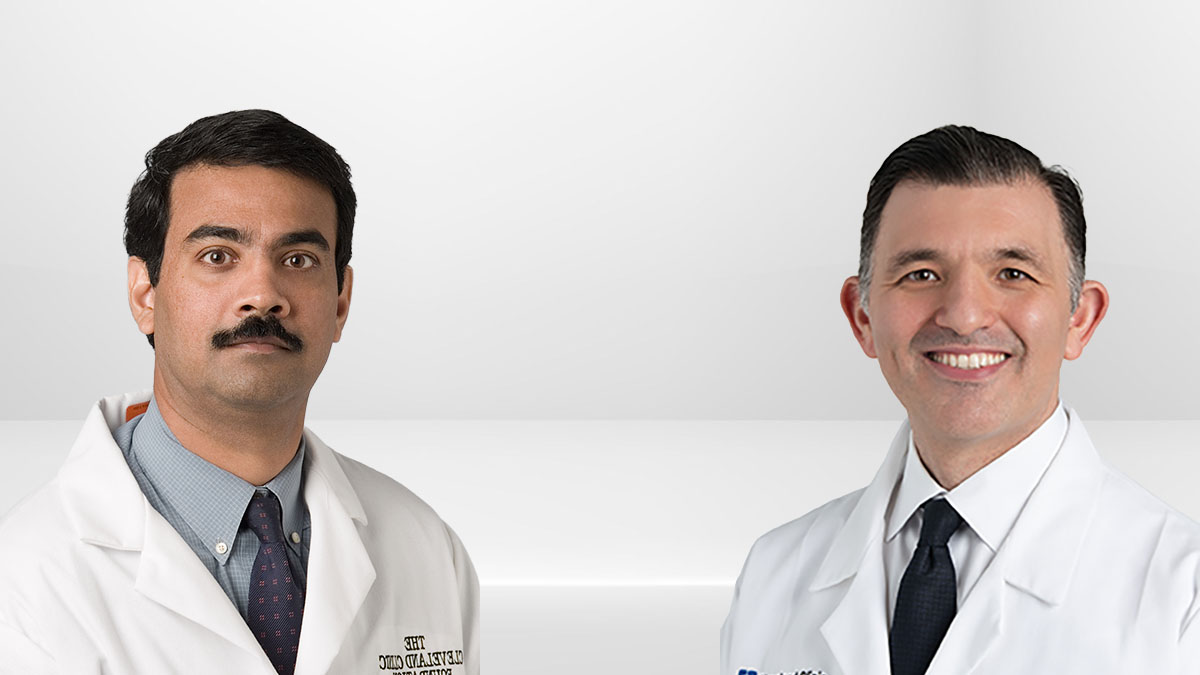
Cleveland Clinic's New Cardiovascular Center on Aging
Venugopal Menon, MD, and Abdulla Damluji, MD, discuss the emerging subspecialty of cardiovascular aging and the growing need to tailor cardiovascular care for older adults. They explore how integrating geriatric expertise into cardiovascular practice can improve diagnostic accuracy, individualize therapy and optimize outcomes for this rapidly expanding patient population.
Looking to refer a patient? Please reach out to our Physician Referral team Mon. - Fri., 8 a.m. - 5 p.m. (ET) at 855.751.2469.
Advertisement
Cleveland Clinic is a non-profit academic medical center. Advertising on our site helps support our mission. We do not endorse non-Cleveland Clinic products or services. Policy
Recent Episodes
Talking Tall Rounds® Renal Denervation for Uncontrolled Hypertension
In this excerpt from Tall Rounds®, Luke Laffin, MD, discusses the evolving role of renal denervation for uncontrolled hypertension, includin…
Talking Tall Rounds® Cardiac Sarcoidosis: Systematic Team Approach to Diagnosis & Management
In this excerpt from Tall Rounds®, Cleveland Clinic experts discuss imaging modalities that aid the diagnosis of cardiac sarcoidosis. View…
Evolving Strategies in Aortic Arch Repair
Eric Roselli, MD, and Patrick Vargo, MD, discuss how advances in open, hybrid and endovascular techniques are changing the treatment of aort…
Video content: This video is available to watch online.
View video online (https://cdnapisec.kaltura.com/p/2207941/sp/220794100/playManifest/entryId/1_ybbi050w/flavorId/1_5f3sgelj/format/url/protocol/https/a.mp4)
Transcript
Announcer:
Welcome to Cardiac Consult, brought to you by the Sydell and Arnold Miller Family Heart, Vascular and Thoracic Institute at Cleveland Clinic. This podcast will explore the latest innovations, medical and surgical treatments, diagnostic testing, research, technology and practice improvements.
Advertisement
Cleveland Clinic is a non-profit academic medical center. Advertising on our site helps support our mission. We do not endorse non-Cleveland Clinic products or services. Policy
Venugopal Menon, MD:
Hi, I'm Venu Menon. I'm the clinical section head at the Cleveland Clinic and director of the Cardiac Intensive Care Unit, as well as the Cardiovascular Fellowship Program. With me, I have Dr. Abdulla Damluji, who's the director of our Cardiac Aging Center. Today, we're going to have a little discussion on this new emerging subspecialty of cardiology.
In the area of cardiology, just given the breadth and scope of the kind of patients we treat, over the past few years, there have been new subspecialties emerging, like cardio-obstetrics, cardio-oncology, sports cardiology. One area that we've not paid as much attention to, but which is staring us in the face, is the aging population. Most of our patients that we see in cardiology are over 65, 70 years of age. This is a unique population that we really need to pay more attention to as we get new treatments and new interventions to treat this vulnerable population.
We have with us Dr. Damluji, who is our director of our Cardiovascular Aging Center. We're very proud that we are the first cardiovascular department to have a Cardiovascular Aging Center. I thought we'd interact a little bit today to ask him about the importance of this new emerging field.
Advertisement
So Abdulla, tell me a little bit about the aging crisis in terms of the growing number of elderly people in this country and what ramifications is that going to have for us as cardiologists treating these patients.
Abdulla Damluji, MD:
Thank you so much, Dr. Menon. As you know, the population in the United States and in the developed world is aging rapidly. This is what we call demographic shift, where the older adult population, above 65 and above 75 years of age, is increasing rapidly due to their longevity because of the treatments and therapies that have emerged over the past decades.
To give you a sense, the number of older adults currently in the population is about 16%. By 2060, the number of older adults in the population will be more than 22%. Almost one in four people will be above 65 years of age. If you examine the older adult population in a hospital setting, you will see that they are more likely to present to the hospital with cardiovascular disease.
A chronologic age is a risk factor for cardiovascular disease. If you think about all admissions for acute coronary syndrome, 30 to 40% of them are above 75 years of age. Most of our patients that we take care of are older adults, and they are quite different than the younger patient population, as you know.
They live with conditions that we call geriatric syndromes. These are conditions that do not fit into one disease category, and they're more likely to affect the older adult populations. These conditions that we're going to talk about include, and not limited to, frailty, physical decline, cognitive impairment, sarcopenia, which is muscle loss. All of these conditions affect how we approach the management of cardiovascular disease and also affects the prognosis of cardiovascular disease management.
Venugopal Menon, MD:
Now, as a cardiologist, I have people coming in with acute coronary syndromes. I'm putting a stent in them. I have a person with an aneurysm. I'm doing surgery when indicated in them. How does the presence or absence of these symptoms or syndromes impact how I should be approaching these? Should all patients just be treated the same or do these variables, should they really be measured because they really determine how these patients do with these interventions?
Abdulla Damluji, MD:
Yeah, absolutely. Historically speaking, if you think about cardiovascular disease, mostly it affects mid-age adults, 50s and 60s, and that was 20 or 30 years ago. Clinical trials enrolled these patients, and we found out that certain therapies are effective and safe in this population. That resulted in an increase in longevity and improved in quality of life and better outcomes for these patients. These include drugs and devices, like you mentioned.
Advertisement
But when you take these same drugs and devices and apply it to an older patient, let's say an 80 or 85 year old with the same condition, but you give them the same drugs and the same devices, sometimes they don't fare as well as those who are younger and mid-age adults, and the reason is those geriatric syndromes.
To give you an example, an older patient may be living with multiple chronic conditions. They have heart failure, chronic lung disease. They have hypertension. They have diabetes. With these, they are treated with multiple medications. This is what we call polypharmacy. Those patients are treated with more than five drugs or probably more than 10 drugs in certain cases.
They come into the hospital with the same problem, which is acute coronary syndrome or heart failure, and we give them the same standard therapies, but they develop exacerbations of their chronic conditions while they're in the hospital. We add more medications to them, and they develop adverse events as a result of medication drug-drug interactions or drug-disease interactions. We give them beta blockers, and their lung disease gets worse or their conduction disease gets worse. This is as part of the standard management of acute coronary syndrome. As we look at the older patient, we have to really measure these geriatric syndromes and tailor our therapies slightly differently compared to the young patient population.
Advertisement
You see that in all aspects of cardiovascular management. Dr. Menon, I just wanted to ask you, you specialize in critical care cardiology. Do you see that also in the hyperacute setting for some of these patients, and how challenging is it to manage these patients in the CICU?
Venugopal Menon, MD:
I think it's certainly a very challenging issue because while we have new therapies and new interventions that can really benefit people at the extremes of age, many of these devices are large bore devices. They're invasive. They come with long hospital stays where patients are in a room where the lights are never turned off for days on end. Their sleep cycles are affected. They're already cognitively diminished. For us, in that kind of a background, to really make a determination as to how an intervention or treatment will positively impact a patient in the long run is extremely challenging. I think what you're describing here is a clinical problem that every cardiologist is very familiar with.
My concern here is, let's take myself as an example, my training in terms of recognizing these kinds of frailties independent of the cardiovascular status, are things like sarcopenia or just general frailty, I'm not as well-trained and adapted to do that. When you plan or design a cardiovascular aging center, while you can educate cardiologists like me to be aware of these vulnerabilities, how do you involve our geriatric colleagues who've been so familiar spending time with these patients mainly in an outpatient setting to help with care?
Advertisement
Abdulla Damluji, MD:
I mean, this is a team sport. As we do, medicine is a team sport, especially in cardiovascular medicine, where we sometimes call our colleagues in imaging and colleagues in intervention to tackle a problem from different dimensions in the diagnostic phase and also in the therapeutic phase. That follows the same premise here. A cardiologist is not trained in diagnosing and measuring these geriatric conditions, and we need the geriatrician's help in that aspect.
So, if you think about how do you diagnose frailty, how do you screen for cognitive impairments, and how do you measure cognitive impairment, which is a completely different skillset in terms of screening versus in terms of diagnosing. And then how do you act on physical decline? All of these things are in the realm of a geriatrician to address in any patients, but for us here at the Cleveland Clinic, we brought that to the cardiovascular medicine.
We have a number of geriatricians, including the Chair of Geriatrics here, that is helping us with this initiative. The patient who comes in with a cardiovascular event is being assessed and treated for their cardiovascular conditions primarily by the Cleveland Clinic cardiologist, but the geriatrician will come in as a consultant to help measure and diagnose these geriatric conditions so that we can alter the treatment and the therapies for those patients.
And then, not only is an older patient with a cardiovascular condition followed by a cardiologist, but also the geriatrician is following them during their hospital stay, and then transitioning them to the outpatient setting, where we have a collaborative approach to management.
Venugopal Menon, MD:
So if I'm a cardiologist and I'm seeing all of these patients in an inpatient setting, many of whom are elderly, should I be calling our geriatric colleagues on all of them, or can you just give us some guidance on which select patients amongst the elderly would benefit the most from this valuable resource?
Abdulla Damluji, MD:
Dr. Menon and the rest of the team worked very hard to try to figure out who would benefit the most from such service, and we came up with certain criteria. We thought that the evidence would favor those who are above 75 years of age who have certain higher burden of these geriatric conditions.
For example, those who have advanced frailty, those who have hyperpolypharmacy. For example, having 10 active drugs that they're being treated in the hospital, they may benefit from a geriatric pharmacist to look over these drugs and look at drug-drug interactions and adjust the dosing of these medications. Those who have mild or advanced cognitive impairment, because that affects compliance with medications. That affects their understanding of the therapies. It affects whether they are consenting for procedures or not. Those who have advanced physical decline, because that can affect also where they go after they leave the hospital, after their acute cardiovascular conditions.
And lastly, those who need help with advanced care planning. As you know, most of the older patients come in with valvular heart disease and those who come in with acute coronary syndrome, they may require high-risk intervention or those who may require coronary artery bypass graft surgery, which is quite a big event for an older patient who is 80 or 75 years of age.
So they may facilitate some of these discussions to see what these patients would like to achieve from such therapy, what matters most to them. Whether it's longevity and living longer or whether they prioritize having their time left with their families at home, avoiding hospital admissions or whether they just want to have an improvement in their quality of life, including less angina, less heart failure symptoms, et cetera.
So I think the overall way we have to look at an older adult should change from a disease-focused approach to really a multidisciplinary way, a comprehensive way of assessing an older adult and that would provide a better outcome over the long run.
Venugopal Menon, MD:
Now, the other part clearly is not all elderly people succumb to all of these disabilities. Some of them have really productive, healthy lives.
Abdulla Damluji, MD:
That's right.
Venugopal Menon, MD:
What insights can we gain from that population, where people are living to be 85, 90, but they're otherwise extremely functional, and you see them all the time?
Abdulla Damluji, MD:
Right. I mean, that's the concept of chronologic age versus biologic aging. We are moving away from chronologic age because of this observation. We are observing a 95-year-old, and I had a patient in the valve clinic who is a 95-year-old farmer who came here. He's still quite physical, carrying potato bags from one place to another. Now, most recently he has noticed that he's becoming more short of breath, and we noticed that he had aortic valve stenosis, and we're trying to solve that problem for him. But he looks much younger than his stated age, and then the question is, how do you define aging in this context?
The concept of biologic aging came into play, whereas there are certain conditions, exposure factors like smoking, chronic conditions like diabetes and infections, the chronic infections. You have radiation exposure. You have genetics. All of these may accelerate the aging process. Or a lack of these risk factors for aging may probably make you live a longer, better life, and you will have a better biologic age compared to a chronologic age.
Now, in the research space, there are several biologic clocks. Mostly there are organ-specific clocks and there are comprehensive clocks that can define biologic age, and we're trying to find some of these applications in patients with cardiovascular disease.
Venugopal Menon, MD:
Are there any large clinical trials trying to address this in a scientific fashion in this age group?
Abdulla Damluji, MD:
Yeah. I mean, now we have transitioned to looking into enrolling older patients with these conditions. Historically speaking, most of clinical trials enroll patients who have one or two disease processes. They are mid-age adults. We follow them for 10 years, and we say this drug or device is safe and effective. However, most of our patients are not like that. They have 10 medications, and they have multiple chronic conditions, and they are quite pre-frail, et cetera.
So recently, the NIH and the FDA are advocating for enrollment of older patients in clinical trials and enrolling patients across the lifespan, really, but those who are older patients, enrolling them in clinical trials in a way that's pragmatic. We call them pragmatic clinical trials. We have less inclusion and exclusion criteria for enrolling them.
Examples for these are the REHAB-HFpEF trial that we're involved with, and which is quite fascinating to enroll 75 and 80-year-old heart failure patients with multiple chronic conditions, frailty, and some of them have other geriatric conditions, randomizing them into physical rehabilitation intervention versus the standard of care.
Another example would be the LIVEBETTER trial, which is a medication trial where we are randomizing patients to a calcium channel blocker and versus beta blocker in the older adult population so that we can understand which treatment would work best in what patient group. There are more clinical trials on the way that we're thinking of with Dr. Menon, but a really exciting area.
I just want to see, Dr. Menon, where do you think the future would lead as we're thinking about these intricacies combining age-associated risk factors with cardiovascular conditions. How do you see the future coming?
Venugopal Menon, MD:
I think the future is now, because obviously, the aging process is not going to stop. The demographic profile of the population is changing dramatically. Unless we pay attention to this like you are at this point in time, we're going to be faced with a crisis in the years to come. So, I think this has been a very opportune conversation, and I want to congratulate you on really focusing on a very vulnerable group of patients who don't necessarily make a lot of noise out there.
They've lived their lives. They've lived productive lives. They just want to live the rest of their lives with the minimum disability, and so to pay attention to them and to really hone in on not their aortic valve or their mitral valve or their coronary artery disease, but to who they are and to return them to normal health as a human being is really very important in our role as physicians. I want to congratulate you on that, and I look forward to wonderful both clinical care, as well as research discoveries from this program. Congratulations.
Abdulla Damluji, MD:
Perfect. Thank you so much.
Announcer:
Thank you for listening to Cardiac Consult. We hope you enjoyed the podcast. For more information or to refer a patient to Cleveland Clinic, please call 855.751.2469. That's 855.751.2469. We welcome your comments and feedback. Please contact us at heart@ccf.org. Like what you heard? Subscribe wherever you get your podcasts or listen at clevelandclinic.org/CardiacConsultPodcast.
Recent Episodes
Talking Tall Rounds® Renal Denervation for Uncontrolled Hypertension
In this excerpt from Tall Rounds®, Luke Laffin, MD, discusses the evolving role of renal denervation for uncontrolled hypertension, includin…
Talking Tall Rounds® Cardiac Sarcoidosis: Systematic Team Approach to Diagnosis & Management
In this excerpt from Tall Rounds®, Cleveland Clinic experts discuss imaging modalities that aid the diagnosis of cardiac sarcoidosis. View…
Evolving Strategies in Aortic Arch Repair
Eric Roselli, MD, and Patrick Vargo, MD, discuss how advances in open, hybrid and endovascular techniques are changing the treatment of aort…
Never miss a moment - subscribe now.
Listen to the Health Essentials Podcast on your favorite streaming platform.
Other Podcasts You May Love
Butts & Guts
A Cleveland Clinic podcast exploring your digestive and surgical health from end to end. You’ll lear…
Health Essentials
Tune in for practical health advice from Cleveland Clinic experts. What's really the healthiest diet…
Love Your Heart
A Cleveland Clinic podcast to help you learn more about heart and vascular disease and conditions af…
Neuro Pathways
A Cleveland Clinic podcast for medical professionals exploring the latest research discoveries and c…