



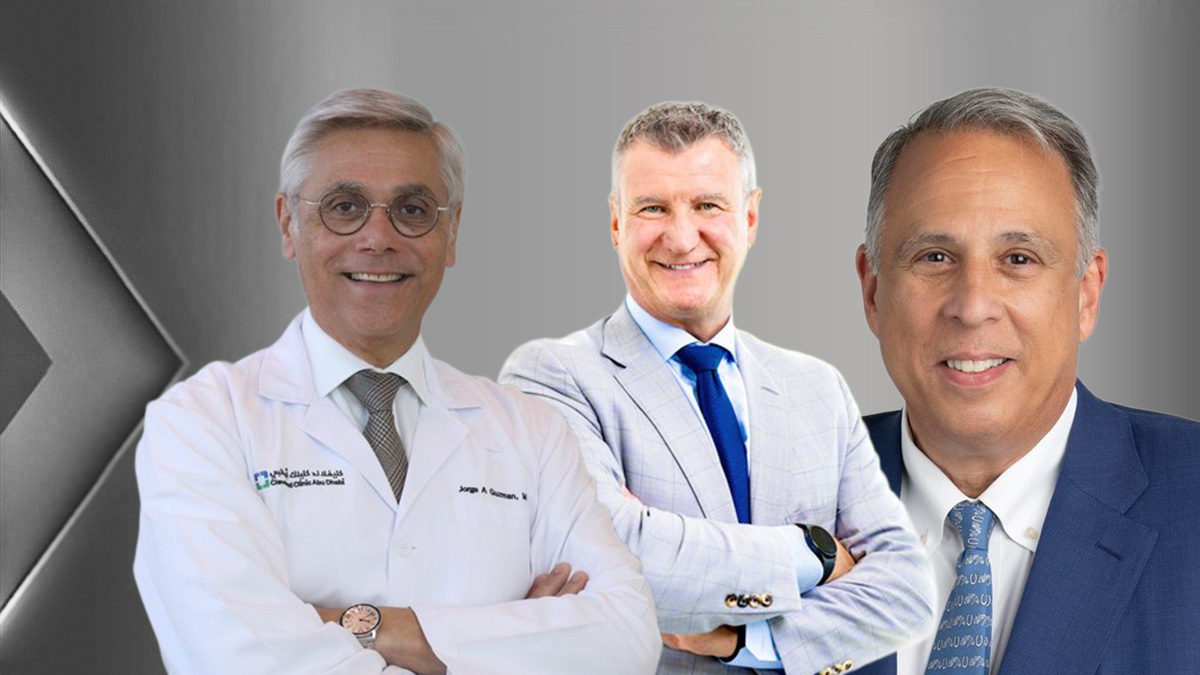
Igniting Change: Driving Innovation in Healthcare
This episode will focus on the essential strategies for building a culture of innovation in healthcare. The panel discusses the frameworks needed to transition frontline ideas into system-wide solutions, illustrating how a mission-driven approach ensures long-term institutional growth.
Advertisement
Cleveland Clinic is a non-profit academic medical center. Advertising on our site helps support our mission. We do not endorse non-Cleveland Clinic products or services. Policy
Recent Episodes
Bridging the Gap by Reconnecting Disconnected Workforces
This episode will focus on approaches to fostering culture, connection, and involvement in hybrid and remote work environments. They focus o…
New Leadership Skills: AI and Beyond
This episode explores how artificial intelligence (AI) is reshaping healthcare. The panel examines the practical AI applications across clin…
Empowering Leadership Voice
This episode will explore how leaders can strengthen their voice, balance advocacy with active listening, and build psychological safety. Th…
Video content: This video is available to watch online.
View video online (https://cdnapisec.kaltura.com/p/2207941/sp/220794100/playManifest/entryId/1_rljtnq5y/flavorId/1_5f3sgelj/format/url/protocol/https/a.mp4)
Transcript
Beyond Leadership Podcast Series
Advertisement
Cleveland Clinic is a non-profit academic medical center. Advertising on our site helps support our mission. We do not endorse non-Cleveland Clinic products or services. Policy
Release Date: March 26, 2026
Expiration Date: March 25, 2029
Estimated Time of Completion: 35 minutes
Igniting Change: Driving Innovation in Healthcare
Jorge Guzman, MD Jospeh Iannotti, MD Geoffrey Vince, PhD
Description
Welcome to L.E.A.D., a special series by Beyond Leadership. L.E.A.D. is an innovative, action-oriented framework built on four human-centered behaviors: Listening, Empathizing, Adapting, and Developing. In this series, we explore how top leaders apply these behaviors to build trust, foster collaboration, promote growth, and connect authentically every day.
This episode will focus on the essential strategies for building a culture of innovation in healthcare. The panel discusses the frameworks needed to transition frontline ideas into system-wide solutions, illustrating how a mission-driven approach ensures long-term institutional growth.
Learning Objectives
Target Audience
This program is designed for healthcare professionals interested in advancing their leadership skills.
Accreditation
In support of improving patient care, Cleveland Clinic Center for Continuing Education is jointly accredited by the Accreditation Council for Continuing Medical Education (ACCME), the Accreditation Council for Pharmacy Education (ACPE), the American Nurses Credentialing Center (ANCC), and Interprofessional Continuing Education (IPCE) Credit to provide continuing education for the healthcare team.
Advertisement
Credit Designation
Cleveland Clinic Center for Continuing Education designates this internet enduring material for a maximum of 0.5 AMA PRA Category 1 Credits ™. Physicians should claim only the credit commensurate with the extent of their participation in the activity.
Participants claiming CME credit from this activity may submit the credit hours to the American Osteopathic Association for Category 2 credit.
Cleveland Clinic Center for Continuing Education designates this internet enduring material for a maximum of 0.5 ANCC contact hours.
Cleveland Clinic Center for Continuing Education has been authorized by the American Academy of PAs (AAPA) to award AAPA Category 1 CME credit for activities planned in accordance with AAPA CME Criteria. This activity is designated for 0.5 AAPA Category 1 CME credits. PAs should only claim credit commensurate with the extent of their participation.
Cleveland Clinic Center for Continuing Education designates this knowledge-based activity for a maximum of 0.5 hours. Credit will be provided to NABP CPE Monitor within 60 days after the activity completion. Universal Activity Number List:
- Pharmacist UAN : JA0000192-0000-26-037-H99-P
This activity was planned by and for the healthcare team, and learners will receive 0.5 Interprofessional Continuing Education (IPCE) credit for learning and change.
A certificate of participation will be provided to other health care professionals for requesting credits in accordance with their professional boards and/or associations.
Cleveland Clinic Planning Committee
James Stoller, MD, MS Co-Activity Director Chair, Education
Cecile Foshee, PhD Co-Activity Director Director, Office of Interprofessional Learning
Sawsan Abdel Razig, MD Chief Academic Officer, Cleveland Clinic Abu Dhabi
Lindsey Amerine, PharmD Sr. VP, Chief Pharmacy Officer
Lisa Baszynski, DNP Executive Director, Associate Chief Nursing Officer
Colleen Carroll, MS Sr. Director of Leadership and Learning
Matthew Donnelly, MBBS (Hons) VP, Professional Staff Affairs
Mark Hamilton, MD Cleveland Clinic London
Jospeh Iannotti, MD Chief of Staff, Cleveland Clinic Florida
Debra Kangisser, PA-C Office of Interprofessional Learning
Aanchal Kapoor, MD, MEd Founder and Director of the Medical Intensive Liver Unit
Suchetha Kshettry, MD Enterprise & Ohio Women’s Professional Staff Association President, (2025-2026)
Christopher Nagel, BA, MA VP, Leadership and Learning
Silvia Perez Protto, MD Immediate Women’s Professional Staff Association Past President, (2025)
Ronna Romano, MBA Office of Interprofessional Learning
Advertisement
Stormy Sweitzer, PhD Office of Interprofessional Learning
Faculty
Jorge Guzman, MD Executive Vice President and President Cleveland Clinic Northeast Ohio Market
Jospeh Iannotti, MD Chief of Staff, Cleveland Clinic Florida Chief of Research and Academic Officer, Florida Market
Geoffrey Vince, PhD Chief of Innovations Cleveland Clinic
Host
Jim Pae, MSOD Manager, Organizational Development
Disclosures
The Cleveland Clinic Center for Continuing Education has implemented a policy to comply with the Accreditation Council for Continuing Medical Education Standards for Integrity and Independence. This activity includes non-clinical content only. In accordance with the Standards for Integrity and Independence, identification, mitigation and disclosure of financial relationships does not apply.
CME Disclaimer
The information in this educational activity is provided for general medical education purposes only and is not meant to substitute for the independent medical judgment of a physician relative to diagnostic and treatment options of a specific patient's medical condition. The viewpoints expressed in this CME activity are those of the authors/faculty. They do not represent an endorsement by The Cleveland Clinic Foundation. In no event will The Cleveland Clinic Foundation be liable for any decision made or action taken in reliance upon the information provided through this CME activity.
Advertisement
HOW TO OBTAIN AMA PRA Category 1 Credits™, ANCC, AAPA, ACPE, IPCE Contact Hours, OR CERTIFICATE OF PARTICIPATION:
Go to:
http://cce.ccf.org/ccecme/process?site_code=main&activity_session_code=EKCE02702
to log into myCME and begin the activity evaluation and print your certificate. If you need assistance, contact the CME office at myCME@ccf.org
Copyright © 2026 The Cleveland Clinic Foundation. All Rights Reserved.
Podcast Transcript
Kelly Hancock, DNP, RN, NE-BC, FAAN:
Hello and welcome to Beyond Leadership, a Cleveland Clinic podcast where we explore the many dimensions of leadership. I'm Kelly Hancock, Executive Vice President, Chief Caregiver, and Administrative Officer here at Cleveland Clinic, and I'm thrilled to have you join us. In this podcast series, we'll feature conversations with remarkable thinkers and uncover how their insights and experiences are shaping the future of leadership in healthcare. Now let's turn it over to our host, who will guide us through today's enlightening conversation.
Jim Pae, MSOD:
Hello everyone. I'm your host, Jim Pae, and this is Beyond Leadership. Today, I'm joined by three of Cleveland Clinic's most innovative leaders, Dr. Jorge Guzman, Executive Vice President and President of Northeast Ohio Market, Dr. Joe Iannotti, Chief of Research and Academic Officer of Cleveland Clinic Florida, and Dr. Geoff Vince, Chief of Innovations for Cleveland Clinic.
Advertisement
Proudly, for more than a hundred years, Cleveland Clinic has been at the forefront of advances in medical innovation. Now, we find the future of healthcare is being shaped by forces more complex and fast-moving than ever before. What we are finding is advances in science and technology are expanding what's clinically possible, by offering breakthroughs in personalized medicine and using artificial intelligence to augment provider care. Yet at the same time, health systems face mounting challenges, rising costs, workforce pressures, shifting patient expectations, and the realities of operating in a world of limited resources.
Meeting these challenges requires a mindset of continuous innovation in which we are constantly asking ourselves, what can we do next? Clinically, we are compelled to advance scientific discovery, ensuring we improve the human condition, all the while delivering the safest and most effective care. Organizationally, it is imperative [that] we infuse our cultures with the energy that inspires and empowers employees to reimagine how teams, processes, and systems work together. Innovation is no longer optional. It's the catalyst that will determine whether healthcare thrives in the future or falls behind.
This podcast is about that journey. Together with leaders and innovators from Cleveland Clinic, we will explore how new ideas are being tested, scaled, and embedded across the organization, and how they are shaping the future of healthcare for patients, caregivers, and communities worldwide. What does it truly take to ignite change and move ideas into action? So together, it will be our job to unpack what it means to lead innovation in complex healthcare systems.
So, let's talk first about fostering a culture of innovation. Innovation tends to thrive when an organization's culture actually rewards that informed risk taking, and even views some of those potential failures as true learning opportunities. So, how do you create a culture where innovation is possible? Jorge, maybe you could kick us off.
Jorge Guzman, MD:
When I look at this, I think that it goes to the very core of Cleveland Clinic. And innovation is one of our values, and innovation in its broadest sense, meaning we innovate in the way we take care of patients, we innovate in the way we operate as an organization, [and] we innovate in the way we interact with each other. We are constantly looking at different ways that we can do what we do every day and serve the purpose, [and] our mission better. And there is no other way than trying to discover new ways of doing it.
And I just want to highlight the importance of having a broad mindset to innovation. Because sometimes, [we] think innovation is a new drug, new therapies, and a new surgical procedure, and that's a part of it. But we also look at new ways of staffing, new ways of using technology to help us be more efficient, to do the same at a lower cost. And that goes into the package of what is called innovation.
And I think that we take pride in leading in that front. I think that there are numerous examples of clinical discoveries, clinical breakthroughs, but also, we take great pride [in] leading on innovative ways of operating a large and complex system like Cleveland Clinic, and putting it in the hands of our many different caregivers, that are encouraged to come up with new ideas, and new ways of doing things.
Joseph Iannotti, MD:
I think that's a great high-level overview of what the Cleveland Clinic does well, which is to innovate in multiple areas, not just the traditional technology areas. It's how you practice medicine. I think to do that well, to develop a culture, I think it's very important for leadership to define its goals and objectives in each area. Because it defines, sort of, the areas that you want to focus on.
For example, if you chose to say, work hours among providers is too onerous, how does technology help us do that more efficiently? Then that's a goal or an objective. The second thing you have to do is give people empowerment to say you are responsible, or partly responsible for helping us innovate or define solutions. And then the third level is you [have to] build processes and infrastructure to allow those ideas to be vetted such that they don't go off in 12 different tangents. And you realize now you have to put the genie back in the bottle because you've got too many people going in too many different directions.
And that's again, where I think the Clinic has done a good job, in terms of saying, how do we build processes so that innovative caregivers who've got good ideas can vet them, or bring them to leadership, and how does leadership then sort of mold those ideas into something that they are capable of implementing? And I think there's multiple examples in the recent few years where that process of defining objectives, enabling or encouraging caregivers to take responsibility, and then having processes in place that allow the organization to vet them in ways that can be implemented. And I think that's what builds a good culture.
Geoffrey Vince, PhD:
If I could just build on that. I agree with all those comments. When you think of medical innovation, you tend to think of the next heart valve or the new hip replacement. But to Jorge's point, it's more than that. It is how do we improve the patient experience? How do we get patients into the hospital so they can experience our level of care quicker, more effectively? We think of pushing forward the frontiers of healthcare generally, but I think this, more mundane appearing thing, of how do we just increase efficiency and keep those processes going is equally important, if not quite as groundbreaking and newsworthy.
Jim Pae, MSOD:
Well, you bring up interesting points about empowering caregivers and giving them the opportunity to share their perspectives. Creating that kind of culture requires developing a sense of psychological safety for those caregivers. How do you do that?
Creating a culture where you really are offering people an opportunity to share something that might be antithetical to the way that things have historically been done. And yet feel free to make that suggestion or to identify a fact, that maybe we did go down a path with a pilot project or something, and it didn't work out the way that we hoped it would. And so now we have to discuss that as a potential failure.
How do you create that kind of culture where you are managing those risks but still enticing people to come and bring you their latest and greatest notions?
Joseph Iannotti, MD:
I think there [are] two parts to that question. I think the first part is that you have to encourage people who have identified a problem. And there are many, many people in a large organization who identify problems, and they are often good at presenting the problem to you, but they are never empowered until you encourage them to come up with a solution, or a suggestion for a solution. Then I think that lowers the barrier, because they don't feel at that point that they're just a complainer, an identifier of a problem. And I think that's empowering. If you can get people to say, I'm more than willing to listen to what you think is wrong, but you should be encouraged to come up with some ideas or solutions. And therefore, now they are empowered, they feel a sense of responsibility.
I think the second part of the culture is that you realize that you are never going to be perfect the first time out. And you tell people, if we define our goals, this is where we are headed. And you have a plan in place to improve that. And as importantly, you have a set of metrics that you can measure and monitor in the process of implementation, and that it's fair, it's okay to re-tool, to modify. And you as a leader do that on a regular basis. Then people figure there's room for small errors, not life changing errors, but small things where you said, well we were in the right direction, but we need to tweak this a bit and modify the plan.
I think that allows people to have that comfort level to say, okay, I can't just be a complainer. I have to at least provide some ideas and solutions. And if they're not perfect, but they're in the right direction, then the organization is willing to pivot to move in a better direction. I think that's important. And I think the Clinic does that well. This whole concept of teams, and teams of teams, give a lot more people than the leader empowerment to do things. And I think it works pretty well. Unfortunately, it results in it taking longer to get things done because you got a lot of people involved, but typically you get it right with more people involved.
Jorge Guzman, MD:
Yeah, I think that these are very kind of pointed observations. I just want to add one or two more. And this is mainly related to the clinical advancements, and something that is pervasive in the culture of Cleveland Clinic, is the allowance to try something that you think can lead to a better clinical outcome. So, modification of a technique or a device that may be structured in a different way or created in a different way. These are things that come out of the high-volume practice, and the observations that little things can yield to advancements and have then become new devices, new medications, new ways of taking care of patients.
And that's something that is ingrained in how we practice in a way that we allow innovators to go ahead and try things. I think that that is different from other organizations. I think that those that have [a] chance to practice elsewhere can see that this is very unique to the Cleveland Clinic. And in those attempts you improve research, you bring grants, and you raise the culture of leading change.
Geoffrey Vince, PhD:
So, from a research and innovation standpoint, this is what we do every day, <laugh>, and we fail many times. Most of the devices that are on the market today are perhaps less than 5% of those that actually start along that pathway. Many, many fail. So, failure is absolutely an option.
I think building psychological safety around that, you need to remove the fear of being judged and penalized. And I think that that's through having that clinical support system, having that operational support system, having a process defined so that you fail at certain stages. And if actually if you're going to fail, you want to fail fast’ You don't want to take eight years and then find out that your approach doesn't work, you want to do eight weeks and find out it doesn't work because then you can reiterate and move on to the next idea or process.
Jim Pae, MSOD:
I think that's really interesting to have that structure, particularly around research driven innovations. we spoke already about the level of innovation our organization has undergone over the past couple of years. So how do you engage our frontline caregivers, people who are not necessarily working on research innovations, but working the day-to-day to bring up the innovations that will drive Cleveland Clinic forward from a patient experience standpoint, from a business operations standpoint, how do you create that groundswell from the teams that are doing the work day after day?
Jorge Guzman, MD:
Well, I think we have an example that a couple of examples that are organizationally wide that highlight that point. The recent one is the operating model change. And for those that are not familiar with operating model change, our leadership put in place a restructuring of the whole Cleveland Clinic to allow us to practice more uniformly to have standards that are pretty similar across the different markets and geographies that we serve patients. And that we have supporting services that enable us to take care of patients pretty much across the globe.
That in itself is innovation at a big scale and it's done with the idea of enabling caregivers at the very point of entry or patient point of entry or patient touch to discover what are things that work and what are things that don't. And as Joe said earlier, come up with solutions, identify what are the barriers to doing what they do well and how can they do better and come up with solutions and in those processes come up with innovation and new developments.
Geoffrey Vince, PhD:
I think just building on that, Jorge, it's a great point. I think that identifying the unmet clinical need is the most critically important part in the whole process. It's very easy to come up with a different way of doing something, but it's not always better. And I think we have to look at what is the impact on the patients? Will it change therapy? Will it be quicker at detection? Will it be faster, will it be more efficient? These are the kind of things we need to think about. And usually that is driven by the clinician in the clinical arena. And therefore, I think encouraging people to do that is basically just asking what problems do you have on a daily basis? And then we have teams within Cleveland Clinic who can help them come up with those solutions. But the identification of the problem is the most important thing in innovation.
Joseph Iannotti, MD:
I would like to just peel that onion back, another couple layers. There are so many levels of leadership within the Cleveland Clinic and to most people on the front line, their leader is not necessarily Tom Mihaljevic. In fact, it is in the long run, but their leader may be the head of environmental services at a particular hospital. It may be the nursing assistant or the head nurse in a unit.
I think it's those leaders that have to embody what the Cleveland Clinic tries to do at the highest level, which is the innovation level. So, I think it's those leaders that are providing care at the local site have to have a similar culture to invite innovation and openness and a sense of cultural freedom to get ground level caregivers to come up with an idea. And that could be at a hospital president level, it could be at a nursing level, it could be in supply chain.
I think when an organization allows those leaders to allow for innovation, then you can get into the deepest parts of the organization, the frontline caregivers. Again, I think we do that through teams of teams. Could we do it better? Of course, I think every larger organization could improve on that. I think this whole L.E.A.D. program that we have in place now over the last two years, I think that's how it's designed. It's designed to get people to lean in and for leaders that are at the local level to take on that cultural transformation.
Jim Pae, MSOD:
I like what you're saying there because it empowers people at every portion of the organization to determine what is most meaningful for them. Of course, one of our leader behaviors is actually driving innovation and change in ways that aren't meaningful for those who they lead. So, I like the idea of not only bringing that to the very local level, but also understanding what their interactions are, who their stakeholders happen to be, where the interdependencies happen to be amongst their teams, and seeing where they might innovate together, even to raise that as a multiplier.
So of course, with that, there is a level of risk when we start talking about change and innovation. And of course, we don't expect our team members to be reckless by any stretch. But let me ask you, how do you differentiate between, like, a bold idea worth pursuing and one that might just be a bridge too far, may just take us into that realm of recklessness. How do you determine those points?
Joseph Iannotti, MD:
I think that's a hard question to answer because sometimes it's a timing issue.
Mm-hmm <affirmative>.
Jim Pae, MSOD:
Things that seem reckless in one decade seem to be almost backward thinking in another decade, <laugh>, because things advance. So, I think it's a very hard question to answer. Where is the borderline between, being bold and reckless?
And I think this gets back to what I said from the very, very beginning. You have to identify as a leader what are the goals and objectives, and then you've got to allow people to think a little bit out of the box. But the third part is critically important. You have to put processes in place that allow maybe the bold idea to be vetted by people and multiple people because sometimes it's not the direct leader that can identify the differential between bold and reckless. It may be somebody in the legal department or in the regulatory department or in the government level that has to be brought into the fold to say, good idea, but you haven't thought through these risks. And sometimes when you think through those risks using a different lens, somebody in a different area of healthcare that you realize this is probably before it's time. This is not ready for implementation.
And then I think you tell teams that are dedicated to that, well, don't give up on it. Maybe the timing is not quite right. Maybe you need more time to incubate this before we can feel comfortable going forward with implementation. So, I, I think it's that third thing. What process do you put in place to go from reckless to bold or not, from bold to practical? And again, no institution is perfect in that, but I think the Clinic does a pretty good job of that.
Geoffrey Vince, PhD:
The other thing to consider is what the innovation involve? For me, the line is whether an idea can be tested in a way that protects patients while still letting us learn. So, for something like a new heart valve or a new hip replacement, there are federal, state, and institutional policies and regulations that we must follow to do that which ensures patient safety. But I think there are other things that we can do. Perhaps, it's implementing a pilot of a new approach for patient scheduling. The risks involved in that are a lot lower than developing a new heart valve. And therefore, what you class as being bold may be different than a bold design of a new pacemaker. So, I think thinking of what is the problem you're trying to solve, and what is the worst-case scenario from that? Very, very different environment.
Jorge Guzman, MD:
I offer something that goes along with both comments. Uh, that's necessity too, right? Necessity will make it something that may sound bold or reckless, not so much. And examples around that come to mind when we faced COVID and we came up with all kinds of innovations and many of the things that we came up, and did actually, would sound today reckless or too bold. But I think that it depends on the time and the necessity and, and the environment. And I think that it circles back also to the early comments is the culture being present will kind of go in the direction of bold and not into the recklessness.
Joseph Iannotti, MD:
There's another good example of where geography made a big difference in what was thought of being bold and maybe not even appropriate. In one geography of the Cleveland Clinic, it made perfect sense, and in another part of the geography it made no sense. And that example is hospital at home. So, it was identified by one caregiver that this emerging thought about providing hospital level care in the patient's home was a great idea. And it was really a great idea for Florida. It was not a great idea for Ohio. And in large measure it was because Florida geographically is very thin and spread out. Whereas northeast Ohio, there's a high density of hospitals and multiple levels, multiple tiers from Main Campus tertiary quaternary care to multiple community hospitals, multiple family health centers, where you'd say, well, why does a patient need to be cared for at home in northeast Ohio if in Florida it made perfect sense.
It took a lot of time and effort to get that approved as an innovative idea. And it was piloted in Florida, and then from that pilot in one location, it spread throughout the Florida region. And it, over two or three years, it said, well, hey, this is not such a bad idea. And it sort of evolved to a point where this crazy idea said, well, it may be appropriate to do even in northeast Ohio. So, that's a good example of something where you would say, this is bold and maybe a little reckless to saying, okay, over two, three years with a little testing and a little bit of implementation to say this is, a good idea and it's actually spread out throughout the country. I mean, this is not a crazy idea in many health systems around the United States.
Jim Pae, MSOD:
Well, that takes us to the interesting transition from having the idea to the actual implementation of it. We can brainstorm and generate all these really great ideas, but ultimately, it's about the implementation of those ideas that actually creates the innovation and the change.
So, do you have an example, potentially of a small pilot project that grew into something that much more transformative? Joe, you gave us one. Might there be others that something started small and then we actually have the opportunity to expand it throughout the organization or the enterprise as a practice?
Geoffrey Vince, PhD:
We have one, it's actually in autism. So, we had a physician here at the Clinic who developed an autism detection system. And autism is traditionally detected in teenagers, sort of 12, 13 years old. There involves manual dexterity, involves reading, and therefore there are limitations, the physical limitations and mental limitations on the patient being able to complete the test.
He came up with an eye tracking system where we show videos, and we monitor the eye tracking and that gives us a quantitative number on a level of autism in the patient because it involves eye tracking and not physical movement and motion. It can be done on patients as young as 18 months old. This was implemented into a VR headset, which was then licensed to a company, who incorporated it into their therapy, which involved a headset. So, from that very simple idea, it's now commercially available, the diagnostic is now tied to a therapy, and rather than treating teenagers, it's now treating little more than babies.
Jim Pae, MSOD:
Are there other strategies that we use internally, even for, from an organizational innovation, things that may start in a particular unit and then move beyond that, things that tend to align with our organizational mission and values and what we're trying to expand throughout the enterprise?
Joseph Iannotti, MD:
I think, uh, an example where the institution in one of its core values, which is care for the caregiver, is a really good example in terms of use of large language models. So that our partnership with Ambience to again, improve the quality of life and the quality of work life for caregivers, is a great example because that was a discussion item for years. And it took a multiple false starts before, the Clinic partnered with the right partner and again define what its goals were, what the objectives were, who was the best partner for that, how to build it out in a small way to do beta testing. And now over the course of two years, it's pervasive in every part of the Cleveland Clinic. And that’s not an innovation on a specific device or technology; it's really how do you deliver care in a modern era with AI type of tools.
And that was not a single inventor. That was the organization choosing to say, how do we fulfill one of our missions of care for the caregiver? It improved quality of life, quality of work life, efficiencies, probably, I don't know for sure, but I suspect it's going to improve the bottom line to say, how do you see more patients more effectively and more efficiently with better caregiver satisfaction? Because no caregiver who went to med school and residencies wants to spend most of their time with a patient typing, and how do you document everything you want to document and still have eye contact with your patient rather than eye contact with the keyboard? So, that I would say is a huge innovation that was at a corporate level rather than it may be at an individual level.
Jorge Guzman, MD:
But I think that Joe makes a good point. And sometimes we kind of become impatient and don't realize that great innovations and discoveries have a life cycle. And sometimes that life cycle is not so short and it takes a long time for a number of reasons.
One is the failing cycle and the allowance to fail, but also is the evolution of the healthcare system, uh, that makes something that was resisted or not so widely accepted early on, become a necessity just a little longer down the line. And I think that the example of the Scribe is one. I can think of when we started working on what we call eHospital, which was a kind of remote monitoring of patients in certain hospital environments. The development acceptance, the early pushbacks, and you see that a few years down the line, and you see how the mindset has changed, to not only be, not pushed back, but on the other hand, asked for. So, I think that these are all critical components of how you implement and execute an idea that is important to have in mind.
Jim Pae, MSOD:
Thanks for that from all of you. As you think about the future of healthcare and what innovations may be necessary, what do you think is one mindset shift that healthcare leaders would benefit from making, to really ignite innovation, to reach what's necessary for the future?
Joseph Iannotti, MD:
I think one of the big opportunities, for particularly a healthcare organization, is to figure out how best to use new technology to be mindfully inserted between the caregiver and the patient. Particularly your patient, not any patient, your patient, because there are a lot of tools out there that are designed for the caregiver. A lot of them are designed for the open use of the patients. All the patients, anybody who thinks they're a patient, can use any AI tool to ask any question.
What really needs to happen is how does a healthcare organization mindfully place the right tools between their caregivers and their patients. An example, a small example of this is how does any healthcare organization use self-service, appointment scheduling for their patients, for their doctors? That requires selection of the right AI tool, implementing it within your culture as a healthcare provider with your patients.
I think there are hundreds of other examples of where the health system has to say, what are the AI tools that we want to use, and how do we position them between our caregivers and our patients so that it's not a generic tool, it's your tool.
Jim Pae, MSOD:
I love that.
Geoffrey Vince, PhD:
I think one of the things that leadership can do is really stop thinking of innovation as a thing. Or time to innovate. Innovation isn't just a new technology; it's really rethinking the way that we do every day work. So, leaders need to treat innovation as part of their culture, which is one of the things we do at the Clinic. And stop thinking of it as a goal or an objective.
Jorge Guzman, MD:
To me, [it] goes to explaining the why. We as leaders need to be very, very clear in terms of explaining why things need to change and the necessity to adapt to the new reality of healthcare or any condition. Healthcare, in this case.
The world is changing. The generations that are coming behind us think differently. Technology or access or any of the things that we manage, and the resources are going to be fewer. So, I think that that itself create a why and the necessity. And then I think we have the recipe, we have the culture, we have the value. Joe said, create the processes, and then we just lead the way.
Geoffrey Vince, PhD:
And I think that ties back nicely to the discussion earlier where we said, you have to identify the problem that you're trying to solve. There are many different ways of doing things, but unless you identify what that problem is, put a plan, and then to Joe's point, measure it and keep metrics and dashboards, then it's really just a waste of time.
Jim Pae, MSOD:
Well, with that, we will conclude this episode of Beyond Leadership. My sincere thanks to each of you, Jorge, Joe, and Geoff.
Joseph Iannotti, MD:
Thank you.
Geoffrey Vince, PhD:
Thank you.
Jorge Guzman, MD:
Thank you.
Jim Pae, MSOD:
Your insights were absolutely brilliant. Thank you so much.
To all our listeners, we hope you'll join us for further conversations around leading for the future of healthcare. Good day to you all.
This concludes another episode of Beyond Leadership. You can find additional podcast episodes on our website, clevelandclinic.org/beyond leadership, or subscribe to the podcast on iTunes, Google Play, Spotify, or wherever you get your podcasts.
Recent Episodes
Bridging the Gap by Reconnecting Disconnected Workforces
This episode will focus on approaches to fostering culture, connection, and involvement in hybrid and remote work environments. They focus o…
New Leadership Skills: AI and Beyond
This episode explores how artificial intelligence (AI) is reshaping healthcare. The panel examines the practical AI applications across clin…
Empowering Leadership Voice
This episode will explore how leaders can strengthen their voice, balance advocacy with active listening, and build psychological safety. Th…
Never miss a moment - subscribe now.
Listen to the Health Essentials Podcast on your favorite streaming platform.
Other Podcasts You May Love
Beyond the Pages: CCJM Podcast
Beyond the Pages: CCJM Podcast takes the listener more in-depth into Cleveland Clinic Journal of Med…
Butts & Guts
A Cleveland Clinic podcast exploring your digestive and surgical health from end to end. You’ll lear…
Cancer Advances
A Cleveland Clinic podcast for medical professionals exploring the latest innovative research and cl…
Cardiac Consult
A Cleveland Clinic podcast exploring heart, vascular and thoracic topics of interest to healthcare p…