



A tortuous aorta is a common finding on imaging tests. It’s when the biggest artery in your body, called your aorta, abnormally twists or turns anywhere along its path through your chest and belly. Age-related changes and genetic syndromes are common causes. It usually doesn’t cause symptoms but may lead to complications in some cases.
Advertisement
Cleveland Clinic is a non-profit academic medical center. Advertising on our site helps support our mission. We do not endorse non-Cleveland Clinic products or services. Policy
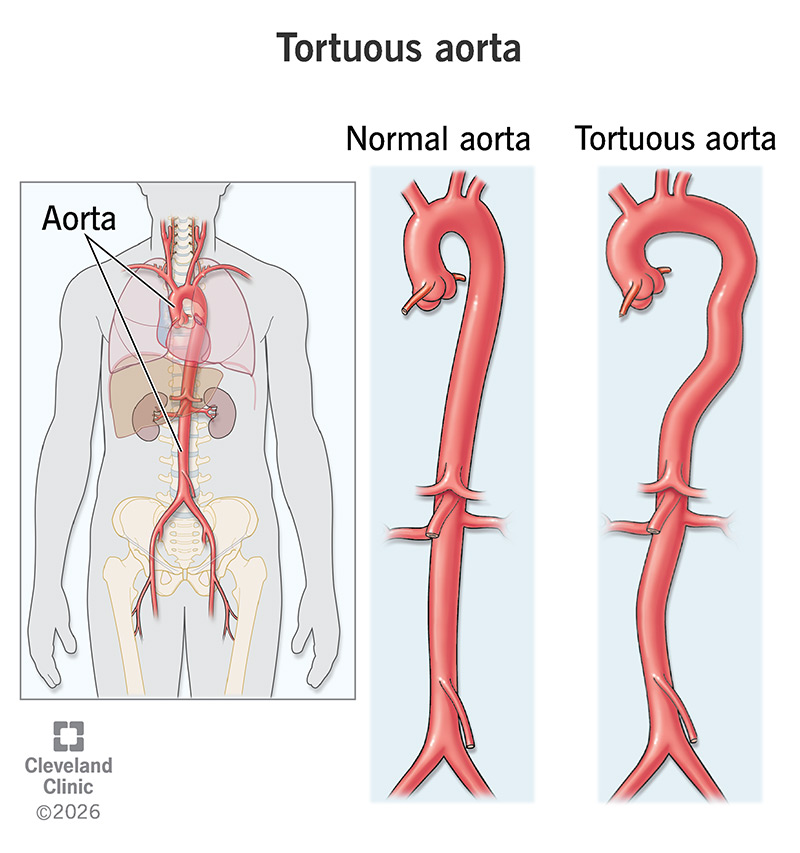
Image content: This image is available to view online.
View image online (https://my.clevelandclinic.org/-/scassets/images/org/health/articles/tortuous-aorta)
A tortuous aorta means the largest artery in your body has several twists or turns that it shouldn’t. It’s often harmless. But in some cases, it can be a sign of a genetic condition that affects your blood vessels. It can also make certain surgeries harder.
Advertisement
Cleveland Clinic is a non-profit academic medical center. Advertising on our site helps support our mission. We do not endorse non-Cleveland Clinic products or services. Policy
A typical aorta curves upward as it leaves your heart. It forms an arch in your upper chest. Then, it curves back down through your chest and belly. But a tortuous aorta may form an S-shape, C-shape or sharp angle at various points along this path, including the:
A tortuous aorta itself has no symptoms. It’s a change to your anatomy that your healthcare provider can see on certain imaging tests. You might live your whole life without ever knowing your aorta has abnormal twists.
In some cases, like if you have a tortuous aorta due to a genetic condition, you may be at risk for an aortic dissection. This is a tear in your aorta’s inner layer. It causes symptoms like:
Seek emergency care if you have these symptoms.
You may develop a tortuous aorta due to:
Advertisement
A tortuous aorta can lead to complications during these procedures:
Healthcare providers use imaging tests to diagnose these changes to your aorta. Possible tests include:
Your provider may diagnose a tortuous aorta by accident. This can happen if you have an imaging test for another reason.
There aren’t hard and fast rules for diagnosing a tortuous aorta. Instead, providers look at the pictures of your aorta and may count the number of turns or loops. They use different scoring systems, like the tortuosity index or distance metric, to decide the severity. Your provider will help you understand what the findings mean.
Most people don’t need treatment for a tortuous aorta. If you have a genetic condition like Marfan syndrome, your provider will monitor it. The goal is to prevent life-threatening complications. You may need surgery on your aorta if you’re at high risk. This can repair weak or enlarged areas to avoid these serious complications.
There’s no specific treatment for a tortuous aorta that’s due to aging or high blood pressure. Your provider will help you manage heart disease risk factors. This helps protect your aorta and all your arteries. You may need to:
See your provider for a yearly checkup. This will let them keep an eye on your overall health and risk for age-related issues. If you have a tortuous aorta, your provider will let you know whether you need any follow-ups or further testing.
A tortuous aorta may not affect your life much. But it depends on the cause. Your provider will explain what you can expect. If you’re diagnosed with a genetic condition, your provider may recommend genetic testing for your close biological relatives.
A tortuous aorta might sound scary. But in many cases, it’s just part of the normal aging process. Sometimes, it’s a feature of genetic conditions that need treatment or a watchful eye. No matter what, your healthcare provider is there to answer your questions. They’ll help you understand what this change to your aorta means and if there’s anything you need to do about it.
Advertisement



Sign up for our Health Essentials emails for expert guidance on nutrition, fitness, sleep, skin care and more.
Learn more about the Health Library and our editorial process.
Cleveland Clinic’s health articles are based on evidence-backed information and review by medical professionals to ensure accuracy, reliability and up-to-date clinical standards.
Cleveland Clinic’s health articles are based on evidence-backed information and review by medical professionals to ensure accuracy, reliability and up-to-date clinical standards.
When your heart needs some help, the cardiology experts at Cleveland Clinic are here for you. We diagnose and treat the full spectrum of cardiovascular diseases.
