



Liver fibrosis is when long-term liver disease starts to change your liver tissues. Chronic inflammation causes scarring, making your liver stiffer and less responsive. If the process continues, it can lead to cirrhosis and liver failure. But with treatment, you can stop and even reverse fibrosis.
Advertisement
Cleveland Clinic is a non-profit academic medical center. Advertising on our site helps support our mission. We do not endorse non-Cleveland Clinic products or services. Policy
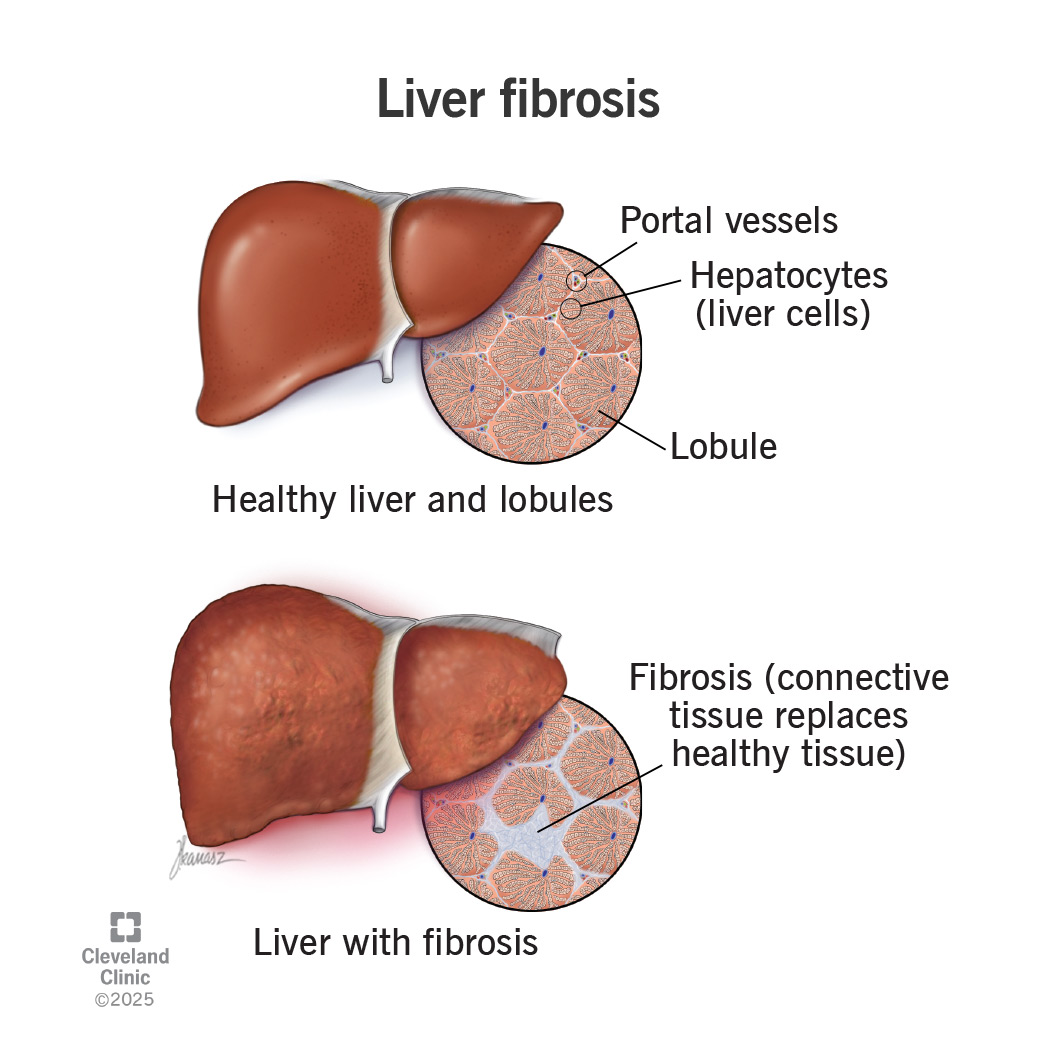
Image content: This image is available to view online.
View image online (https://my.clevelandclinic.org/-/scassets/images/org/health/articles/liver-fibrosis.jpg)
Liver fibrosis is a stage of chronic disease where healthy tissue in your liver begins to change. Ongoing injury from various causes (like alcohol use, hepatitis or steatosis) triggers a scarring process. As your liver tries to heal, it produces tough, fibrous proteins — like collagen — around the damaged areas.
Advertisement
Cleveland Clinic is a non-profit academic medical center. Advertising on our site helps support our mission. We do not endorse non-Cleveland Clinic products or services. Policy
Over time, scar tissue builds up and begins to block blood flow. This increases pressure in your portal vein and reduces how well your liver works.
The stages of liver fibrosis are:
Liver fibrosis itself doesn’t cause any signs or symptoms until stage 4 (cirrhosis) develops. If you have cirrhosis, you may experience:
Liver fibrosis is a result of continuous inflammation in your liver over months or years. This is what happens when you have chronic liver disease.
Many things can cause chronic hepatitis, leading to fibrosis. Some of the most common causes include:
Other causes include:
Advertisement
It takes many years for liver fibrosis to progress to cirrhosis. It’s slower for some people and faster for others. But when it reaches the later stages, the damage is no longer reversible. Over time, your liver function starts to decline. This has many side effects and is eventually life-threatening.
If your provider suspects liver disease, they’ll likely start with blood tests to check for liver stress. If results are abnormal, they may order imaging to look for damage.
Once your provider finds liver injury, they’ll try to figure out the amount of fibrosis. They may use certain blood tests (like FIB-4 or FibroSure®). Or they may measure the “elasticity” of your liver. If you have cirrhosis, your liver will be stiff, not elastic. Your provider may measure elasticity using FibroScan®, liver ultrasound with elasticity or MRI with elasticity.
Standard scans like ultrasound, CT or MRI can show early and late-stage disease, but not fibrosis, the middle stage. That requires enhanced imaging.
If these tests are inconclusive, a liver biopsy can diagnose liver fibrosis. This means your provider takes a small tissue sample from your liver and sends it to a lab. They can usually take the sample in a simple bedside procedure using a hollow needle. A pathologist in the lab will assess the sample for fibrosis.
Treating liver fibrosis starts with treating the cause. If you can stop what’s damaging your liver, you can help slow, stop or reverse the scarring process. Depending on your condition, treatment may involve lifestyle changes, medications or procedures.
Advertisement
Common approaches include:
Some conditions don’t have a direct treatment, but your provider can still help you manage symptoms and slow progression.
Your liver has a built-in ability to bounce back from injury. In fact, it’s the only organ in your body that can grow back to full size from a small piece. These same regenerative powers can also reverse the process of fibrosis — but only if the process stops. Over time, even cirrhosis can be reversible for some people.
Catching liver disease early is your best chance of preventing fibrosis. Since liver disease often doesn’t cause symptoms early on, regular wellness checkups are helpful to screen for it. It’s not always possible to prevent liver disease. But healthy lifestyle habits can help prevent some of the most common causes.
Advertisement
Liver fibrosis doesn’t always lead to cirrhosis or liver failure. With early diagnosis and treatment, it’s often possible to stop — and even reverse — the damage.
But because chronic liver disease often has no symptoms, many people don’t realize they have it until fibrosis is already underway. That news can be overwhelming. You may not have known your liver was at risk, let alone that the damage had been building for years.
The good news: With the right care, there’s still time to slow or reverse the process. Knowing what you’re up against is the first step toward protecting your liver and your health.
Advertisement



Sign up for our Health Essentials emails for expert guidance on nutrition, fitness, sleep, skin care and more.
Learn more about the Health Library and our editorial process.
Cleveland Clinic’s health articles are based on evidence-backed information and review by medical professionals to ensure accuracy, reliability and up-to-date clinical standards.
Cleveland Clinic’s health articles are based on evidence-backed information and review by medical professionals to ensure accuracy, reliability and up-to-date clinical standards.
Cleveland Clinic providers compassionately diagnose and treat all liver diseases using advanced therapies backed by the latest research.
