



Marijuana is a mind-altering substance that comes from the Cannabis sativa plant. It has several short-term and long-term effects, many of which scientists are still studying. As a substance, marijuana increases your risk of physical or psychological dependence.
Advertisement
Cleveland Clinic is a non-profit academic medical center. Advertising on our site helps support our mission. We do not endorse non-Cleveland Clinic products or services. Policy
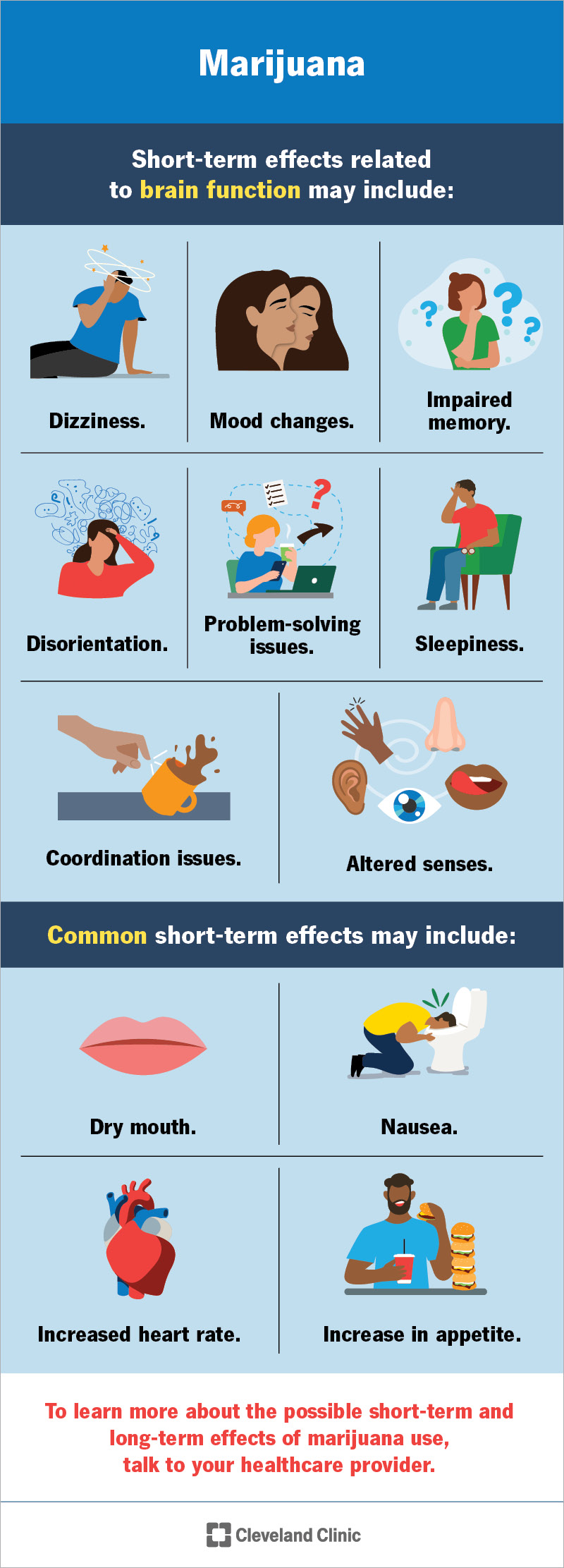
Image content: This image is available to view online.
View image online (https://my.clevelandclinic.org/-/scassets/images/org/health/articles/4392-marijuana-cannibis)
Marijuana (also called cannabis or weed) is a psychoactive substance, which means it has mind-altering (“high”) effects. It comes from the Cannabis sativa plant. But there are manufactured (synthetic) forms, as well. Other common names for it include pot and dope.
Advertisement
Cleveland Clinic is a non-profit academic medical center. Advertising on our site helps support our mission. We do not endorse non-Cleveland Clinic products or services. Policy
People often use the terms “marijuana” and “cannabis” interchangeably. But there are differences. Cannabis (pronounced “KAN-uh-bis”) refers to all products derived from the Cannabis sativa plant, including its dried flowers, leaves, stems and seeds. Marijuana (pronounced “mar-uh-WAH-nuh”) refers to parts or products from the plant that contain delta-9-tetrahydrocannabinol (THC). This is the main chemical (cannabinoid) that causes mind-altering effects.
It can be consumed in many ways. Examples include:
Scientifically, there are many unknowns regarding marijuana. Researchers are still studying the short- and long-term effects of this substance.
Cannabinoids are the active ingredients that lead to cannabis’s effect on your body. You have cannabinoid receptors in your body’s endocannabinoid system. This system helps regulate several functions, like mood, memory and appetite.
Your body naturally makes certain types of cannabinoids. When you consume them from outside sources, they overly activate your receptors. This leads to various effects and symptoms.
Advertisement
The Cannabis sativa plant contains hundreds of cannabinoids. The most well-known ones are:
When you smoke marijuana, THC quickly passes from your lungs into your blood. Your blood carries THC to your brain and other organs. Your body absorbs THC more slowly if you eat or drink it, typically 30 minutes to one hour.
THC overly activates parts of your brain that contain the highest number of endocannabinoid receptors. This leads to a series of effects. You might experience things that are different from what someone else feels. In addition, different episodes of marijuana use can cause a range of effects in the same person.
Marijuana has a wide range of short-term and long-term effects. Factors that may influence what you experience from marijuana include:
Researchers are still learning about its effects, especially long-term ones.
Short-term effects of marijuana use may include:
If you consume marijuana in high doses, you may experience:
So far, studies show the following long-term effects of marijuana use:
Studies show long-term use of marijuana is also associated with:
Advertisement
Some U.S. states have medical marijuana laws that certify marijuana use for symptom management of specific conditions.
But scientists and healthcare providers can’t state any general benefits of marijuana with certainty. This is because there isn’t enough research yet, especially on the long-term effects.
In addition, this substance tends to affect people in many ways. Individuals may report certain personal benefits. But researchers can’t make any broad conclusions regarding its usefulness.
A significant risk of marijuana use is developing cannabis use disorder (CUD). This is one type of substance use disorder (SUD). People who use it every day or almost every day are at the greatest risk of CUD.
Marijuana use is also linked to an increased risk of injury among adults over 65 and motor vehicle crashes.
In addition, some cannabis/marijuana products can be contaminated with microorganisms, pesticides or other harmful substances. And some products contain amounts of cannabinoids that are much higher than what’s stated on their labels.
The U.S. Food and Drug Administration (FDA) strongly advises against the use of CBD, THC and marijuana in any form during pregnancy or while breastfeeding.
Advertisement
Marijuana use during pregnancy may:
Breast milk can contain THC for up to six days after use. So, you should avoid marijuana use while breastfeeding. THC may affect your baby’s brain development.
Marijuana smoke contains many of the same harmful components as tobacco smoke. Because of this, you should avoid smoking weed around babies or children.
Marijuana has several short-term and long-term effects, many of which scientists are still studying. That’s why it’s important to use caution with marijuana and other cannabis products.
If you want to learn more about the potential medical uses of marijuana or are concerned you have cannabis use disorder, talk to a healthcare provider. They’re available to help.
Advertisement



Sign up for our Health Essentials emails for expert guidance on nutrition, fitness, sleep, skin care and more.
Learn more about the Health Library and our editorial process.
Cleveland Clinic’s health articles are based on evidence-backed information and review by medical professionals to ensure accuracy, reliability and up-to-date clinical standards.
Cleveland Clinic’s health articles are based on evidence-backed information and review by medical professionals to ensure accuracy, reliability and up-to-date clinical standards.
A substance use disorder can turn your life upside down. Cleveland Clinic has the hope and treatment you need.
