




PulsePoint
Our team continues to prioritize collaborative and forward‑thinking initiatives that support EMS providers and the communities they serve across Northeast Ohio. One of the programs we take the most pride in championing is PulsePoint.
When a cardiac arrest occurs, every second counts. EMS crews typically require several minutes to navigate to an address and then locate the patient. PulsePoint helps bridge that gap by engaging trained community members who may already be nearby. This community‑based response model dramatically increases the chance that CPR begins before emergency responders arrive.
Local medical and EMS leadership have long supported PulsePoint because it empowers citizens to become active participants in the fight against sudden cardiac arrest—the leading cause of death in the United States. Thousands of trained residents throughout the northeast Ohio area have joined the effort, helping save lives by responding when alerts are issued.
More than 15,000 individuals in Northeast Ohio are subscribed to PulsePoint, and that number continues to grow.
The impact is real: PulsePoint contributes to an average of 1.5 additional lives saved each month. These are individuals who may not have received early CPR without the help of this network of trained responders.
Regional EMS Protocol
The Regional EMS Protocol is a comprehensive, collaboratively developed clinical and operational guide designed to support high‑quality prehospital care across Cuyahoga County and the broader Northeast Ohio region. The document provides a unified framework for emergency medical providers, featuring detailed protocols, color‑coded algorithms, and clearly defined skill sets for EMTs, Advanced EMTs, and Paramedics. It is fully hyperlinked for efficient navigation and includes standardized procedures, medication guidelines, and decision‑support tools to ensure consistency and accuracy in the field.
A key strength of this protocol is the regional collaboration behind it. Cleveland Clinic participates directly in the creation and ongoing revision of the document alongside major health systems including University Hospitals, Southwest General, and MetroHealth—a partnership reflected in regional representation from these organizations within the EMS communities. This cooperative approach ensures that the protocols reflect the expertise, consensus, and shared priorities of all major EMS medical direction agencies in Northeast Ohio.
The resulting document serves as the foundational clinical standard for EMS providers throughout the region. Its structure—complete with color‑coded skill authorizations, hyperlinks for rapid access, and clear guidelines on when medical control is required—supports efficient, safe, and effective prehospital care. By integrating best practices from multiple leading health systems, the Regional EMS Protocol enhances continuity of care, promotes quality improvement, and strengthens collaboration among EMS agencies, hospitals, and medical directors throughout Northeast Ohio.
Download the latest version of the EMS Protocol
Download the app
- Cleveland Clinic EMS Protocols App - App Store
- Cleveland Clinic EMS Protocols - Android Apps on Google Play
Provide protocol feedback
Handtevy
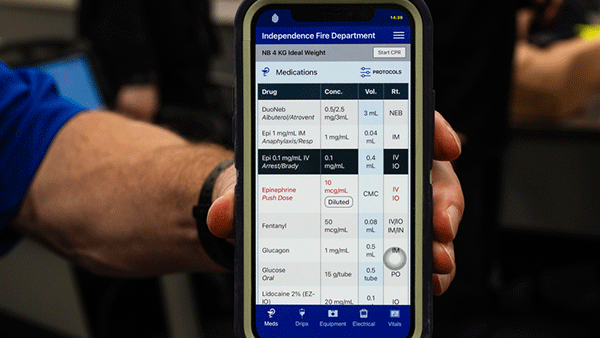
Handtevy is an evidence‑based pediatric and adult resuscitation system designed to give EMS and hospital teams fast, accurate access to critical dosing information, equipment sizing, protocols, and real‑time documentation tools during emergencies. The platform streamlines high‑pressure decision‑making by providing rapid medication dosing guidance, CPR assistance, timers, checklists, and integrated documentation—helping clinicians deliver precise, timely care when every second matters.
The system supports both prehospital and hospital environments, giving healthcare professionals a unified approach across the continuum of emergency care. Handtevy Mobile allows responders to access customized agency or hospital formularies, procedural checklists, and treatment algorithms instantly, and integrates seamlessly with many leading ePCR systems to ensure smooth, real‑time documentation. Its design focuses on reducing the cognitive load and minimizing dosing errors, particularly during pediatric emergencies, where accuracy is essential.
Cleveland Clinic & Handtevy
Cleveland Clinic proudly uses the Handtevy system in all our emergency departments to support high‑quality, standardized pediatric and adult emergency care. In addition, we offer the Handtevy platform to all EMS agencies under Cleveland Clinic medical control, ensuring that prehospital providers and hospital teams operate with the same trusted resources and consistent dosing standards throughout the region. This alignment strengthens continuity of care from the field to the bedside and enhances outcomes for critically ill or injured patients.
If you are a member of a Cleveland Clinic EMS medical control agency and need access to the Handtevy application, please contact your local Cleveland Clinic EMS Coordinator for instructions and onboarding support.

Download the app
Health Data Exchange
Cleveland Clinic’s Health Data Exchange (HDE) is a secure, automated system that connects field providers and hospital clinicians through real‑time data sharing. Our goal is simple: ensure that the care you deliver in the field is immediately accessible to the team who continues that care inside our facilities.
What HDE does
Our HDE platform electronically delivers your EMS patient care report (ePCR) directly into the Cleveland Clinic electronic health record. This seamless flow of information improves patient care continuity, enhances clinical decision‑making, and supports efficient operational and quality‑improvement workflows.
Our HDE vendor: ESO
Cleveland Clinic utilizes ESO as our official Health Data Exchange vendor. ESO facilitates secure, HIPAA‑compliant data transfer between your agency’s ePCR platform and the Cleveland Clinic EHR.
Whether your agency currently uses ESO, ImageTrend, Zoll, or another reporting system, ESO works directly with your ePCR vendor to complete the integration.

How EMS agencies use HDE
Once your agency is onboarded, your ePCR system automatically and securely sends patient encounter data to Cleveland Clinic whenever you transport a patient to one of our hospitals. In return, your department receives up‑to‑date clinical information about your patient’s care throughout their hospital visit, creating a seamless, bidirectional flow of information.
HDE operates quietly in the background, ensuring that critical patient care information is exchanged accurately, efficiently, and securely.
Key benefits include:
- Better-informed hospital teams throughout the patient's stay
- Improved documentation accuracy across the entire continuum of care
- Enhanced QI/QA collaboration between EMS providers and hospital partners
- Faster clinical feedback loops to support provider education and patient outcomes
Free connection for all EMS agencies
As part of our commitment to strong EMS–hospital partnerships, Cleveland Clinic provides HDE connection and onboarding to any EMS agency, regardless of medical control affiliation, at no cost.
Our team coordinates directly with ESO and your ePCR vendor to make onboarding smooth and efficient.
Get your agency connected
If your EMS agency is interested in joining the Cleveland Clinic HDE network, please contact:
Mike Savetski, BSN, RN, EMT-P, FESI-II
EMS Emergency Management Coordinator
Cleveland Clinic Medina Hospital
savetsm@ccf.org
Pharmacy Services
Cleveland Clinic is committed to supporting EMS providers with reliable, efficient, and clinically sound medication management. Through both our 1:1 Drug Exchange Process and Monthly Drug Exchange Program, we ensure that EMS agencies, whether medically controlled by Cleveland Clinic or operating within our region, have timely access to the medications they need to deliver high‑quality prehospital care.
By partnering closely with EMS agencies, our pharmacies help maintain readiness, reduce downtime, and promote consistency in medication availability across the system.
1:1 Drug Exchange Process
The 1:1 Drug Exchange Process is designed to keep EMS crews in service and fully stocked with minimal disruption. When medications are administered during a call — whether the patient is transported or treated and released — crews can quickly replace those medications at the receiving Cleveland Clinic Emergency Department.
How the 1:1 exchange works:
- After administering a medication, crews complete the 1:1 Drug Exchange Form at the ED.
- The ED provides a direct replacement on the spot, eliminating the need to visit the inpatient pharmacy.
- Crews return to service sooner, improving unit availability and response times.
This process ensures efficiency and operational readiness while allowing EMS providers to maintain full drug box availability without unnecessary delays.
Monthly Drug Exchange Process
The Monthly Drug Exchange Process supports safe medication management and quality assurance for all Cleveland Clinic medical control agencies. This structured, proactive system ensures that drug boxes remain current, organized, and compliant with expiration guidelines.
How the monthly exchange works:
- Each month, EMS crews perform a detailed inspection of their medication boxes.
- Any medications nearing expiration are documented on the Monthly Drug Exchange Form.
- The form and expiring medications are submitted directly to the inpatient pharmacy at the agency’s assigned Cleveland Clinic medical control hospital.
- After a 24‑hour processing period, replacement medications are available for pickup from the inpatient pharmacy (not the Emergency Department).
Benefits of the monthly exchange
- Ensures compliance with medication storage and expiration standards
- Supports safe, reliable EMS medication management
- Helps providers stay familiar with drug names, dosages, routes, and box organization
- Reinforces operational readiness and confidence in the field
This process not only maintains medication integrity — it also fosters ongoing clinical awareness and strengthens the partnership between EMS agencies and Cleveland Clinic pharmacy teams.
