



A dobutamine stress test is an alternative to an exercise stress test. You receive medicine that makes your heart work harder, and an echocardiogram creates images that show how your heart responds to the stress. This reveals areas of your heart with reduced blood flow, helping to diagnose coronary artery disease, valve disease and other issues.
Advertisement
Cleveland Clinic is a non-profit academic medical center. Advertising on our site helps support our mission. We do not endorse non-Cleveland Clinic products or services. Policy
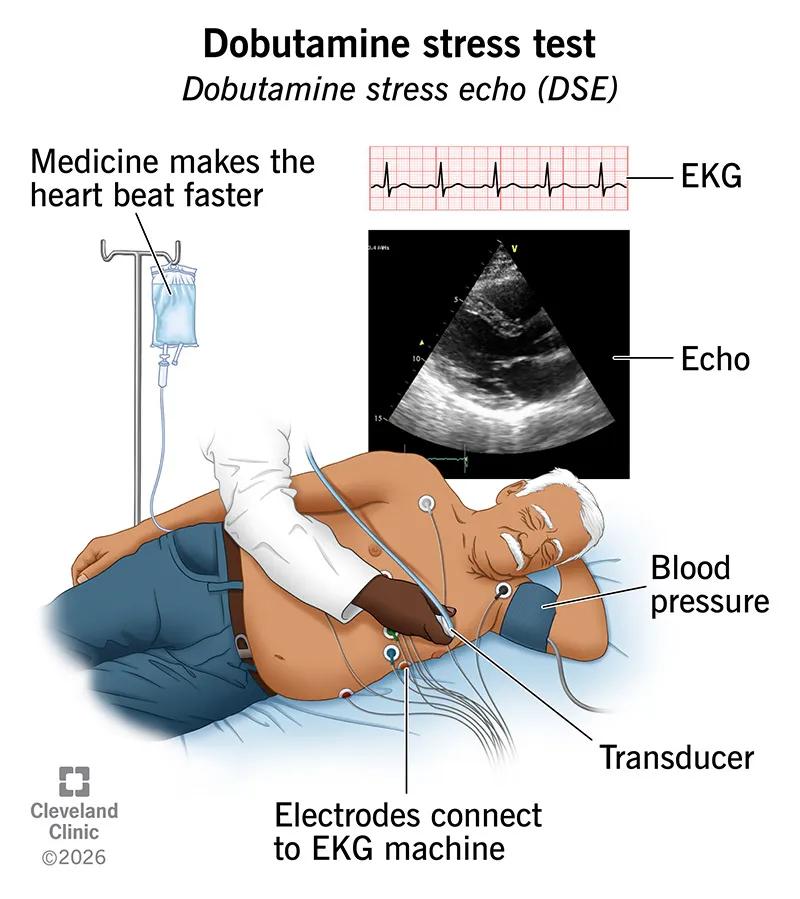
Image content: This image is available to view online.
View image online (https://assets.clevelandclinic.org/transform/3738fdf4-03d4-4d60-bc19-173fbc7d83ef/Diagnosis-and-Testing-Dobutamine-Stress-Test-1)
A dobutamine (pronounced “doh-BYOO-tah-meen”) stress test is a way for your healthcare provider to see how your heart works while under stress. It’s also called a dobutamine stress echo (DSE). It’s an option for when you can’t exercise on a bike or treadmill for a stress test. A healthcare provider gives you medicine through an IV that makes your heart beat faster and work harder, as if you were exercising. At the same time, they take ultrasound images of your heart (an echocardiogram) after each increase in the medicine.
Advertisement
Cleveland Clinic is a non-profit academic medical center. Advertising on our site helps support our mission. We do not endorse non-Cleveland Clinic products or services. Policy
This test helps your healthcare provider check:
Healthcare providers perform dobutamine stress tests for several different reasons. These include finding the cause of unexplained symptoms, assessing your risk of a heart attack and learning if you’re at risk for heart-related complications before you have a major surgery.
A DSE can help diagnose or monitor:
Advertisement
A dobutamine stress test is an alternative to an exercise stress test. That means you don’t use a bike or treadmill. Instead, a healthcare provider gives you medicine called dobutamine through an IV. The medicine makes your heart work harder. Your heart rate will go up, just like if you were exercising. But you’re lying down, rather than moving.
Your provider will gradually increase the dose of medicine as the test goes on. They’ll take pictures of your heart every few minutes. They’ll also monitor your vital signs, like your blood pressure, pulse and blood oxygen level.
The test will end if any of the following happen:
You can expect the entire appointment to take about one hour. But you’ll only be receiving dobutamine for about 10 to 15 minutes.
A cardiac sonographer performs the ultrasound imaging while a physician supervises the test.
Certain substances and medications can interfere with the test and give you false results. Your healthcare provider will tell you what to do or avoid before the test so it works how it should. Be sure to closely follow their guidance and ask if anything is unclear.
In general, you may need to:
If you have diabetes, your provider will also give you special instructions. These include when to take insulin and other medicines. They’ll also explain how to time any meals or snacks. Bring your glucose monitor with you to the test. You’ll need to check your blood sugar levels before and after the test. Tell someone at the lab right away if your blood sugar is low.
If you have a pacemaker or defibrillator (ICD), your healthcare provider must check it before your test. Call your provider to set up a time.
To perform a dobutamine stress test, your sonographer will:
Advertisement
This test is safe for most people. Your healthcare provider will review your health history beforehand. They won’t do the test if certain health conditions make it unsafe for you. Be sure to ask your provider about all possible complications and the chances of them happening.
Let your provider know if you’re pregnant or could be. They may suggest another type of test instead.
About 1 in 500 people have serious complications from a dobutamine stress test, like:
You’re closely monitored during and after the test. Providers are prepared to treat these issues right away if they do occur.
Your provider will monitor you for a short period after the test ends. Your heart rate and blood pressure should gradually go back to normal. Tell your provider if you feel any symptoms.
Dobutamine can cause a slight drop in blood pressure. So, you should arrange for someone to drive you home from your test.
There are three main types of results:
Advertisement
The provider who ordered the test will go over the results with you. They’ll explain any next steps, like treatments or further testing. Contact your provider if you don’t hear from them within one week of your test.
A dobutamine stress test makes your heart beat faster while you lie still. That might feel strange. But the goal is for your healthcare provider to learn how your heart works when it’s under stress. If you have a condition that affects your ability to exercise, this test could be a helpful option. Your provider will explain the benefits and risks in your situation.
Advertisement



Sign up for our Health Essentials emails for expert guidance on nutrition, fitness, sleep, skin care and more.
Learn more about the Health Library and our editorial process.
Cleveland Clinic’s health articles are based on evidence-backed information and review by medical professionals to ensure accuracy, reliability and up-to-date clinical standards.
Cleveland Clinic’s health articles are based on evidence-backed information and review by medical professionals to ensure accuracy, reliability and up-to-date clinical standards.
When your heart needs some help, the cardiology experts at Cleveland Clinic are here for you. We diagnose and treat the full spectrum of cardiovascular diseases.
