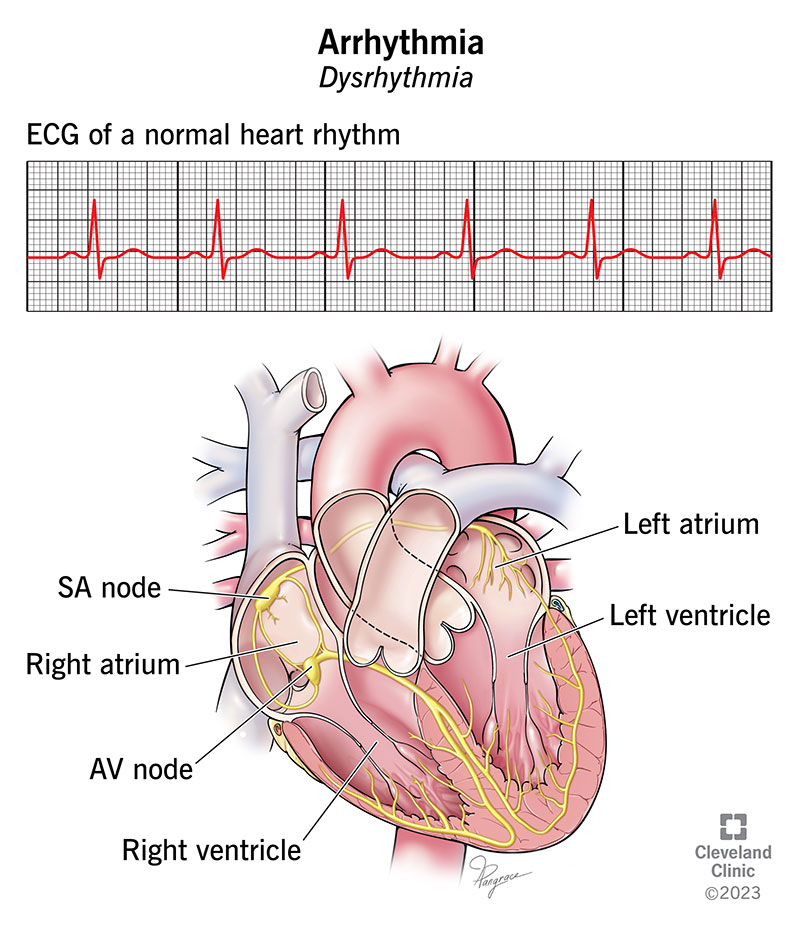
What happens during a normal heartbeat?
The heart’s rhythm is coordinated by its own electrical
system. With each heartbeat, the electrical impulse begins at the
sinus (or sinoatrial, SA) node, also called the heart’s natural pacemaker. The
SA node is a cluster of specialized cells, located in the right atrium. The SA
node produces the electrical impulses that set the rate and rhythm of your
heartbeat. The impulse spreads through the walls of the right and left atria,
causing them to contract and forcing blood into the ventricles.
The impulse then reaches the atrioventricular (AV) node, which
acts as an electrical bridge allowing impulses to travel from the atria to the
ventricles. There is a short delay before the impulse travels on to the
ventricles.
From the AV node, the impulse travels through a pathway of
fibers called the HIS-Purkinje network. This network sends the impulse into the
ventricles and causes them to contract. The contraction forces blood out of the
heart to the lungs and body.
The SA node fires another impulse and the cycle begins again.
The heartbeat is triggered by electrical impulses that travel down a special pathway through your heart muscle.
What is my pulse?
Your pulse indicates your heart rate, or the number of
times your heart beats in one minute. Pulse rates vary from person to person.
Your pulse is slower when you are at rest and increases when you exercise, since
more oxygen-rich blood is needed by the body during exercise.
How do I take my pulse?
You can tell how fast your heart is beating by feeling your pulse on your wrist or neck. Place the tips of your index and middle fingers on the inner wrist of your other arm, just below the base of your thumb. Or, place the tips of your index and middle fingers on your lower neck, on
either side of your windpipe. Press lightly with your fingers until you feel the
blood pulsing beneath your fingers. You may need to move your fingers around
slightly up or down until you feel the pulsing.
Your heart rate, or pulse, is the number of beats felt in one
minute. You can count the number of beats in 10 seconds and multiply by 6 to
determine your heart rate in beats per minute. A normal heart rate, at rest, is
50 to 100 beats per minute.
Your Heart Rate = Pulse in 10 seconds x 6 = ____ beats per minute
What is an arrhythmia?
An arrhythmia (also called dysrhythmia or irregular heart rhythm) is an irregular or abnormal heartbeat.
What are the common types of arrhythmias?
- Tachycardia -- a fast heart
rhythm with a rate of more than 100 beats per minute.
- Bradycardia -- a slow heart rhythm
with a rate below 60 beats per minute.
- Supraventricular arrhythmias -- arrhythmias that begin above the ventricles, such as in the upper chambers, or atria. "Supra" means above; "ventricular" refers to the
lower chambers of the heart (ventricles).
The types of supraventricular arrhythmias include:
- Premature atrial contractions (PACs) -- early, extra beats that originate in the upper chambers of the heart (atria).
- Paroxysmal supraventricular tachycardia (PSVT)
-- a rapid but regular rhythm that comes from the atria. PSVT begins and
ends suddenly.
- Accessory pathway tachycardias (such
as Wolff-Parkinson-White syndrome) -- a fast heart rhythm caused by an
extra abnormal electrical pathway or connection between the atria and
ventricles. The impulses travel through the extra pathways as well as
the usual route. This allows the impulses to travel around the heart
very quickly, causing the heart to beat unusually fast.
- AV nodal reentrant tachycardia (AVNRT)
-- a fast heart rate caused by the presence of more than one pathway
through the atrioventricular (AV) node.
- Atrial tachycardia -- a rapid heart
rhythm originating in the atria.
- Atrial fibrillation -- a very common
irregular heart rhythm. Many impulses begin and spread through the
atria, competing for a chance to travel through the AV node. The
resulting rhythm is disorganized, rapid and irregular. Because the
impulses are traveling through the atria in a disorderly fashion, there
is a loss of coordinated atrial contraction.
- Atrial flutter -- an atrial arrhythmia
caused by one or more rapid circuits in the atrium. Atrial flutter is
usually more organized and regular than atrial fibrillation.
Ventricular arrhythmias --
arrhythmias that begin in the lower chambers of the heart.
- Premature ventricular contractions (PVCs)
-- early, extra beats beginning in the lower chambers of the heart. PVCs
are common. Most of the time they cause no symptoms and require no
treatment. In some people, they can be related to stress, too much
caffeine or nicotine, or exercise. But sometimes, PVCs can be caused by
heart disease or electrolyte imbalance. People who have several PVCs
and/or symptoms associated with them should be evaluated by a
cardiologist (heart doctor).
- Ventricular tachycardia (V-tach) -- a
rapid rhythm originating from the lower chambers of the heart. The rapid
rate prevents the heart from filling adequately with blood, and less
blood is able to pump through the body. This can be a more serious
arrhythmia, especially in people with heart disease, and may be
associated with more symptoms. A cardiologist should evaluate this
condition.
- Ventricular fibrillation (V-fib) -- an
erratic, disorganized firing of impulses from the ventricles. The
ventricles quiver and cannot generate an effective contraction, causing
an inability to deliver blood to the body. This is a medical
emergency that must be treated with cardiopulmonary resuscitation
(CPR) and defibrillation (delivery of an energy shock to the heart
muscle to restore a normal rhythm) as soon as possible.
- Long QT -- the QT interval is the area
on the electrocardiogram (ECG or EKG) that represents the time it takes
for the heart muscle to contract and then recover, or for the electrical
impulse to fire and then recharge. When the QT interval is longer than
normal, it increases the risk for "torsade de pointes," a
life-threatening form of ventricular tachycardia.
Bradyarrhythmias --
slow heart
rhythms that may arise from disease in the heart's conduction system, such as
the sinus (or sinoatrial, SA) node, AV node or HIS-Purkinje system.
- Sinus node dysfunction -- slow heart
rhythms caused by an abnormal SA node.
- Heart block -- a delay or complete
block of the electrical impulse as it travels from the sinus node to the
ventricles. The level of the block or delay may occur in the AV node or
HIS-Purkinje system. The heart may be irregular and slow.
What causes an arrhythmia?
Arrhythmias may have many causes, including:
- coronary artery disease
- high blood pressure
- changes in the heart muscle (cardiomyopathy)
- valve disorders
- electrolyte imbalances in the blood (such as sodium or potassium)
- injury from a heart attack
- the healing process after heart surgery, and
- some other medical conditions.
Irregular heart rhythms can also occur in "normal,
healthy" hearts. Certain substances or medications, such as caffeine,
nicotine, alcohol, cocaine, inhaled aerosols, diet pills, and cough and cold
remedies, can cause arrhythmias. Some emotional states, such as shock, fright,
or stress, can also cause irregular heart rhythms.
Arrhythmias that are recurrent or related to an underlying
heart condition are more concerning and should always be evaluated by a doctor.
In most cases, treating the underlying condition will take care of the
arrhythmia. If not, many medications and procedures are available to eliminate
or control the abnormal heart rhythm.
What are the symptoms of an arrhythmia?
An arrhythmia may be "silent" and not cause
any symptoms. A doctor can detect an irregular heartbeat during an examination
by taking your pulse, listening to your heart, or by performing diagnostic tests.
If symptoms occur, they may include:
- Palpitations -- a feeling of skipped heart beats, fluttering, "flip-flops," or feeling that the heart is "running away"
- Pounding in the chest
- Dizziness or feeling light-headed
- Shortness of breath
- Chest discomfort
- Weakness or fatigue (feeling very tired)
How is an arrhythmia diagnosed?
If you have symptoms of an arrhythmia, you should make an
appointment with a cardiologist. You may want to choose an electrophysiologist,
a cardiologist who has received additional specialized training in the diagnosis
and treatment of heart rhythm disorders.
After evaluating you and performing a physical
examination, the cardiologist may perform a variety of diagnostic tests to help
confirm the presence of an arrhythmia and indicate its causes.
Some tests that may be done to confirm the presence of an irregular heart rhythm include:
- Electrocardiogram (ECG) -- a
picture, on graph paper, of the electrical impulses traveling through the heart
muscle, recorded by electrodes attached to the skin on the chest, arms, and legs.
- Ambulatory monitors -- there are several types:
- Holter monitor: a small portable recorder
that is attached to electrodes on the chest. It records the heart rhythm
continuously for 24 hours.
- Transtelephonic monitor: a small monitor
is attached to electrode leads, usually on the finger or wrist. With the aid
of this device, the heart rhythm is transmitted over the phone line to the doctor’s office.
- Transtelephonic monitor with a memory loop:
a small, portable recorder, worn continuously for a prolonged period;
records and saves the heart rhythm around the time that an event button is
activated. The rhythm is recorded, saved, and transmitted over the phone line.
- Stress test – a test used to
record arrhythmias that start or are worsened with exercise. This test also may
be helpful in determining if there is underlying heart disease or coronary
artery disease associated with an arrhythmia.
- Echocardiogram – a type of
ultrasound used to provide a view of the heart to determine if there is heart
muscle or valve disease that may be causing an arrhythmia. This test may be
performed at rest or with activity.
- Cardiac catheterization – using a
local anesthetic, a catheter (small, hollow, flexible tube) is inserted into a
blood vessel and guided to the heart with the aid of an X-ray machine. A
contrast dye is injected through the catheter so that X-ray movies of the coronary
arteries, heart chambers, and valves may be taken. This test helps your doctor
determine if the cause of an arrhythmia is coronary artery disease. This test
also provides information about how well the heart muscle and valves are working.
- Electrophysiology study (EPS) -- a
special heart catheterization that evaluates the heart's electrical system. The
catheters inserted into the heart record the electrical activity. The EPS is
used to find the cause of the abnormal rhythm and determine the best treatment.
During the test, the arrhythmia may be safely reproduced and terminated.
- Head upright tilt test (HUT) -- a
test used to safely reproduce fainting spells in people who may be prone to
these episodes (syncope). During the test, the patient is tilted upright on a
special table at different angles (usually 30 to 60 degrees). Blood pressure and
heart rhythm are recorded. In some people, a fainting spell may be provoked. A
medication that may bring on these spells also may be used during the tilt
procedure.
How is an arrhythmia treated?
Treatment depends on the type and severity of the
arrhythmia. In some cases, no treatment is necessary. Treatment options include:
medications, lifestyle changes, invasive therapies, electrical devices, or
surgery.
Medications
Antiarrhythmic drugs are medications used to convert the arrhythmia to a normal sinus rhythm or to
prevent an arrhythmia. Other medications may include heart rate control drugs,
anticoagulant or antiplatelet drugs such as warfarin (a "blood
thinner"), or aspirin, which reduce the risk of blood clots forming or stroke.
It is important to know the names of your medications, why
they are prescribed, how often and at what times to take them, what side effects
may occur, and what medications you have tried for your arrhythmia in the past.
Lifestyle changes
Arrhythmias may be related to certain lifestyle factors. Here are some ways to change these factors:
- If you smoke, stop.
- Limit your intake of alcohol.
- Limit or stop using caffeine. Some people are sensitive
to caffeine and may notice more symptoms when using caffeinated products
(such as tea, coffee, colas, and some over-the-counter medications).
- Avoid the use of stimulants. Beware of stimulants
used in cough and cold medications and herbal or nutritional supplements.
Some of these substances contain ingredients that cause irregular heart
rhythms. Read the label and ask your doctor or pharmacist what medication
would be best for you.
Your family may also want to get involved with your care by learning to recognize your symptoms and beginning emergency medical treatment (cardiopulmonary resuscitation or CPR) if needed.
If you notice that your irregular heart rhythm occurs more often with certain activities, you should avoid those activities.
Invasive therapies
The following invasive therapies may be used to treat or eliminate irregular heart rhythms.
Your doctor will discuss the need and the benefits and risks of these therapies with you.
- Electrical cardioversion -- in patients
with persistent arrhythmias (such as atrial fibrillation), a normal rhythm
may not be achieved with drug therapy alone. After administration of a
short-acting anesthesia, an electrical shock is delivered to your chest wall
that synchronizes the heart and allows the normal rhythm to restart.
- Catheter ablation -- during ablation,
energy is delivered through a catheter to tiny areas of the heart muscle.
This energy can "disconnect" the pathway of the abnormal
rhythm; block the abnormal pulses and promote normal conduction of impulses;
or disconnect the electrical pathway between the atria and the ventricles.
Ablation most often is used to treat PSVTs, atrial fibrillation, atrial flutter, AV nodal re-entrant tachycardia, and ventricular tachycardia. Ablation may be combined with other procedures to
achieve optimal treatment.
Electrical devices
- Permanent pacemaker -- a device that
sends small electrical impulses to the heart muscle to maintain a normal
heart rate. The pacemaker has a pulse generator (which houses a battery
and a tiny computer) and leads (wires) that send impulses from the pulse
generator to the heart muscle, as well as sense the heart's electrical
activity. Pacemakers are mostly used to prevent the heart from beating
too slowly. Newer pacemakers have many sophisticated features that are
designed to help with the management of arrhythmias, optimize
heart rate-related functions, and improve synchronization.
- Implantable cardioverter-defibrillator (ICD)
-- a sophisticated electronic device used primarily to treat ventricular
tachycardia and ventricular fibrillation, two life-threatening abnormal
heart rhythms. The ICD constantly monitors the heart rhythm. When it
detects a very fast, abnormal heart rhythm, it delivers energy to the
heart muscle to cause the heart to beat in a normal rhythm again.
There are several ways an ICD can restore a normal heart rhythm:
- Anti-tachycardia pacing, or ATP: When the
heart beats too fast, a series of small electrical impulses may
be delivered to the heart muscle to restore a normal heart rate
and rhythm.
- Cardioversion: a low-energy shock may be
delivered at the same time as the heartbeat to restore a normal
heart rhythm.
- Defibrillation: when the heart is beating
dangerously fast or irregularly, a higher energy shock may be
delivered to the heart muscle to restore a normal rhythm.
- Anti-brachycardia pacing: many ICDs provide
back-up pacing to prevent heart rhythms that are too slow.
Heart surgery
May be needed to correct arrhythmias not controlled with medications or non-surgical treatment
methods. Arrhythmia surgery also may be recommended if you need surgery to
correct other forms of heart disease (such as valve or bypass surgery). The Maze
and modified Maze procedures are two surgeries used to correct atrial fibrillation.
Regular follow-up visits
You will need to visit your doctor for regular follow-up
visits, depending on your treatment plan. Your follow-up visits with your doctor
can help to:
- Make sure your arrhythmia is controlled
- Properly adjust your medications
- Evaluate the functioning of any implanted devices
- Make sure you are staying healthy and not having other medical problems
Your doctor will tell you how often you should visit. Call your doctor between visits if your symptoms become more frequent or severe.
Copyright 2/2003 The Cleveland Clinic Heart Center; Reprinted with permission.
© Copyright 1995-2009 The Cleveland Clinic Foundation. All rights reserved.
Can't find the health information you’re looking for?
Ask a Health Educator, Live!
Know someone who could use this information?...send them this link.
This information is provided by the Cleveland Clinic and is not intended to replace the medical advice of your doctor or health care provider. Please consult your health care provider for advice about a specific medical condition. This document was last reviewed on: 5/31/2007…#8245