



Liver disease includes many conditions that can damage your liver and affect how it works. Some are mild, while others can be serious or long-lasting. Because your liver plays such an important role in your body, damage can affect your overall health. Knowing what to watch for and getting early care can make a big difference.
Advertisement
Cleveland Clinic is a non-profit academic medical center. Advertising on our site helps support our mission. We do not endorse non-Cleveland Clinic products or services. Policy
“Liver disease” is a broad term for any condition that damages your liver and affects how it works. Some of the conditions are common, while others aren’t. They can all range from mild to life-threatening. Some types develop slowly over time, while others happen more quickly.
Advertisement
Cleveland Clinic is a non-profit academic medical center. Advertising on our site helps support our mission. We do not endorse non-Cleveland Clinic products or services. Policy
Your liver plays an important role in your body. It helps clean your blood, process nutrients and fight off infections. When it’s damaged, it can’t perform these jobs well. Over time, liver disease can lead to severe scarring, liver cancer, liver failure and the need for a new liver (liver transplantation).
You can treat and even reverse some liver diseases, especially if you find them early. Others are long-term conditions (chronic liver disease) that need ongoing care. Treatment depends on the type and how much damage there is.
Many liver diseases follow a similar pattern as damage builds over time. The stages of liver disease are:
Advertisement
Not everyone moves through all these stages. But many people are living with chronic liver disease.
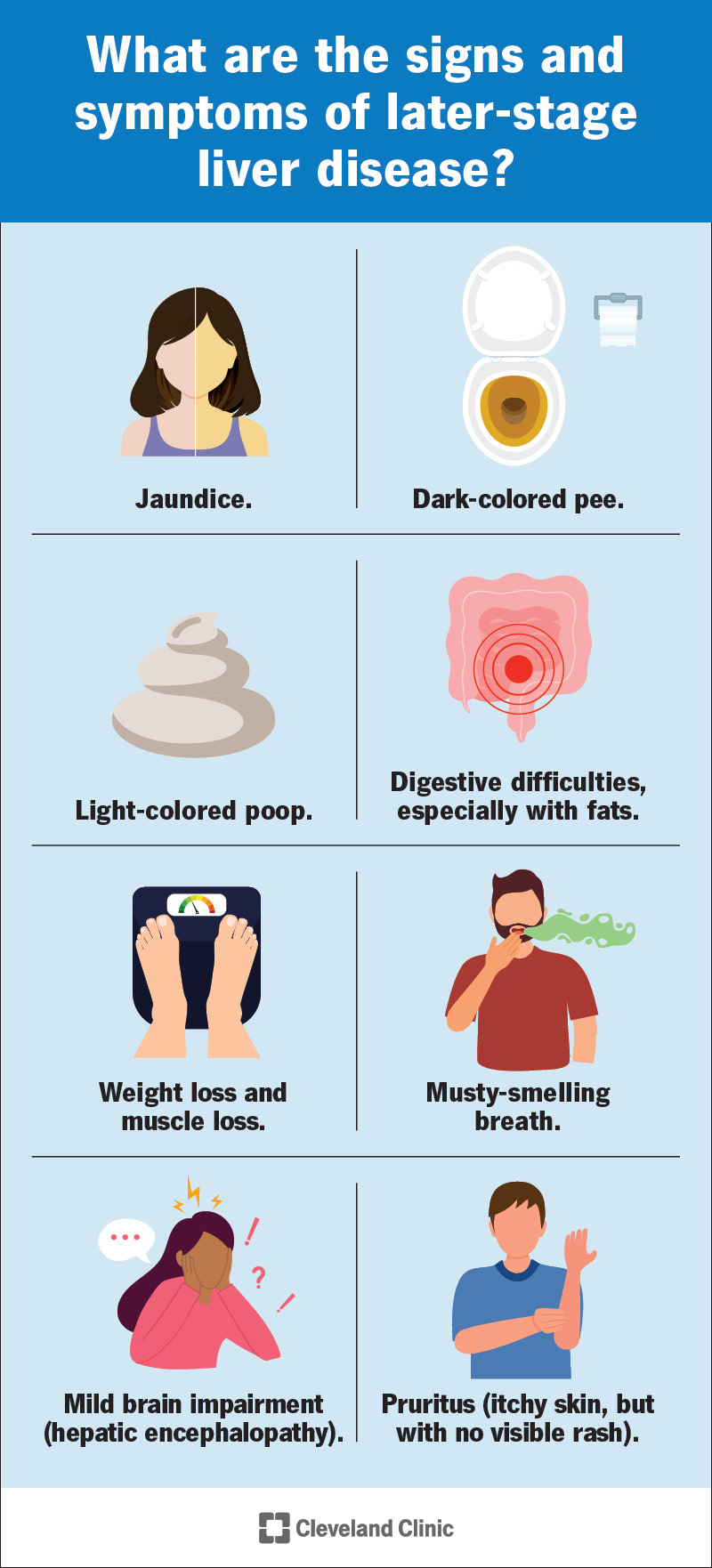
Image content: This image is available to view online.
View image online (https://my.clevelandclinic.org/-/scassets/images/org/health/articles/17179-liver-disease)
Liver disease doesn’t always cause symptoms in its early stages. Advanced, later-stage signs of liver disease may include:
There are many types of liver disease. Each type has its own causes. Some of the most common causes include:
You may be more likely to develop liver disease if you:
If liver disease gets worse, it can lead to:
When diagnosing liver disease, your healthcare provider will use several tools. They’ll perform a physical exam and ask you about your symptoms and health history. They may also ask about your eating and drinking habits, as well as the amount of physical activity you get.
They’ll use lab tests and imaging scans as well. These may include:
These tests help your provider figure out the type of liver disease and how advanced it is.
Treatment for liver disease depends on the cause and stage. In earlier stages, you may be able to treat and possibly reverse liver disease by making changes to your daily habits. This may include:
In the later stages, liver disease treatment may include:
Advertisement
Recovery depends on the type of liver disease you have and how your provider treats it. Mild liver damage may improve within weeks to months. More advanced or chronic liver disease may require lifelong care.
Contact a provider if you notice:
Some liver diseases are curable. You can manage others for many years with the right care.
In some cases, early treatment can reverse liver damage. But once severe scarring (cirrhosis) develops, the damage is usually permanent.
The most important step is to find liver disease early and follow your treatment plan. That can help protect your liver and improve your long-term health.
Your liver does a lot to keep your body running. So, it’s important to pay attention to any changes in your body and take them seriously. Many liver diseases develop slowly, giving you a chance to catch them early. With the right care, you may be able to slow or stop damage. Even with chronic liver disease, treatment can help you manage symptoms and stay well. Small steps can have a lasting impact on your health.
Advertisement



Sign up for our Health Essentials emails for expert guidance on nutrition, fitness, sleep, skin care and more.
Learn more about the Health Library and our editorial process.
Cleveland Clinic’s health articles are based on evidence-backed information and review by medical professionals to ensure accuracy, reliability and up-to-date clinical standards.
Cleveland Clinic’s health articles are based on evidence-backed information and review by medical professionals to ensure accuracy, reliability and up-to-date clinical standards.
Cleveland Clinic providers compassionately diagnose and treat all liver diseases using advanced therapies backed by the latest research.
