



A Chiari malformation is a structural abnormality in your skull that causes part of your brain to move into your spinal canal. You may have mild or severe symptoms or no symptoms at all. It usually causes headaches and difficulty with balance and coordination, as it affects your cerebellum. Surgery may help.
Advertisement
Cleveland Clinic is a non-profit academic medical center. Advertising on our site helps support our mission. We do not endorse non-Cleveland Clinic products or services. Policy
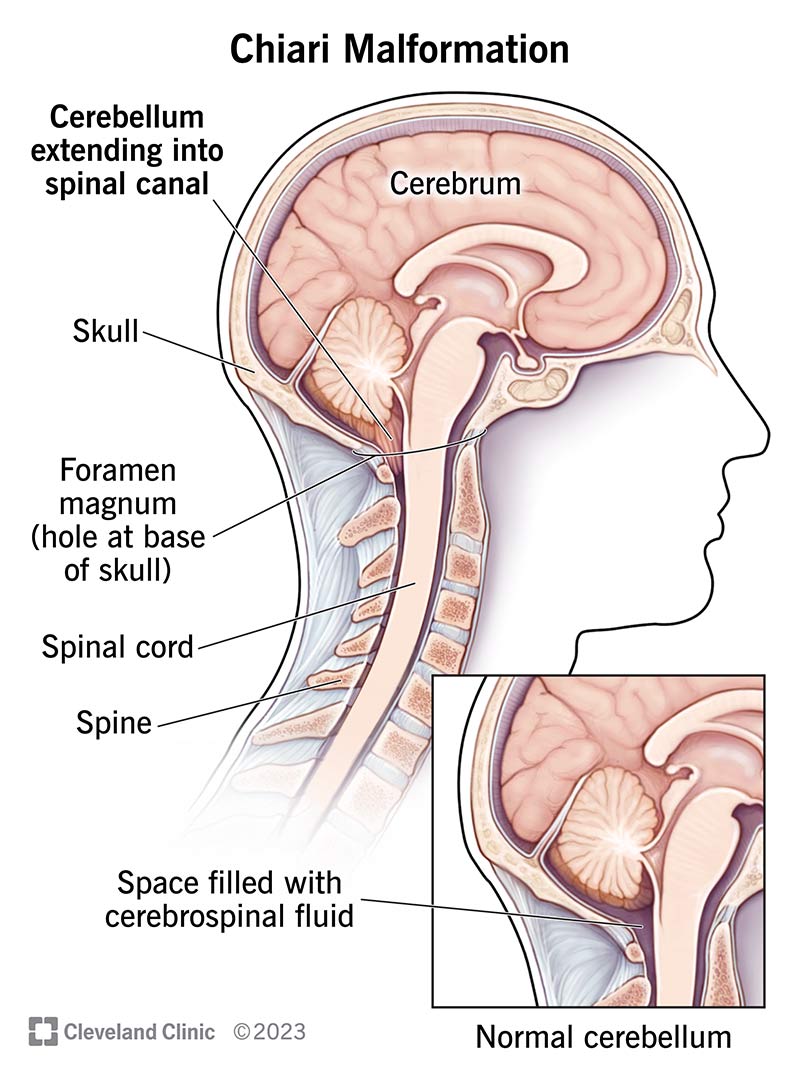
Image content: This image is available to view online.
View image online (https://my.clevelandclinic.org/-/scassets/images/org/health/articles/6008-chiari-malformation)
A Chiari malformation is a growth abnormality where brain tissue in the lower back of your skull extends into your spinal canal (the base of your skull).
Advertisement
Cleveland Clinic is a non-profit academic medical center. Advertising on our site helps support our mission. We do not endorse non-Cleveland Clinic products or services. Policy
It happens because of a structural problem like a smaller-than-expected skull size. If you don’t have enough room in your skull, part of your brain, specifically your cerebellum, will grow downward where there’s extra space in an opening at the base of your skull — called the foramen magnum.
Your cerebellum is the part of your brain that helps with your muscle movements, posture, balance, speech and coordination. It causes symptoms that affect the function of this part of your brain, like loss of balance.
This growth abnormality causes your brain to press against the base of your skull. It blocks the flow of cerebrospinal fluid. This fluid cushions your brain and spinal cord, circulates nutrients and chemicals, and removes waste products.
There are five types of Chiari malformations including:
Advertisement
Studies suggest that Chiari malformations occur in about 1 in every 1,000 people in the United States. Because some people don’t have any symptoms or don’t show them until adolescence or adulthood, the condition may be more common.
You may experience the following symptoms if you have a Chiari malformation.
Common symptoms of Chiari malformations include:
Symptoms vary from person to person and range from no symptoms to mild to severe symptoms. In some people, symptoms are present at birth. In others, symptoms appear in late childhood or adulthood. Symptoms may also get better or worse at different points in time.
A Chiari malformation happens when the lower back part of your brain pushes through your spinal canal or the foramen magnum, where your brain and spinal cord meet. A structural growth abnormality (a smaller-than-expected size in the area where your cerebellum sits) in your brain and spinal cord causes pressure in this part of your brain. The pressure makes your cerebellum grow in a different than expected location. This happens during fetal development.
Chiari malformations are almost always present at birth (congenital), though symptoms may not develop until later in life. This is usually the result of a genetic change (mutation) that you inherit from your biological family or it happens randomly after conception.
Very rarely, a Chiari malformation can develop in someone who wasn’t born with the condition. In these cases, the skull or spinal cord might change shape due to:
A Chiari malformation may happen in addition to an underlying health condition like:
A Chiari malformation can affect anyone. You may be more likely to develop a Chiari malformation if someone in your biological family has the condition.
Advertisement
Chiari malformation can cause severe health issues and developmental delays. Complications may include:
Advertisement
In addition, symptoms of a Chiari malformation can affect your mood, especially if you experience insomnia or severe headaches. Some people may develop depression. If this condition affects your mood, talk to your healthcare provider or a mental health professional.
A healthcare provider will diagnose a Chiari malformation after a complete physical exam. Your provider will test your movement, balance and the sensations in your hands and feet. In addition, they’ll look for memory problems, learning challenges and developmental delays among children.
To confirm a diagnosis, a healthcare provider will order imaging tests to see a detailed image of your brain and spinal cord. Imaging tests may include:
Advertisement
Sometimes, Chiari malformations appear on prenatal ultrasounds before a fetus is born. An ultrasound is an imaging test that uses sound waves to produce pictures of soft tissues.
If you don’t experience symptoms of a Chiari malformation, you might receive this diagnosis if you get imaging tests for another unrelated reason.
Your healthcare provider will make a treatment plan based on the severity of your symptoms. If you don’t have symptoms, you don’t need treatment. Your provider will monitor your health with regular MRIs.
Treatment for mild symptoms like a headache or neck pain may include:
Severe Chiari malformation cases may need surgery. Surgical procedures may include:
Your healthcare provider will discuss the side effects of treatment before you begin so you can make an informed decision about your health. Every surgery comes with possible risks. Surgery around your brain and skull is high risk due to the location of the incision and procedure being near your brain. Repeat surgeries might be necessary as you age.
Depending on what treatment you and your healthcare provider choose, you may find relief from mild symptoms soon after taking pain medication or participating in therapy. It could take several weeks to months before you heal from surgery. You may notice your symptoms go away or reduce significantly after surgery.
A Chiari malformation can be very serious in some cases, but not all. In most cases, babies are born with a Chiari malformation. However, symptoms aren’t always present, and a diagnosis won’t happen until late childhood or adulthood when a healthcare provider orders an imaging test for another unrelated reason.
Although there isn’t a cure for a Chiari malformation, treatment like surgery can help manage your symptoms to help you feel better and prevent life-threatening complications.
Your outlook varies depending on the severity and type of Chiari malformation. It’s important to work closely with your healthcare provider and care team, who can monitor your symptoms and determine the right treatment plan for you.
If you don’t have symptoms or you have mild symptoms after a Chiari malformation diagnosis, you’ll likely have a normal life expectancy. Severe symptoms and certain types of Chiari malformation can be fatal. Talk to your healthcare provider about what to expect after a diagnosis.
There’s no known way to prevent a Chiari malformation.
If you plan on becoming pregnant, talk to your healthcare provider about ways to maintain good health. Your provider may recommend you regularly take vitamins like folic acid to lower your risk of having a child diagnosed with spina bifida. Your provider may suggest genetic testing so you can understand your risk of having a child with a genetic condition.
Visit a healthcare provider if you experience symptoms of a Chiari malformation or if your symptoms get worse. If you have a child with a Chiari malformation and they miss developmental milestones for their age, talk to their provider. After surgery, contact your healthcare provider if you show signs of an infection like severe pain, swelling or your surgical wound not healing.
Contact local emergency services or 911 if you or a loved one have a seizure for the first time.
A Chiari malformation affects each person differently. You may not have any symptoms or they could be mild and have little interference with your daily routine. Others may experience severe, often disabling symptoms that require surgery. Treatment is available to reduce your symptoms and prevent life-threatening complications for certain types of the condition. If your symptoms don’t improve, get worse or you experience problems like an infection after surgery, contact your healthcare provider.



Sign up for our Health Essentials emails for expert guidance on nutrition, fitness, sleep, skin care and more.
Learn more about the Health Library and our editorial process.
Cleveland Clinic’s health articles are based on evidence-backed information and review by medical professionals to ensure accuracy, reliability and up-to-date clinical standards.
Cleveland Clinic’s health articles are based on evidence-backed information and review by medical professionals to ensure accuracy, reliability and up-to-date clinical standards.
Learning you may have Chiari malformation can leave you wondering what’s next. Cleveland Clinic’s expert team is here to help you get the care you need.
