



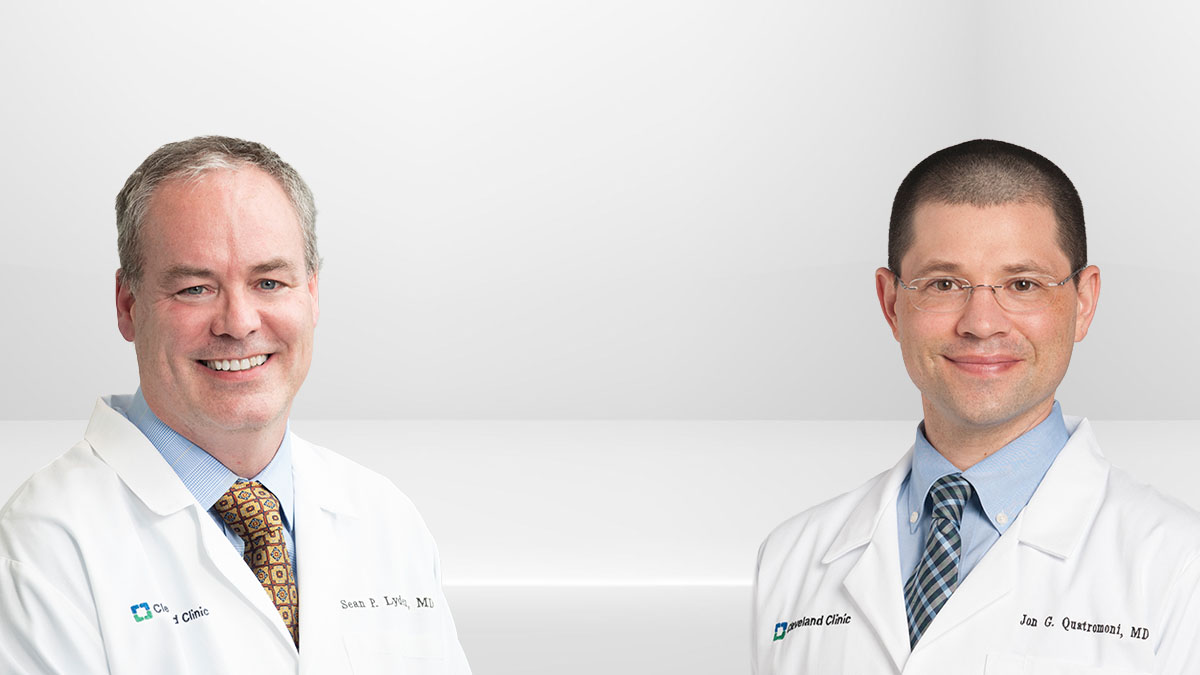
Advancing Vascular Surgery Care Through Clinical Trials
Sean Lyden, MD, and Jon Quatromoni, MD, discuss the evolving landscape of vascular clinical trials, highlighting investigational therapies and device-driven innovations. Learn how these trials are shaping evidence-based decision-making, expanding minimally invasive options and influencing future standards of care for aortic, carotid, peripheral arterial and venous disease.
Looking to refer a patient? Please reach out to our Physician Referral team Mon. - Fri., 8 a.m. - 5 p.m. (ET) at 855.751.2469.
Advertisement
Cleveland Clinic is a non-profit academic medical center. Advertising on our site helps support our mission. We do not endorse non-Cleveland Clinic products or services. Policy
Recent Episodes
Infective Endocarditis Diagnosis and Management
Bo Xu, MD, and Shinya Unai, MD, discuss approaches to diagnosing and treating infective endocarditis, including indications for surgical int…
Expanding Coronary Revascularization With TECAB
Donna Kimmaliardjuk, MD, and Gianluca Torregrossa, MD, discuss the expanding role of robotic coronary artery bypass grafting, including tota…
Stenting, Surgery and Hybrid Strategies for Coronary Disease
Faisal Bakaeen, MD, and Grant Reed, MD, discuss recent advances in the treatment of coronary artery disease, including drug-coated balloons,…
Video content: This video is available to watch online.
View video online (https://cdnapisec.kaltura.com/p/2207941/sp/220794100/playManifest/entryId/1_baxzfll2/flavorId/1_5f3sgelj/format/url/protocol/https/a.mp4)
Transcript
Announcer:
Welcome to Cardiac Consult, brought to you by the Sydell and Arnold Miller Family Heart, Vascular & Thoracic Institute at Cleveland Clinic. This podcast will explore the latest innovations, medical and surgical treatments, diagnostic testing, research, technology and practice improvements.
Advertisement
Cleveland Clinic is a non-profit academic medical center. Advertising on our site helps support our mission. We do not endorse non-Cleveland Clinic products or services. Policy
Sean Lyden, MD:
My name is Sean Lyden. I'm the Chairman of Vascular Surgery at Cleveland Clinic, and I'm here with my partner, Dr. Jon Quatromoni. We're going to talk about some of the aortic and peripheral vascular carotid trials. We're going to talk about the things we do as vascular surgeons, the trials that we're involved in here at Cleveland Clinic, things that we're doing that we can help offer our patients and why we're involved in the trials.
Welcome, Jon. I know we're involved in a lot of aortic trials from the advent of minimally invasive aortic disease. We've been pioneers in pushing that therapy forward, and we're involved in a couple of different trials right now. Why don't you tell us a little bit about the first trial, which is preventing aortic growth, and that's using a novel compound to help, hopefully, maybe make it so people don't need their aneurysm repaired. That is the Nectero trial. Why don't you talk to us a little about that trial and why we're involved in it, Jon?
Jon Quatromoni, MD:
Yeah. Well, this is a very exciting trial. I think this is a new paradigm of trying to treat abdominal aortic aneurysms, and it's the first of its kind. It's being developed for folks where we can try to go in and impregnate medication into the wall of the aneurysm, but try to actually prevent aneurysms from growing. We don't have a technology quite like that yet, and I think that will offer a new tool in our toolbox in the future.
Advertisement
Sean Lyden, MD:
A lot of patients are worried about their aneurysms. There are clear guidelines for when we should repair them in terms of the benefit to the patient, but while we're cautiously watching them, many patients are worried. This provides a new avenue that hopefully will delay the growth of the aneurysm so that maybe they actually don't need it fixed in their lifetime. But once they do need to be fixed, there are a lot of devices that are out. Two of the devices that are out, one is made by a company called GORE. One is made by a company called Endologix. One of the devices we led the national trial here at Cleveland Clinic, and they're trying to compare the two devices, see if they're equal or better. That trial is called the JAGUAR trial. I'm in charge of that nationwide, and it's the first company trying to compare their device versus another device.
Usually, what happens is a company will look at their device, get one-year data, get five-year data, show that it works, but no one's compared one over another. This trial allows us to look at that Ovation Alto device versus whatever device the physician's comfortable with. We've been involved in that trial here in the national leadership, but it's also trying to tell us, is one device better than the other? Because patients ask us. A lot of times, it personally comes down to preference right now because we don't have good data. What are your thoughts about that trial, Jon?
Jon Quatromoni, MD:
I’m excited for this. I think that this study could change the management of abdominal aortic aneurysm moving forward if we're actually able to show that one device is better than another. I like the flexibility of this study because it lets the investigators use an alternative device that they're comfortable with, as well as the Ovation device. I think in terms of the possibility of changing the way that we manage abdominal aortic aneurysms, this is a really exciting trial to be involved with.
Sean Lyden, MD:
Then, once the aneurysm becomes involved in the kidney arteries, sometimes there are devices that are commercially approved we can use, but some patients don't fit that. We have a physician-sponsored trial that I'm the sponsor on, and Dr. Frank Caputo is our physician PI that allows us to create custom off-the-shelf devices and modify them to use in patients. There are also now trials for when patients have thoracoabdominal aneurysms. There's now an FDA-approved device that we are involved in that trial and now we're studying that after release to make sure the results after release continue to mirror what we found in the early trial.
One of the areas that we're really limited in how we can treat patients is carotid disease. Carotid surgery has been the backbone of vascular surgery throughout our history as a specialty since the early 80s when we became our own specialty, but we just had a landmark trial, the CREST-2 trial. It was comparing best medical management alone versus best medical management with carotid stenting, and a second arm, best medical management alone versus best medical management with surgery. In the surgery and medical management arm, it was better than the medical management arm, but it wasn't statistically significant at four years. The curves continue to separate, so we feel as surgeons, it will continue to show benefit. When you look at the medical management arm alone versus the medical management arm with stenting, it shows stenting clearly, for low-risk patients, was superior.
Advertisement
And that's huge. There's been a lot of skepticism amongst the surgical world of how stenting should work. TCAR (transcarotid artery revascularization), one of the unique advantages we do offer people, wasn't studied, but there's been a lot of discussion of what we should do, how we should treat patients. But when we look at stenting patients, whether it's from minimally invasive, small incision TCAR through the neck, direct neck approach, or carotid stenting, calcium is the biggest issue. When I see patients, that's probably the biggest thing that says, "Okay, stenting either from the direct neck access or a groin or arm access isn't possible." So, we're now working with Shockwave, which was acquired by J&J to study a lithoplasty balloon. It's a balloon that delivers a shockwave, just like breaking up calcium for kidney stents, trying to break that calcium.
When we've looked in lower extremities, one of the unique things about it, Jon, is it doesn't break off and go downstream. There's not really any risk of breaking stuff downstream. It's now getting studied in the carotid. When we see patients with carotid disease, calcium is common. What percentage of your populations do you see thick calcium that limits what their therapeutic options are and drives us toward surgery as a first approach?
Advertisement
Jon Quatromoni, MD:
It seems like that's all my patients here. At Cleveland Clinic, we see some of the most advanced carotid disease and most often my main concern with carotid stenting is the heavy degree of calcification. Having this technology, which enables us to go in and fractionate that calcium, again, as Dr. Lyden said, is very low risk. In the other spaces that we use this balloon for embolization of that debris, it fractionates the calcium within the wall itself and would make the vessel more able to accept that stent. But I think that's going to be a big game changer for me because right now that is the number one contraindication for stenting in my practice.
Sean Lyden, MD:
And if you look at all the trials for carotid stenting, we led a few of them here, and then I was part of the multi-specialty carotid alliance that led CMS (Centers for Medicare and Medicaid Services) to open up carotid stenting as an equivalent therapy. The calcium, if it's greater than three millimeters thick or circumferential, is a contraindication to stents. We know that the current stents we have do not put enough radial force against the blood vessel to adequately expand it. We’re hopeful with this technology, which basically microfractures the plaque and allows it to compress so that you can hopefully then get adequate expansion of the stent when you put it in a carotid artery, in the iliac arteries, in the superficial femoral, common femoral arteries, the shockwave technology has been great. It has actually had that outcome. Now the FDA is allowing that company to apply that technology to the carotids.
Advertisement
The trial will first start through a direct neck access approach. With that approach, you basically reverse blood flow away from the brain, so it'll provide the least amount of risk for the patients. Then, soon after that, a femoral approach where you then place a distal filter. It'll allow us to study all those options for our patients. I know that when patients can have a surgery with an incision this big [2 inches], a surgery with an incision this big [4 inches], or they can have a percutaneous procedure, when the outcomes are equivalent, all patients are generally going to choose the minimally invasive procedure. We’re excited about this trial here at Cleveland Clinic, excited for what that'll bring to our patients. We're hopeful to be a high enroller so that we can learn which is the best approach. The patients will be randomized. That's why we do science, but I think it's one of the unique novel things that we're leading here at Cleveland Clinic that will hopefully drive an impactful change on carotid disease, which is about 30% of the diseases we see at Cleveland Clinic.
Jon Quatromoni, MD:
It’s one of the pathologies that I think a lot of the vascular surgeons got into vascular surgery for. Just having a larger toolbox to be able to help these patients and offer them the best treatment for each specific patient, I think will be a very satisfying option.
Sean Lyden, MD:
Now with CREST-2 showing that carotid stenting is equivalent to surgery and its outcomes, we know that both early in terms of the stroke risk, late in terms of the re-stenosis risk, this will hopefully allow us to then apply that technology to more of our patients.
And then we'll transition to peripheral vascular disease, from the abdominal aorta down to the toes. Typically when it's in the pelvis and the iliac arteries, we treat those patients with stents. The stents we use are generally made out of stainless steel or a self-expanding metal called nitinol, but recently there's been some data suggesting that stents lined with fabric with GORE-TEX perform better. They come at about 10 times the cost. We actually have a trial right now looking at that, comparing it to bare metal stents, that Jon is in charge of here at the clinic. Why don't you talk to us about why and who we can treat in that trial, and what it's trying to tell us?
Jon Quatromoni, MD:
Well, this has been a highly contested topic, both for the iliac arteries as well as other blood vessels that we treat. The question is, do you need fabric on these stents, or do stents without the fabric perform just as well? This has been an ongoing debate in the iliac arteries, looking from various institutional experiences. I think this is one of the first trials that is trying to actually look at this in a highly scientific way to figure out if those stents have fabric on them, will they perform better over the long run? So, I think that these studies will help answer that question.
Sean Lyden, MD:
Then, once you start getting down into the thigh and into the leg, we've learned that when you add drugs, specifically drugs that prevent re-narrowing, those were originally used for cancer. They've been shown when we put on heart stents that they reduce the risk of a renarrowing with a heart stent from 30% now down to like 2 or 3%. We've had first-generation balloons with drugs on them and stents with drugs on them for the thigh, but haven’t had much below the thigh into the calf. We've had first-generation drugs. There have been second-generation drugs that have worked better in the heart. We finally now have trials looking at those second-generation devices, so stents within the calves that are resorbable, that don't stay there forever, and newer generation balloons. We're excited that that will hopefully allow a longer duration of our treatments for our patients when they have blockages in lower extremity arteries.
I think one of the nice things, Jon, is, even though these trials are led through the vascular surgery department, this is an HVTI trial. There’s a vascular medicine department, there's an interventional cardiology department, and we are co-collaborators. Sometimes we have them as the leaders on that trial, but we have everybody in the Heart, Vascular & Thoracic Institute who can do these therapies involved in these trials. Why don't you talk about some of your thoughts about, right now, the first-generation drugs with paclitaxel and now going to the limus-based drugs, which have been better for the heart, but not necessarily, early on data, better for the lower extremities.
Jon Quatromoni, MD:
Yeah. I think it's an interesting area because we seem to be a little bit behind the cardiac world in this. I think it's a very exciting avenue. As you said before, this is a great demonstration of how we work together as a team, both us, interventional cardiology and vascular medicine. Treating those vessels below the knee is very challenging. Often balloon angioplasty alone, which is what historically we've been falling back on for endovascular approaches, has been limited. I think looking at the data from paclitaxel thus far has been very promising in all the areas of the body that we've been using that thus far. I think there's promise for some of these newer agents that have shown promise in the cardiac world, and now we're transitioning over into the peripheral arterial disease space.
Having that in our toolbox, alongside our traditional approaches with just using a regular balloon, will be very helpful in advancing the options that a lot of these patients have that maybe their other options are limited. I think these trials are very exciting to be able to, again, expand our toolbox for helping these patients.
Sean Lyden, MD:
As vascular surgeons, we don't just treat with the arteries. We also treat with the veins. A lot of times patients will present with blood clots in their veins, many times occluding their veins in their pelvis or their vena cava, which is the main vein that drains from the legs up to the heart. In those, typically, we use stents designed for the arterial circulation. Over the last five years, we've seen stents that are now purposely built, designed for the venous circulation, that are larger, have more outward force because they have to resist compression, because they're deep inside the body.
There's a trial going on now that we're participating in that looks at using a stent for the inferior vena cava, as well as the iliac arteries. Jon is in charge of that for us here, and that brings hopefully better novel treatments. The first devices were just designed for the iliac veins, and this trial that's led by the company GORE has a covered stent that has some fabric on it to hopefully prevent that re-narrowing. Jon, why don't you talk to us a little bit about that?
Jon Quatromoni, MD:
This stent is, again, specifically designed for the inferior vena cava in the iliac vein. It's designed to resist compression. It also combines that strength with a very high degree of flexibility. Being designed for that space, I'm hoping this is going to be a game changer in terms of helping those patients who have those compression syndromes to be able to resist re-narrowing of that iliac vein.
Sean Lyden, MD:
I think the important point is that you can never be good enough. One of the things we try to do at Cleveland Clinic is keep involved with cutting edge research. Research that allows us to improve the way we treat patients, to continue to push to more minimally-invasive options. If you can achieve the same outcome through a percutaneous approach, as opposed to a large surgical approach, we're doing that. We've been both leaders in many of these trials as well as participants in running them here at Cleveland Clinic. We feel that's vital to offer to our patients throughout the whole Heart, Vascular & Thoracic Institute so we can continue to have the best outcomes for our patients.
Jon Quatromoni, MD:
I agree. I think that's a very important part of what we do here at Cleveland Clinic. I think that's why all of us that are here, we enjoy that aspect and it's one of the things that keeps us going.
Sean Lyden, MD:
As we finish up here, Jon, I think the important thing is that at Cleveland Clinic, we strive to have availability for anything that's cutting-edge research. We want to bring the greatest and best technology to our patients.
We want to continue to evolve and define vascular care for the next century. I think that's really critical. We lead trials here, both across the nation and here locally. We want to thank everybody for listening in and thank people for being involved and listening to Cardiac Consult.
Announcer:
Thank you for listening to Cardiac Consult. We hope you enjoyed the podcast. For more information or to refer a patient to Cleveland Clinic, please call 855.751.2469. That's 855.751.2469. We welcome your comments and feedback. Please contact us at heart@ccf.org. Like what you heard? Subscribe wherever you get your podcasts or listen at clevelandclinic.org/cardiacconsultpodcast.
Recent Episodes
Infective Endocarditis Diagnosis and Management
Bo Xu, MD, and Shinya Unai, MD, discuss approaches to diagnosing and treating infective endocarditis, including indications for surgical int…
Expanding Coronary Revascularization With TECAB
Donna Kimmaliardjuk, MD, and Gianluca Torregrossa, MD, discuss the expanding role of robotic coronary artery bypass grafting, including tota…
Stenting, Surgery and Hybrid Strategies for Coronary Disease
Faisal Bakaeen, MD, and Grant Reed, MD, discuss recent advances in the treatment of coronary artery disease, including drug-coated balloons,…
Never miss a moment - subscribe now.
Listen to the Health Essentials Podcast on your favorite streaming platform.
Other Podcasts You May Love

Butts & Guts
A Cleveland Clinic podcast exploring your digestive and surgical health from end to end. You’ll lear…
Health Essentials
Tune in for practical health advice from Cleveland Clinic experts. What's really the healthiest diet…
Love Your Heart
A Cleveland Clinic podcast to help you learn more about heart and vascular disease and conditions af…
Neuro Pathways
A Cleveland Clinic podcast for medical professionals exploring the latest research discoveries and c…